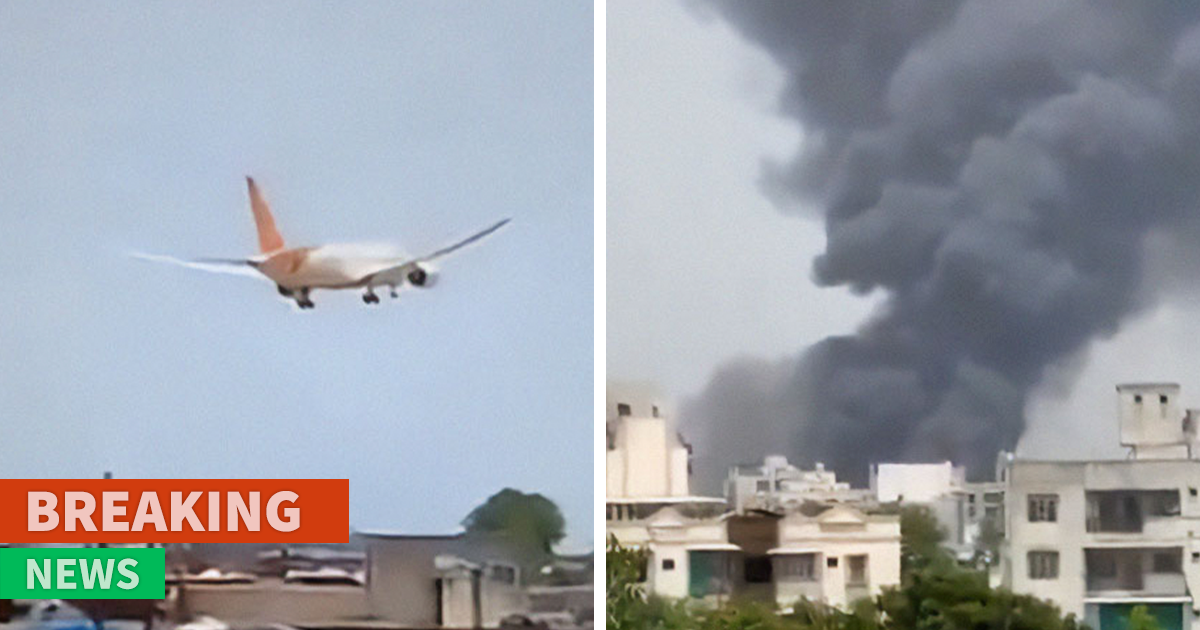
"A Nation In Shock": Air India Plane Headed For London Crashes In Residential Area With 242 Passengers Onboard

India woke up to one of those aviation tragedies that instantly freezes a country mid-sentence. Air India Flight AI171, a Boeing 787-8 Dreamliner headed from Ahmedabad to London Gatwick, crashed shortly after takeoff on June 12, 2025, turning an ordinary international departure into a national moment of grief, confusion, and urgent investigation.
The headline was devastating: a London-bound Air India plane crashed in a residential area with 242 people onboard. More precisely, the aircraft was carrying 230 passengers and 12 crew members. Only one passenger survived. The crash also caused deaths and injuries on the ground, because the aircraft came down near buildings connected to B.J. Medical College in Ahmedabad, a place where students and staff were going about a normal day before aviation history arrived at their doorstep in the worst possible way.
This was not simply another aircraft incident in a news cycle already stuffed with alerts, push notifications, and doom-scrolling fatigue. It was the first fatal crash involving a Boeing 787 Dreamliner, an aircraft widely known for long-haul comfort, modern technology, and the kind of sleek design that makes passengers feel like the future has cup holders. That contrast made the tragedy feel even more jarring.
What Happened To Air India Flight AI171?
Air India Flight AI171 departed from Sardar Vallabhbhai Patel International Airport in Ahmedabad and was scheduled to fly to London Gatwick. Shortly after takeoff, the aircraft lost altitude and crashed into a densely populated area near the airport. Early reports described the plane as struggling almost immediately after leaving the runway.
According to official and widely reported accounts, the crew issued a mayday call soon after takeoff, but communication was lost moments later. The aircraft did not have time to climb away from the city. Within less than a minute, a long-haul international flight had become a major emergency involving passengers, crew, first responders, hospital staff, investigators, grieving families, and a stunned public watching updates arrive in fragments.
The passenger list reflected the international nature of the route. Those onboard included Indian, British, Portuguese, and Canadian nationals. For families in India and the United Kingdom, the crash became a shared tragedy across borders, time zones, and communities.
Why The Crash Site Made The Disaster Even More Complex
Air crashes are always complicated. A crash in a residential and institutional area multiplies the difficulty. The site was not an empty field or remote hillside. It was part of a living city, close to medical college buildings and daily civilian life.
That meant emergency teams faced two crises at once: the aircraft itself and the damaged buildings around it. Firefighters, police, medical workers, and disaster-response teams had to secure the area, assist survivors and injured people, manage traffic, protect nearby residents, and preserve evidence for investigators. In a situation like this, every minute matters, but so does every footprint. Move too slowly, and lives may be at risk. Move too aggressively, and important evidence may be disturbed.
The fact that the crash occurred near a medical campus added another painful layer. Some of the people affected on the ground were students and staff connected to a place built for healing. That irony is not dramatic writing; it is the kind of cruel detail that makes real life feel badly scripted.
The Sole Survivor And The Human Scale Of The Disaster
Among the 242 people onboard, one passenger survived. Reports identified the survivor as a British national of Indian origin seated near an emergency exit. His survival became one of the most widely discussed parts of the tragedy, not because it softened the loss, but because it highlighted the randomness and fragility of disaster.
Aviation safety experts often caution that there is no magic seat on an aircraft. Survival depends on many factors: impact dynamics, structural breakup, fire, seat location, speed, terrain, rescue access, and pure chance. In this case, the lone survivor became a symbol of both miracle and heartbreak. A single life spared does not make the tragedy smaller. It makes the scale easier to understand, because numbers become human only when we remember that every passenger had a plan, a reason for travel, and someone expecting a message after landing.
The families of those lost were left facing the slowest kind of time: waiting for confirmation, answers, and explanations. Airline disasters do not end when the smoke clears. For families, they continue through paperwork, memorials, investigations, insurance claims, and the impossible task of returning to normal life when normal has changed shape.
What Investigators Looked At First
After any major aviation accident, investigators avoid quick conclusions. That is not bureaucracy being dramatic; it is the entire point of accident investigation. Planes are complex machines operated by trained humans inside systems that include maintenance, weather, air traffic control, airport infrastructure, airline procedures, manufacturing records, and regulatory oversight.
In the Air India AI171 crash, attention eventually focused on the aircraft’s engine fuel-control switches after preliminary findings indicated both engines lost thrust shortly after takeoff. The preliminary report did not close the case or assign final responsibility. Instead, it raised urgent technical and human-factors questions about how the fuel-control switches moved, why thrust was lost at such a critical stage, and why recovery was not possible before impact.
Takeoff is one of the most demanding phases of flight. Aircraft are heavy, engines are producing high thrust, pilots are managing speed and climb, and there is very little altitude available if something goes wrong. At cruising altitude, crews may have minutes to troubleshoot. Seconds after takeoff, they may have only seconds. Aviation, in that sense, is both deeply engineered and brutally unforgiving.
The Importance Of The Flight Recorders
The flight data recorder and cockpit voice recorder are central to understanding what happened. These devices help investigators reconstruct aircraft performance, cockpit actions, system behavior, warnings, and crew communication. They do not exist to create blame. They exist to create clarity.
A final investigation report typically examines the chain of events, not just the last event. That chain can include mechanical design, switch position, maintenance history, crew training, checklist flow, aircraft configuration, warning systems, airport conditions, and regulatory guidance. The public often wants one clean answer. Aviation safety usually produces something more useful: a layered explanation.
Why The Boeing 787 Detail Matters
The Boeing 787 Dreamliner is one of the world’s most recognizable long-haul aircraft. Airlines use it for intercontinental routes because it is efficient, modern, and passenger-friendly. Before the Air India crash, the 787 had not been associated with a fatal crash in the same way older aircraft types had been over decades of service.
That history made the Ahmedabad crash especially significant for aviation watchers. It did not automatically mean the aircraft type was unsafe, and responsible reporting should avoid that leap. But the first fatal crash of any major aircraft model naturally attracts attention from regulators, airlines, pilots, manufacturers, insurers, and passengers who suddenly find themselves staring a little longer at the aircraft model listed on their booking confirmation.
After the crash, Indian aviation authorities ordered additional checks on Air India’s Boeing 787 fleet. Later, inspections also focused on fuel-control switch locking mechanisms. Air India said no issues were found in those inspections. Still, the process mattered because confidence in aviation depends not only on safety but on visible, disciplined responses when safety is questioned.
Air India, Tata Group, And The Response After The Crash
Air India, owned by Tata Group, faced one of the most difficult tests any airline can face: responding to a catastrophic crash involving passengers, crew, families, regulators, and international governments. The airline pledged cooperation with investigators and support for families affected by the disaster.
Tata Group also announced financial assistance for the families of those who died, support for injured people, and help rebuilding affected facilities at B.J. Medical College. No compensation can balance a loss like this, and nobody should pretend otherwise. But rapid financial and logistical assistance matters because families must deal with travel, legal documents, medical bills, memorials, and sudden household disruption while grieving.
For Air India, the crash arrived during a broader transformation effort. Since returning to Tata ownership, the airline has been trying to modernize its fleet, service culture, digital systems, and global reputation. A tragedy of this scale does not erase those ambitions, but it does force the airline to prove that safety, transparency, and care are not marketing words wearing a blazer.
How A Nation Reacted
The phrase “a nation in shock” is often overused, but in this case it fits. India has a deep emotional relationship with Air India. The airline is more than a carrier; for generations, it has been connected to migration, family reunions, overseas work, education, and the long emotional bridge between India and the diaspora.
That is why the London route mattered. Flights between India and the United Kingdom carry business travelers, students, parents, grandparents, newlyweds, workers, tourists, and people making journeys that may have taken years to afford. A plane headed for London is rarely just a plane headed for London. It is a flying collection of life chapters.
Public grief spread quickly. Officials expressed condolences. Families gathered for news. Airports became places of silence. And online, where everyone becomes an expert in seven minutes, speculation arrived almost immediately. That is one of the hardest parts of modern disasters: grief has to share space with rumors.
Why Speculation Can Be Harmful
After a crash, the internet often tries to solve the case before investigators have finished collecting evidence. A video clip appears. A still image circulates. Someone slows footage to one-quarter speed and suddenly becomes Captain Comment Section. The problem is that aviation accidents are rarely solved by vibe.
Early speculation can harm families, unfairly damage reputations, and distract from the careful work of investigators. It can also create false confidence among the public. A preliminary report is not a final report. A theory is not a finding. A cockpit detail is not a full explanation until it is placed in context.
The better approach is patience. Investigators must verify data, cross-check timelines, examine components, review maintenance records, study crew actions, and evaluate system behavior. That takes time because the goal is not to win the internet. The goal is to prevent another tragedy.
What Passengers Can Learn Without Becoming Afraid To Fly
A major crash naturally makes people nervous about flying. That reaction is human. But fear should not be confused with risk analysis. Commercial aviation remains one of the safest ways to travel, largely because accidents are investigated so thoroughly and lessons are shared across the industry.
Passengers can still take practical steps. Pay attention to the safety briefing, even if you have flown often enough to mentally narrate it yourself. Know where the nearest exits are. Keep your seat belt fastened when seated. Wear shoes you can move in during takeoff and landing. Avoid blocking the aisle during boarding with a suitcase that appears to contain a small apartment.
These habits do not guarantee survival in every emergency. Nothing does. But they improve awareness and reduce avoidable confusion. Aviation safety is built from huge systems and small behaviors, and passengers are part of the cabin environment too.
The Bigger Aviation Safety Questions
The Air India crash raised broader questions that go beyond one aircraft and one airline. How should regulators respond to rare switch-related risks? How should airlines document inspections? How should cockpit alerts help crews diagnose sudden dual-engine issues at low altitude? How can training better prepare pilots for extremely rare but high-consequence events?
These are not easy questions. Aviation is already highly regulated, and most flights are uneventful precisely because thousands of rules, checklists, maintenance routines, and training systems work quietly in the background. But major accidents expose the weak points that normal operations can hide.
The final report will matter because it may influence maintenance policies, cockpit design discussions, pilot training, regulator advisories, and airline operating procedures. In aviation, a tragedy becomes a safety lesson only when the industry is willing to be honest about what failed.
Experiences And Reflections Related To The Air India Plane Crash
For travelers, the Air India plane crash is a reminder that air travel is both routine and extraordinary. Most of us treat flights like buses with better clouds. We check in, complain about baggage fees, search for charging ports, and silently judge the person who reclines during meal service. Then a disaster happens, and the ordinary miracle of flight becomes visible again.
One experience many frequent flyers understand is the emotional rhythm of takeoff. The engines rise, the aircraft accelerates, the wheels lift, and everyone settles into that brief private thought: we are really doing this. For some passengers, it is exciting. For others, it is white-knuckle theater. The AI171 crash happened during that fragile window when the aircraft had left the runway but had not yet reached the safety margin of altitude. That timing is one reason the story felt so frightening to the public.
Families also experience flight differently from passengers. A person at the airport gate sees a boarding pass. A person waiting at home sees a countdown. They track departure times, message “text me when you land,” and assume the journey will end with a suitcase rolling through arrivals. After a tragedy like this, that everyday ritual becomes emotionally heavier. It reminds us to treat travel updates, farewells, and reunions with more tenderness than we usually do when rushing through life on 12 percent phone battery.
For airline employees, the crash represents another kind of experience: professional grief. Pilots, cabin crew, engineers, dispatchers, gate agents, and maintenance teams know that aviation safety depends on discipline. When a crash occurs, it shakes not only passengers but everyone who works inside the system. Crew members may continue flying while mourning colleagues. Engineers may inspect aircraft with added pressure. Customer-service teams may speak with frightened passengers who need reassurance, not corporate wallpaper.
For communities near airports, the crash shows why emergency planning matters. Airports are not isolated bubbles. They sit beside neighborhoods, roads, schools, hospitals, factories, and homes. A strong emergency response requires coordination between airport authorities, city officials, hospitals, police, fire services, and local volunteers. Drills may look boring on paper, but in a real crisis, boring preparation becomes lifesaving order.
For readers following the story online, the most important experience may be learning how to consume disaster news responsibly. Do not share unverified videos. Do not turn victims into content. Do not blame pilots, passengers, airlines, or manufacturers before evidence is complete. Curiosity is natural. Cruel certainty is optional. A better response is to follow credible updates, respect families, and wait for the final investigation.
The Air India crash will be remembered for its scale, its timing, its lone survivor, and the unanswered questions that followed. But its lasting value must be measured by what changes because of it. Better inspections, clearer procedures, improved training, stronger emergency response, and more transparent communication are the only meaningful tribute the aviation system can offer after a disaster of this magnitude.
Conclusion: A Tragedy That Demands Answers, Not Noise
The crash of Air India Flight AI171 was a devastating aviation disaster that shook India, the United Kingdom, and the global aviation community. A London-bound journey carrying 242 people ended shortly after takeoff in Ahmedabad, leaving one survivor, grieving families, ground casualties, and a long list of urgent questions.
The preliminary investigation brought attention to engine fuel-control switches and the loss of thrust, but the final report remains essential. Until then, the most responsible conclusion is also the simplest: this tragedy deserves patience, accuracy, compassion, and a relentless commitment to safety.
Aviation history is written in checklists, warnings, investigations, and reforms. The hope now is that the lessons from AI171 will help make future flights safer, so that the people who board a plane with ordinary plans can arrive with those plans still intact.