
Down a discreet staircase in Hoxton Square, a tiny lunch club once turned a kitchen showroom into one of East London’s most memorable tables. PipsDish paired market-led British cooking, communal seating, vintage tableware, and the cheerful suspense of a no-choice menu. The result was not merely lunch; it was a lesson in how good ingredients, instinctive cooks, and ten curious strangers can make a basement feel like the most desirable room in London.
A Hoxton Lunch Hidden in Plain Sight
London has always rewarded diners who are willing to look beyond the obvious. The grand dining rooms are easy to spot. The more interesting meal may be behind an unmarked door, above a pub, beneath a shop, or at the bottom of a staircase that makes you briefly wonder whether you are about to eat lunch or inspect the boiler.
PipsDish belonged to that wonderfully eccentric category. In 2013, the pop-up occupied the lower level of the British Standard kitchen showroom at 41 Hoxton Square. Upstairs, visitors could admire carefully made cupboards and classic English joinery. Downstairs, Philip Dundas and Mary Doherty used the working kitchen to prepare lunch for a single communal table. It was part restaurant, part supper club, part design demonstration, and part invitation to relax your grip on certainty.
The setup was intimate: approximately ten guests, a fixed meal shaped by the day’s market finds, and cooks who treated the weather as an ingredient. In a city full of menus that read like corporate mission statements, PipsDish offered a more appealing proposition: sit down, trust us, and please pass the bread.
Why the Below-Stairs Setting Mattered
The basement was not a theatrical gimmick. It connected the lunch to a recognizable feature of older London homes, where kitchens and service areas were commonly placed below street level, often with their own exterior steps. PipsDish borrowed that architectural history without turning it into costume drama. There were no powdered wigs, no footmen, and no one announcing the soup with a silver gong.
Instead, the room felt practical, warm, and domestic. The British Standard cabinetry gave the kitchen a restrained, workmanlike beauty. Painted cupboards, honest materials, open work surfaces, and a sturdy range created the impression that this was a room designed to be used rather than admired from a safe distance.
That distinction matters. A showroom kitchen can feel like a museum exhibit. A simmering pot, a tray of roasting fish, and a pile of peppery radishes give it a pulse.
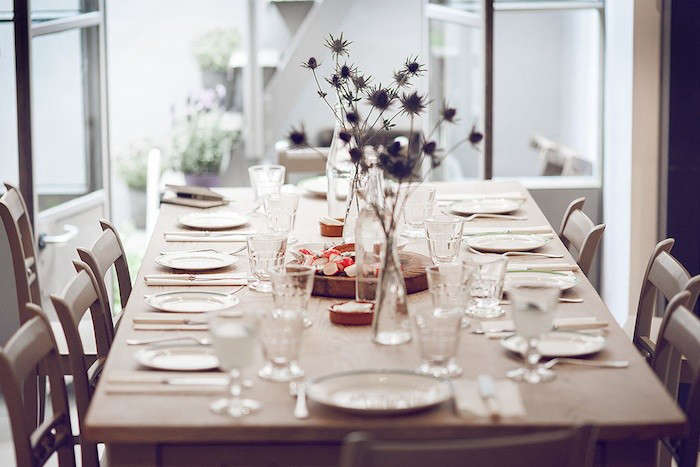
The table completed the transformation. Philip and Mary used vintage pieces, including china sourced from an old Scottish country house, secondhand cutlery, rustic French glassware, and simple vases. Nothing matched too perfectly. That was precisely the charm.
The setting suggested that hospitality comes from attention, not from buying twelve identical place settings and threatening guests who use the wrong fork.
Design You Could Taste
At PipsDish, the relationship between food and interiors was unusually direct. The kitchen was not scenery behind the experience; it was part of the experience. Guests could see ingredients being handled, smell fish roasting, hear plates being assembled, and understand how a functional room supports generous cooking.
The meal demonstrated a basic design truth: the best kitchen is not necessarily the one with the most impressive brochure. It is the one that makes people want to stay.
Market-Led Cooking Without a Script
Philip Dundas built his cooking philosophy around confidence rather than rigid instructions. His book, Cooking Without Recipes, encouraged home cooks to understand ingredients and techniques well enough to improvise. That idea became the operating system of PipsDish.
The menu depended on what looked best at the market, along with the temperature and mood of the day. This approach sounds casual, but it requires skill. Improvisation is not the absence of discipline; it is discipline that has become instinct.
A jazz musician still knows the scales. A good market cook still understands acidity, texture, timing, and the precise moment when a mackerel has gone from succulent to office stationery.
Documented PipsDish meals show how the method worked. French breakfast radishes appeared with fresh goat cheese and an herb-filled dip on a hot day. Cornwall mackerel was roasted and paired with Sicilian-style breadcrumbs, pine nuts, golden raisins, lemon, parsley, red chard, and lentils.
Another summer lunch began with watermelon, feta, and olives, followed by sardines stuffed with raisins, breadcrumbs, and anchovies. Desserts ranged from comforting bread-and-butter pudding to an apricot and raspberry meringue parfait.
These dishes were not fussy in the modern tasting-menu sense. They were colorful, generous, and built around contrasts: sweet fruit against salty cheese, oily fish against bright citrus, soft lentils against crisp breadcrumbs, and cool cream against tart berries.
The food felt composed but not overexplained. Nobody needed a three-minute lecture about the emotional childhood of the parsley.
Seasonality as a Creative Advantage
Cooking from the market naturally limits the menu, and that limitation can be liberating. When tomatoes are excellent, use tomatoes. When the weather calls for bitter greens and roasted fish, let them lead. Peak ingredients reduce the need for manipulation because they already arrive with personality.
PipsDish also showed that seasonal British cooking does not need to be narrowly British in flavor. Its ingredients might come from Cornwall or an English dairy, while its ideas wandered through Sicily, Turkey, France, and the Mediterranean.
This was London cooking in the best sense: local produce speaking with several accents at once.
The Communal Table Changed the Meal
A single table for ten is an efficient use of a small basement, but it also changes how people behave. Conventional restaurants divide guests into private islands. A communal table quietly removes some of those borders.
You may arrive with a friend and leave knowing why the person opposite you distrusts raisins, loves old kitchens, and once missed a train because of a particularly persuasive cheese shop.
The arrangement suited PipsDish because the meal was shared in spirit even when each diner had an individual plate. Everyone received the same courses at approximately the same time. Conversation rose and fell around the food. The cooks were hosts rather than distant figures hidden behind swinging doors.
One contemporary account even mentions a dog padding around beneath the table, making the experience feel closer to lunch at a talented friend’s home than a commercial transaction.
This kind of hospitality is difficult to scale, which is also why it is memorable. A ten-seat lunch club depends on personality, timing, and the willingness of guests to participate. The reward is a meal with edges, surprises, and storiesthe qualities polished restaurants sometimes sand away.
Hoxton Was the Perfect Neighborhood
Hoxton Square has a long history, but its modern reputation was shaped by artists, designers, media companies, bars, and restaurants that transformed the area from the 1990s onward. By the early 2010s, Hoxton and neighboring Shoreditch had become shorthand for East London’s creative energy.
The district could be self-conscious, certainly, but it also provided room for experiments combining retail, design, food, and community.
PipsDish fit that moment neatly. It was temporary, collaborative, visually distinctive, and difficult to categorize. The project used an existing showroom rather than building a conventional restaurant from scratch. It promoted British kitchen design by cooking in it. It turned lunch into an event without demanding formal clothes or ceremonial silence.
In other words, it was extremely Hoxton, but in a way that produced something more substantial than a mustache-wax subscription.
The location also encouraged a satisfying East London rhythm. Guests could arrive through streets lined with galleries, studios, cafes, and shops, disappear below ground for a long lunch, then emerge into Hoxton Square with the mild confusion that follows a very good meal in the middle of the day.
London continued rushing around them, but they had briefly stepped out of its schedule.
What Made This One of London’s Best Hidden Lunches?
Calling any restaurant the “best” is a reliable way to begin an argument, particularly in London, where diners can debate roast potatoes with the intensity of constitutional lawyers. Yet PipsDish offered a combination that was difficult to reproduce.
First, the food was genuinely responsive. The menu changed because the ingredients changed, not because a marketing calendar required a seasonal refresh.
Second, the room had an authentic purpose. It was a real kitchen showroom animated by real cooking. Third, the small scale made hospitality personal. Finally, the no-choice structure created anticipation.
Guests did not spend twenty minutes comparing entrees and then experience order envy. Everyone took the same delicious gamble.
Value also contributed to the appeal. Contemporary accounts described lunch-club sittings priced at approximately £20 per person, sometimes including a glass of wine. Even in 2013, that was attractive for a multi-course, carefully sourced lunch in central East London.
The price supported the democratic spirit of the table: this was special, but it was not designed as a velvet-rope luxury experience.
Lessons for Today’s Restaurants and Home Cooks
Let the Ingredient Write Part of the Menu
Planning is useful, but overplanning can make cooks ignore what is actually good. Start with the best fish, vegetables, fruit, or cheese available, then build the meal around them. A ripe peach needs less assistance than an underripe peach with an expensive publicist.
Use Constraints to Create Character
One table, one menu, and a tiny kitchen might sound restrictive. At PipsDish, those constraints created identity. Restaurants and home hosts can benefit from doing fewer things with greater confidence. Three thoughtful courses often produce more pleasure than seven complicated ones assembled in a state of panic.
Make the Table Feel Collected, Not Decorated
Vintage china, secondhand cutlery, and simple flowers gave the room texture without making it precious. A memorable table does not require a perfectly matching set. It requires clean glasses, comfortable seating, good light, and enough informality that guests are not afraid to move the salt.
Hospitality Is More Than Service
Service delivers food efficiently. Hospitality makes diners feel included. The communal table, visible kitchen, and direct relationship with the cooks made guests part of the event. That principle remains valuable in any dining room, regardless of size.
A Historical Dining Moment, Not a Current Listing
PipsDish’s Hoxton Square residency belongs to a particular chapter of London’s food history. The operation later moved on to other projects, including a Covent Garden location, and the details recorded from the Hoxton lunch club should not be treated as current opening information.
That does not reduce its relevance. Pop-ups disappear; their best ideas travel. Market-led menus, intimate supper clubs, shared tables, adaptive reuse, and design-conscious dining are now familiar parts of urban food culture.
PipsDish demonstrated how naturally those ideas could work together when the cooks cared more about flavor and connection than creating a concept that could be summarized on a tote bag.
Extended Experience: Imagining a Long Lunch Below Stairs
You arrive at Hoxton Square slightly early because hidden restaurants activate a primitive fear of walking past the correct door twelve times. The entrance is discreet. There is no giant sign, no host with a tablet, and no glowing arrow promising “ARTISANAL THINGS DOWN HERE.” You find the staircase and descend from the noise of East London into a room that feels calmer, older, and unexpectedly domestic.
The first impression is the kitchen. It looks handsome, but not fragile. Cupboard doors have the reassuring proportions of furniture built to survive decades of opening, closing, bumping, and searching for the good serving bowl.
On the worktop, herbs, radishes, citrus, and greens provide the decoration. The room smells faintly of warm bread and something roasting. This is much better than a scented candle called “Tuscan Pantry,” because lunch will actually follow.
At the table, ten settings wait without military precision. The plates have history. The glasses catch the basement light. A small arrangement of flowers looks as though someone gathered it on the way rather than negotiated with an event florist.
You sit beside people you do not know. For the first minute, everyone performs the polite London ritual of pretending not to notice one another. Then a bowl is passed, someone asks what is in the dip, and the ice gives up.
The opening plate is bright and sharp: perhaps radishes with goat cheese and herbs, or watermelon with feta and olives. It does what a first course should doit wakes up the mouth and changes the subject from traffic.
The ingredients are familiar, but the combination feels precise. Pepper, salt, creaminess, and acidity arrive in the right order. Conversation becomes easier because everyone is tasting the same thing.
Then comes fish, its skin glossy from the oven, with lemon, parsley, breadcrumbs, pine nuts, and fruit. The flavors lean toward Sicily while the fish itself speaks of British waters. Lentils and chard make the plate generous enough for lunch without flattening the afternoon.
You notice how the cooks move through the room: checking, serving, explaining briefly, then allowing the table to take over. Nobody recites a manifesto. The food is trusted to make its own case.
Dessert brings a different kind of quiet. A berry-streaked meringue parfait on a warm day would be light enough to justify finishing every spoonful. Bread-and-butter pudding would be heavier, nostalgic, and nearly impossible to share with a hopeful dog beneath the table.
Either way, the course feels less like a restaurant finale and more like the moment at a friend’s house when everyone agrees they are full and then accepts seconds.
By the time coffee appears, strangers have exchanged recommendations, opinions, and at least one story that would never have surfaced across separate tables. The basement no longer feels hidden; it feels protected.
Above ground are appointments, buses, emails, and people eating sandwiches while typing. Below stairs, lunch has been allowed to occupy its proper size.
You climb back toward daylight with the pleasant sensation that the meal happened outside ordinary London time. The pleasure was not just in the cooking, though the cooking mattered enormously. It was in the alignment of room, table, hosts, ingredients, and guests.
That is the secret of the best Hoxton lunch experiences: they make a small space feel like a temporary world, then return you to the city with crumbs on your coat and a much higher standard for basements.
Conclusion
London’s best below-stairs lunch was memorable because it made modest elements feel abundant. A basement showroom became a dining room. A market haul became a menu. Ten chairs became a community.
PipsDish captured the appeal of Hoxton at its most inventive: stylish without stiffness, experimental without nonsense, and serious about food without behaving as though lunch were a doctoral defense.
The Hoxton residency may be history, but its central lesson remains fresh. Great dining does not always require a grand address, a long menu, or theatrical technique. Sometimes it requires a useful kitchen, confident cooks, excellent produce, and a staircase leading curious people away from the obvious.