
Quick note: This guide is for general educational purposes and is not legal advice. A California domestic partnership can affect property, taxes, benefits, debt, health coverage, and future separation rights, so consider speaking with a family law attorney or tax professional if your situation is complicated.
Filing for a California domestic partnership is not exactly romantic in the candlelight-and-violins sense. There is no aisle, no officiant, and no requirement that your cousin give a questionable toast. Instead, the process is paperwork-driven: you confirm eligibility, complete the correct California Secretary of State form, sign it with wet signatures, get it notarized, pay the filing fee, and submit it properly.
Simple? Mostly. Important? Absolutely. A registered domestic partnership in California is a serious legal relationship. Under California law, registered domestic partners generally receive many of the same state-level rights, protections, benefits, responsibilities, and obligations as spouses. That means this is not a “we share Netflix and a houseplant” form. It can affect taxes, community property, health benefits, inheritance rights, support obligations, and how the relationship is legally ended.
This step-by-step guide explains how to file for a California domestic partnership, what forms to use, who qualifies, what mistakes to avoid, and what to expect after filing.
What Is a California Domestic Partnership?
A California domestic partnership is a legally recognized relationship between two adults who choose to share their lives in an intimate and committed relationship of mutual caring. In practical terms, it gives qualifying couples a way to formalize their relationship with the State of California without getting married.
Domestic partnerships in California are available to same-sex and opposite-sex couples who meet the eligibility requirements. Since changes that took effect in 2020, California domestic partnership registration is no longer limited to same-sex couples or opposite-sex couples where one partner is age 62 or older. Today, most eligible adult couples can apply.
Unlike marriage, filing for a domestic partnership does not require a ceremony. You do not need an officiant, witnesses, flowers, a DJ, or a dance floor. You need the correct form, accurate information, notarized signatures, and proper submission to the California Secretary of State.
California Domestic Partnership vs. Marriage: What Is the Difference?
For California state law purposes, registered domestic partners generally receive the same rights and responsibilities as married spouses. That may include rights related to community property, partner support, health care decisions, hospital visitation, inheritance, family leave, and certain employee benefits.
However, the federal government does not always treat registered domestic partners as married spouses. For example, registered domestic partners are generally not considered married for federal tax purposes. This can create a split reality: California may treat you like spouses for many state-law purposes, while federal agencies may not.
That difference matters. Couples should think about state taxes, federal taxes, Social Security, immigration, retirement accounts, employer benefits, health insurance, estate planning, and debt before filing. In other words, the form may be short, but the consequences can be long.
How to File for a California Domestic Partnership: 7 Steps
Step 1: Confirm That You and Your Partner Qualify
Before touching the form, make sure you both meet California’s eligibility requirements. At the time of filing, all of the following must generally be true:
- Neither person is married to someone else.
- Neither person is already in another domestic partnership that has not been legally ended.
- The partners are not related by blood in a way that would prevent them from marrying each other in California.
- Both people are at least 18 years old, unless a special court order allows a minor to establish a domestic partnership.
- Both people are legally capable of consenting to the domestic partnership.
California does not require both partners to be California residents to register a domestic partnership. This surprises many people. You also do not register through a county clerk the way you might handle certain marriage-related tasks. California domestic partnerships are registered through the California Secretary of State.
Example: If one partner lives in San Diego and the other is temporarily working in Nevada, they may still be able to register, assuming they meet the legal requirements and correctly complete the same form with notarized signatures.
Step 2: Choose Between a Public or Confidential Domestic Partnership
California offers two main filing options:
- Declaration of Domestic Partnership, Form DP-1: This creates a public domestic partnership record.
- Confidential Declaration of Domestic Partnership, Form DP-1A: This creates a confidential domestic partnership record that is not open to public inspection except under limited circumstances.
The public form is simpler from a records-access perspective, but it means the registration becomes a public record. A public domestic partnership record may include both partners’ names and the mailing address listed on the form.
The confidential form gives more privacy. However, confidential records are handled more strictly. Information about the filing is generally available only to the partners after identity verification or to someone with a qualifying court order. If privacy matters to you, this distinction is worth discussing before you file.
Think of the public version as “official and searchable,” and the confidential version as “official, but please keep the megaphone in the closet.” Both can establish a registered domestic partnership, but the records-access rules are different.
Step 3: Download and Carefully Complete the Correct Form
Once you choose the form, complete it carefully. The form asks for basic information, including the current legal names of both partners and a mailing address. You should type the form or print neatly in black or blue ink. This is not the moment for decorative handwriting that looks like it belongs on a medieval scroll.
Do not alter the declaration statement. The declaration language is required. By signing, both partners are declaring that they meet the legal requirements and that the information provided is true and complete.
The form also includes an optional name change section. One or both partners may choose a new middle or last name upon registration, but California limits the types of name changes allowed through this process. For example, a partner may be able to adopt the other partner’s current last name, a birth last name, a combined last name, or a hyphenated combination.
If you want to change your name through the domestic partnership filing, read the instructions carefully. If the new name uses a name not obvious from the current legal names listed on the form, additional proof, such as a birth certificate, may be required. Also, the form must be signed using the person’s name before the requested name change.
Step 4: Sign the Form With Wet Signatures
California requires original wet signatures for domestic partnership registration forms. That means both partners must physically sign the same form. Electronic, digital, copied, scanned, or reproduced signatures are not accepted.
This is one of the most common filing mistakes. A couple may complete the form perfectly, scan it beautifully, email it confidently, and then wonder why nothing happens. The California Secretary of State does not accept domestic partnership registration forms by email or fax. The original signed form must be submitted.
If the partners are not in the same place, they can still complete the same form. Each partner may sign and have their signature notarized separately, as long as both signatures are on the same form. Separate forms with one signature each will not work.
Step 5: Get Both Signatures Notarized
Both partners’ signatures must be acknowledged by a notary public. The notarization confirms the identity of the signer, not the truth of the statements in the form. In plain English: the notary is verifying that the person signing is who they say they are, not acting as a relationship referee.
You may be able to use one notarial acknowledgment for both partners if you appear together, or two separate acknowledgments if you sign separately. If one partner is out of state or out of the country, notarization may still be possible if it follows the rules of that jurisdiction.
Bring valid identification to the notary. Also, do not sign too early if the notary needs to watch you sign. Notary procedures can vary, so ask before putting pen to paper. Nothing kills paperwork momentum quite like having to start over because someone signed while standing in the parking lot.
Step 6: Pay the Filing Fee and Submit the Form
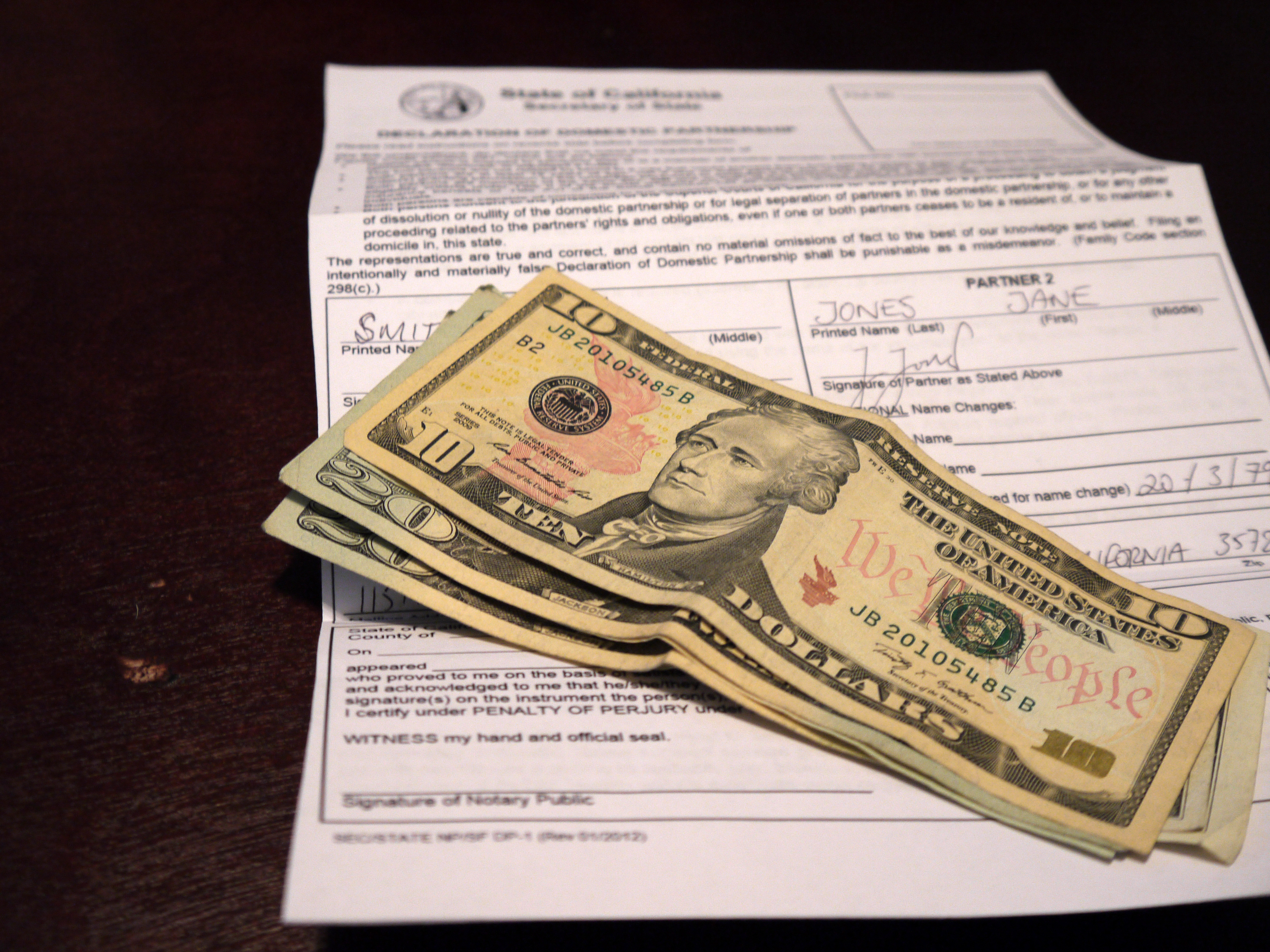
The filing fee for a California domestic partnership is currently $33 if both partners are under age 62. If either partner is age 62 or older, the filing fee is currently $10. If you submit the document in person at the Sacramento or Los Angeles office, an additional special handling fee may apply.
You can submit completed domestic partnership forms in three main ways:
- By mail to the California Secretary of State, Domestic Partners Registry, P.O. Box 942870, Sacramento, CA 94277-2870.
- In person at the Sacramento office.
- In person at the Los Angeles office.
The Los Angeles office does not process documents received by mail, so mailed filings should go to the Sacramento mailing address. Payment options depend on the submission method. By mail, payment is generally made by check or money order payable to the California Secretary of State. In-person payment options may include check, money order, credit card, and, in Sacramento, cash.
Before mailing, make a copy for your personal records. The original goes to the state. Your copy is not proof of registration yet, but it is useful if you need to review what you submitted.
Step 7: Keep Your Filed Copy and Order Certified Copies if Needed
After the California Secretary of State files the domestic partnership, the partners receive one uncertified copy of the file-stamped declaration and a Certificate of Registration of Domestic Partnership. Many couples also order certified copies because employers, insurers, government offices, financial institutions, and other entities may ask for proof.
A certified copy of the filed Declaration of Domestic Partnership is commonly used as official proof of registration. If you are updating benefits, changing a name, revising estate planning documents, or dealing with insurance, having a certified copy can save time.
Store the document somewhere safe. This is not a random receipt from a coffee shop. It is legal proof of a relationship status that may affect major rights and obligations.
Common Mistakes to Avoid When Filing
Using the Wrong Form
Use Form DP-1 for a public domestic partnership and Form DP-1A for a confidential domestic partnership. Choosing the wrong one may affect privacy and record access.
Submitting a Copy Instead of the Original
The Secretary of State requires the original form with wet signatures. Copies, scans, digital signatures, and faxed forms are not accepted.
Changing the Form After Notarization
If you discover a mistake after the form has been signed and notarized, you should complete a new form. Do not cross out, patch, squeeze in, or creatively “fix” the notarized document.
Forgetting the Tax Consequences
Registered domestic partners may have different California and federal tax treatment. California generally uses married/RDP filing statuses for registered domestic partners, while the IRS does not treat registered domestic partners as married for federal tax filing status. This can make tax preparation more complex, especially in a community property state like California.
Assuming It Is Easy to Undo
A domestic partnership is easier to register than to casually erase. Some couples may qualify for termination through the Secretary of State, but others must go through California Superior Court. Issues such as property, debt, support, and children can make the ending process more involved.
What Happens After You Register?
Once your domestic partnership is registered, you and your partner may have many of the same rights and responsibilities as spouses under California law. Depending on your circumstances, you may want to update:
- Employer benefit elections
- Health insurance information
- Emergency contact records
- Estate planning documents
- Beneficiary designations
- Property agreements
- Tax withholding forms
- Financial account records
Do not assume every institution automatically knows what a California registered domestic partnership means. Some employers and agencies will ask for a certified copy of the declaration. Others may have their own forms or deadlines. The sooner you update important records, the less likely you are to run into confusion later.
Do You Need a Lawyer to File?
Many couples can complete the filing process without a lawyer if their situation is straightforward. The form itself is short, and the Secretary of State provides instructions. However, legal advice may be wise if you have significant assets, children, real estate, business interests, prior marriages, immigration questions, tax concerns, or uncertainty about federal benefits.
A domestic partnership is not just an emotional commitment; it is a legal status. If your finances are complex, getting advice before filing is usually cheaper than trying to untangle confusion later. Think of it as measuring twice and filing once.
Practical Experience: What Filing for a California Domestic Partnership Feels Like in Real Life
For many couples, filing for a California domestic partnership feels less like a dramatic legal event and more like a surprisingly formal errand. You may start with a conversation at the kitchen table: “Should we register?” Then suddenly you are comparing public and confidential forms, hunting for a notary, and discussing whether your printer has enough ink. Romance has many languages; apparently, one of them is PDF.
The couples who tend to have the smoothest experience are the ones who treat the process like a small legal project. They read the eligibility rules first, choose the correct form, gather identification, decide whether either partner wants a name change, and review the mailing address before signing. This may sound obvious, but many filing problems come from tiny preventable errors: a missing date, an unreadable name, a signature made before the notary was ready, or a payment made out incorrectly.
One practical lesson is to talk about expectations before filing. A domestic partnership can affect money, taxes, benefits, property, and future separation rights. That does not mean the conversation needs to feel cold or suspicious. It can be simple and caring: What are we hoping this registration does for us? Are we trying to secure health benefits? Create legal recognition? Support estate planning? Make medical decision-making easier? Avoid marriage while still creating a formal commitment? Knowing the “why” helps both partners understand what they are signing.
Another real-world tip is to order certified copies early. Many couples do not think about proof until an employer, insurance provider, or agency asks for it. Then the document becomes urgent at the worst possible time. Having certified copies ready can make benefit updates and administrative tasks much less stressful.
Privacy is another experience-based consideration. Some couples are comfortable with a public filing. Others prefer a confidential domestic partnership because they do not want their relationship record easily available for public inspection. There is no universally correct answer. The better choice depends on your privacy concerns, paperwork needs, and comfort level.
Finally, do not rush the notary step. It is tempting to treat notarization as a quick stamp, but it is a key part of the filing. Bring valid ID, use the same names consistently, and ask questions before signing. If the two partners are signing in different places, make sure both signatures are notarized on the same form. That single detail can prevent a frustrating rejection.
In short, the best experience comes from slowing down just enough to get it right. Filing is not difficult, but it is meaningful. A little preparation turns the process from “bureaucratic scavenger hunt” into a clean, organized step toward legal recognition.
Conclusion
Filing for a California domestic partnership is a manageable process when you understand the steps. First, confirm that you and your partner qualify. Then choose whether you want a public or confidential registration, complete the correct form, sign with original wet signatures, get both signatures notarized, pay the filing fee, and submit the paperwork to the California Secretary of State.
The process may look simple on paper, but the legal effects can be significant. Registered domestic partners in California generally receive many of the same state-level rights and responsibilities as spouses, while federal treatment may differ. Before filing, take time to understand how registration may affect taxes, property, benefits, health coverage, and future separation rights.
The good news? You do not need a ballroom, a bouquet, or a playlist with three versions of “At Last.” You need accurate paperwork, clear consent, and a practical understanding of what this legal status means. That may not sound glamorous, but it is exactly how California makes a domestic partnership official.