
Imagine your bloodstream as a busy city. Red blood cells are delivery vans. White blood cells are security guards. Platelets are tiny repair workers who rush to patch leaks. Most days, the whole operation runs like a slightly chaotic but surprisingly efficient cartoon factory.
Then, in 2021, a strange plot twist appeared in the COVID-19 vaccine story: a very small number of people who received the Johnson & Johnson COVID-19 vaccine developed an unusual blood-clotting condition. It was rare, serious, and confusing enough to make even the body’s “repair crew” look like they had accidentally joined a slapstick episode of medical mystery theater.
This condition became known as thrombosis with thrombocytopenia syndrome, or TTS. In some medical discussions, a closely related term is vaccine-induced immune thrombotic thrombocytopenia, or VITT. Yes, the names sound like villains from a science-fiction comic. But the basic idea is easier to understand: unusual blood clots appeared together with low platelet counts. That combination is what made the condition so unusual.
This article explains blood clots and the Johnson & Johnson vaccine in plain English, with a comic-style approach, real medical context, and zero panic foghorns. The goal is not to scare readers. It is to explain what happened, why doctors paid close attention, and what the story teaches us about vaccine safety monitoring.
The Quick Backstory: What Was the Johnson & Johnson COVID-19 Vaccine?
The Johnson & Johnson COVID-19 vaccine, developed by Janssen, was different from the Pfizer-BioNTech and Moderna vaccines. Pfizer and Moderna used mRNA technology, while the Johnson & Johnson shot used an adenovirus vector. Think of it like two different delivery trucks bringing instructions to the immune system. The destination was similar: teach the body to recognize part of the coronavirus and prepare a defense.
The Johnson & Johnson vaccine attracted attention because it was originally a single-dose vaccine. That made it useful for mobile clinics, rural areas, people with limited transportation, and anyone who looked at a two-dose schedule and thought, “My calendar is already fighting me.”
But after the vaccine rollout began, U.S. safety monitoring systems detected rare cases of serious blood clots with low platelets. In April 2021, the CDC and FDA recommended a temporary pause so experts could review the data, inform healthcare providers, and update guidance. The pause was not a shrug. It was more like hitting the emergency brake to inspect a strange noise before driving farther.
Later, the vaccine returned with warnings, then its use was limited in the United States. Eventually, the Johnson & Johnson COVID-19 vaccine was no longer available in the U.S., and the FDA revoked its emergency use authorization in 2023 after the manufacturer requested withdrawal.
Meet the Cast: Platelets, Clots, and the Immune System
To understand the blood clot concern, let’s introduce the cartoon characters inside your body.
Platelets: The Tiny Repair Crew
Platelets are small blood components that help stop bleeding. If you get a cut, platelets rush to the scene, stick together, and help form a clot. In normal life, they are heroes. They are the construction workers who patch potholes before your bloodstream turns into a water park.
Blood Clots: Helpful Until They Are Not
A clot in the right place is useful. A clot in the wrong place can be dangerous. If a clot blocks blood flow in a leg, lung, brain, or abdomen, it can cause serious complications. Most blood clots are not related to vaccines. They can happen for many reasons, including surgery, long periods of immobility, certain medications, pregnancy, cancer, inherited clotting conditions, smoking, and infections, including COVID-19 itself.
The Immune System: Security With a Megaphone
The immune system is supposed to identify threats and respond. Most of the time, it does this beautifully. Occasionally, it gets dramatic. With TTS/VITT, researchers found evidence that the immune system appeared to activate platelets in an unusual way, creating a situation where clots formed even while platelet counts dropped.
That is the medical plot twist: a person had clotting and low platelets at the same time. Usually, platelets help clots form, so seeing clots while platelet levels are low is like seeing firefighters spraying water while the water tank is mysteriously empty. Doctors noticed because the pattern was unusual.
What Is TTS, in Human Language?
Thrombosis means a blood clot forms inside a blood vessel. Thrombocytopenia means the platelet count is lower than normal. Syndrome means a pattern of signs and symptoms that tend to appear together.
So, TTS means: blood clots plus low platelets in a concerning pattern. In the Johnson & Johnson vaccine story, some clots appeared in unusual locations, such as veins that drain blood from the brain, known as cerebral venous sinuses. Some cases also involved clots in the abdomen or other large blood vessels.
Doctors took this seriously because ordinary clot treatment may not always be appropriate for TTS/VITT. In particular, early guidance warned clinicians to be careful with heparin, a common blood thinner, because this immune-driven clotting pattern could behave differently from typical clots. That is one reason the temporary pause mattered: it gave hospitals and clinicians time to recognize the condition and treat it correctly.
How Rare Was This Blood Clotting Problem?
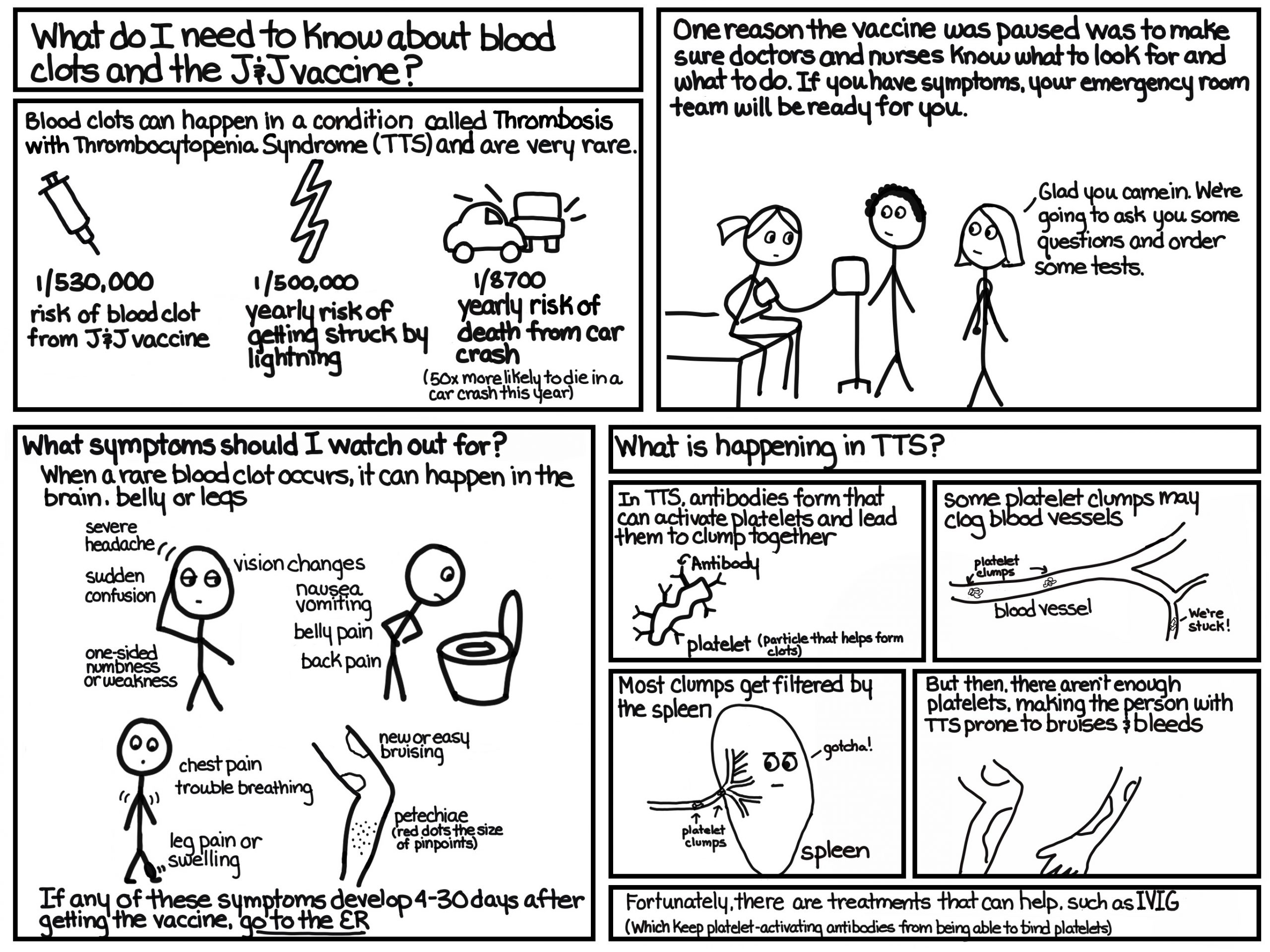
The key word is rare. Not “rare like finding a matching sock in a teenager’s laundry,” but medically rare. The number of reported cases was very small compared with the number of vaccine doses given. Still, because TTS could be severe or even fatal, regulators treated it as important.
This is where public-health communication gets tricky. If officials say, “This is rare,” some people hear, “Ignore it.” If they say, “This can be serious,” some people hear, “Everybody panic and hide in the cereal aisle.” The truth is more balanced: the condition was uncommon, but the possible outcome was serious enough to require clear warnings, careful monitoring, and updated recommendations.
That is how vaccine safety systems are supposed to work. They are designed to catch rare events after millions of people receive a vaccine. Clinical trials can detect common side effects, but extremely rare events may only become visible after large-scale use. Safety monitoring is the smoke alarm, not the fire itself.
Why Did the CDC and FDA Pause the Vaccine?
In April 2021, the CDC and FDA recommended a temporary pause in the use of the Johnson & Johnson vaccine after reports of rare clotting events with low platelets. The pause allowed experts to review cases, study patterns, update fact sheets, and alert healthcare providers about diagnosis and treatment.
Comic version: the medical world saw a weird footprint in the hallway and said, “Nobody move. We are checking whether this is a raccoon, a monster, or Uncle Gary wearing flippers.”
After review, U.S. officials allowed use to resume with updated warnings. Later, as more data became available and mRNA vaccines were widely available, U.S. guidance shifted toward preferring mRNA vaccines. In 2022, the FDA limited authorized use of the Johnson & Johnson vaccine to certain adults for whom other vaccines were not accessible or clinically appropriate, or who would otherwise not receive a COVID-19 vaccine. By 2023, the vaccine was no longer available in the United States.
Symptoms Doctors Wanted People to Watch For
Most common vaccine side effects, such as mild fever, sore arm, fatigue, headache, or body aches, usually appear soon after vaccination and improve within a few days. TTS was different because concerning symptoms often appeared several days to a few weeks after vaccination.
Warning signs that were emphasized included severe or persistent headache, vision changes, shortness of breath, chest pain, leg swelling, persistent abdominal pain, easy bruising, or tiny blood spots under the skin away from the injection site. These symptoms do not automatically mean TTS, but they deserve urgent medical attention, especially if they appear in the concerning time window after vaccination.
For readers today, this is mostly historical because the Johnson & Johnson COVID-19 vaccine is no longer available in the United States. But the lesson remains useful: unusual, severe, or worsening symptoms after any medical intervention should not be ignored. Your body does not need you to become a medical detective with a corkboard and red string. It needs you to get professional help when something feels seriously wrong.
Why Clots From COVID-19 Infection Also Matter
A strange part of the public conversation was that many people focused only on vaccine-related clot risk while forgetting that COVID-19 infection itself can increase the risk of blood clots. The virus can inflame blood vessels, affect clotting pathways, and contribute to complications in hospitalized patients.
That comparison does not erase vaccine concerns. A rare vaccine risk is still worth studying. But it does add context. Public health decisions compare risks and benefits: the risk of a rare adverse event, the risk of infection, the risk of severe disease, and the availability of safer or more effective alternatives.
When mRNA vaccines were widely available, the benefit-risk calculation changed. The Johnson & Johnson vaccine still played a role during parts of the pandemic, especially when vaccine access was difficult. But as options expanded, regulators and advisory committees could recommend alternatives with fewer concerns about TTS.
The Comic Explanation: The Platelet Parade Goes Off Script
Picture a parade inside your bloodstream. Platelets are carrying tiny toolboxes. The immune system is wearing sunglasses, scanning the crowd. Everything is normal until a false alarm goes off.
Suddenly, some immune signals appear to tell platelets, “Emergency! Build barricades!” The platelets, being enthusiastic little repair goblins, start clumping. But the alarm is not happening at a regular injury site. Now barricades may form where they should not, blocking traffic in important blood vessels.
Meanwhile, because platelets are being used up in the chaos, the platelet count in the blood drops. So the city has two problems at once: traffic jams caused by clots and fewer repair workers available where they are actually needed. That is why TTS is so unusual and why doctors treated it differently from a standard clot.
This cartoon version is simplified, of course. Real immunology involves antibodies, platelet factor 4, clotting pathways, and several mechanisms that scientists continue to study. But the core idea is simple enough: in rare cases, the immune system appeared to trigger platelet activation in a way that caused dangerous clotting while platelet levels were low.
What Did Scientists Learn?
Scientists learned several important things from the Johnson & Johnson vaccine blood clot issue.
First, large-scale safety monitoring matters. Rare side effects may not be visible until millions of people receive a vaccine. Systems such as clinical reporting, expert review, and advisory committee meetings help detect patterns quickly.
Second, transparency matters. The pause was disruptive, but it also showed that regulators were willing to act when signals appeared. In public health, trust is not built by pretending nothing unusual ever happens. Trust is built by saying, “Here is what we saw, here is what we know, here is what we do not know yet, and here is what we are doing next.”
Third, risk is not one-size-fits-all. Age, sex, medical history, vaccine availability, community transmission, and personal circumstances can affect recommendations. That is why medical advice often changes as evidence changes. Changing guidance is not automatically a scandal. Sometimes it is science doing its job in public, wearing mismatched socks.
What This Means Now
For people in the United States, the Johnson & Johnson COVID-19 vaccine is no longer part of the current vaccine menu. The practical question is not usually, “Should I get J&J?” because that option is no longer available in the U.S. The more relevant question is: “What can we learn from how this safety concern was handled?”
The answer is that medicine constantly balances benefit and risk. No medical product is completely risk-free, including vaccines, antibiotics, pain relievers, anesthesia, or even the humble adhesive bandage that somehow removes three arm hairs per square inch. The goal is to understand risks honestly, minimize them, and compare them with the risks of the disease being prevented or treated.
The Johnson & Johnson blood clot story is not a simple cartoon with a perfect hero and a mustache-twirling villain. It is a more realistic comic strip: useful tool, rare serious problem, rapid investigation, updated warnings, revised recommendations, and eventual discontinuation in the U.S. market.
Common Misunderstandings About Blood Clots and the Johnson & Johnson Vaccine
Misunderstanding 1: “All blood clots after vaccination were TTS.”
No. Blood clots happen in the general population for many reasons. TTS had a specific pattern: clotting combined with low platelets, often in unusual locations, within a certain time frame after vaccination.
Misunderstanding 2: “Rare means impossible.”
Rare does not mean impossible. It means the event occurs infrequently. A rare risk can still matter when the outcome is severe, which is why health agencies paid attention.
Misunderstanding 3: “The pause proved the vaccine was useless.”
No. The pause showed that safety systems detected a possible rare adverse event and investigated it. The vaccine had benefits, especially earlier in the pandemic, but recommendations changed as more data and more vaccine options became available.
Misunderstanding 4: “Changing guidance means experts were making everything up.”
Changing guidance can mean new evidence arrived. Science is not a stone tablet dropped from the sky. It is a process of collecting data, checking it, arguing over it, and updating decisions when the evidence changes.
Experience Section: What the Johnson & Johnson Blood Clot Story Felt Like in Real Life
For many people, the Johnson & Johnson vaccine blood clot news was not just a medical update. It was an emotional experience. In 2021, the world was already exhausted. People were trying to protect grandparents, reopen schools, keep jobs, understand variants, and decode public-health announcements that sometimes felt like they were written by a committee of anxious calculators.
When the pause was announced, reactions varied. Some people felt reassured because regulators were watching closely. Others felt alarmed because the word “blood clot” sounds scary even before anyone adds “brain,” “low platelets,” or “rare but serious.” A person who had just received the J&J vaccine might have spent the next two weeks overanalyzing every headache, leg cramp, or weird stomach bubble. Was it a medical emergency? Was it lunch? Was it anxiety wearing a fake mustache? That uncertainty was real.
Healthcare workers had their own experience. Clinics had to change plans quickly. Pharmacists, nurses, and doctors needed updated guidance. They had to explain risk without either minimizing it or turning it into a horror movie trailer. That is hard. Good medical communication requires emotional balance: enough seriousness to encourage action, enough calm to prevent panic.
For families, the story often became a kitchen-table debate. One person might say, “See, this is why I worry.” Another might say, “But COVID can cause clots too.” Someone else might search online and return fifteen minutes later with the confidence of a person who has read three headlines and half a comment section. The real challenge was separating useful information from noise.
The most helpful experience many people reported was talking to a trusted healthcare professional. A doctor or pharmacist could explain the actual warning signs, the time window of concern, and the difference between common side effects and symptoms that required urgent care. That conversation often did more than a dozen social media posts. It turned a giant cloud of fear into a checklist: watch for severe headache, shortness of breath, chest pain, leg swelling, abdominal pain, unusual bruising, or vision changes; seek help if they occur; otherwise, do not let anxiety drive the bus.
The J&J blood clot issue also revealed something important about public trust. People do not only need facts. They need facts delivered clearly, honestly, and with respect. Saying “the risk is tiny” may be mathematically accurate, but if someone is frightened, it can sound dismissive. Saying “this is serious” is also accurate, but without context, it can sound terrifying. The best explanation lives in the middle: the event was rare, it was taken seriously, systems responded, guidance changed, and people with concerning symptoms were encouraged to seek urgent care.
In hindsight, the Johnson & Johnson vaccine blood clot story is a case study in how modern medicine works under pressure. It was not perfect. Communication was messy at times. Public reactions were intense. But the core safety process functioned: signals were detected, experts reviewed data, warnings were updated, and recommendations evolved. That may not make for a neat superhero ending, but it is a realistic one.
Conclusion: A Serious Topic, Explained Without the Thundercloud
Blood clots and the Johnson & Johnson vaccine became a major topic because a rare but serious condition appeared during safety monitoring. The condition, TTS or VITT, involved unusual blood clots combined with low platelet counts. It was not the same as ordinary post-vaccine soreness or a normal headache after immune activation. It was a specific medical pattern that required careful recognition and treatment.
The Johnson & Johnson COVID-19 vaccine is no longer available in the United States, but the story remains important. It shows why safety monitoring matters, why public-health guidance changes, and why risk communication should be clear instead of theatrical. In comic terms, the platelet repair crew briefly went off script in very rare cases, the medical directors called a timeout, and the science team rewrote the safety notes.
The best takeaway is not panic. It is perspective. Vaccines, like all medical tools, are judged by evidence, benefits, risks, and available alternatives. The Johnson & Johnson blood clot issue reminds us that rare risks can be real, real risks can be monitored, and good science is willing to update the script when new information walks onto the page.