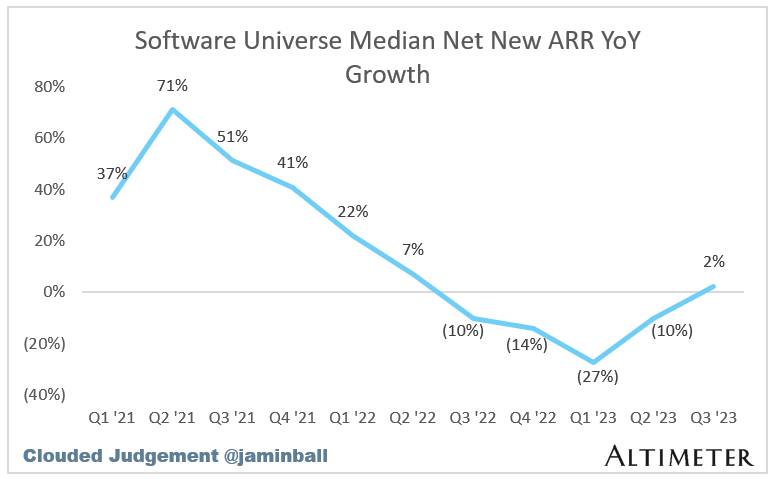

SaaS growth is back. Sort of. Not in the champagne-tower, “every startup gets a unicorn hoodie” way of 2021, but in a quieter, more adult way: bookings are improving, budgets are loosening in selective areas, and buyers are finally showing signs that they are willing to spend again when the software clearly saves money, creates revenue, or brings AI into a workflow without turning the company into a science fair.
The phrase “SaaS growth has finally rebounded, albeit only a little bit” captures the mood perfectly. It is not a victory parade. It is more like seeing your houseplant grow one new leaf after two years of looking emotionally unavailable. Still, that one leaf matters. In SaaS, small changes in new bookings, retention, expansion revenue, and sales efficiency can signal where the next cycle is heading.
Altimeter Capital’s SaaS and cloud analysis, widely followed by founders and investors, has emphasized a key pattern: new bookings for many public SaaS and cloud companies surged during the pandemic-era software boom, then fell sharply as customers tightened budgets and interest rates rose. After hitting a low around early 2023, growth began to stabilize and improve modestly. That modest rebound is the story. It is not the old “growth at all costs” world. It is the beginning of a more disciplined SaaS era.
What the SaaS Growth Rebound Really Means
When people hear “rebound,” they often picture a dramatic comeback. SaaS founders may imagine CFOs sprinting down the hallway with purchase orders in hand. Reality is more restrained. The current SaaS growth rebound means buyers are no longer freezing every software decision by default. It means some companies are seeing healthier pipeline conversion, better renewal conversations, and more willingness to expand contracts when the value is obvious.
But the improvement is uneven. AI-native companies, cybersecurity platforms, data infrastructure providers, vertical SaaS businesses with deep workflow ownership, and tools that improve productivity are attracting more attention. Meanwhile, generic point solutions, nice-to-have dashboards, and “we help teams collaborate better” products are still facing brutal scrutiny. In 2026, a buyer does not want another tab. They want a measurable outcome.
Why SaaS Slowed Down in the First Place
To understand the rebound, we need to remember the slowdown. SaaS did not magically lose its charm. It ran into a wall built from higher interest rates, overhiring, budget fatigue, and customer consolidation. During the 2020 and 2021 boom, companies bought software aggressively. Many teams added tools quickly because remote work, digital transformation, and cheap capital made speed feel more important than discipline.
Then the environment changed. Capital became expensive. Public SaaS valuations compressed. CFOs started asking harder questions. Procurement teams became the bouncers at the software nightclub. Tools that once passed through with a smile suddenly had to prove ROI, security, usage, integration value, and whether anyone had logged in since last Tuesday.
This created a painful reset. Growth rates fell. Sales cycles stretched. Expansion revenue slowed. Net revenue retention came under pressure. Many SaaS companies shifted from hiring aggressively to improving operating margins, reducing burn, and focusing on the Rule of 40: the combination of revenue growth and profitability. The market did not stop loving SaaS; it stopped rewarding sloppy SaaS.
The New SaaS Buyer Is More Practical
The modern SaaS buyer is not anti-software. In fact, businesses continue to spend heavily on cloud services, AI infrastructure, workflow automation, cybersecurity, and data platforms. The difference is that buyers now expect software to justify itself faster. “This will improve collaboration” is no longer enough. “This reduces support tickets by 30%,” “this shortens invoice processing,” or “this helps reps close more pipeline with fewer manual steps” is much better.
That shift favors SaaS companies with strong product analytics, clear use cases, and customer success teams that can tie adoption to business outcomes. It also favors vendors that expand inside existing accounts. For larger SaaS companies, expansion revenue often becomes the engine that keeps growth alive when new logo acquisition slows. When existing customers buy more seats, more modules, or higher-tier plans, growth becomes more durable and less dependent on constantly finding new buyers.
AI Is Helping SaaS Growth, But Not Equally
AI is the loudest force in software right now, but it is not a magic growth button. Adding “AI-powered” to a homepage is easy. Creating AI that customers trust, adopt, and pay for is much harder. The strongest SaaS companies are not simply bolting a chatbot onto an old interface. They are rebuilding workflows around automation, prediction, summarization, decision support, and agentic execution.
Benchmark data increasingly shows that AI-native startups and SaaS companies with AI deeply embedded in the product can grow faster than traditional peers. That makes sense. A product that turns ten manual steps into two useful clicks has a stronger budget argument than a product that merely rearranges existing information into a prettier dashboard.
However, AI also raises the bar. Customers may ask why they should pay per seat if AI agents do the work. They may expect outcome-based pricing, usage-based billing, or performance-linked packages. SaaS companies must rethink packaging, gross margins, infrastructure costs, and customer education. AI can accelerate growth, but it can also expose weak products faster than ever. A mediocre SaaS tool with a chatbot is still mediocre. It just answers questions about its mediocrity more politely.
Public SaaS vs. Private SaaS: Two Different Weather Reports
Public SaaS companies provide clearer data because their financial results are visible. That is why Altimeter’s work is so influential: tracking bookings, revenue growth, margins, and valuation multiples across public cloud companies can reveal early shifts in market health. Public SaaS showed a major decline from the pandemic peak, followed by a small rebound from the lows.
Private SaaS tells a more mixed story. Surveys from SaaS benchmark providers show that many private companies are still growing, but the median growth rate is lower than the frothy years. Retention remains one of the biggest dividing lines. Companies with strong net revenue retention can compound through upsells and cross-sells. Companies with weak retention must keep pouring money into acquisition just to replace lost revenue, which is about as fun as filling a bathtub while someone quietly removes the drain.
The Metrics That Matter Most in the Rebound
1. New Bookings
New bookings are one of the earliest signs of demand recovery. Revenue often lags because SaaS contracts are recognized over time, but bookings show whether customers are signing new deals. If bookings improve for several quarters, it can signal that buyers are returning.
2. Net Revenue Retention
Net revenue retention measures whether existing customers spend more or less over time, including expansions, contractions, and churn. In a slower market, NRR becomes a survival metric. If customers stay and expand, the company has a strong base. If they shrink or leave, growth becomes much harder.
3. CAC Payback
Customer acquisition cost payback shows how long it takes to recover sales and marketing spend. In the easy-money era, companies tolerated long payback periods. Today, investors prefer efficient growth. A company that spends heavily to win customers who barely expand will struggle to earn premium valuations.
4. Gross Margin
AI is making gross margin more important. Traditional SaaS often enjoyed attractive margins because software could scale cheaply. AI workloads may add significant compute costs. Companies must price carefully so AI features improve revenue without quietly eating profitability in the basement.
5. Rule of 40
The Rule of 40 combines growth and profitability. A SaaS company growing 25% with a 15% free cash flow margin reaches 40. Investors use it as a shorthand for balanced performance. In the current market, balance matters more than swagger.
Why “Only a Little Bit” Still Matters
A small rebound may sound underwhelming, but in SaaS, direction matters. When growth is decelerating, everyone becomes defensive. Hiring slows, marketing budgets shrink, and product bets become cautious. When growth stabilizes, companies can plan again. Even modest improvement can restore confidence inside sales teams, boardrooms, and customer conversations.
The key is not to mistake a rebound for a return to 2021. The old playbook was built on abundant capital and aggressive spending. The new playbook is built on focus. The best SaaS companies will grow by solving urgent problems, improving retention, embedding AI where it creates measurable value, and selling into budgets tied to productivity, compliance, security, and revenue.
Examples of SaaS Categories Positioned for Better Growth
Not every SaaS category benefits equally from the rebound. Some categories are closer to the budget line than others.
AI Workflow Automation
Tools that automate repetitive work in customer support, finance, legal operations, sales development, and healthcare administration can make a strong ROI case. If software replaces manual labor or speeds up expensive processes, it gets attention.
Cybersecurity and Identity
Security remains a board-level concern. As companies adopt more SaaS tools and AI systems, identity management, access control, monitoring, and SaaS security posture management become more important.
Data Infrastructure
AI needs clean, accessible, governed data. Companies investing in AI often need better data pipelines, observability, warehousing, and governance first. The glamorous AI assistant may get the applause, but the data layer does the laundry.
Vertical SaaS
Vertical SaaS companies focused on industries such as healthcare, construction, logistics, insurance, restaurants, and legal services can win by owning industry-specific workflows. Deep domain knowledge creates defensibility that generic platforms often lack.
What Founders Should Do Now
Founders should treat the rebound as an opportunity, not a permission slip to return to bad habits. The market is improving selectively, and selective markets reward disciplined execution. The first priority is retention. Before chasing every new lead, companies should understand why customers renew, expand, downgrade, or churn.
Second, founders should sharpen positioning. A vague product will struggle in a practical buying environment. The homepage, sales deck, demo, and onboarding experience should answer one question quickly: “What expensive problem do we solve?” If the answer requires twelve slides and a philosophical monologue, the positioning needs work.
Third, companies should integrate AI thoughtfully. The goal is not to look modern; the goal is to make the product more valuable. AI should reduce friction, increase accuracy, speed up workflows, or unlock a new capability customers could not easily achieve before.
Finally, founders should manage cash with respect. The rebound is real, but not huge. Efficient growth remains the winning formula. Teams that can grow while improving margins will have more strategic options, whether they want to raise capital, pursue acquisitions, or build independently.
Experience-Based Insights: What This Rebound Feels Like Inside a SaaS Business
For operators inside SaaS companies, a small rebound does not feel like a market headline. It feels like tiny signals appearing in places that were quiet for too long. A prospect who ghosted six months ago suddenly replies. A customer who delayed expansion asks for a fresh quote. A finance leader who used to say, “No new tools this quarter,” now says, “Show me the business case.” Nobody throws confetti, but people start checking the pipeline dashboard with less dread.
The most important experience from this phase is that buyers have become more serious, not necessarily more negative. They are willing to buy, but they expect the vendor to do more homework. A sales call that once focused on features now has to include implementation timelines, adoption plans, security documentation, integration requirements, and measurable ROI. The best sales teams are not pushing harder; they are selling smarter.
Customer success teams also feel the shift. During the slowdown, renewals became defense. Teams had to prove usage, value, and executive alignment. In the rebound, customer success becomes offense again, but with discipline. Expansion opportunities appear when customers trust the product and see clear results. A customer who saves money with one workflow may be open to automating another. That is where the rebound becomes real: not in market commentary, but in a customer saying, “What else can this platform do?”
Product teams have learned a similar lesson. Features are no longer enough. SaaS companies need to package outcomes. A reporting feature becomes more valuable when it recommends action. A support tool becomes more valuable when it drafts responses, detects churn risk, and escalates urgent accounts. A CRM feature becomes more valuable when it helps a rep prioritize the next best action instead of simply storing another note that no one will read until the heat death of the universe.
Marketing teams should also pay attention. In a cautious rebound, hype performs worse than clarity. Content that says “transform your business with next-generation innovation” sounds like it was assembled from leftover conference banners. Content that explains how to reduce onboarding time, improve retention, lower support costs, or automate invoice review is far more useful. The companies that educate the market honestly will earn trust faster.
From a leadership perspective, the rebound requires emotional balance. It is tempting to overreact to a few good months. It is equally tempting to stay too conservative after a painful slowdown. The better approach is measured confidence. Invest in channels that are working. Support the customers that are expanding. Improve the product areas that create measurable value. Keep the team focused on durable growth, not vanity growth.
In practical terms, the SaaS rebound feels like the market has moved from “prove why we should not cancel you” to “prove why we should expand with you.” That is a meaningful change. It is not easy mode, but it is better. For strong SaaS companies, this is a chance to separate from weaker competitors. For weaker ones, it is a final warning: the market is giving software another shot, but it expects better answers this time.
Conclusion
SaaS growth has finally rebounded, but only a little bit. That small improvement is still important because it marks a shift from panic to cautious optimism. The market is no longer rewarding growth at any cost, and buyers are not returning to careless software spending. Instead, the next phase of SaaS will favor companies that combine useful AI, strong retention, efficient acquisition, clear ROI, and disciplined financial management.
The Altimeter view is valuable because it reminds us to look at real demand signals, not just vibes. Bookings, retention, expansion revenue, margins, and customer behavior tell the story better than any dramatic headline. SaaS is not dead. It is maturing. And like many things that mature, it now has a budget, a calendar invite, and a much lower tolerance for nonsense.
Note: This article is an original synthesis created for web publication. It is based on publicly available SaaS market research, benchmark reports, and industry analysis, rewritten in a natural editorial style without source-code citation artifacts.