
Learning guitar scales can feel like being handed a map of a city where every street is named “Fret.” You know there is treasure somewhere on the neck, but at first everything looks like a mysterious grid of dots, strings, and mild finger panic. The good news? Guitar scales are not secret wizard language. They are organized groups of notes that help you play melodies, write riffs, understand chords, improvise solos, and stop guessing where the “good notes” live.
If you want to learn guitar scales the smart way, do not try to memorize every scale in every key by Friday. That way lies confusion, sore fingertips, and possibly a dramatic stare out the window. Instead, start with a few useful patterns, connect them to real music, practice slowly, and learn how each scale sounds. A scale is not just a finger exercise; it is a sound, a mood, and a musical tool.
This guide explains how to learn guitar scales from the ground up, including which scales to start with, how to practice them, how to use a metronome, how to connect scales to chords, and how to turn boring up-and-down patterns into actual music. Whether you play acoustic guitar, electric guitar, blues, rock, pop, country, metal, worship music, or bedroom-concert-for-one, these steps will help you build a fretboard you can actually understand.
What Are Guitar Scales?
A guitar scale is a sequence of notes arranged by pitch. Those notes usually follow a pattern of whole steps and half steps. On the guitar, a half step equals one fret, and a whole step equals two frets. That simple idea unlocks the entire fretboard.
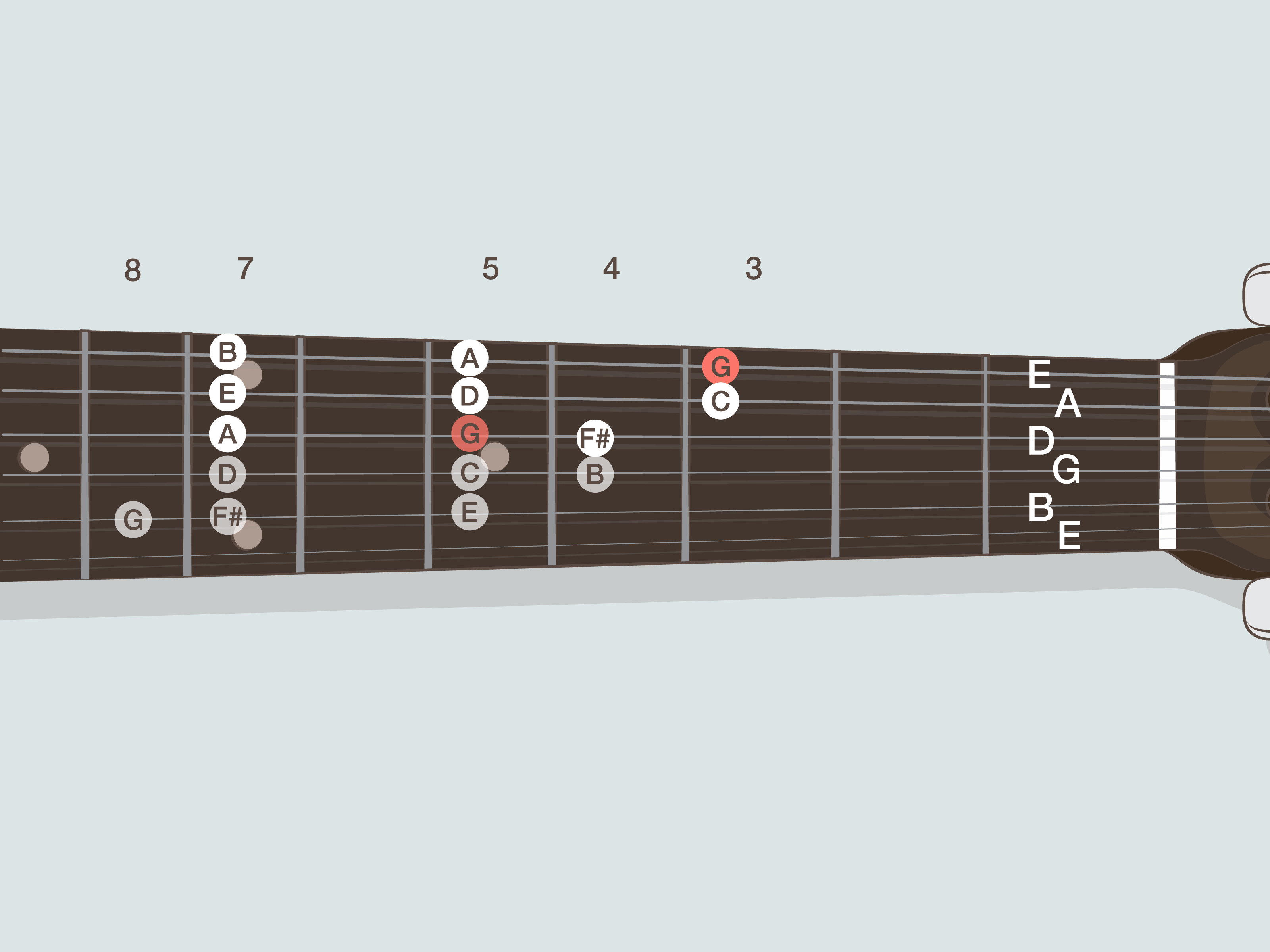
For example, the C major scale uses the notes C, D, E, F, G, A, and B. It sounds bright, stable, and familiar because it is one of the foundations of Western music. The A minor pentatonic scale uses A, C, D, E, and G. It sounds bluesy, direct, and instantly guitar-friendly. If you have ever heard a rock solo that made someone make “guitar face,” there is a good chance the minor pentatonic scale was somewhere nearby, wearing sunglasses.
Scales help you understand melody, harmony, and improvisation. Chords are built from scales. Solos are shaped from scales. Riffs often come from scales. Even if you only want to play rhythm guitar, scales help you add fills, connect chords, and understand why certain notes sound right over a progression.
Why Learning Guitar Scales Matters
Many beginners ask, “Do I really need scales?” Technically, you can learn songs without studying scales. You can also drive with a foggy windshield, but it is not the preferred method. Guitar scales make the fretboard clearer. They show you where notes repeat, how keys work, and how melodies move around chord shapes.
Scales also improve technique. When you practice scales properly, your picking hand becomes more accurate, your fretting hand becomes cleaner, and your timing improves. You begin to notice patterns instead of seeing the neck as six long wires of chaos. Most importantly, scales give you musical confidence. Instead of poking random notes and hoping one survives, you can choose notes with purpose.
The Best Guitar Scales for Beginners
There are many scales in music, but beginners do not need to learn them all at once. Start with scales that appear constantly in real songs and are easy to apply.
1. Minor Pentatonic Scale
The minor pentatonic scale is often the best first guitar scale because it has only five notes and works beautifully in blues, rock, metal, pop, and country. The A minor pentatonic scale contains A, C, D, E, and G. The classic first-position box begins at the fifth fret on the low E string.
Why start here? Because the pattern is easy to remember, it sounds musical quickly, and it is forgiving. You can use A minor pentatonic over many A minor or A blues progressions and sound like you meant it. That is a big emotional win for beginners.
2. Major Scale
The major scale is the foundation of music theory. It explains keys, chord construction, intervals, and modes. The formula is whole, whole, half, whole, whole, whole, half. In C major, that gives you C, D, E, F, G, A, and B.
Learning the major scale helps you understand why a C major chord contains C, E, and G, why the G chord belongs in the key of C, and why certain melodies sound resolved. It is not just a scale; it is the grammar book of Western music, except with fewer commas and more calluses.
3. Major Pentatonic Scale
The major pentatonic scale has five notes and sounds brighter than the minor pentatonic. It is common in country, pop, gospel, folk, and classic rock. A C major pentatonic scale contains C, D, E, G, and A. Because it removes some of the stronger tension notes from the major scale, it is very friendly for improvising melodies.
4. Natural Minor Scale
The natural minor scale has a darker, moodier sound. A natural minor contains A, B, C, D, E, F, and G. If the major scale feels like a sunny sidewalk, the natural minor scale feels like the same sidewalk during the final scene of a movie. It is essential for rock, metal, pop ballads, cinematic music, and emotional songwriting.
5. Blues Scale
The blues scale is basically the minor pentatonic scale with one extra note, often called the blue note. In A, the blues scale contains A, C, D, Eb, E, and G. That Eb creates tension, grit, and attitude. Use it carefully, like hot sauce. A little can make the lick delicious; too much can make everyone sweat.
How to Learn Guitar Scales Step by Step
Step 1: Learn One Scale Shape at a Time
The biggest mistake beginners make is trying to learn five positions, seven modes, twelve keys, and three picking patterns in one practice session. That is not practice; that is a hostage situation. Begin with one shape, such as the A minor pentatonic box at the fifth fret. Memorize the pattern slowly. Say the note names out loud if possible: A, C, D, E, G.
Play the scale ascending and descending. Use one finger per fret when the shape allows it. Keep your thumb relaxed behind the neck. Press close to the fret, not directly on top of it. Clean notes matter more than speed.
Step 2: Practice With a Metronome
A metronome is the friend who tells you the truth, even when your ego wanted a compliment. Start slowly, around 60 beats per minute. Play one note per click. Then try two notes per click. Do not increase the tempo until every note sounds clean and even.
Timing is not optional. A fast sloppy scale sounds like a drawer full of forks falling down stairs. A slow clean scale sounds controlled and musical. Speed comes from accuracy repeated over time.
Step 3: Learn the Root Notes
The root note is the note the scale is named after. In A minor pentatonic, A is the root. In C major, C is the root. Root notes are your home base. When improvising, landing on the root often sounds stable and complete.
As you practice a scale pattern, identify every root note in the shape. This helps you move the pattern to new keys. If your minor pentatonic shape starts on the fifth fret for A, move it to the seventh fret and you are playing B minor pentatonic. Move it to the third fret and you are playing G minor pentatonic.
Step 4: Connect Scales to Chords
Scales become far more useful when connected to chords. If you are playing over an A minor chord, the A minor pentatonic scale will usually fit nicely. If you are playing over a C major progression, the C major scale or C major pentatonic scale can work well.
Try this simple exercise: strum an A minor chord, then play three notes from the A minor pentatonic scale. Strum the chord again, then play a different three-note phrase. This trains your ear to hear the relationship between harmony and melody. It also prevents scales from becoming robotic finger gymnastics.
Step 5: Practice Sequences, Not Just Up and Down
Playing scales straight up and down is useful at first, but music rarely moves like an elevator. Practice small sequences to make scales sound more melodic.
For example, instead of playing notes 1-2-3-4-5, try 1-2-3, 2-3-4, 3-4-5. You can also play in groups of four: 1-2-3-4, 2-3-4-5, 3-4-5-6. These patterns improve coordination and help you break out of predictable scale runs.
Step 6: Use Backing Tracks
Backing tracks are one of the best ways to turn scale practice into music. Search for a simple “A minor blues backing track” or “C major backing track.” Start by playing only a few notes from the scale. Do not try to play nonstop. Leave space. Repeat phrases. Bend notes. Add vibrato. Listen.
Great solos are not just correct notes. They are rhythm, phrasing, tone, and emotion. Even three notes can sound powerful if played with confidence and timing. Remember, your goal is not to prove you memorized a diagram. Your goal is to say something musical.
How to Memorize the Guitar Fretboard
Learning scales becomes easier when you know the fretboard. Start with the notes on the low E and A strings because many scale roots and barre chord shapes begin there. Learn the natural notes first: A, B, C, D, E, F, and G. Then add sharps and flats.
Use octave shapes to find repeated notes. For example, if you play a note on the low E string, the same note often appears two strings higher and two frets up. These visual relationships help you connect scale patterns across the neck.
Do not try to memorize the entire fretboard in one night. Spend five minutes per day naming notes. Pick one note, such as C, and find every C on the neck. Tomorrow, find every G. This small daily habit creates long-term fretboard freedom.
Common Mistakes When Learning Guitar Scales
Practicing Too Fast
Speed feels exciting, but rushing creates tension and messy technique. Practice slowly enough that every note sounds clear. If you make the same mistake three times, reduce the tempo. Your fingers are not being lazy; they are asking for better instructions.
Ignoring Rhythm
Many players learn the right notes but forget rhythm. Practice scales using quarter notes, eighth notes, triplets, and rests. Clap the rhythm before playing it. A simple scale phrase with strong rhythm will sound better than a fast run with no groove.
Only Learning Shapes
Scale shapes are helpful, but do not stop there. Learn note names, root notes, intervals, and how the scale sounds over chords. Otherwise, you may know where to put your fingers but not understand what you are playing.
Never Applying Scales to Songs
Scales should connect to music you enjoy. If you learn E minor pentatonic, find riffs and solos that use it. If you study the major scale, look for melodies in major keys. Real songs make theory stick because your ear recognizes the sound.
A Simple 20-Minute Guitar Scale Practice Routine
Here is a practical routine for beginners and early intermediate players:
- Minutes 1-5: Warm up with a slow chromatic exercise or one familiar scale shape.
- Minutes 6-10: Practice one scale with a metronome, focusing on clean notes and even timing.
- Minutes 11-15: Play sequences inside the scale, such as groups of three or four notes.
- Minutes 16-20: Improvise over a backing track using only that scale.
This routine balances technique, timing, memory, and creativity. It also keeps practice from becoming a joyless note parade. The final five minutes are important because they teach you to use the scale in a musical context.
How to Make Scales Sound Like Music
To make scales sound musical, focus on phrasing. A phrase is a small musical sentence. Instead of playing every note available, choose three to five notes and create a short idea. Repeat it. Change the rhythm. Move it higher or lower. Add a bend, slide, hammer-on, pull-off, or vibrato.
For example, in A minor pentatonic, try playing C-D-E, then pause. Play E-G-A, then pause. Bend the D slightly toward Eb for a bluesy effect. Add vibrato to the A. Suddenly, you are not just practicing a scale; you are speaking guitar.
Space matters. Silence gives your notes meaning. If you play nonstop, listeners have no time to absorb the phrase. Think like a singer. Singers breathe. Guitarists should breathe too, even if their fingers are very excited.
How Long Does It Take to Learn Guitar Scales?
You can learn your first scale shape in a day, but using it musically takes weeks or months of steady practice. That is normal. The goal is not instant mastery. The goal is consistent progress.
After a few weeks, you may feel comfortable with one pentatonic shape. After a few months, you may connect multiple positions and improvise simple solos. After a year of thoughtful practice, you can understand keys, chord tones, and scale choices much more clearly. Progress depends on consistency, not heroic six-hour practice marathons followed by three weeks of avoiding the guitar because it “looked judgmental.”
Personal Practice Experiences: What Really Helps When Learning Guitar Scales
One of the most useful experiences when learning guitar scales is realizing that memorization and music are not the same thing. Many players can run a scale pattern from bottom to top, but the moment a backing track starts, their fingers freeze like they have been asked to solve algebra in public. The solution is to practice scales in smaller, more musical pieces.
For example, instead of practicing the entire A minor pentatonic box for twenty minutes, take only the top two strings. Create short phrases using those notes. Add bends on the G string. Slide into notes from one fret below. Repeat one idea until it starts to sound intentional. This approach builds confidence because it gives your ear time to understand the sound of the scale.
Another helpful experience is practicing with limitations. Give yourself a rule: “I can only use three notes for the next two minutes.” At first, this feels restrictive. Then something surprising happens. You start caring more about rhythm, vibrato, bends, and timing. You discover that expression does not come from having more notes; it comes from making better choices with the notes you already have.
Recording yourself is also a game changer. Nobody loves hearing their own practice recording at first. It can feel like opening a voicemail from your past self saying, “We need to talk.” But recording reveals what your ears miss in the moment. You may notice that your bends are slightly flat, your timing rushes, or your phrases always start on beat one. Once you hear the issue, you can fix it.
Playing scales over real chord progressions is another breakthrough. Try looping Am-G-F-E and using A natural minor or A minor pentatonic. Then try C-G-Am-F and use C major pentatonic. You will hear how the same notes feel different depending on the chord underneath. This is where scales stop being diagrams and start becoming emotional colors.
It also helps to learn one scale in several locations. The first pentatonic box is useful, but if you live there forever, your solos may sound trapped in a tiny musical apartment. Learn the same scale on one string. Then learn a second box. Then connect the two with slides. Horizontal movement across the neck makes your playing sound more vocal and less boxed-in.
Finally, the best experience is learning a short lick from a song you love and identifying the scale behind it. This connects theory to something exciting. When you realize a favorite solo uses the same five notes you have been practicing, the fretboard suddenly feels less mysterious. You are no longer just learning guitar scales; you are learning the language your favorite players use to create emotion.
Conclusion
Learning guitar scales is one of the best ways to understand the fretboard, improve technique, build confidence, and become a more expressive player. Start with the minor pentatonic scale, then add the major scale, major pentatonic, natural minor, and blues scale. Practice slowly with a metronome, learn the root notes, connect scales to chords, and use backing tracks to turn patterns into music.
The secret is simple: do not treat scales like homework. Treat them like musical vocabulary. Learn a few words, make short sentences, listen carefully, and keep speaking. Over time, those boxes and patterns become melodies, riffs, solos, and songs. Your fingers will get stronger, your ears will get sharper, and the fretboard will feel less like a maze and more like a place you actually know your way around.