
Note: This article is written for general interest, maker culture, design, and engineering audiences. References to bottled drinks include soda, sparkling water, kombucha, craft beverages, and adult beverages where legally appropriate.
Some tools are so simple they practically disappear from our attention. A spoon scoops. A door handle turns. A bottle opener pops a cap and then returns to its humble life in a drawer, usually next to the mystery batteries and that one key nobody dares throw away. But every now and then, someone looks at a perfectly good solution and asks, “Yes, but what if this required 190 custom parts, a lead screw, elastic tubing, a pawl, a cradle, a dramatic mechanical strike, and the emotional commitment of a small moon landing?”
That is the irresistible charm behind the over-engineered bottle opener: a machine designed to make an easy task hilariously complicated. It does not merely open a bottle. It performs. It grips, slides, stores energy, releases force, and turns a tiny metal cap into the final boss of a tabletop engineering opera.
The phrase “Over-Engineered Bottle Opener Takes The Drudgery Out Of Drinking” sounds like a joke because it is onebut it is also a surprisingly good doorway into physics, product design, maker culture, Rube Goldberg thinking, and the human habit of turning everyday chores into miniature festivals of mechanical nonsense. And honestly, thank goodness we do. Life would be terribly boring if every problem were solved in the most efficient way possible.
What Is an Over-Engineered Bottle Opener?
An over-engineered bottle opener is a device that uses far more complexity than necessary to remove a crown cap from a glass bottle. A normal opener works through leverage: one edge grips under the cap, another point rests on the cap or bottle lip, and a small movement of the handle creates enough force to lift the crimped metal seal. It is the kind of physics that quietly does its job while you say, “Nice, it worked.”
An over-engineered version takes that same job and adds theater. Instead of one hand motion, you may get a bottle cradle, a moving carriage, elastic energy storage, spring-loaded triggers, machined arms, sliding rails, counterweights, or a chain reaction that looks like it was assembled by a mechanical engineer, a cartoonist, and a caffeinated raccoon working in shifts.
The point is not efficiency. In fact, inefficiency is part of the joke. The point is delight. The machine says, “Sure, we could open this bottle in half a second, but what if we took the scenic route through mechanical advantage, kinetic energy, and questionable life choices?”
The Real Inspiration: Rube Goldberg Meets Modern Maker Culture
The over-engineered bottle opener sits comfortably in the long tradition of Rube Goldberg machines: complicated contraptions designed to perform simple tasks in ridiculous ways. Rube Goldberg, the American cartoonist whose name became shorthand for comic over-complexity, understood something timeless about technology. Humans are not impressed only by function. We are impressed by function with personality.
A Rube Goldberg-inspired opener transforms a bottle cap into a punchline. A marble rolls down a track. A lever flips. A hammer falls. A cap pops. Maybe candy drops out. Maybe the machine splashes. Maybe everyone nearby laughs because the whole system looks one loose screw away from applying for its own insurance policy.
Modern maker culture has embraced this idea. Workshops, garages, YouTube channels, maker fairs, and engineering classrooms are filled with people building machines that are technically unnecessary but creatively valuable. A simple task becomes a playground for learning: how force travels, how alignment matters, how tolerances affect reliability, and how even a tiny cap can reveal the difference between “it should work” and “it actually worked three times in a row.”
Why Bottle Openers Are Perfect for Over-Engineering
The bottle opener is an ideal victim for over-engineering because the original tool is almost too good. It is compact, cheap, durable, and easy to understand. That makes it a perfect target for creative exaggeration. When a task is already simple, every added mechanism becomes funny.
There is also something satisfying about the cap itself. A crown cap is small but stubborn. It is crimped around the bottle lip to hold carbonation and preserve the drink inside. That means opening it requires a focused upward force applied in the right place. Not a huge force, not a heroic force, just a neat little mechanical victory.
That tiny victory gives makers plenty to play with. Should the opener pry the cap upward like a lever? Should it strike the cap using impulse? Should it pull the bottle against a fixed edge? Should it store energy in elastic tubing and release it suddenly? Should it launch the cap into a collector, a bucket, or a tray labeled “evidence”? Every choice turns a basic tool into a design challenge.
The Engineering Behind the Drama
Leverage: The Classic Trick
At its core, a traditional bottle opener works because of mechanical advantage. A lever allows a smaller input force over a longer distance to create a larger output force over a shorter distance. That is why a standard opener can lift a stubborn cap without requiring you to wrestle the bottle like it owes you money.
The opener usually behaves like a second-class lever. The cap is the load, the contact point near the bottle lip acts as the fulcrum, and your hand supplies the effort at the handle. The longer the handle and the better the contact geometry, the easier the opening action feels.
Impulse: The Dramatic Cousin of Leverage
Some over-engineered openers use a more theatrical method: a quick strike. The idea is similar to the familiar countertop trick, where the cap edge is braced and a sudden downward motion or slap pops it off. In a machine, that can mean a spring-loaded or elastic-powered arm releases stored energy and snaps the cap upward.
This approach is fun because it feels less like opening and more like a tiny mechanical ambush. The cap does not gradually surrender. It is surprised into retirement.
Alignment: The Unseen Hero
Any builder of an over-engineered bottle opener quickly learns that alignment is everything. The bottle must sit at the correct height. The cap must meet the pawl, hook, or striking edge at the right angle. The moving parts must avoid wobble. The bottle should be held firmly, but not so firmly that the device looks like it is interrogating the beverage.
That is why many elaborate openers include cradles, clamps, rails, or adjustable arms. These parts may look excessive, but they solve a real problem: bottles vary, caps vary, and gravity has a long history of being unhelpful at parties.
From Crown Cap History to Mechanical Comedy
The over-engineered bottle opener also tells a broader story about packaging innovation. The crown bottle cap, invented in the late nineteenth century, helped make bottled carbonated beverages reliable and portable. Before that, sealing fizzy drinks was a major challenge. Stoppers could leak, carbonation could escape, and consumers could end up with a sad, flat drinkbasically soda with the personality removed.
The crown cap solved the problem by creating a tight crimped seal around a standardized bottle lip. That reliable seal helped the bottled beverage industry grow. But every strong seal creates a second problem: someone eventually has to open it. Enter the bottle opener, the small tool that turns packaging engineering back into access.
In that sense, the over-engineered bottle opener is a joke built on top of a serious invention. It exaggerates a tool that exists because beverage packaging itself had to become more precise, sanitary, and dependable. The cap says, “I protect freshness.” The opener replies, “Cute. I brought a lever.”
Why People Love Needlessly Complicated Machines
Over-engineered tools are funny because they reveal a familiar human truth: we enjoy watching effort exceed necessity when the result is playful. A machine that takes ten seconds to do a one-second job can be silly, but it can also be mesmerizing. Every moving part creates suspense. Will the carriage travel smoothly? Will the spring release? Will the cap fly off? Will the drink remain inside the bottle where civilized society prefers it?
This suspense is why Rube Goldberg machines perform so well online. They offer a tiny story with a beginning, middle, and payoff. The viewer understands the goal immediately, then watches complexity pile up like a mechanical joke that refuses to stop explaining itself.
A bottle opener is especially relatable. Almost everyone has handled a capped drink bottle at some point, whether it held soda, sparkling water, iced tea, kombucha, root beer, or another fizzy treat. That familiarity makes the absurd machine easier to enjoy. You do not need an engineering degree to understand the punchline. You only need to know that a normal opener would have been faster.
Over-Engineering as a Design Lesson
Although the over-engineered bottle opener is usually built for fun, it teaches real design principles. First, it shows the difference between a working prototype and a reliable product. A machine that opens one bottle once is a success on video. A machine that opens bottles repeatedly, safely, and cleanly is a much harder achievement.
Second, it highlights trade-offs. Add more parts and you gain control, adjustability, or spectacle. But you also add friction, cost, weight, failure points, and assembly time. A normal opener wins on practicality. The over-engineered opener wins on entertainment, education, and “please come look at what I made before it breaks.”
Third, it demonstrates how constraints shape creativity. The bottle must remain upright. The cap must be removed without damaging the glass. The device must manage force without becoming dangerous. The best whimsical machines still respect these constraints. They may look chaotic, but underneath the fun is a quiet structure of problem-solving.
Generative Design, 3D Printing, and the Fancy Future of Simple Tools
Not every over-engineered opener is a Rube Goldberg machine. Some are over-engineered through advanced materials and manufacturing. For example, modern generative design can produce lightweight, organic-looking shapes based on strength, load, and material constraints. Add 3D printing, titanium, or CNC machining, and suddenly a pocket-sized opener looks like it was grown inside an aerospace lab.
These designs may seem excessive, but they serve a purpose. Engineers often use simple objects as training exercises because the stakes are low and the lessons are clear. A bottle opener needs to be strong at the contact points, comfortable to hold, and efficient enough to pry a cap. It is small enough to prototype, test, redesign, and manufacture without requiring a factory the size of an airport terminal.
In other words, the humble bottle opener is a tiny classroom. It can teach leverage, ergonomics, stress concentration, material efficiency, surface finish, user experience, and manufacturing limitations. That is a lot of education for something that usually lives on a keychain.
Specific Examples of Over-Engineered Bottle Opener Ideas
The Robotic Cradle Opener
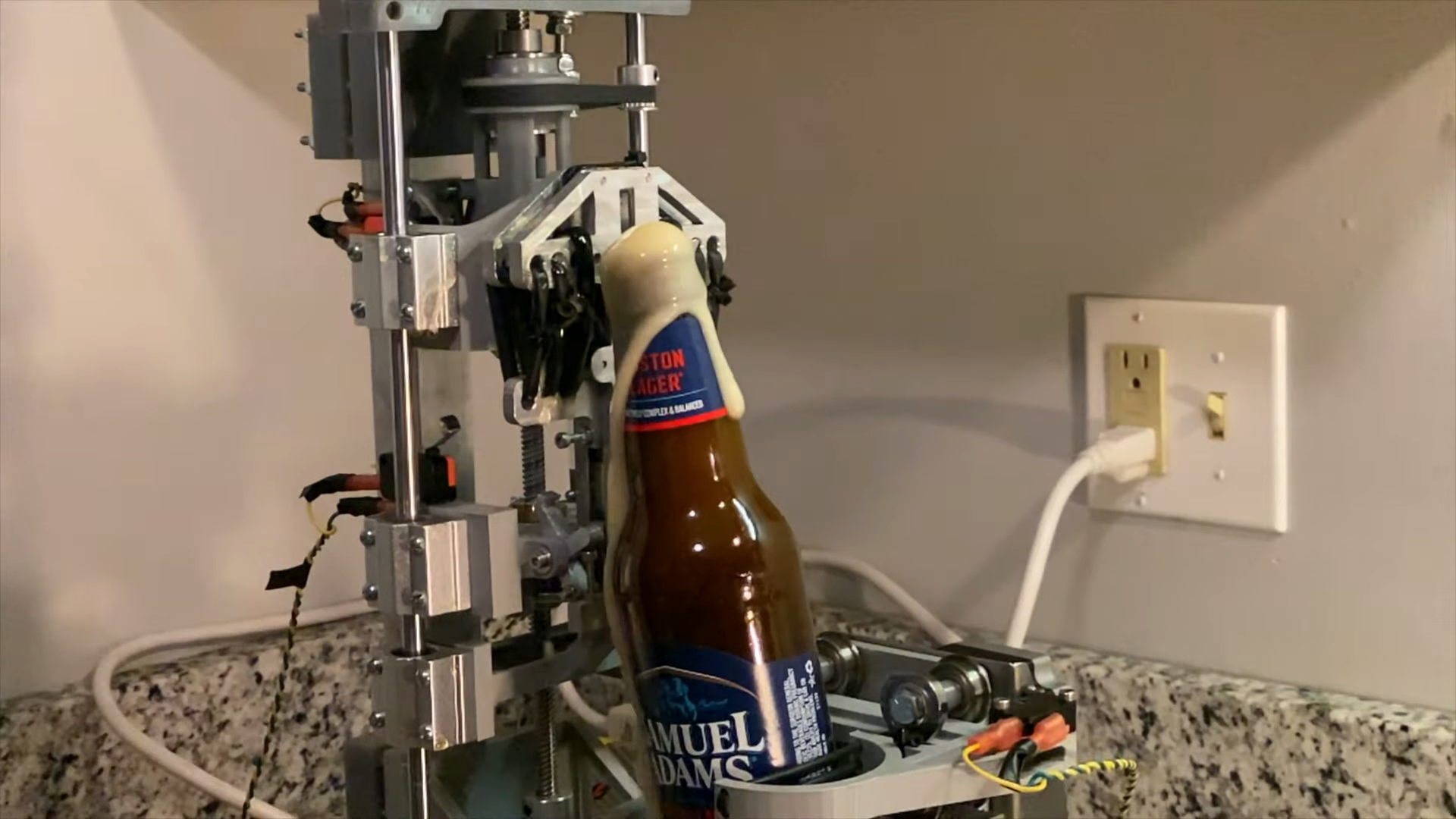
One memorable style uses a bottle cradle that grips the glass and positions it under a moving mechanism. A lead screw drives a carriage, elastic tubing stores energy, and a pawl or hook snaps upward to remove the cap. The result is part robot, part slapstick, and part “someone definitely had access to tools over the weekend.”
The Workshop Hammer Opener
Another approach uses an adjustable frame and a striking mechanism. The bottle is placed in position, a lever or hammer arm is released, and the cap pops off with satisfying speed. This design has the charm of a carnival strength tester, except the prize is not a stuffed bear; it is a bottle that is now open.
The Candy-Dispensing Chain Reaction
Some Rube Goldberg-style openers turn the bottle cap into the first domino in a second system. The cap falls into a track, rolls through a maze, triggers a lever, and releases a treat. This is beautifully unnecessary. It turns “I opened a soda” into “I opened a soda and received candy from a wooden bureaucracy.”
Is Over-Engineering Bad?
In professional design, over-engineering can be a problem. Too many features can make a product expensive, fragile, confusing, or unpleasant to use. A kitchen gadget with 47 settings may sound impressive until you just want toast and the machine asks for your Wi-Fi password.
But playful over-engineering is different. It is not pretending to be the most practical solution. It is exploring the edges of function, humor, and craft. It is closer to kinetic sculpture than consumer appliance. The goal is not to eliminate drudgery in the most efficient way; it is to make the drudgery worth watching.
Safety and Common Sense Matter
Any mechanical bottle opener, especially one using springs, elastic energy, impact, or moving arms, should be designed with safety in mind. Bottles are glass. Caps can fly. Stored energy can release suddenly. A good builder shields moving parts, controls the bottle securely, avoids excessive force, and tests carefully with appropriate supervision and protective gear.
For everyday use, a normal handheld opener is still the smartest choice. The over-engineered version belongs in the world of demonstrations, workshops, videos, and maker projectsnot crowded spaces where people are leaning in too closely with their eyebrows full of optimism.
What This Contraption Says About Us
The over-engineered bottle opener is funny because it solves a problem we barely have. But it is also meaningful because it celebrates curiosity. It reminds us that invention does not always begin with necessity. Sometimes it begins with a question: “What would happen if we made this absurdly complicated?”
That question can lead to real learning. A maker who builds a ridiculous opener may gain practical skills in CAD, machining, woodworking, 3D printing, electronics, testing, and iteration. A viewer who laughs at the machine may also learn how levers work. A simple cap becomes a tiny doorway into engineering thinking.
And that is the magic. The best over-engineered designs do not merely perform a function. They make people pay attention to a function they normally ignore.
Experience Section: What It Feels Like to Use an Over-Engineered Bottle Opener
Using an over-engineered bottle opener is less like using a tool and more like hosting a very small engineering ceremony. With a regular opener, the process is almost invisible: grip, lift, pop, done. With a complicated opener, you become part user, part audience member, and part nervous stage manager. You place the bottle carefully, check the cap alignment, step back slightly, and watch the mechanism prepare itself like it has been training for this moment since birth.
The first thing you notice is anticipation. A simple opener has no suspense. It either works or you try again. But an over-engineered opener makes every second feel important. The carriage slides. A spring stretches. A lever catches. A hook finds the cap. You suddenly care about tolerances. You never cared about tolerances before. Five minutes ago, you thought a tolerance was just what you needed at family gatherings.
Then comes the release. When the cap finally pops, the payoff is wildly out of proportion to the task. It is just a bottle cap, yes, but the sound feels like applause. People laugh. Someone says, “Do it again.” Another person asks how long it took to build. The builder smiles with the tired pride of someone who has spent hours solving a problem that nobody requested and everybody now wants to see repeated.
From a user-experience perspective, that is the secret. The machine creates a shared moment. A normal opener is private and practical. An over-engineered opener is social. It gathers attention. It gives people something to talk about. It turns a countertop into a tiny stage. The beverage is almost secondary; the real refreshment is the small burst of wonder that happens when a silly machine actually works.
There is also a lesson in patience. Over-engineered devices often fail during testing. The cap slips. The bottle tilts. The hook misses by a few millimeters. The spring is too weak, then too strong, then somehow both depending on the mood of the universe. Each failure teaches something. The builder adjusts the angle, reinforces a bracket, changes a contact point, or adds a guide. Slowly, the ridiculous machine becomes less ridiculous and more dependable.
That process mirrors serious design work. Great products often look effortless because the messy experiments are hidden. An over-engineered opener proudly displays the messiness. You can see the decisions. You can feel the trial and error. You understand that “simple” is not always simple when you try to automate it.
In the end, the experience is memorable because it combines function with comedy. The opener does not just remove a cap. It tells a joke in the language of mechanisms. The setup is complexity. The punchline is pop. And the audience, whether in a garage, kitchen, classroom, or online video, gets to enjoy the rare pleasure of watching a machine take itself seriously while doing something deeply silly.
Conclusion
The over-engineered bottle opener is proof that good design is not always about doing less. Sometimes it is about doing far too much with style, curiosity, and a wink. A standard opener remains the practical champion, but the over-engineered version wins a different contest: the contest of delight. It turns a tiny cap into a mechanical adventure and reminds us that creativity often lives in the space between “useful” and “completely unnecessary, but I love it.”
Whether built with springs, levers, lead screws, 3D-printed titanium, wooden tracks, or pure workshop mischief, the over-engineered bottle opener makes an everyday action feel fresh again. It takes the drudgery out of drinking not because opening a bottle was ever that hard, but because watching a beautifully excessive machine do it is simply too fun to ignore.