
If you grew up with Spotify, Apple Music, YouTube Music, or whatever algorithm currently thinks you need three sad songs, two synth-pop throwbacks, and one suspiciously aggressive lo-fi remix before lunch, a record player can feel like a charmingly confusing object. It spins. It crackles. It asks you to stand up every 20 minutes. It does not shuffle. In other words, it is the exact opposite of modern convenience.
And yet, vinyl keeps pulling people in. Not because it is easier. Definitely not because it is cheaper. And not because every record automatically sounds like angels singing in analog. People love record players because they turn listening into an event. You do not just hear music. You choose it, handle it, drop the needle, and commit to an album instead of swiping away after 14 seconds.
This guide breaks down what a record player is, how it works, what all those parts do, why phono preamps keep showing up in every conversation, and how a streaming-first listener can get into vinyl without accidentally building a second job in their living room. Consider this your no-snob, no-gatekeeping, no-“you need a $3,000 cartridge to understand jazz” introduction.
Why Record Players Still Matter in a Streaming World
Streaming wins on speed, convenience, and sheer volume. You can listen to almost anything almost instantly. That is incredible, and nobody needs to pretend otherwise. But convenience changes behavior. When every song is one tap away, music can quietly become wallpaper. It plays while you scroll, text, answer emails, and wonder why your brain has 47 browser tabs open.
A record player pushes in the opposite direction. Vinyl is slower by design. You pick an album. You place it on the platter. You clean the surface if you are being responsible. You lower the stylus. Then you listen in sequence, often the way the artist intended the record to unfold. Side A is not just the first half of the file. It is part of the experience.
That physical ritual is a huge reason younger listeners keep discovering turntables. Records give music weight, literally and emotionally. Album art becomes visible again. Liner notes stop being a hidden menu. Owning music feels different when it takes up shelf space and follows you home in a paper bag from a record shop.
Record Player vs. Turntable: Same Thing or Not Quite?
People use these terms interchangeably, but they are not always identical. A turntable is the component that spins the record and reads the groove. A record player often refers to a more complete package, sometimes with built-in speakers and amplification. Think of “turntable” as the precision tool, and “record player” as the broader category.
That distinction matters when you shop. Some models are all-in-one units designed for simplicity. Others are traditional turntables that need powered speakers, a receiver, or a separate phono stage to work. This is why vinyl beginners often have the same first reaction: “Why is there no sound?” The answer is usually not magic. It is usually the signal chain.
How a Record Player Actually Works
1. The record stores music as a physical groove
A vinyl record is not just a flat black disc with cool cover art. It contains a spiral groove, and that groove holds the information that becomes music. Tiny changes in the groove guide the stylus as the record spins.
2. The stylus rides the groove
The stylus, also called the needle, sits in the groove and moves with its tiny variations. This is where the “analog” part becomes very literal. You are not reading code. You are tracing physical movement.
3. The cartridge turns motion into signal
The stylus is attached to a cartridge, which converts those physical vibrations into a tiny electrical signal. This is the “aha” moment for a lot of new listeners: the cartridge is doing serious work. It is not just an accessory hanging off the tonearm for decoration.
4. The phono preamp boosts and corrects the signal
The signal coming from a turntable is extremely weak. It also needs special equalization to sound normal. That is the job of the phono preamp. Without one, your music will be whisper-quiet, oddly thin, or just plain wrong. If vinyl has one recurring plot twist, it is this: yes, the phono preamp matters.
5. Your amp and speakers do the rest
Once the phono signal is boosted to line level, it can travel through a receiver, integrated amp, powered speakers, or a wireless system with line-in support. From there, it becomes the sound you actually hear. So the journey is simple in theory: groove, stylus, cartridge, preamp, amplifier, speakers. Tiny canyon to living-room concert.
The Main Parts of a Record Player, in Plain English
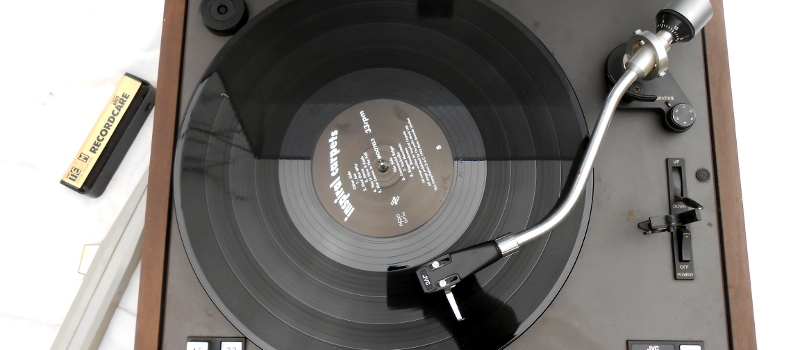
Platter
This is the spinning surface that holds the record. A stable platter helps the record rotate evenly, which keeps pitch from wobbling around like a karaoke night gone sideways.
Tonearm
The tonearm holds the cartridge and stylus, guiding them across the record. A better tonearm helps the stylus track the groove correctly, which affects sound quality and record wear.
Cartridge
This is the small transducer at the end of the tonearm. It contains the stylus and converts groove movement into electrical output. Many beginner decks come with a cartridge pre-installed, which is great news for anyone who enjoys music more than microscopic screws.
Stylus
The stylus is the part that physically touches the groove. It wears out over time and should not be treated as immortal. A worn stylus can hurt sound quality and, eventually, your records.
Phono preamp
This can live inside the turntable, inside your receiver, inside certain powered speakers, or as a separate box. If your turntable has a PHONO/LINE switch, that is your clue that a built-in preamp is involved.
Dust cover
Not glamorous, very useful. Dust is one of vinyl’s least charming personality traits. A dust cover will not solve everything, but it helps keep your setup cleaner and saner.
What Do 33, 45, and 78 Mean?
Those numbers refer to RPM, or revolutions per minute. In normal human language, that means how fast the record spins.
33 1/3 RPM
This is the standard speed for most full-length LPs, the classic 12-inch albums most people picture when they think of vinyl.
45 RPM
Usually used for 7-inch singles, though some 12-inch records also use 45 RPM for sound-quality reasons. You may know this format as the one that makes you look for the tiny adapter and immediately forget where you put it.
78 RPM
This is an older format associated with much earlier records. Not every modern turntable supports it, and not every stylus is appropriate for it, so do not assume “three-speed” is just a bonus button for fun.
Belt Drive vs. Direct Drive
Belt drive
In a belt-drive design, the motor is offset and spins the platter using a belt. These turntables are often favored for home listening because the design can reduce motor vibration reaching the platter. They tend to suit people who care more about relaxed listening than dramatic DJ hand moves.
Direct drive
In a direct-drive design, the platter connects directly to the motor. That gives faster start-up and a design that is popular with DJs, especially for cueing and scratching. For casual home use, it is not automatically “better” or “worse.” It is about purpose.
The right answer depends on how you listen. If your dream involves a cozy shelf and weekend albums, belt drive makes sense. If your dream involves mixing tracks while friends pretend not to be impressed, direct drive starts looking very appealing.
Manual vs. Automatic: How Hands-On Do You Want This to Be?
Manual turntables require you to place the tonearm at the start of the record and lift it when the side is over. They are simple, often favored by enthusiasts, and can offer better value at the same price because more of the budget goes into core performance rather than convenience features.
Automatic or semi-automatic turntables handle some of that motion for you. Press a button, and the arm moves into place. For beginners, that ease can be a genuine advantage. It lowers the stress level, reduces clumsy mistakes, and makes the whole hobby feel more inviting.
Translation: automatic is not cheating. It is just nice.
What Setup Do You Actually Need?
Option 1: All-in-one record player
This is the simplest path. You get a single box with built-in speakers and minimal setup. It is convenient, compact, and beginner-friendly. The tradeoff is that you usually give up upgrade potential and, often, better sound.
Option 2: Turntable + powered speakers
This is the sweet spot for many first-time vinyl listeners. If the turntable has a built-in phono preamp, or the speakers accept phono input, setup is straightforward. Sound quality is typically much better than all-in-one units, and the system still stays manageable.
Option 3: Turntable + receiver/integrated amp + passive speakers
This is the classic hi-fi route. It gives you flexibility, easier upgrades, and the best chance of building a system that grows with you. It also gives you more boxes, more cables, and more opportunities to briefly question your life choices during setup.
Option 4: Turntable + wireless ecosystem
Yes, vinyl can live in a modern wireless home. Some systems let you run a turntable or preamp into line-in and then distribute the sound through connected speakers. It is a very streaming-generation move: analog ritual, digital convenience, zero shame.
The Famous PHONO vs. LINE Question
If your turntable has a PHONO/LINE switch, do not ignore it and hope for the best. PHONO means the signal is leaving the turntable without internal preamplification, so it needs a phono input or external phono preamp downstream. LINE means the built-in preamp is active, and the output can feed a regular line-level input on speakers, amps, or wireless adapters.
A common mistake is sending a line-level output into another phono stage, or sending a raw phono signal into a standard line input. The result is usually either distorted chaos or near silence. So if your turntable sounds weird, the switch is one of the first things to check. The second thing is whether a cable is plugged into the right place. The third thing is admitting the first two were probably the problem.
How to Get Better Sound Without Becoming Insufferable
Place the turntable on a stable surface
Vibration is not your friend. A wobbly shelf, foot traffic, or a speaker vibrating right next to the deck can all hurt playback. Keep things level and solid.
Keep records clean
Dust and static add noise and wear. A simple record brush goes a long way, and a deeper cleaning routine helps older or dirtier records sound better. Vinyl is wonderfully physical, but it also means your fingerprints and floating dust bunnies are now part of the listening environment.
Do not ignore stylus wear
The stylus is not forever. Replacing it at the right time protects your records and keeps sound crisp. If playback starts sounding dull, distorted, or unusually harsh, the stylus deserves a look.
Learn the basics of tracking force and anti-skate
You do not need to become an engineer overnight, but understanding these settings can improve tracking and reduce unnecessary wear. Think of them as the “alignment and tire pressure” of vinyl playback: not glamorous, very real.
What Streaming Natives Usually Love About Vinyl
Intentional listening. A record asks for attention. That is refreshing in a distracted age.
Album flow. Vinyl makes sequencing matter. You stop skipping every track that does not explode in the first 11 seconds.
Ownership. A record collection feels personal in a way playlists sometimes do not. It becomes part of your space and your identity.
Artwork and notes. A 12-inch jacket is big enough to admire, display, and actually read without zooming in like you are studying satellite images.
A different relationship with music. You do not need vinyl to prove you are serious about music. But for many people, it changes the pace of listening in a good way.
What Vinyl Will Not Magically Do
Let us keep this honest. A record player will not automatically sound “better” than every digital source. Good streaming through a solid system can sound excellent. A bad pressing on a cheap setup can sound bad. Vinyl also costs money, takes storage space, and asks for maintenance. It can be wonderfully rewarding, but it is not a shortcut. It is a format with strengths, tradeoffs, and a surprisingly strong opinion about dust.
Best Advice for a First-Time Buyer
Start with the setup, not just the turntable
Do not spend your whole budget on the deck and forget speakers, accessories, or the preamp question. A balanced system beats a flashy centerpiece attached to disappointment.
Buy the records you already love
Your first purchases should be albums you know you will play again and again. Vinyl is more fun when your collection reflects your taste, not internet pressure.
Leave room to grow
A turntable with a decent cartridge, reliable speed, and upgrade options can carry you much farther than a trendy impulse buy.
Do not let snobs ruin it
If your entry point is a simple automatic deck with powered speakers, congratulations: you are listening to music. That is the point. Every expert was once a beginner staring at an RCA cable like it was ancient technology recovered from a cave.
Final Take: Why Record Players Make Sense for the Streaming Generation
Record players do not compete with streaming by being faster, smarter, or more convenient. They compete by being different. They make music tangible. They slow the process down. They reward focus. They turn an album into a small ritual instead of a background tab.
For a generation raised on instant access, that difference can feel oddly luxurious. Not luxury in the fancy, velvet-rope sense. Luxury in the “I am doing one thing at a time, and it actually feels good” sense. And in 2026, that may be the rarest feature of all.
The Experience of Living With a Record Player
The best way to understand a record player is not through specifications, although those matter. It is through the lived experience of using one. The first time many streaming-era listeners play a record, there is a tiny moment of panic. You have the album. You have the turntable. You lower the stylus. Then there is that brief second where you wonder whether you just did something horribly wrong. But when the music arrives, it feels earned. Not difficult-earned, like assembling furniture with missing screws. More like intentional-earned. You participated in the start of the music.
That changes how you listen. With streaming, songs often blur together because convenience invites constant movement. You can skip, search, build a queue, switch artists, and jump decades in less than a minute. Vinyl does the opposite. It gently traps you in a good way. You put on one album and let it exist. You hear track two because you did not sprint past track one. You notice transitions, pacing, and mood. Suddenly, albums stop feeling like containers for singles and start feeling like complete creative statements again.
There is also something weirdly satisfying about the physical routine. Sliding a record out of its sleeve. Checking for dust. Setting it on the platter. Watching it spin. Flipping it at the end of a side. None of these actions are efficient, which is exactly why people enjoy them. They break the passive habit of music consumption. You are no longer just receiving sound from the cloud. You are creating a listening session in real space, with your hands, your room, and your attention.
Then there is the social side. A record player changes the mood of a room in a way a phone speaker never will. When friends visit, pulling a record from the shelf becomes part of the conversation. The album cover sparks memories, opinions, debates, and occasionally extremely strong feelings about which side is better. People look at the art. They ask what version it is. They read the credits. Music becomes visible again, and that visibility invites interaction.
Even the imperfections become part of the charm. The faint surface noise before a song starts. The mechanical movement of the arm. The fact that you have to get up and flip the record instead of staying fused to the couch like a modern statue. None of that is objectively more convenient than streaming. That is the point. A record player reminds you that convenience is not the only thing that creates enjoyment. Sometimes friction makes an experience more memorable.
For many people, vinyl also creates a stronger emotional map of their music. A playlist can hold a thousand tracks, but an album on a shelf tends to anchor itself to a time, place, or season of life. You remember where you bought it. Who recommended it. Whether it was your first great thrift-store find or the record you saved up for because the pressing sold out everywhere. Collections become stories. Shelves become memory banks.
That is why record players still resonate with the streaming generation. They offer not just sound, but presence. They ask a little more from you, and in return they often give a little more back. Not because the format is magical, but because it makes listening feel deliberate again. And in a world built to keep everything instant, disposable, and endlessly skippable, deliberate can feel pretty amazing.