
Some art asks you to stand back, fold your arms, and whisper intelligent things like “interesting use of negative space.” Then there are the hypnotizing GIFs of everyday objects by Polish artist Feliks Tomasz Konczakowski, which ask a much simpler question: “Would you like to fall into a cauliflower and question reality for the next eight minutes?”
Konczakowski has built a fascinating corner of internet art by transforming ordinary itemscauliflower, ears, flowers, fruit, stairs, pizza, popcorn, and other familiar shapesinto endless digital loops. These are not just funny animated images. They are tiny visual wormholes. One moment you are looking at a vegetable. The next moment, the vegetable has become a spinning cathedral, a psychedelic tunnel, or a strangely delicious portal to another dimension.
That is the charm of his work. He takes objects we usually ignore and makes them impossible to ignore. His GIFs are playful, strange, slightly disorienting, and deeply satisfying. They sit somewhere between motion graphics, optical illusion, digital collage, and the kind of internet weirdness that makes you say, “I should probably look away,” while absolutely not looking away.
Who Is Feliks Tomasz Konczakowski?
Feliks Tomasz Konczakowski is a Polish visual artist associated with a distinct style of looping GIF art. Born in Krakow, Poland, he became known online for creating surreal animations from mundane objects. His visual identity is delightfully odd: on his Tumblr, he describes himself as an “unpolished visual artist who probably comes from Mars,” which is honestly a strong personal brand. Most LinkedIn bios could learn something from that.
His GIFs gained attention on art, design, and culture websites because they are instantly understandable yet hard to explain. The ingredients are simple: everyday imagery, digital editing, repetition, rotation, zooming, and a perfect loop. But the result feels bigger than the technique. A piece of broccoli stops being a side dish. A staircase becomes a spiral trap. An ear turns into a fleshy galaxy. A rose becomes a tunnel of petals that looks romantic until it starts feeling like it might swallow your mouse cursor.
Konczakowski’s work has often been linked to Adobe After Effects, a professional tool used for motion graphics and visual effects. That matters because his GIFs are not random internet edits. They are carefully constructed motion experiments. The magic lies in how the animation hides its own beginning and end, making the viewer feel as though the image has always been moving and will continue forever.
Why These Everyday Object GIFs Feel So Hypnotic
The word “hypnotic” gets thrown around online almost as casually as “life-changing” gets used for sandwich recipes. But in this case, it fits. Konczakowski’s GIFs are hypnotic because they combine three powerful visual ingredients: repetition, texture, and expectation.
1. The Loop Never Lets Your Brain Finish
A perfect loop is sneaky. It gives the brain a pattern, then refuses to provide a conclusion. We watch because we expect the motion to arrive somewhere. But it never arrives. It keeps folding back into itself, like a tiny visual prank. The viewer becomes trapped in a soft cycle of “just one more second.” Spoiler: it is never one more second.
This is why a looping cauliflower can hold attention longer than it logically should. The mind wants closure. The GIF says, “Absolutely not.”
2. Ordinary Objects Become Strange Through Scale
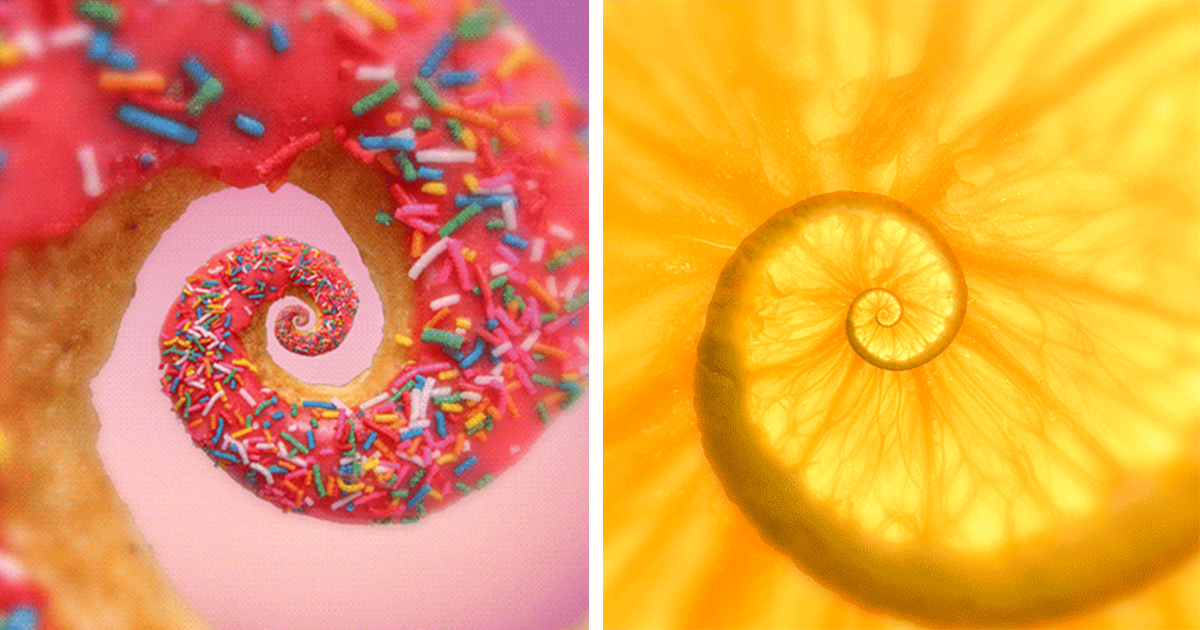
Konczakowski’s art often feels like a zoom into the hidden architecture of daily life. A cauliflower already has a naturally fractal look, with repeating bumps and branching textures. When animated into a tunnel, that structure suddenly looks cosmic. The same thing happens with fruit, baked goods, flowers, and even ears. Scale changes everything. Look at an orange casually and it is breakfast. Look at it as a spinning universe and suddenly breakfast has lore.
3. Texture Gives the Motion Something to Grab
Many of his best GIFs use objects with strong visual surfaces: ridges, spirals, folds, seeds, crumbs, petals, or wrinkles. Texture makes the loop more convincing because the eye has details to follow. The motion feels physical, even though the scene is impossible. The surface becomes the road, and the viewer’s attention becomes the tiny car driving in circles without a license.
The Art of Making the Mundane Feel Magical
The brilliance of these hypnotizing GIFs is that they do not need rare subjects. There are no dragons, exploding planets, or cinematic battles. The stars of the show are vegetables, snacks, body parts, flowers, and household-like forms. That choice is important. By starting with the familiar, Konczakowski creates surprise. The viewer recognizes the object first, then watches recognition collapse into wonder.
This is a classic artistic move with a digital twist: take something ordinary, isolate it, alter it, and return it to the viewer as something new. Marcel Duchamp did it with readymades. Pop artists did it with soup cans and advertising. Contemporary digital artists do it with pixels, loops, glitches, and motion software. Konczakowski’s version is less museum silence and more “Why am I emotionally attached to this animated donut?”
His GIFs also invite us to notice forms we usually overlook. Romanesco broccoli, cauliflower, roses, oranges, popcorn, and pastries already contain beautiful structures. Nature is basically a designer who never turns off the pattern tool. Konczakowski exaggerates those structures until they feel alive. A vegetable stops being a vegetable and becomes architecture. A slice of food becomes a tunnel. A petal becomes a wave.
GIF Art, Internet Culture, and the Beauty of the Endless Loop
The Graphics Interchange Format, better known as GIF, has been around since the late 1980s. It began as a practical file format for compressed images, but the internet turned it into a language. GIFs became reaction shots, memes, jokes, micro-stories, mood boards, and eventually a serious medium for artists. They are short, silent, repeatable, and easy to share. In other words, they are perfectly engineered for human distraction.
That is why Konczakowski’s work feels so native to the web. His pieces do not need long captions or gallery labels. They work instantly. You see the loop, understand the object, feel the pull, and then lose track of time. The GIF format is humble, but it is powerful because it makes motion feel casual. A video asks you to press play. A GIF simply begins. It is already moving before you have decided whether you consent to being mesmerized by a broccoli vortex.
Digital art platforms and GIF libraries have helped artists reach global audiences without needing traditional gatekeepers. A strange loop can travel across Tumblr, GIPHY, Pinterest, design blogs, Reddit, and social feeds in minutes. That kind of circulation suits Konczakowski’s style. His work is visual, compact, and instantly shareable. It does not require translation. The international language of “Whoa, what is happening to this cauliflower?” is widely understood.
Specific Examples That Show His Style
Cauliflower: The Vegetable That Became a Portal
The cauliflower GIF is one of the most memorable examples because the vegetable already looks like a miniature landscape. Its branching clusters create a natural sense of depth. When animated, it becomes a soft, pale tunnel that seems to expand forever. It is oddly calming and slightly unsettling, like meditation guided by a salad ingredient.
Ears: Familiar, Funny, and Mildly Uncomfortable
Some of Konczakowski’s object choices lean into the uncanny. Ears are familiar, but when repeated and looped, they become strange fast. The humor comes from the tension between recognition and discomfort. You know what you are seeing, but your brain keeps asking why it is seeing so much of it.
Fruit, Flowers, and Food: The Sweet Spot of Texture
Fruit and flowers work beautifully in GIF art because they contain color, rhythm, and organic detail. A rose has petals that naturally spiral. Citrus has juicy radial geometry. Popcorn has chaotic little surfaces. Donuts and pizza bring a playful pop-culture flavor. These objects are visually rich before editing; animation simply pushes them into dream territory.
Stairs and Architecture: Everyday Space Turned Into Motion
When staircases or built environments appear in this kind of loop, they create a different kind of hypnosis. Instead of organic texture, the viewer follows lines, angles, and perspective. The result can feel like an impossible hallway, a visual maze, or a screensaver designed by someone who drinks espresso with a compass.
What Creators Can Learn From These Hypnotic GIFs
Konczakowski’s GIFs are fun to watch, but they also offer useful lessons for designers, animators, illustrators, and content creators.
Start With a Strong Shape
The best loops often begin with an object that already has visual rhythm. Spirals, circles, folds, repeating lines, and layered surfaces are excellent raw material. Before adding motion, the still image should already have personality.
Keep the Concept Simple
These GIFs work because the idea is clear. The viewer does not need instructions. There is an object, and the object has become an endless visual tunnel. Simple concepts travel faster online because people can understand them in a blink.
Make the Loop Invisible
A rough loop breaks the spell. A smooth loop keeps the viewer inside the illusion. The best GIFs feel like they have no first frame and no final frame. That seamlessness is what turns animation into hypnosis.
Use Humor Without Explaining the Joke
There is something inherently funny about making a cauliflower look profound. Konczakowski’s work does not force a punchline. The humor is built into the contrast between the seriousness of the visual effect and the silliness of the subject.
Why We Love Strange Digital Art Like This
Part of the appeal is that these GIFs make the internet feel surprising again. Online life can become repetitive in the worst way: same posts, same ads, same outrage, same “you won’t believe what happened next” headlines. Konczakowski’s loops are repetitive in the best way. They create repetition that reveals detail instead of draining attention.
They also remind us that digital art does not need to be huge to be memorable. A GIF can be tiny and still create a strong emotional response. It can be funny, elegant, weird, and technically impressive in the same breath. It can make a viewer stop scrolling, which is basically the Olympic gold medal of internet creativity.
Most importantly, these hypnotizing GIFs encourage curiosity. They ask viewers to look twice at ordinary things. What patterns are hiding in food? What shapes are built into flowers? What happens when a familiar object is repeated until it becomes alien? These are playful questions, but they lead to a serious artistic point: wonder often begins when attention slows down.
Experiences Related to Hypnotizing GIFs Of Everyday Objects By Polish Artist
Anyone who has spent time staring at Konczakowski-style GIFs knows the experience is strangely personal. You open one for a quick look, expecting a tiny visual snack, and suddenly you are deep in a loop, watching a vegetable breathe like it has secrets. The first reaction is usually amusement. The second is curiosity. The third is a small internal negotiation: “Should I stop watching this?” The fourth is continuing to watch it anyway.
That experience says a lot about how we interact with digital art. Unlike a painting in a museum, a GIF often finds us in a casual setting. We might be checking our phone during lunch, avoiding an email, or taking a five-minute break that has somehow become a twenty-minute break. Then a looping image appears, and it changes the mood of the moment. A mundane object becomes a little event. The screen stops feeling like a tool and starts feeling like a peephole into a stranger, funnier universe.
There is also a relaxing quality to these loops. Not relaxing in the spa-commercial sense, where someone places stones on a towel and whispers about lavender. More like the relaxation of watching rain slide down a window or staring at a washing machine spin. Repetition can be soothing when it is predictable but still detailed. Konczakowski’s GIFs offer that balance. The motion repeats, but the texture keeps revealing tiny variations. Your eyes wander through the pattern, and your thoughts slow down just enough to enjoy the weirdness.
At the same time, some of the GIFs can feel slightly uncomfortable, and that is part of the fun. Organic objects, especially ears or close-up textures, can cross into uncanny territory. They are not frightening, exactly, but they remind us that familiar things become strange when isolated and repeated. A single ear is normal. A tunnel of ears is a situation. The viewer laughs partly because the brain is trying to file the image under a category and keeps dropping the folder.
These works also change how we notice real objects afterward. A trip through the produce section can become unexpectedly artistic. Cauliflower looks more architectural. Oranges look more radial. Popcorn looks like tiny edible sculptures. Roses look like natural spirals waiting for animation. Even a staircase might seem like it has secret motion hiding inside it. That is one of the best effects art can have: it sends you back into daily life with upgraded eyes.
For creators, the experience is encouraging. Konczakowski’s work suggests that strong ideas do not always require expensive locations, giant teams, or dramatic subject matter. Sometimes the subject is already on your plate. The creative act is not finding the rarest object; it is seeing the ordinary object from a new angle and giving it a rhythm. That is why these hypnotizing GIFs remain memorable. They prove that everyday life is not boring. It is just waiting for someone strange enough, patient enough, and skilled enough to turn it into a loop.
Conclusion
Hypnotizing GIFs of everyday objects by Polish artist Feliks Tomasz Konczakowski show how digital art can transform the most ordinary materials into something unforgettable. His looping animations turn cauliflower, fruit, flowers, ears, stairs, and snacks into surreal portals that are funny, beautiful, and oddly absorbing. Using motion, repetition, texture, and seamless looping, he reveals the hidden drama inside everyday things.
What makes the work so successful is not just technical skill. It is the artist’s ability to notice potential where most people see background noise. A vegetable becomes a galaxy. A rose becomes a tunnel. A snack becomes a tiny universe. In a web culture overflowing with fast content, these GIFs invite us to pause, stare, laugh, and maybe reconsider the objects sitting quietly around us.
Konczakowski’s art is proof that the internet can still surprise us. Sometimes all it takes is a perfect loop, a familiar object, and the courage to ask: what if this cauliflower were a portal?