
Note: This original article synthesizes publicly available film history, box office records, critic reception, interviews, and industry reporting about Ben Affleck’s Batman, rewritten for web publication without source links.
Yes, We Are Really Doing This
Defending Ben Affleck’s Batman used to feel like walking into a comic book shop and announcing that your favorite Robin is “the one from the toy commercial.” You could practically hear the record scratch. When Affleck was cast as Bruce Wayne in 2013, the internet reacted with the calm maturity of a raccoon trapped in a pantry. “Batfleck” became a punchline before he had even put on the cowl, and for many fans, the debate was over before the first trailer dropped.
But time has a funny way of polishing unpopular opinions into reasonable ones. A decade later, Ben Affleck’s Batman deserves a more serious defense. Not because every creative choice around him worked. Not because Batman v Superman: Dawn of Justice is secretly a flawless masterpiece wrapped in a rubber cape. And definitely not because the “Martha” scene suddenly became Shakespeare after enough online arguing. Affleck’s Batman deserves defending because the performance itself is stronger, stranger, and more emotionally specific than its reputation suggests.
He gave us a Bruce Wayne who looked like he had been fighting crime for twenty years and sleeping for about seven minutes. He gave us a Batman built like a haunted refrigerator. He gave us a version of the character who was not beginning his mission, not mastering it, but collapsing under the weight of it. That is not everyone’s favorite Batman, and that is fair. But it is a real interpretation, rooted in recognizable comic book DNA, especially the older, brutal, exhausted Batman of Frank Miller’s The Dark Knight Returns.
The Casting Backlash Was Loud, But Not New
Batman casting controversies are practically a Gotham tradition. Michael Keaton was once mocked as “Mr. Mom” in a cape before becoming one of the most beloved versions of the character. Heath Ledger’s Joker casting was greeted with skepticism before becoming legendary. Robert Pattinson was dismissed by some fans as “the vampire guy” before proving he could brood in eyeliner with the best of them.
Affleck’s backlash, however, arrived in the age of instant outrage. He was not just criticized; he was meme-ified. Fans remembered Daredevil, worried about celebrity baggage, and compared him unfavorably to Christian Bale, who had just finished Christopher Nolan’s highly respected Dark Knight trilogy. Following Bale was already a terrible job. Following Bale while the internet had discovered petition culture was basically stepping into a room full of Batarangs.
Yet the criticism often focused more on the idea of Affleck than on what he eventually did. The actual performance is calm, controlled, and physically convincing. He does not play Bruce Wayne as a charming playboy with a secret. He plays him as a public mask barely covering a private crater. His smile at parties looks rented. His eyes scan rooms like security cameras. His body language suggests a man who has survived so much violence that even luxury feels like another form of armor.
Affleck Looked Like Batman Walked Off the Page
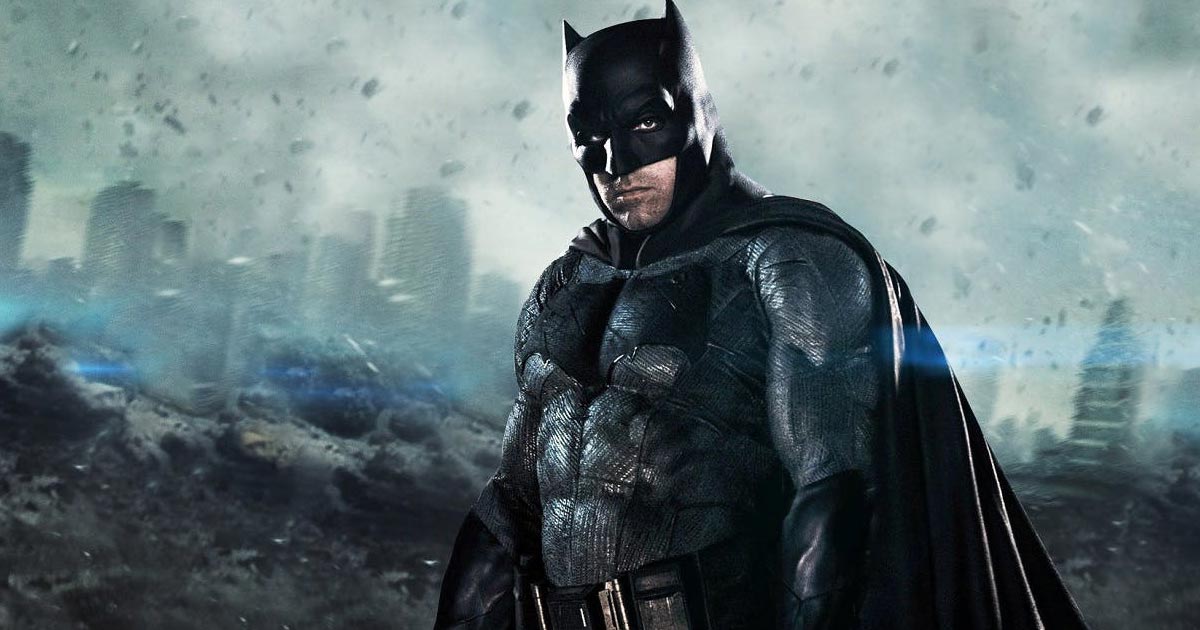
Let’s be honest: visually, Affleck’s Batman is one of the most comic-accurate live-action Batmen ever put on screen. The broad frame, square jaw, gray temples, thick suit, and heavy silhouette all communicate a seasoned Dark Knight. This is not a ninja-in-training Batman or a detective still learning the city’s rhythm. This is a Batman who has already broken bones, lost allies, built contingency plans, and probably labeled the spice cabinet in the Batcave by threat level.
The costume design matters. Earlier live-action Batmen often looked sleek, armored, or theatrical. Affleck’s Batman looks mythic and worn. His standard suit in Batman v Superman has a fabric-like texture that echoes comic art more than tactical military gear. It gives him a hulking, almost statue-like presence. When he stands in the rain or emerges from shadows, the image sells the idea of Batman as urban legend. You understand why criminals are terrified before he throws a single punch.
Even his Bruce Wayne styling works. The older appearance is not cosmetic decoration; it tells the story before the script explains it. The gray hair says time has passed. The tired eyes say time has not healed much. The expensive suits say wealth remains, while the posture says peace does not. Affleck’s Bruce is not a billionaire pretending to be fine. He is a man so committed to pretending that the performance itself has become another prison.
The Warehouse Scene Is Still a Serious Argument
No defense of Ben Affleck’s Batman can avoid the warehouse fight in Batman v Superman. Even viewers who dislike the film often admit this sequence delivers one of the most dynamic Batman action scenes in live-action cinema. It is fast, heavy, tactical, and filmed with enough clarity that you can actually understand the geography of the fight. Revolutionary concept: seeing the action.
In that scene, Batman moves like a predator with a plan. He uses gadgets, misdirection, intimidation, hand-to-hand combat, and the environment. He is not simply punching goons in a hallway; he is dismantling a room. The choreography communicates experience. Every movement feels like something learned from years of fighting people who do not politely attack one at a time.
Yes, the brutality is controversial. This Batman is violent in a way that pushes against the traditional “no killing” rule many fans consider essential. That criticism is valid. Batman’s moral code is not a decorative bumper sticker; it is central to many versions of the character. But the movie is not presenting Affleck’s Batman as morally healthy. It is presenting him as a fallen, damaged version of Batman who has drifted from his own principles. The discomfort is part of the point, even if the execution sometimes muddies that point with explosions and Zack Snyder’s favorite color palette: thunderstorm gray.
He Is Not the Ideal Batman, and That Is the Point
The strongest defense of Affleck’s Batman is also the simplest: he is not supposed to be Batman at his best. He is Batman at his worst. He is a warning label in a cape. He has become cynical, cruel, paranoid, and dangerously close to the criminals he once swore to fight. That is not a betrayal of Batman as a concept; it is a dramatic question. What happens when the symbol of justice becomes infected by fear?
Batman v Superman opens with Bruce Wayne witnessing the destruction of Metropolis during Superman’s battle with General Zod. This is a smart entry point. Instead of asking viewers to accept that Batman distrusts Superman because the plot demands it, the film shows him standing on the ground while gods tear apart the sky. From Bruce’s perspective, Superman is not a smiling farm boy from Kansas. He is an unchecked force capable of causing mass devastation, even unintentionally.
Affleck sells that fear. His Bruce is not jealous of Superman’s power; he is terrified of what power without accountability could mean. The tragedy is that his fear curdles into obsession. He stops seeing Clark Kent as a person. He sees only a threat. That is how good men become dangerous: not because they wake up and choose evil, but because they convince themselves cruelty is necessary.
The Performance Is More Subtle Than the Movie Around It
One reason Affleck’s Batman is underrated is that he is trapped inside a very loud movie. Batman v Superman is full of operatic imagery, symbolic dialogue, dream sequences, apocalyptic warnings, and enough slow motion to make a falling coffee cup feel biblical. In that environment, it is easy to miss the quieter work Affleck is doing.
Watch his face during the Metropolis sequence. He is not playing generic action-movie concern. He is registering helplessness, rage, and calculation almost simultaneously. Watch him at the party with Clark Kent. His Bruce Wayne is socially smooth, but the smoothness has edges. He is listening, measuring, and testing. Watch him in the Batcave with Alfred. Jeremy Irons’ Alfred needles him with dry wit, but Bruce barely lets the jokes land. He is too far gone.
That restraint matters. Affleck does not overplay Batman as madness. He underplays him as fatigue. His voice, especially as Bruce, often has a flat, depleted quality. This is not because the actor is asleep at the wheel. It is because the character is emotionally numb. He has seen too much, lost too much, and built an identity around never admitting how broken he is. Superhero performances do not always get credit for that kind of interior acting, especially when the actor is wearing a cowl that looks like it was designed by a very angry sculptor.
Affleck’s Batman Works Best as a Deconstruction
Comic book fans often talk about “comic accuracy” as if there is only one correct Batman. But Batman has been many things: detective, ninja, gothic avenger, camp icon, father figure, urban myth, tech genius, traumatized orphan, and emotionally unavailable gym enthusiast. Affleck’s version belongs to the deconstruction branch of Batman history. He asks what this mission would do to a person over decades.
That is why the Frank Miller influence matters. The Dark Knight Returns imagined an older Bruce Wayne pulled back into violence by a city that still needed him and by his own inability to let the mission die. Snyder’s films borrow that weathered energy: the bulky suit, the armored confrontation with Superman, the sense of a hero who has become more frightening with age. Affleck fits that concept naturally. He has the physical scale, but also the melancholy. He looks like someone who has won many fights and lost the larger war inside himself.
Compared with Christian Bale’s Batman, Affleck’s is less psychologically balanced. Compared with Robert Pattinson’s Batman, he is less investigative and more militarized. Compared with Michael Keaton’s Batman, he is less eerie and more bruised. That difference is not a flaw by itself. It gives the live-action Batman lineup variety. Affleck is the midlife-crisis Batman, except instead of buying a sports car, he buys a Kryptonite spear and starts glaring at aliens.
The Bruce Wayne Side Deserves More Credit
Many Batman debates focus on the suit, the voice, and the fight scenes, but Bruce Wayne is half the role. Affleck’s Bruce Wayne is not the careless playboy mask popularized in some earlier versions. His public persona is more restrained and aristocratic. He does not seem like a party animal; he seems like a man too famous, too rich, and too emotionally remote for anyone to challenge him.
This works particularly well opposite Henry Cavill’s Clark Kent. Their first major conversation is not just a superhero Easter egg. It is a clash of worldviews. Clark sees Batman as a vigilante terrorizing the poor and powerless. Bruce sees Superman as a godlike figure who could become a tyrant. Both men are partly right and dangerously incomplete. Affleck gives Bruce a chilly confidence in that scene, but you can feel the anger underneath.
His relationship with Alfred is also effective. Jeremy Irons plays Alfred as a sardonic partner rather than a gentle butler, and Affleck’s Bruce responds like a man who needs Alfred but hates needing anyone. Their exchanges suggest a long history without over-explaining it. Alfred’s concern lands because Bruce seems genuinely unreachable. He is not simply ignoring advice; he is past the point where advice can easily reach him.
Justice League Complicated the Legacy
Affleck’s Batman became harder to evaluate because the surrounding franchise shifted under his feet. Batman v Superman presented him as broken and in need of redemption. Justice League was supposed to continue that arc by showing Bruce trying to build something better after Superman’s sacrifice. But the 2017 theatrical version, shaped by major production changes, tonal rewrites, and reshoots, left the character feeling inconsistent.
In one scene, he is the haunted strategist. In another, he is cracking jokes like a tired dad trying to survive a family road trip. Some humor works, but the transition is bumpy. The lighter tone does not always feel like growth; sometimes it feels like a different movie has borrowed the same costume. Affleck still has moments of charm, especially when Bruce admits his limitations among gods and metahumans, but the film does not give him enough emotional continuity.
Zack Snyder’s Justice League restores more of the intended mythic tone and gives Batman a clearer role as the organizer of hope. He is still not the most developed character in that version, but his mission makes more sense. He is trying to honor Superman by assembling the League. In other words, the man who nearly killed hope is now trying to rebuild it. That is a strong arc, even if it remains unfinished.
The Lost Solo Batman Movie Still Haunts the Conversation
Part of Affleck’s appeal comes from unrealized potential. He was once attached to direct and star in a standalone Batman film, reportedly involving Deathstroke. Fans imagined a gritty, tactical, detective-driven story featuring an older Batman facing the consequences of his past. Then Affleck stepped away from directing, the project changed direction, and eventually Matt Reeves made The Batman with Robert Pattinson in a separate continuity.
That lost movie has become a kind of fandom ghost. We never saw Affleck’s Batman carry a full solo story. We never saw his Gotham explored in depth. We never saw his rogues’ gallery, his detective process, or the full history behind Robin’s death hinted at in Batman v Superman. He exists as a powerful sketch rather than a completed portrait.
That incompleteness is frustrating, but it also explains why the defense of Affleck’s Batman remains passionate. His version had ingredients that could have supported a great solo film: a veteran hero, a morally complicated past, a weary Alfred, a brutal city, and a Bruce Wayne who needed redemption more than victory. The cake was never fully baked, but the batter had flavor. Possibly too much salt, but flavor.
The Common Criticisms Are Fair, But Not Fatal
“He kills people.”
This is the biggest criticism, and it should not be brushed aside. Batman’s refusal to kill is a defining trait in many stories. Affleck’s Batman crosses lines that make some fans reject the interpretation entirely. The defense is not that Batman killing is “cool.” The defense is that this Batman is portrayed as morally compromised. The story is about a hero who has lost his way. Whether the movie communicates that clearly enough is debatable, but Affleck’s performance supports that reading.
“He is too grim.”
He is extremely grim. This Batman looks like he considers smiling a security breach. But grimness fits the version being attempted: an older, traumatized Bruce Wayne who has become consumed by fear. The problem is less Affleck’s grim performance and more the franchise’s lack of balance around it. A dark Batman can work beautifully when the story gives him contrast, humor, mystery, or emotional release.
“He is not the world’s greatest detective.”
This is partly true. The films emphasize warrior Batman more than detective Batman. That is a limitation of the writing, not necessarily Affleck’s casting. In fact, his older, watchful Bruce could have been excellent in a mystery-driven solo film. His eyes are always working. He looks like a man who notices exits, lies, weapons, and whether someone moved his coffee mug.
Why His Batman Has Aged Better Than Expected
Affleck’s Batman has aged better because superhero movies themselves have changed. The genre has become crowded with origin stories, multiverse jokes, cameo parades, and digital chaos. Against that backdrop, Affleck’s Batman stands out as a bold, specific swing. It may be messy, but it is not bland. It has texture. It has a point of view. It has a Batman who feels like he has lived a whole tragic life before the movie begins.
There is also something fascinating about a superhero performance built around regret. Many comic book films focus on becoming a hero. Affleck’s Batman focuses on what happens after heroism has curdled into obsession. He is not aspirational in the usual way. He is cautionary. He reminds us that symbols need renewal, that trauma does not automatically create wisdom, and that even Batman can become the thing he fears if he stops seeing people as people.
That is why his final moments in The Flash carry unexpected emotional weight for fans who followed the whole messy journey. Whatever one thinks of that film, Affleck’s return as Batman functions like a farewell to an era: imperfect, overdebated, but memorable. He never got the clean trilogy arc. He never got the solo masterpiece. But he left an imprint.
A Personal Viewing Experience: Coming Around on Batfleck
My first reaction to Ben Affleck’s Batman was probably similar to many people’s: suspicion with a side order of internet seasoning. The casting sounded odd, mostly because the public conversation had already turned Affleck into a symbol of Hollywood second chances, comeback narratives, and old superhero-movie trauma. It was hard not to think of Daredevil, even though holding one early-2000s comic book movie against an actor forever is a little like refusing to trust someone with dinner because they once burned toast in 2003.
Then the first images arrived, and the mood shifted. The suit looked serious. The silhouette looked right. The older Bruce Wayne concept made sense. By the time the trailers showed Affleck running into the destruction of Metropolis, I started to understand the angle. This was not a replacement for Christian Bale. It was not trying to be. This was a Batman who had already survived the classic Batman story and come out worse.
Watching Batman v Superman for the first time was a strange experience because the film itself kept pulling me in two directions. Some scenes felt overloaded, as if five different movies were fighting for the steering wheel. But Affleck kept grounding the chaos. Even when the story became too symbolic for its own good, his Bruce Wayne felt concrete. He gave the movie a human center of damage and fear. I did not agree with every choice the character made, but I believed the man making them.
The warehouse fight was the moment the theater seemed to collectively understand what this Batman could do. It was not just “cool action.” It was a release of everything the character had been carrying: rage, skill, obsession, and terrifying competence. You could feel the audience react to the physicality. For years, fans had argued about whether live-action Batman had ever truly moved like comic book Batman. In that scene, Affleck’s version did. He was fast, brutal, prepared, and frighteningly efficient.
Later viewings made me appreciate the performance more than the spectacle. I started noticing the small choices: the way Bruce stares at the damaged Robin suit, the way he treats Alfred’s warnings like background noise, the way his anger at Superman feels less like hatred and more like panic wearing expensive shoes. Affleck’s Batman is not fun in the traditional sense, but he is interesting. He gives viewers something to wrestle with, and that matters.
What makes the experience bittersweet is knowing how much was left unexplored. A solo Affleck Batman movie could have turned the character’s flaws into a focused story about accountability, grief, and redemption. It could have shown Gotham as a city shaped by twenty years of Batman’s victories and failures. It could have made the Robin tragedy central instead of decorative. It could have forced Bruce to face the cost of becoming a symbol people fear more than trust.
Instead, we got fragments: a powerful debut, an uneven team-up, a restored director’s cut, and a farewell cameo. That is not a complete Batman era. It is a weathered statue recovered from the ruins of a larger franchise plan. But sometimes fragments are enough to prove the idea had value. Affleck’s Batman remains compelling because he feels unfinished in the same way the character feels unfinished. Bruce Wayne is always trying to repair something that cannot be fully repaired.
So yes, seriously, Ben Affleck’s Batman deserves a defense. He was not the definitive Batman for everyone, and he did not appear in the best overall Batman film. But he delivered a visually iconic, emotionally bruised, physically imposing, and thematically rich version of the Dark Knight. He made Bruce Wayne feel older, heavier, and more dangerous than usual. He showed us a Batman who had lost his moral balance and still might find his way back.
That is a valid Batman. Not the only Batman. Not the cleanest Batman. But a Batman worth discussing after the memes fade. And for a character who has been reinvented for more than eighty years, that may be the highest compliment: Affleck’s Batman gave the mythology another shadow to explore.
Conclusion: The Bat Deserved Better, But He Was Never the Problem
Ben Affleck’s Batman was surrounded by controversy, franchise confusion, tonal whiplash, and impossible expectations. Yet beneath all that noise is a performance that understood a specific version of Bruce Wayne: old enough to be legendary, broken enough to be dangerous, and human enough to still be saved. The movies around him did not always know how to use him, but Affleck brought presence, intelligence, and bruised dignity to the role.
Defending Batfleck does not require pretending the DCEU had a perfect plan. It only requires acknowledging that a flawed franchise can still contain a great interpretation. Affleck’s Batman was a war story in superhero form. He was what happens when the mission wins and the man disappears. That may not be the Batman everyone wanted, but it is one worth taking seriously.