
Sales development representatives are the brave souls standing at the front door of your revenue engine, smiling politely while strangers ignore their emails, dodge their calls, and occasionally reply with “unsubscribe” to a thoughtful three-paragraph message. They are expected to build pipeline, qualify leads, personalize outreach, master the product, understand buyer pain, keep CRM data clean, collaborate with account executives, hit quota, and somehow remain cheerful while doing the professional equivalent of knocking on 100 doors in the rain.
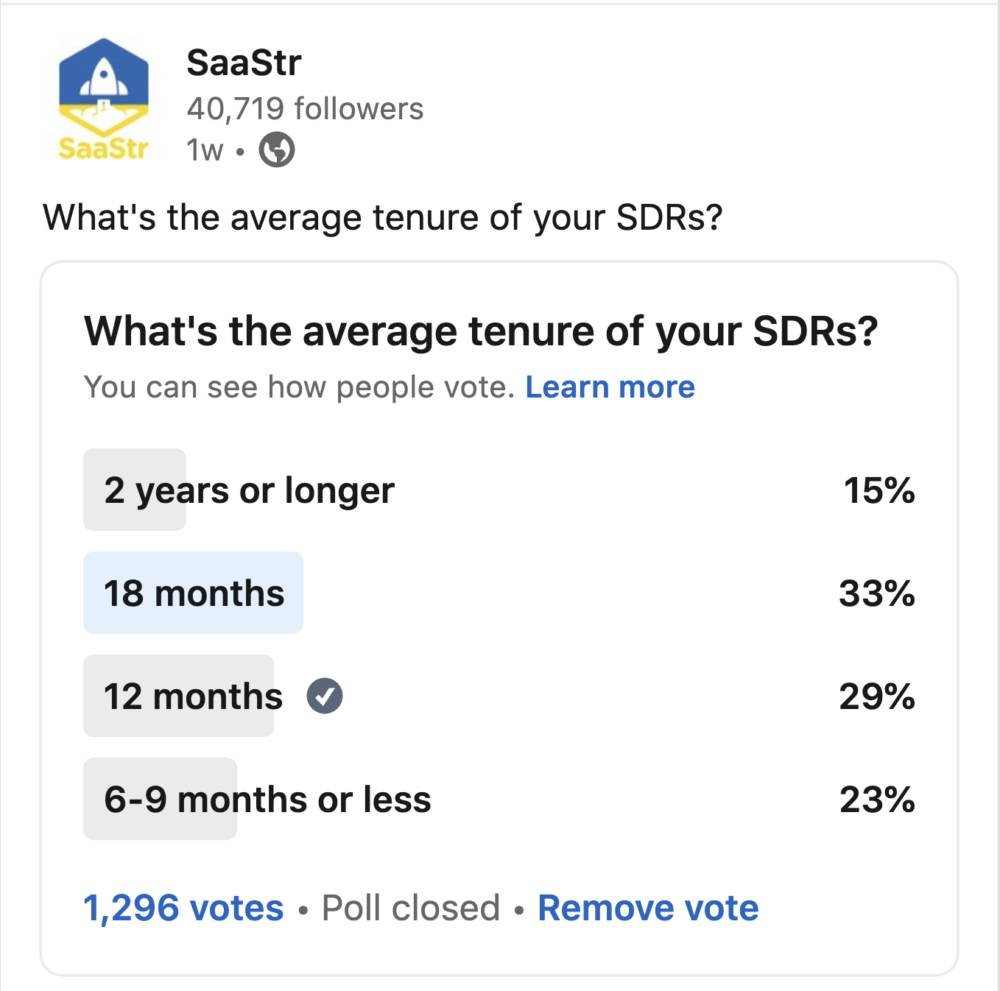
So when sales leaders hear that the average SDR tenure is about 14 months, many nod like this is simply the weather report. “Ah yes, another quarter of scattered resignations with a chance of backfilling.” But the real issue is sharper: 14 months is not 14 months of productive selling. Once you subtract recruiting time, onboarding, ramp, mistakes, coaching gaps, vacation, internal process confusion, and the last few weeks when someone is mentally updating their LinkedIn headline, the productive life of an SDR can be far shorter.
That is why SDR turnover is not just an HR problem. It is a pipeline problem, a forecasting problem, a management problem, a morale problem, andif we are being honesta “maybe our go-to-market math is wearing a fake mustache” problem.
Why SDR Tenure Matters More Than Most Sales Leaders Admit
The SDR role is often treated as an entry-level stepping stone, which is partly true. Many people become SDRs because they want to move into account executive roles, customer success, marketing, revenue operations, or leadership. That ambition is healthy. The problem begins when companies design the SDR function as if constant churn is unavoidable, harmless, or even proof that the role is working.
It is not harmless. Every time an SDR leaves, the company loses more than a seat. It loses territory knowledge, prospect context, messaging lessons, manager time, enablement investment, team momentum, and future pipeline. If that SDR had been working strategic accounts, those accounts may go quiet for weeks or months. If the SDR was strong, their departure also affects morale because the remaining team sees proof that “success” may simply mean leaving.
The 14-Month Number Is Misleading
Let’s assume your average SDR tenure really is 14 months. That sounds manageable until you break it down. A new SDR may need two to four months to ramp, depending on product complexity, market maturity, enablement quality, and whether the CRM looks like a civilized system or a garage sale with dropdown menus. During ramp, the rep is learning buyer personas, objection handling, qualification criteria, talk tracks, email sequencing, competitive positioning, and the very important skill of not sounding like a LinkedIn automation bot having a nervous breakdown.
Now subtract that ramp period from 14 months. Suddenly you may only have 10 or 11 months of meaningful productivity. Then subtract the final month when the SDR is interviewing elsewhere, waiting for a promotion decision, or emotionally checked out because they have been told “next quarter” three quarters in a row. The real productive window may be closer to nine or 10 months.
That is the real math. Not tenure. Productive tenure.
What Causes SDRs to Leave So Quickly?
SDR attrition is rarely caused by one dramatic event. It is usually a slow leak. A little unclear coaching here, a little bad data there, a quota that feels mathematically fictional, and suddenly your promising new hire is applying for a customer success role at a company with better snacks and fewer cold calls.
1. The Role Is Emotionally Tough
Being an SDR means dealing with rejection at industrial scale. A good day may include several conversations, one qualified meeting, and 80 people pretending the phone is a haunted object. A bad day may include bounced emails, no-shows, a prospect who replies “wrong person,” and an account executive asking why the meeting was not better qualified.
This constant rejection requires resilience. But resilience is not an unlimited subscription plan. Without coaching, peer support, realistic goals, and visible progress, SDRs burn out. They start strong, then become robotic. Robotic outreach produces worse results, which creates more pressure, which creates more robotic outreach. Congratulations, the team has invented a treadmill with a quota.
2. Ramp Takes Too Long for Such a Short Role
In many B2B organizations, SDR ramp time commonly falls around three months, and it can be longer in complex enterprise environments. That may be reasonable for a role someone stays in for three years. It is painful when the person leaves after 14 months. The company spends a large percentage of the employee lifecycle teaching the rep how to become productive, only to lose them shortly after they become genuinely useful.
This is why onboarding cannot be casual. “Shadow Sarah for a week and read these 47 Notion pages” is not a ramp plan. It is a scavenger hunt with a headset.
3. Career Paths Are Too Vague
Many SDRs accept the role because they believe it leads somewhere. They are not just looking for a paycheck. They are looking for proof that effort turns into opportunity. If the path to promotion is unclear, political, inconsistent, or always delayed, the best SDRs will leave first. The mediocre ones may stay longer, which is not exactly the retention strategy investors dream about.
A healthy SDR program explains what promotion requires, how performance is evaluated, what skills must be demonstrated, and how long the journey typically takes. It also offers multiple paths. Not every great SDR should become an AE. Some may thrive in partnerships, customer success, enablement, RevOps, or management.
4. Bad Data Makes the Job Miserable
Nothing drains an SDR faster than being measured on activity while working terrible accounts. If lists are outdated, contacts are wrong, titles are irrelevant, and territories are messy, SDRs are not prospecting. They are archaeology interns digging through old CRM fossils.
Bad data creates fake performance problems. A rep may look slow or ineffective when the real issue is that they are calling disconnected numbers, emailing people who left the company two years ago, or chasing accounts that were never a fit. Clean data is not a luxury. It is emotional support for the revenue team.
5. The SDR-AE Relationship Is Broken
The SDR and AE partnership can be powerful. It can also become a tiny workplace sitcom with recurring conflict. SDRs complain that AEs reject meetings too easily. AEs complain that SDRs book weak meetings. Managers ask everyone to “align,” which usually means scheduling another meeting where nothing aligns except the calendar invite.
Clear qualification rules fix much of this. So do shared account plans, regular feedback loops, and compensation structures that encourage quality rather than calendar stuffing. The SDR should not feel like a meeting vending machine. The AE should not feel like a cleanup crew. Both roles should be working the same revenue strategy.
The Hidden Cost of SDR Turnover
SDR turnover is expensive, but the cost is often scattered across departments, so nobody sees the full bill. Recruiting spends time sourcing candidates. Managers spend time interviewing. Enablement spends time onboarding. RevOps provisions tools. AEs wait for coverage. Marketing wonders why lead follow-up is inconsistent. Finance sees payroll, but not always the invisible cost of lost pipeline.
Here is a practical way to think about the cost. Every departing SDR creates at least five categories of loss: hiring cost, ramp cost, lost pipeline, management distraction, and cultural drag. The cultural drag may be the most underestimated. When SDRs see teammates leaving every few months, they stop asking, “How do I succeed here?” and start asking, “Where did they go?”
Turnover Weakens Forecasting
If your pipeline generation depends on people who are constantly new, ramping, or leaving, forecasting gets noisy. A quarter may look weak not because the market is dead, but because half the SDR team is still learning which persona actually answers the phone. Another quarter may look strong because a few experienced reps are carrying the team. Then they get promoted or leave, and the graph falls down the stairs.
Stable SDR teams create cleaner pipeline patterns. Managers can identify what is working, what needs improvement, and which market segments respond. Constant churn makes every conclusion suspicious.
How to Extend SDR Tenure Without Turning the Role Into a Waiting Room
The goal is not to trap SDRs in the role forever. That would be weird, inefficient, and probably the plot of a very niche workplace thriller. The goal is to create a role where SDRs stay long enough to become productive, contribute meaningfully, grow professionally, and leave the seat in a planned way rather than a panicked one.
Build a Real 30-60-90 Day Ramp Plan
A strong onboarding plan should define exactly what the SDR learns, practices, and demonstrates in the first 30, 60, and 90 days. The first month should focus on product basics, buyer personas, ICP, CRM hygiene, messaging, call structure, and listening to real calls. The second month should emphasize live practice, targeted outreach, objection handling, and manager feedback. The third month should move toward consistent quota behavior, account strategy, and self-diagnosis.
Do not confuse information with enablement. A 90-slide deck is not training. It is a sleep aid with bullet points. SDRs need practice, feedback, repetition, and examples of what good looks like.
Create Transparent Promotion Criteria
Promotion should not feel like a rumor. Define the metrics and behaviors that qualify someone for the next role. That may include quota attainment, meeting quality, discovery skills, pipeline influence, CRM discipline, peer leadership, and product knowledge. Then review progress regularly.
When SDRs know where they stand, they are less likely to leave from frustration. Even if the answer is “not yet,” clarity beats mystery. Mystery is for detective novels, not sales careers.
Coach Weekly, Not Randomly
Coaching is often promised and rarely systematized. The best SDR managers do not just ask, “How’s pipeline?” They review calls, inspect messaging, role-play objections, analyze conversion rates, and help reps improve specific skills. Weekly coaching creates momentum. Random coaching creates confusion.
A useful coaching session might focus on one narrow skill: opening calls, handling “send me information,” writing first-touch emails, researching accounts, or turning a vague pain point into a qualified meeting. Small improvements compound. Big vague advice does not.
Measure Quality, Not Just Activity
Activity matters. SDRs need enough calls, emails, social touches, and follow-ups to generate opportunities. But pure activity metrics can create strange behavior. If reps are rewarded only for volume, they will produce volume. Some of it may even be sent to real humans.
Balanced SDR metrics should include activity, connect rates, reply rates, meeting show rates, accepted opportunities, pipeline generated, and feedback from AEs. This helps teams reward thoughtful work, not just motion. A hamster has high activity. Nobody is putting it in charge of enterprise pipeline.
Improve Territory and Account Design
Many SDR teams suffer because territories are unfair, stale, or poorly matched to market opportunity. One rep gets a rich patch of high-intent accounts. Another gets a digital swamp of tiny companies, bad-fit industries, and contacts named “Info.” Then leadership compares their performance as if the playing field were equal.
Territory design should consider account quality, market segment, historical engagement, intent signals, and AE capacity. Fairer account distribution improves morale and makes performance management more honest.
Should AI Replace SDRs?
AI has entered the SDR conversation with the confidence of someone who just discovered cold email and has not yet been blocked by an entire buying committee. AI can help with research, account prioritization, personalization drafts, call summaries, CRM updates, and follow-up reminders. Used well, it reduces administrative drag and gives human SDRs more time for judgment, creativity, and real conversations.
But replacing SDRs entirely is not a magic fix. Buyers are already overwhelmed by generic outreach. If companies use AI only to send more mediocre messages faster, they will not solve turnover. They will simply automate annoyance at scale. The better approach is human-led, AI-assisted sales development: let technology handle repetitive tasks while SDRs focus on relevance, timing, insight, and conversation quality.
What a Healthier SDR Model Looks Like
A healthier SDR model starts with a simple idea: the SDR role should be designed as a professional development engine, not a disposable labor pool. That means better hiring, stronger onboarding, cleaner data, clearer expectations, more coaching, smarter technology, and a promotion path that feels real.
It also means being honest about the economics. If the average SDR is only fully productive for less than a year, the business model must account for that. Either extend productive tenure, shorten ramp, improve productivity, or redesign the role. Pretending the math works because the spreadsheet is colorful will not help.
Specific Example: The 14-Month SDR Lifecycle
Imagine a SaaS company hires an SDR in January. The rep spends January and February learning the product, tools, messaging, buyer personas, and qualification process. In March, they begin producing more consistent meetings. By April, they understand which accounts are worth pursuing and which ones are just CRM confetti. From April through October, they are productive. In November, they begin asking about promotion. In December, they hear the AE team has no open headcount. In January, they interview elsewhere. In February, they resign.
On paper, the company got 14 months of tenure. In reality, it got roughly seven to nine strong months. That is the gap leaders must manage.
Experience-Based Lessons From the SDR Tenure Problem
After observing how sales development teams operate across startups, scaling SaaS companies, and more mature revenue organizations, one pattern becomes obvious: SDR tenure is rarely fixed by one grand policy. It improves when the daily experience of the role improves. SDRs do not leave only because competitors offer more money. They leave because the job stops feeling like a path and starts feeling like a punishment with a dashboard.
The best SDR teams usually have managers who treat coaching as their main job, not as something squeezed between forecast calls. These managers know each rep’s strengths and weaknesses. They can explain why one person struggles with cold calls while another struggles with discovery. They do not motivate only with leaderboards, because leaderboards are great when you are winning and mildly cursed when you are not. Instead, they build skill plans. They show reps how to get better.
Another lesson: fast feedback matters. SDRs live in short cycles. They send emails today, make calls today, book meetings today, and get rejected today. If feedback arrives three weeks later, it is stale. A manager who reviews two calls right after a tough prospecting block can change the rep’s next conversation. That is how confidence grows. Not from a quarterly enablement webinar titled “Prospecting Excellence 2.0,” but from timely, practical correction.
Good teams also protect SDRs from chaos. That means sales and marketing agree on lead definitions. AEs accept or reject meetings based on written criteria, not mood, astrology, or whether they had coffee. RevOps keeps routing clean. Leadership does not change the compensation plan every time the moon looks expensive. Stability helps SDRs focus on the hard part of the job: creating conversations with people who did not wake up hoping to talk to sales.
One of the most overlooked retention tools is respect. SDRs know they are early in their careers, but they do not want to be treated as calendar assistants. Invite them to account strategy discussions. Explain what happened after the meeting they sourced. Show them how pipeline turns into revenue. Let them hear discovery calls and late-stage calls. When SDRs understand the full sales cycle, they become better at the top of it.
Finally, the strongest companies plan for movement. They do not panic when SDRs want the next step; they expect it. They build bench strength, create senior SDR roles, offer specialist tracks, and promote based on readiness rather than desperation. Ironically, when people see a real way forward, they are more patient. When the path is cloudy, they leave to find sunlight somewhere else.
The SDR tenure problem is not solved by telling young sellers to toughen up. It is solved by building a role worth staying in long enough to master. Make the work clearer, the coaching better, the data cleaner, the goals fairer, and the future more visible. Do that, and 14 months stops being a depressing countdown. It becomes the beginning of a stronger revenue careerand a much healthier pipeline engine.
Conclusion
The average tenure of SDRs may hover around 14 months in many sales organizations, but the more important question is how much of that time is truly productive. When ramp takes months and disengagement begins before resignation, companies may only receive a short window of real performance. That makes SDR retention a strategic revenue issue, not just a people operations metric.
To improve SDR tenure, leaders must stop treating churn as the cost of doing business and start fixing the systems that create it. Better onboarding, structured coaching, clean data, transparent promotion paths, fair territories, and smarter use of AI can all extend productive tenure. The SDR role will always be challenging. But it does not have to be a revolving door with a headset.
Note: This article is written in standard American English and synthesized from real sales development benchmarks, revenue leadership research, and current B2B sales best practices, with no inline source links included for cleaner web publishing.