
“`
If American comedy had a messy family photo album, Jimmy Kimmel and Howard Stern would be standing near the center of it: not exactly smiling, not exactly apologizing, and definitely making the photographer uncomfortable. Both men built careers by saying things polite society did not want said out loud. Both became rich enough to own several rooms where nobody is allowed to say, “Maybe don’t.” And both eventually evolved into something more respectable, more political, more emotionally fluent, and, depending on whom you ask, much less fun.
The dubious evolution of Jimmy Kimmel and Howard Stern is not simply a story about two entertainers “growing up.” That version is too tidy, like a celebrity memoir edited by a nervous publicist. Their changes reveal something larger about American media: the rebel becomes the brand, the troublemaker becomes the institution, and the guy once accused of lowering the culture suddenly becomes a guardian of decency. It is a fascinating journey. It is also, at times, a little suspicious.
From Mischief to Mainstream: Two Very Different Starting Lines
Jimmy Kimmel: The Bro-Comedy Graduate
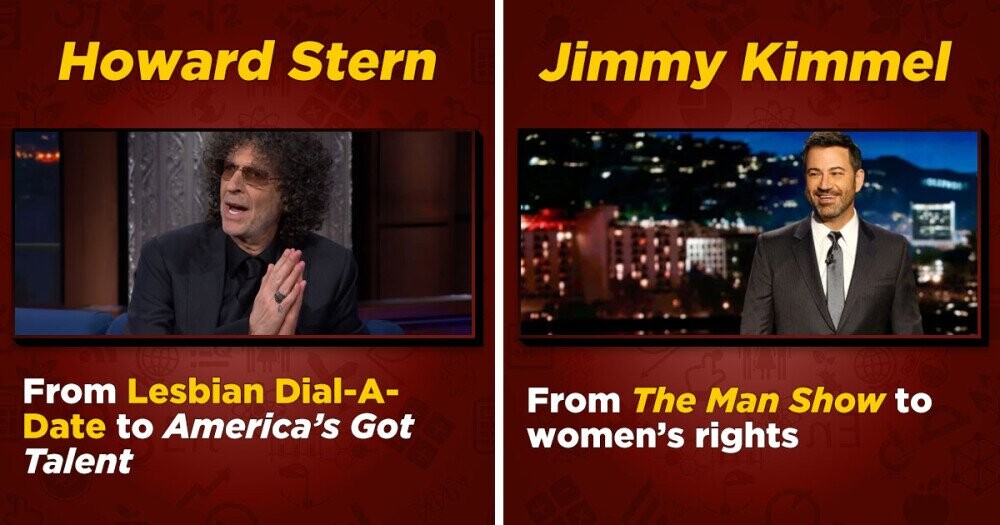
Before Jimmy Kimmel became the emotional late-night host who could turn a healthcare debate into appointment television, he was a radio guy with a taste for prankish, locker-room absurdity. His early television breakthrough came through Win Ben Stein’s Money, where his regular-dude timing helped balance Ben Stein’s human-sleeping-pill brilliance. Then came The Man Show, the Comedy Central program he co-hosted with Adam Carolla beginning in 1999.
The Man Show was not subtle. It was beer, babes, bad judgment, and jokes that often sounded like they had been workshopped at a bachelor party where the best man lost the deposit. At the time, it fit perfectly into the late-1990s cable mood: ironic sexism, frat-house satire, and an assumption that being offensive was automatically the same as being funny. Sometimes it was funny. Sometimes it was just a fog machine for immaturity.
That background matters because Kimmel’s later image depends heavily on contrast. The host of Jimmy Kimmel Live!, which debuted on ABC in 2003, eventually became one of network television’s most visible political and moral voices. But the old clips never vanished. In 2020, Kimmel apologized for past blackface impressions, including a Karl Malone bit from his earlier career. His apology acknowledged harm while also revealing the uneasy bargain of celebrity evolution: the past is not deleted; it is monetized, resurfaced, apologized for, and folded into the next chapter.
Howard Stern: The Shock Jock Who Built an Empire Out of Nerves
Howard Stern’s origin story is louder, longer, and more combustible. Stern came up through radio, sharpened his personality in local markets, and became nationally famous through The Howard Stern Show. By the late 1980s and 1990s, he was the king of outrageous broadcast confession: sex talk, staff humiliation, celebrity feuds, oddball callers, strippers, grudges, and an endless appetite for turning private embarrassment into public ritual.
Stern was not merely a shock jock; he was the shock jock against whom other shock jocks were measured, weighed, and often found to be knockoffs in cheaper headphones. His battles with the Federal Communications Commission became part of the act. Fines, censorship, station disputes, and moral panic helped sell the legend. Every attempt to contain him made him seem more dangerous, and danger is very good for ratings when wrapped in a morning commute.
Then came the satellite-radio revolution. Stern’s move to Sirius in 2006 gave him freedom from the strictest broadcast-indecency limits and helped transform him from a radio host into a subscription-media asset. The man who once seemed like a pirate became an anchor tenant. That is a strange kind of rebellion: still profane, still powerful, but now protected by a corporate fortress with a billing department.
The Pivot: When Comedy Discovered Feelings, Politics, and Legacy
Kimmel Becomes the Late-Night Conscience
Kimmel’s biggest transformation was not from radio to television. It was from smirking everyman to late-night moral witness. The shift accelerated in the Trump era, when many comedy hosts became nightly translators of national chaos. Kimmel was less academic than John Oliver, less theatrical than Stephen Colbert, and less eager to seem like a civics professor trapped inside a blazer. His appeal came from sounding like the sarcastic guy at the end of the bar who suddenly realized the bar was on fire.
The most important moment in Kimmel’s evolution came in 2017, when he spoke about his newborn son Billy’s congenital heart condition and connected his family’s experience to the national healthcare debate. It was raw, personal, and politically consequential. Critics accused him of using emotion as argument; supporters saw a rare instance of celebrity vulnerability clarifying a policy issue that often gets buried under acronyms and actuarial fog.
That moment changed Kimmel’s public role. He was no longer just the guy who joked about celebrities and tormented Matt Damon. He became a figure in the culture war over healthcare, Donald Trump, media trust, and the boundaries of comedy. The result was powerful but risky. Once a comedian becomes a moral voice, every old joke becomes evidence in a trial that never adjourns.
Stern Becomes the Celebrity Confessor
Stern’s transformation was equally dramatic, though less visible to casual television audiences. The older Stern became famous not just for being less raunchy, but for being more psychologically curious. Therapy, aging, health scares, and the changing media climate all helped reshape his style. In his later years, Stern developed a reputation for long-form interviews that could draw surprisingly intimate answers from major celebrities.
Instead of simply poking guests until something leaked, he began listening for emotional patterns. Musicians talked about parents, fame, insecurity, and creative fear. Actors opened up about rejection. Political figures entered the Stern universe not as carnival targets, but as interview subjects in a softer, more reflective arena. The man once associated with crude spectacle became known for empathy, patience, and the occasional question that sounded like it had been approved by a therapist with excellent parking.
This evolution won praise, but it also alienated some longtime fans. For listeners who loved Stern as the enemy of polish, the new Stern could feel like a betrayal. They did not tune in for emotional intelligence; they tuned in for chaos with a side of Robin Quivers laughing in disbelief. When Stern criticized Donald Trump or embraced more mainstream liberal positions, some former fans accused him of going “woke,” which in modern media discourse often means “a person I liked changed in a way that inconveniences my nostalgia.”
Why Their Evolution Feels Dubious
Growth or Rebranding?
The central question is whether Kimmel and Stern evolved because they genuinely matured, because culture changed around them, or because survival required a new costume. The honest answer is probably yes to all three. People age. Fathers soften. Therapy works. Political events force choices. Also, giant media careers are not kept alive by accident. Reinvention is not always cynical, but it is almost always strategic.
Kimmel’s move from The Man Show to anti-Trump late-night commentary can look jarring. Stern’s journey from FCC nightmare to elite interviewer can seem almost too perfect, like a redemption arc pitched during awards season. Yet dismissing both as fake would be too easy. Public figures can change. The dubious part is not that they changed; it is that the entertainment industry often rewards change only after the old version has already made everyone rich.
The Audience Has Receipts
The internet is a cruel archivist. It does not care that a joke was “of its time.” It does not accept “different era” as a magic spell. Kimmel’s old sketches and Stern’s old segments remain part of how audiences evaluate them. That does not mean a performer is permanently frozen at his worst moment, but it does mean evolution requires more than a fresh haircut, a serious monologue, and better lighting.
For both men, the tension is obvious. They built fame by pushing boundaries, then later became judges of other people’s boundaries. Kimmel mocks indecency in politics after profiting from indecent comedy. Stern criticizes cruelty and dishonesty after years of turning discomfort into sport. This does not make their criticism invalid. It does make it complicated, and complication is where the interesting story lives.
Rebels Who Became Institutions
Another dubious element is institutional comfort. Kimmel is a network late-night host backed by Disney’s ABC, a position that makes rebellion look different. Stern is a SiriusXM cornerstone whose name is tied to contracts, channels, archives, and platform identity. These are not outsiders with slingshots. They are media landlords with very expensive microphones.
That shift changes the meaning of their work. When Stern was fighting FCC limits on terrestrial radio, he could plausibly cast himself as a free-speech insurgent. When Kimmel uses ABC’s stage to attack political hypocrisy, he operates from inside one of the most powerful entertainment companies in the world. Both can still be funny. Both can still be right. But the romance of rebellion fades when the rebel has corporate security badges.
The Similarities: Two Men, One American Pattern
Kimmel and Stern share a deeper pattern: each learned that vulnerability could become a more durable form of power than provocation. Kimmel’s tears over his son reached people who never cared about late-night comedy. Stern’s emotionally detailed interviews reached listeners who once dismissed him as a loudmouth in leather pants. In both cases, sincerity became a second act.
They also benefited from the collapse of old media categories. A late-night host is now a political commentator, viral clip factory, awards-show emcee, and social-media punching bag. A radio host is now a podcaster-adjacent long-form interviewer, digital archive, celebrity therapist, and subscription driver. The job changed, so the performers changed with it.
Their critics often ask: “What happened to them?” But the better question may be: “What happened to the audience?” Many viewers who once wanted comedians to be dangerous now want them to be responsible. Many fans who once cheered cruelty now want accountability, unless the accountability is aimed at someone they like. Comedy did not become political overnight; the country became so political that even a monologue about the weather sounds like a congressional hearing with jokes.
The Differences: Kimmel Punches Nightly, Stern Digs Slowly
Kimmel’s modern weapon is the monologue. He responds to events quickly, often with jokes sharpened by visible irritation. His best political comedy feels like a pressure valve. His weakest moments can feel repetitive, especially to viewers who do not share his assumptions. The danger of political late night is that the audience may applaud recognition more than surprise. Sometimes the punchline is simply, “We agree this person is awful,” and agreement is a comfortable couch, not always a comedy engine.
Stern’s modern weapon is time. A long interview lets him circle a subject, flatter a guest, confess something of his own, and wait for the guarded answer to crack open. His best interviews feel intimate because he understands insecurity from the inside. His weakest moments can feel overly admiring, especially when compared with the old Stern’s willingness to embarrass anyone within range. The danger of the new Stern is not vulgarity; it is reverence.
In that sense, Kimmel became sharper while Stern became softer. Kimmel moved from juvenile comedy toward moral confrontation. Stern moved from confrontation toward emotional excavation. One now throws darts at power. The other invites power to sit down and explain its childhood.
So, Is the Evolution Good or Bad?
The answer depends on what you think comedy owes the public. If comedy owes only laughs, both men have become more complicated products. Kimmel’s politics can divide viewers before the first joke lands. Stern’s reflective interviews can disappoint fans who miss the old unpredictable circus. But if comedy owes honesty, then both evolutions have value. Kimmel found honesty in anger and family vulnerability. Stern found honesty in self-examination and deeper listening.
The suspicious part is the packaging. Media loves a redemption narrative because it turns discomfort into content. “He has changed” is easier to sell than “he changed, but the old stuff still matters, and maybe we should discuss how audiences rewarded it.” Kimmel and Stern are not exceptions to American entertainment history. They are case studies in how fame launders, updates, and reintroduces itself with a new tagline.
Experience Section: Watching the Evolution From the Cheap Seats
For many viewers and listeners, the experience of following Jimmy Kimmel and Howard Stern over the years feels less like watching two careers and more like aging alongside two loud relatives who somehow became respectable before anyone could hide the photo albums. There is a strange whiplash in remembering Kimmel from The Man Show era and then seeing him deliver emotional monologues about healthcare, gun violence, or democratic norms. It is like watching the class clown become principal and then give a moving speech about school funding. You may agree with him. You may even be touched. But part of your brain still remembers him launching beer jokes into basic cable like confetti.
Stern creates a similar experience, especially for longtime listeners. The old Stern show felt like forbidden radio. People listened in cars, at work, in garages, and in places where they probably should have been doing something more productive, such as earning a living. The appeal was not just the vulgarity. It was the sense that anything could happen, and that the polished world of celebrity had accidentally wandered into a room where nobody respected the velvet rope. When Stern later became a careful, empathetic interviewer, it was impressive, but it also changed the temperature. The danger was replaced by depth. For some fans, that was growth. For others, it was decaf rebellion.
The most revealing experience is noticing how your own reaction changes. A joke that once seemed harmless may now sound lazy. A monologue that once seemed brave may later sound predictable. A celebrity interview that once seemed soft may reveal more than a hostile grilling ever could. Kimmel and Stern force audiences to confront their own archives too. What did we laugh at? Why did we laugh? Were we responding to wit, cruelty, honesty, shock, or the thrill of hearing someone else break rules we were too cautious to break ourselves?
That is why the evolution remains dubious in the most useful sense of the word. It invites doubt. Not automatic condemnation, not blind applause, but doubt. Kimmel and Stern are both better than their worst clips and less pure than their best moments. They are entertainers, businessmen, cultural weather vanes, and occasionally accidental philosophers of American embarrassment. Their careers remind us that public growth is never clean. It happens under studio lights, in contract negotiations, through backlash cycles, and in front of audiences who remember everything except their own participation.
Watching them now is watching American media try to reconcile three incompatible desires: the desire to be entertained, the desire to be morally correct, and the desire to pretend we never enjoyed the messy stuff. Kimmel and Stern did not create that contradiction. They simply rode it longer, louder, and more profitably than most.
Conclusion
The dubious evolution of Jimmy Kimmel and Howard Stern is ultimately the story of American comedy growing older in public. Kimmel moved from bro-comedy mischief to network late-night conscience. Stern moved from radio outlaw to introspective master interviewer. Both transformations contain real maturity, obvious strategy, and unresolved baggage.
Their careers prove that reinvention is possible, but not painless. Audiences can accept growth while still remembering the receipts. Critics can question motives without denying progress. And entertainers can become wiser without becoming saints. In fact, it is probably better if we stop asking comedians to become saints. Saints rarely have good timing.
What makes Kimmel and Stern so compelling is not that they changed. Everyone changes. What makes them compelling is that their changes expose the machinery behind modern fame: outrage, apology, reinvention, polarization, nostalgia, and the eternal hope that the next version of a public figure will finally make the old version easier to explain.
“`
Note: This article is written in original language for web publishing and is based on publicly reported facts, entertainment history, and media analysis.
“`