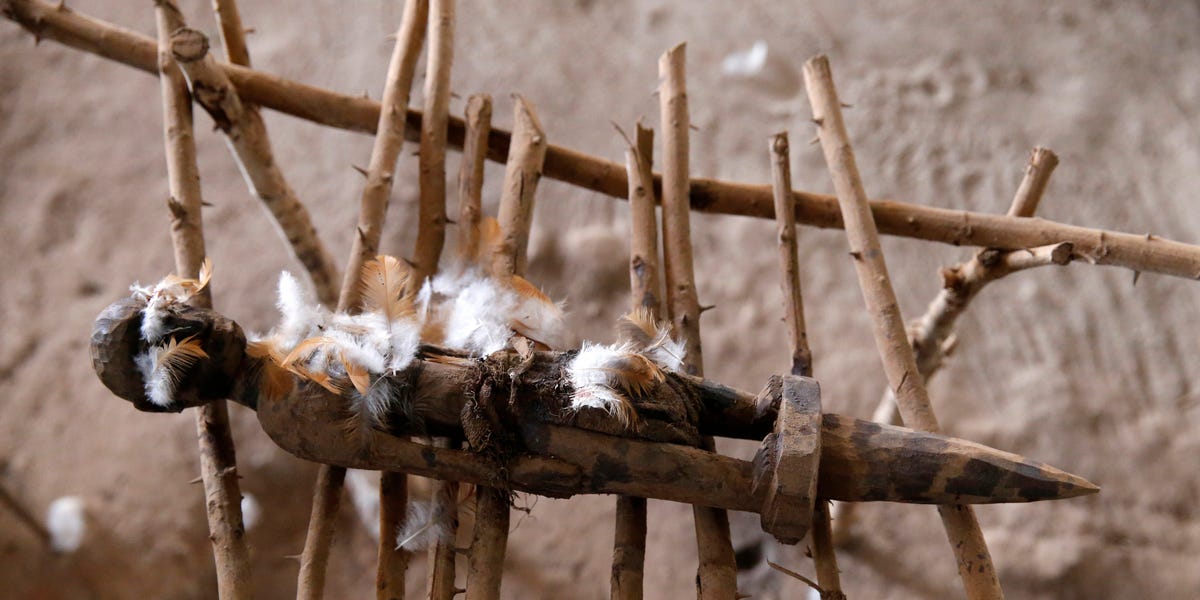
A Chilling Discovery Suggests This King Built Funerary Huts With Blood From 41 Sacrifice Victims

For generations, a disturbing story clung to the royal palaces of Abomey in present-day Benin. According to local tradition, the walls of sacred funerary huts associated with King Ghezo were bound with a mixture containing the blood of 41 sacrificed people. It sounded like the kind of tale that might grow darker every time it was retolduntil scientists tested the walls and found evidence that part of the legend was startlingly real.
A Palace Complex Where Architecture Carried Political Power
The discovery centers on the Royal Palaces of Abomey, a sprawling complex that once formed the political and spiritual heart of the Kingdom of Dahomey. Between the 17th and late 19th centuries, successive rulers constructed palaces within a fortified area of earthen walls, courtyards, ceremonial spaces, tombs, shrines, and royal residences.
These were not merely fancy houses for monarchs with unusually large decorating budgets. The palaces expressed royal authority, preserved dynastic memory, hosted ceremonies, stored treasured objects, and connected living rulers with deceased kings. Architectural space was political theater, historical archive, religious center, and government headquarters rolled into one.
Today, the complex is recognized as a UNESCO World Heritage Site. Its surviving structures provide rare physical evidence of the Aja-Fon culture and the organized power of Dahomey, one of the most influential states on the West African coast.
Among its sacred structures are a djexo, described as a hut associated with the spirit of a deceased king, and an adoxo, or royal tomb. Traditional materials such as laterite earth, wood, water, and straw were central to construction. One particular wall binder, however, appeared to contain something far less ordinary.
Who Was King Ghezo?
King Ghezo, whose name is also written Gezo, Gezu, or Guezo, ruled Dahomey from 1818 to 1858. His four-decade reign was marked by military expansion, political reform, elaborate royal culture, and deep involvement in systems of warfare and enslavement.
In 1823, Ghezo’s forces defeated the Oyo Empire and ended Dahomey’s obligation to pay tribute to it. The victory strengthened his position at home and helped transform him into one of the kingdom’s most powerful rulers.
Royal art associated Ghezo with the buffalo and elephant, animals representing strength, endurance, and authority. Court artists created finely worked objects that reinforced his public image. The royal message was not subtle: this was a king who expected his presence to leave a mark.
Unfortunately, military power had a brutal economic foundation. Dahomey conducted campaigns against neighboring populations, taking captives who could be sold into the Atlantic slave trade, forced into labor, incorporated into the kingdom, or selected for ritual purposes. Ghezo explored palm oil as an alternative source of income when British pressure against the overseas slave trade increased, but the trade in human beings remained entangled with his reign.
Dahomey also maintained the Agojie, the celebrated all-woman military units sometimes called the “Dahomey Amazons” by European observers. Their history reveals the kingdom’s unusual opportunities for some women, but it also reflects the militarized society in which they served. Dahomey’s past refuses to fit neatly into a hero-or-villain box, no matter how much modern storytelling might prefer a tidier package.
The Legend of the Blood-Bound Walls
Oral accounts held that the binder covering parts of two sacred funerary huts was prepared from red palm oil, ritually purified water, and blood obtained from 41 sacrificial victims. The victims were traditionally believed to have been captives or enslaved people.
In this tradition, blood was not added because an ancient contractor had run out of cement and decided to improvise. It carried religious meaning. Blood represented vitality and could be included in ceremonies intended to consecrate, protect, or spiritually activate a structure.
The number 41 is also described as ritually significant within the relevant local tradition. However, oral history, symbolic numbers, and physical evidence do not always line up with mathematical precision. A sacred number may represent ritual completeness rather than a literal head count.
That distinction matters. The new research supports the claim that human blood was incorporated into the wall material. It does not provide a scientific roll call of 41 identifiable victims.
How Scientists Tested a Centuries-Old Story
Taking a Minute Sample
A French-Beninese research team studied tiny samples collected from the inner-facing cladding of a cenotaph wall. Because the historic structure is culturally important and physically fragile, researchers could not treat it like a kitchen wall awaiting demolition. They needed to recover the maximum amount of information from a minimal quantity of material.
Using Metaproteomics
The researchers turned to metaproteomics, a method used to identify collections of proteins from complex samples. Instead of searching for one predetermined substance, scientists can examine a broad mixture and determine which organisms contributed biological material.
The extracted proteins were broken into smaller fragments called peptides. Researchers then analyzed those peptides with high-resolution tandem mass spectrometry. In simplified terms, the instrument sorts and measures molecular fragments so precisely that scientists can compare them with protein databases and identify likely biological sources.
It was archaeology’s version of “CSI: Ancient Mortar,” except with more spreadsheets and considerably fewer dramatic sunglasses.
The team identified more than 6,300 molecular entities in the samples. The collection included material associated with bacteria, fungi, plants, animals, and humans. Many of those organisms could have accumulated through soil, weathering, handling, insects, repairs, or centuries of environmental exposure. The challenge was determining which proteins belonged to the original ritual mixture.
The Proteins That Pointed to Blood
The most important findings involved proteins associated with human and chicken blood. Researchers detected evidence connected to hemoglobin, the oxygen-carrying protein found in red blood cells, along with immunoglobulins and other blood-related proteins.
Multiple protein indicators made the conclusion stronger than a result based on a single molecule. Contamination is always a concern when studying historic buildings, particularly structures that have been touched, repaired, inhabited by animals, exposed to ceremonies, and battered by the environment. A consistent group of blood-associated proteins is harder to explain as a random modern accident.
The poultry evidence also fits documented ritual practices involving chickens. Animal offerings have played roles in Vodun ceremonies associated with protection, communication, consecration, and the transfer of vital force.
The human proteins are the more unsettling discovery. They indicate that human blood was intentionally or otherwise incorporated into the binder. When combined with the long-standing local account, the most reasonable interpretation is that the material reflects a ritual practice rather than an ordinary construction recipe.
However, the analysis cannot reconstruct the entire event. Scientists do not yet know how many people contributed blood, whether every individual was killed, precisely when the material was prepared, or whether it was added during original construction or later ritual maintenance.
Why Proteins Worked Better Than Ancient DNA
Ancient DNA receives most of the celebrity treatment. It gets documentaries, dramatic headlines, and the scientific equivalent of red-carpet photography. Proteins, meanwhile, quietly show up and solve cases that DNA cannot.
DNA breaks down over time and can be difficult to recover from warm, humid environments. Proteins may survive under conditions that destroy useful genetic material. Certain proteins are also strongly associated with particular tissues or biological fluids, making them valuable for identifying blood, milk, eggs, muscle, and other substances in archaeological residues.
The wall study demonstrated that proteomics can uncover evidence invisible to traditional excavation. No complete remains had to be discovered beside the huts. The building material itself preserved a molecular record of the ceremony.
Future genetic testing might provide additional information, but it may never produce a definitive victim count. The sample is mixed, degraded, and centuries old. Even if several genetic profiles were identified, they would represent only the people whose biological material survived in the tiny section tested.
The Unexpected Wheat Mystery
Human and chicken proteins were consistent with the ritual story. Wheat proteins were not.
Researchers found molecular traces associated with wheat even though wheat was not commonly cultivated in that part of sub-Saharan Africa during Ghezo’s reign. The discovery raises questions about long-distance exchange between Dahomey and Europe.
Ghezo maintained diplomatic relationships with foreign powers and reportedly admired Napoleon III of France. Gifts, weapons, textiles, cowrie shells, food products, and luxury goods traveled through political and commercial networks. Imported bread, flour, or another wheat-based product may therefore have reached the royal court.
It is possible that wheat food was used as a ceremonial offering and eventually incorporated into the wall mixture. It could also have entered during a later repair or ritual. The evidence does not prove that someone ceremonially mortared the wall with a baguette, amusing as that headline might be.
Still, the wheat proteins show how one archaeological sample can reveal more than one story. The wall records ritual practice, biological material, trade connections, and perhaps elite fascination with imported goods.
Vodun Is More Complex Than Horror-Movie “Voodoo”
Popular coverage often describes the discovery as evidence of a “voodoo blood palace.” That phrase is clickable, but it risks flattening a living religious tradition into a horror prop.
Vodun developed through West African religious systems involving ancestors, spirits, divination, sacred objects, community responsibilities, healing, and relationships between the material and spiritual worlds. Related traditions traveled across the Atlantic with enslaved Africans and developed into distinct religions in Haiti, Louisiana, Cuba, Brazil, and elsewhere.
Human sacrifice is historically associated with certain royal Dahomean ceremonies, but it should not be presented as the everyday essence of Vodun. Royal ritual, state violence, warfare, and political spectacle operated within a particular historical setting. Treating all Vodun practice as sinister would be as inaccurate as defining every world religion solely by its most violent ruler.
The blood-wall discovery should therefore be discussed honestly without turning modern practitioners into characters from a supernatural thriller. Respectful history does not require softening the evidence. It requires placing the evidence in context.
What the Number 41 Doesand Does NotTell Us
The dramatic headline naturally emphasizes 41 sacrifice victims. Yet the study did not identify 41 people. No collection of 41 separate genetic profiles was recovered, and no corresponding group of remains was analyzed.
The number comes from tradition describing the preparation of the wall binder. It may be literal, symbolic, or both. Royal ceremonies often used carefully structured numbers, repeated offerings, and formal sequences to express legitimacy and sacred order.
The safest conclusion is straightforward: the wall contains human blood proteins, supporting the central claim behind the tradition. The exact number of contributors remains unknown.
This qualification does not make the discovery less important. In some ways, it makes it more scientifically interesting. Researchers have moved the story from “legend with no physical support” to “tradition supported in part by molecular evidence.” Archaeology rarely produces a perfect courtroom confession. More often, it assembles several lines of evidence and labels the remaining gaps with a responsible question mark.
Power, Memory, and the Purpose of the Funerary Huts
The sacred huts were designed to preserve the presence and memory of deceased royalty. In the political theology of Dahomey, a king’s death did not necessarily remove him from public life. Royal ancestors could remain sources of authority, protection, danger, and legitimacy.
Using blood in a funerary structure would have transformed the building from a passive monument into a ritually charged space. The wall was not simply intended to keep out rain. Its materials could express the continuation of royal vitality and establish a boundary between ordinary life and sacred royal memory.
The sacrifice also communicated political power. A ruler capable of mobilizing labor, controlling valuable goods, commanding ritual specialists, and deciding the fate of captives demonstrated authority over both society and spiritual practice.
The structure was therefore architecture with a message: the monarchy remained powerful even in death.
Why the Discovery Matters to Archaeology
The research illustrates how modern science can test oral tradition without automatically dismissing it or accepting every detail literally. For decades, scholars sometimes treated local accounts as folklore while granting excessive authority to European colonial records. Yet colonial observers carried their own prejudices, political objectives, misunderstandings, and appetite for sensational stories.
Molecular evidence offers an additional source of information. It cannot replace oral history, written documents, architecture, or community knowledge, but it can place them in conversation.
The study also expands the possibilities of archaeological residue analysis. Similar techniques may identify ceremonial liquids, foods, adhesives, pigments, medicines, or animal products preserved on artifacts and buildings. A wall that appears silent may contain a crowded molecular archive.
At the same time, scientific access must be balanced with cultural authority. These are not abandoned movie sets waiting for researchers to collect interesting samples. The Royal Palaces of Abomey remain sacred and culturally significant. Any investigation should involve Beninese scholars, heritage professionals, royal families, religious communities, and local institutions.
Experiencing the Story Beyond the Sensational Headline
Encountering this discoverywhether through a museum exhibition, an archaeological article, or a visit to Abomeycan be an unsettling experience. The first reaction is often fascination mixed with disbelief. A wall containing centuries-old blood proteins sounds more like gothic fiction than laboratory science.
The most meaningful experience begins after that initial shock. Instead of seeing only a “blood-built hut,” a careful visitor starts noticing the larger landscape: the arrangement of courtyards, the earthen construction, the royal bas-reliefs, the symbols assigned to different kings, and the continuing importance of sacred spaces.
Imagine standing before a weathered earthen wall at the palace complex. Visually, it may appear modest compared with a marble European palace. There are no endless mirrored galleries or chandeliers competing for attention. Yet the site communicates authority through sequence, enclosure, ritual access, historical continuity, and symbolic design.
A knowledgeable guide might explain how each king added to the complex, allowing architecture to trace the royal succession. The walls become a family tree made of earth. Some spaces governed public affairs, while others were increasingly private or sacred. Movement through the palace reflected movement through layers of political importance.
Learning that proteins survived in the wall changes the experience again. The building is no longer merely something people looked at or lived inside. It becomes an artifact composed of human decisions, imported materials, biological traces, ceremony, and memory.
The discovery may also create discomfort about tourism. Visitors should resist treating the funerary huts as a spooky attraction or using living Vodun traditions as decorative entertainment. Human suffering is part of the history, and the likely victims did not leave written accounts explaining who they were. Ethical interpretation should give them more dignity than a dramatic number in a headline.
Another valuable experience comes from comparing the evidence with popular portrayals of Dahomey. Movies and television often focus on the Agojie and the kingdom’s resistance to European power. Those stories can recover histories neglected by Western audiences, but they may simplify Dahomey’s participation in slave trading, warfare, forced labor, and sacrifice.
The palace asks visitors to hold several truths at once. Dahomey produced remarkable art, complex political institutions, influential women soldiers, sophisticated diplomacy, and powerful resistance to colonial conquest. It also participated in systems that inflicted enormous suffering. Historical maturity means resisting the urge to erase either side.
Finally, the scientific process offers its own memorable lesson. Researchers did not scrape the wall, find a label reading “human blood,” and call it a day. They studied thousands of molecular signals, separated likely ritual ingredients from environmental contamination, compared peptide sequences, and stated the limits of their conclusions.
That patience is part of the experience readers should take away. The most responsible version of the story is not “scientists proved every terrifying legend.” It is more precise and more interesting: advanced protein analysis confirmed that human and poultry blood contributed to a sacred wall binder, while the identities and exact number of the people involved remain unknown.
Conclusion: A Wall That Preserved More Than a Legend
The funerary wall connected with King Ghezo has preserved a remarkable intersection of architecture, ritual, politics, trade, and molecular biology. Scientists found human and chicken blood proteins in its binder, providing strong physical support for a long-standing account of blood being used to consecrate royal structures.
The research does not prove that exactly 41 people were sacrificed, nor does it explain every stage of the ceremony. The wheat proteins remain mysterious, the human contributors remain unidentified, and the sequence of construction and ritual maintenance is not fully known.
Nevertheless, the discovery demonstrates that oral traditions can contain testable historical information. It also shows that archaeological buildings are not just arrangements of earth and timber. Their materials can preserve evidence of belief, international exchange, royal ambition, and people whose names have vanished from written history.
King Ghezo intended royal memory to endure. He probably could not have imagined that, nearly two centuries later, scientists would examine the walls molecule by molecule. History, it turns out, has developed an exceptionally powerful microscope.
SEO Metadata