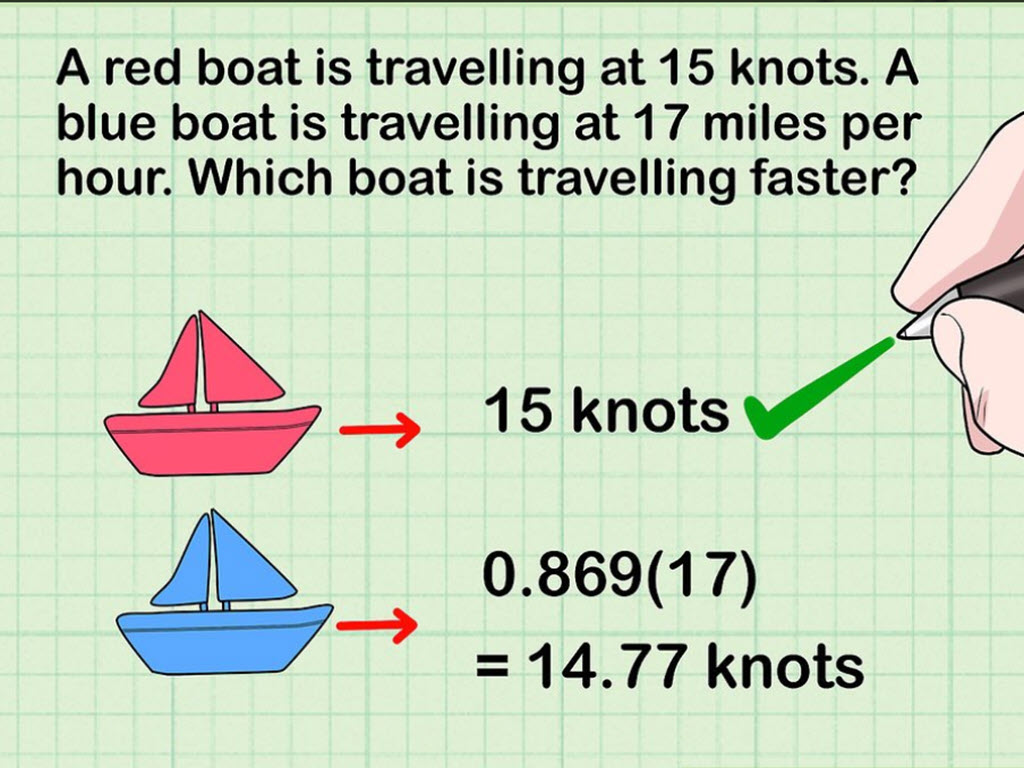

Knots show up everywhere once your travels leave the highway. Boat speedometers use them. Pilots discuss them. Weather reports use them for winds, currents, and tropical storms. Then someone asks, “How fast is that in miles per hour?” and suddenly a pleasant afternoon becomes an unexpected math quiz.
Fortunately, converting knots to miles per hour is easy. For an accurate answer, multiply the speed in knots by 1.15078. For quick mental math, add approximately 15 percent. When convenience matters more than showing your work, use a conversion calculator or reference chart.
This guide explains all three methods, shows practical examples, and clears up common mistakesincluding why saying “knots per hour” makes experienced sailors twitch ever so slightly.
The Quick Knots-to-MPH Formula
Miles per hour = knots × 1.15078
For example:
20 knots × 1.15078 = 23.0156 mph
Rounded to a practical number, 20 knots equals approximately 23 mph.
The conversion works because one knot means one nautical mile traveled in one hour. An international nautical mile is exactly 1,852 meters, while a U.S. statute mile is 1,609.344 meters. Dividing those distances produces the conversion factor of approximately 1.15078.
What Is a Knot?
A knot is a unit of speed equal to one nautical mile per hour. Its standard symbol is commonly written as kn, although kt and kts also appear in aviation, marine reports, and weather observations.
Knots are widely used in maritime navigation, aviation, meteorology, and oceanography. The unit fits those fields naturally because nautical miles relate to geographic coordinates and navigation across Earth’s curved surface. In U.S. aviation guidance, horizontal speed and wind speed are generally expressed in knots, while navigational distances are commonly expressed in nautical miles.
A Knot Is Not a Nautical Mile
A nautical mile measures distance. A knot measures speed. The relationship is similar to the difference between a mile and miles per hour:
- Nautical mile: distance
- Knot: one nautical mile per hour
- Statute mile: the ordinary land mile used on U.S. roads
- MPH: statute miles traveled per hour
That distinction also explains why “knots per hour” is usually incorrect. A knot already includes “per hour.” Saying “20 knots per hour” would technically describe acceleration, not a steady speed.
Why Is a Knot Faster Than One MPH?
One nautical mile is longer than one statute mile. As a result, traveling at one nautical mile per hour covers more distance than traveling at one statute mile per hour.
The basic relationship is:
- 1 knot = 1.15078 mph
- 10 knots = 11.5078 mph
- 100 knots = 115.078 mph
In everyday language, one knot is about 15 percent faster than one mile per hour. NOAA commonly summarizes the relationship as approximately 1.15 mph for every knot.
Method 1: Multiply Knots by 1.15078
Multiplication by the official conversion factor is the most accurate way to convert knots to miles per hour. Use it for navigation calculations, technical writing, flight planning exercises, performance comparisons, or any situation in which decimals matter.
Step-by-Step Conversion
- Write down the speed in knots.
- Multiply that number by 1.15078.
- Round the result to an appropriate number of decimal places.
Example: Convert 28 Knots to MPH
28 × 1.15078 = 32.22184
Therefore, 28 knots is approximately 32.22 mph. For casual conversation, rounding that to 32 mph is perfectly reasonable. The speed police will not arrive with a floating calculator.
Example: Convert 65 Knots to MPH
65 × 1.15078 = 74.8007
Therefore, 65 knots is approximately 74.8 mph.
Example: Convert 120 Knots to MPH
120 × 1.15078 = 138.0936
Therefore, 120 knots is approximately 138.09 mph.
How Much Should You Round?
Choose the precision that matches the purpose of the calculation:
- Use a whole number for casual descriptions: 28 knots is about 32 mph.
- Use one decimal place for practical comparisons: 28 knots is 32.2 mph.
- Use two or more decimal places for technical work: 28 knots is 32.22 mph.
Extra digits do not automatically make a result more useful. Reporting a small boat’s speed as 23.01558896 mph may be mathematically impressive, but it is also a fine way to make everyone move to another table.
Method 2: Add 15 Percent for Quick Mental Math
When you need an approximate answer without a calculator, add 15 percent to the number of knots. This shortcut works because the exact increase from knots to mph is about 15.078 percent.
Approximate MPH = knots + 15% of knots
The 10-Percent-Plus-5-Percent Trick
To calculate 15 percent mentally:
- Find 10 percent by moving the decimal one place left.
- Find 5 percent by dividing the 10-percent amount in half.
- Add both amounts to the original speed.
Example: Convert 40 Knots Mentally
- 10 percent of 40 is 4.
- 5 percent of 40 is 2.
- 15 percent of 40 is 6.
- 40 + 6 = 46 mph.
The exact conversion is 46.03 mph, so the mental estimate is remarkably close.
Example: Convert 60 Knots Mentally
- 10 percent of 60 is 6.
- 5 percent of 60 is 3.
- 60 + 6 + 3 = 69 mph.
The exact result is approximately 69.05 mph.
An Even Faster Shortcut
For very rough estimates, add one-sixth of the knot value. One-sixth is approximately 16.7 percent, so it gives a slightly high answer but remains useful for quick comparisons.
For example, one-sixth of 30 is 5, so 30 knots is roughly 35 mph. The exact answer is 34.52 mph.
The University Corporation for Atmospheric Research teaches a similar practical method: add about 15 percent to the value in knots to estimate statute miles per hour.
Method 3: Use a Calculator or Conversion Chart
A digital calculator is the fastest option when you are working with awkward values such as 37.6 knots or when several speeds must be converted at once. Enter the speed, multiply by 1.15078, and record the result.
Online wind-speed converters from the National Weather Service can also translate among knots, mph, kilometers per hour, meters per second, and feet per second. These tools are especially convenient when comparing marine forecasts with land-based weather reports.
Knots-to-MPH Conversion Chart
| Knots | Miles per Hour |
|---|---|
| 1 | 1.15 mph |
| 5 | 5.75 mph |
| 10 | 11.51 mph |
| 15 | 17.26 mph |
| 20 | 23.02 mph |
| 25 | 28.77 mph |
| 30 | 34.52 mph |
| 40 | 46.03 mph |
| 50 | 57.54 mph |
| 60 | 69.05 mph |
| 100 | 115.08 mph |
| 250 | 287.69 mph |
Spreadsheet Formula
To convert a list of values in Excel or Google Sheets, place the knot value in cell A2 and enter this formula in another cell:
Copy the formula down the column to convert an entire list. This method is useful for boat specifications, aviation data, weather records, and comparison tables.
How to Convert MPH Back to Knots
Sometimes the conversion must travel in the opposite direction. To convert miles per hour to knots, divide mph by 1.15078.
Knots = miles per hour ÷ 1.15078
You can also multiply mph by approximately 0.86898.
Example: Convert 50 MPH to Knots
50 ÷ 1.15078 = 43.44 knots
Therefore, 50 mph is approximately 43.44 knots. The National Weather Service uses the same reciprocal relationship in its wind-conversion guidance.
Common Conversion Mistakes
Multiplying by 1.15 in the Wrong Direction
Knots are converted to mph by multiplying. MPH is converted to knots by dividing. Because one knot is greater than one mph, the converted mph number should be larger than the original knot number.
For example, 30 knots cannot equal 26 mph. A smaller result signals that the conversion was performed backward.
Confusing Nautical Miles with Statute Miles
Both units contain the word “mile,” but they represent different distances. Highway signs and vehicle speedometers in the United States use statute miles. Marine charts and aviation navigation generally use nautical miles.
Saying “Knots Per Hour”
One knot already means one nautical mile per hour. Use “the wind is 25 knots,” not “the wind is 25 knots per hour.” It is the nautical equivalent of saying “miles per hour per hour.”
Using the Wrong Kind of Aircraft Speed
Converting units does not change what a speed represents. Indicated airspeed, true airspeed, and ground speed may all be expressed in knots, but they describe different measurements. Wind can make an aircraft’s ground speed substantially different from its airspeed. A mathematically correct conversion cannot repair a contextually incorrect comparison.
Rounding Too Early
For multi-step calculations, keep several decimal places until the final step. Rounding the conversion factor to 1.1 at the beginning can create a noticeable error, particularly at aircraft speeds or over long distances.
Where Knots-to-MPH Conversion Is Useful
Boating and Sailing
Boat manufacturers, navigation instruments, marine forecasts, and captains typically report speed in knots. Converting that number to mph helps passengers and new boaters compare water speed with familiar road speed.
A vessel traveling at 12 knots is moving at approximately 13.81 mph. That may sound leisurely beside freeway traffic, but water resistance, waves, visibility, and stopping distance make the experience quite different from driving at 14 mph.
Aviation
Pilots routinely work with knots for airspeed, wind speed, and ground speed. A training aircraft moving at 100 knots is traveling at approximately 115 mph, while 250 knots equals approximately 287.7 mph. FAA materials use the factor of about 1.15 when converting between knots and statute miles per hour.
Weather Forecasts
Marine weather forecasts, wind barbs, and many tropical weather products use knots. Weather reports intended for the general U.S. public often use mph instead. Converting the values helps readers compare forecasts without accidentally treating a 40-knot wind as merely 40 mph.
A 40-knot wind is approximately 46 mph. The difference matters when evaluating outdoor plans, marine conditions, or the strength of a storm. National Weather Service wind-barb conventions also represent wind speeds using combinations of 5-knot, 10-knot, and 50-knot symbols.
Ocean Currents
Ocean-current speeds may look small when stated in knots, but even a few knots can meaningfully affect navigation. NOAA describes portions of the Gulf Stream as moving at roughly one to three knots, equivalent to approximately 1.15 to 3.45 mph. A current does not need to resemble a speedboat to alter a vessel’s route and arrival time.
Frequently Asked Questions
How many miles per hour is one knot?
One knot equals approximately 1.15078 miles per hour.
What is the easiest way to convert knots to mph?
Multiply the knot value by 1.15 for a quick estimate. Use 1.15078 when greater precision is needed.
Is 10 knots the same as 10 mph?
No. Ten knots equals approximately 11.51 mph.
How fast is 20 knots on a boat?
Twenty knots equals approximately 23.02 mph.
How fast is 50 knots?
Fifty knots equals approximately 57.54 mph.
Why do ships and airplanes use knots?
Knots are based on nautical miles, which are convenient for marine and air navigation using latitude, longitude, charts, and geographic coordinates. The unit has become standard across maritime and aviation operations.
Are knots used only for vehicles?
No. Knots are also used to report wind and ocean-current speeds. Meteorological and marine organizations frequently provide wind values in knots.
Conclusion
Converting knots to miles per hour requires only one dependable number: 1.15078. Multiply knots by that factor for a precise conversion. Add approximately 15 percent for fast mental math. Use a calculator or conversion chart when working with many values or inconvenient decimals.
The most important detail is remembering which direction the numbers should move. Because a nautical mile is longer than a statute mile, a speed expressed in mph will be numerically higher than the same speed expressed in knots. Thus, 30 knots becomes about 34.52 mphnot 26 mph and certainly not “30 knots per hour.”
Once the relationship becomes familiar, marine forecasts, aircraft specifications, and boating conversations become much easier to understand. You may still need sea legs, but at least the arithmetic will remain steady.
Practical Experiences: What Knots Feel Like in the Real World
Understanding the formula is useful, but seeing how the numbers behave in realistic situations makes the conversion easier to remember. A common beginner experience occurs during a first recreational boat trip. The display might show 18 knots, which sounds slower than 18 mph to someone accustomed to road speeds. After conversion, however, 18 knots is approximately 20.71 mph.
Twenty-one miles per hour may still sound modest until the boat begins crossing choppy water. Unlike a car traveling along smooth pavement, a boat rises, drops, turns, and reacts to waves. Wind reaches every passenger, spray moves over the bow, and shoreline objects pass at unfamiliar angles. The converted number provides perspective, but the physical experience reminds passengers that equal numerical speeds do not necessarily feel equal in different environments.
Weather forecasts offer another memorable lesson. Imagine planning a coastal fishing trip and seeing a forecast for sustained winds of 25 knots. Someone who casually reads that as 25 mph understates the wind. The accurate conversion is approximately 28.77 mph. Gusts of 35 knots would equal roughly 40.28 mph. That difference can affect comfort, wave conditions, handling, and the decision to leave the dock at all.
The 15-percent shortcut becomes particularly valuable in situations like this. To estimate 25 knots, add 10 percent, or 2.5, and another 5 percent, or 1.25. The result is 28.75 mphalmost identical to the precise conversion. Once practiced several times, the calculation takes only a few seconds.
Aviation provides a different kind of perspective. A small aircraft cruising at 110 knots is moving at approximately 126.59 mph through the air. Passengers may compare that number with highway driving, but pilots must also consider wind. A headwind can reduce ground speed, while a tailwind can increase it. Converting 110 knots to mph explains the unit, yet it does not automatically reveal how quickly the aircraft is moving over the ground.
This distinction often surprises people tracking a flight. The aircraft may maintain roughly the same airspeed while its estimated arrival time changes. The conversion formula remains correct; the underlying type of speed has changed. It is a good reminder to identify whether a number represents airspeed, ground speed, boat speed through water, or speed over the bottom before drawing conclusions.
High-speed examples make the 15-percent difference even more obvious. A Coast Guard response boat capable of 40 knots can travel at approximately 46.03 mph. A vessel listed at 28 knots can reach approximately 32.22 mph. Official Coast Guard and Navy specifications frequently pair speeds in knots with ranges in nautical miles because those units suit marine operations.
The most effective way to build confidence is to practice with familiar benchmark values. Remember that 10 knots is about 11.5 mph, 20 knots is about 23 mph, 40 knots is about 46 mph, and 100 knots is about 115 mph. These anchors make unfamiliar values easier to estimate.
For instance, 37 knots is a little less than 40 knots, so the answer should be slightly below 46 mph. Using the exact formula gives approximately 42.58 mph. Even before touching a calculator, the benchmark prevents an unreasonable answer.
Ultimately, the conversion becomes less about memorizing a long decimal and more about developing number sense. Multiply by 1.15078 when precision matters, add 15 percent when time is short, and use a chart when your brain has declared itself off duty. All three approaches lead to the same destinationwithout requiring a captain’s license or an emergency flare.