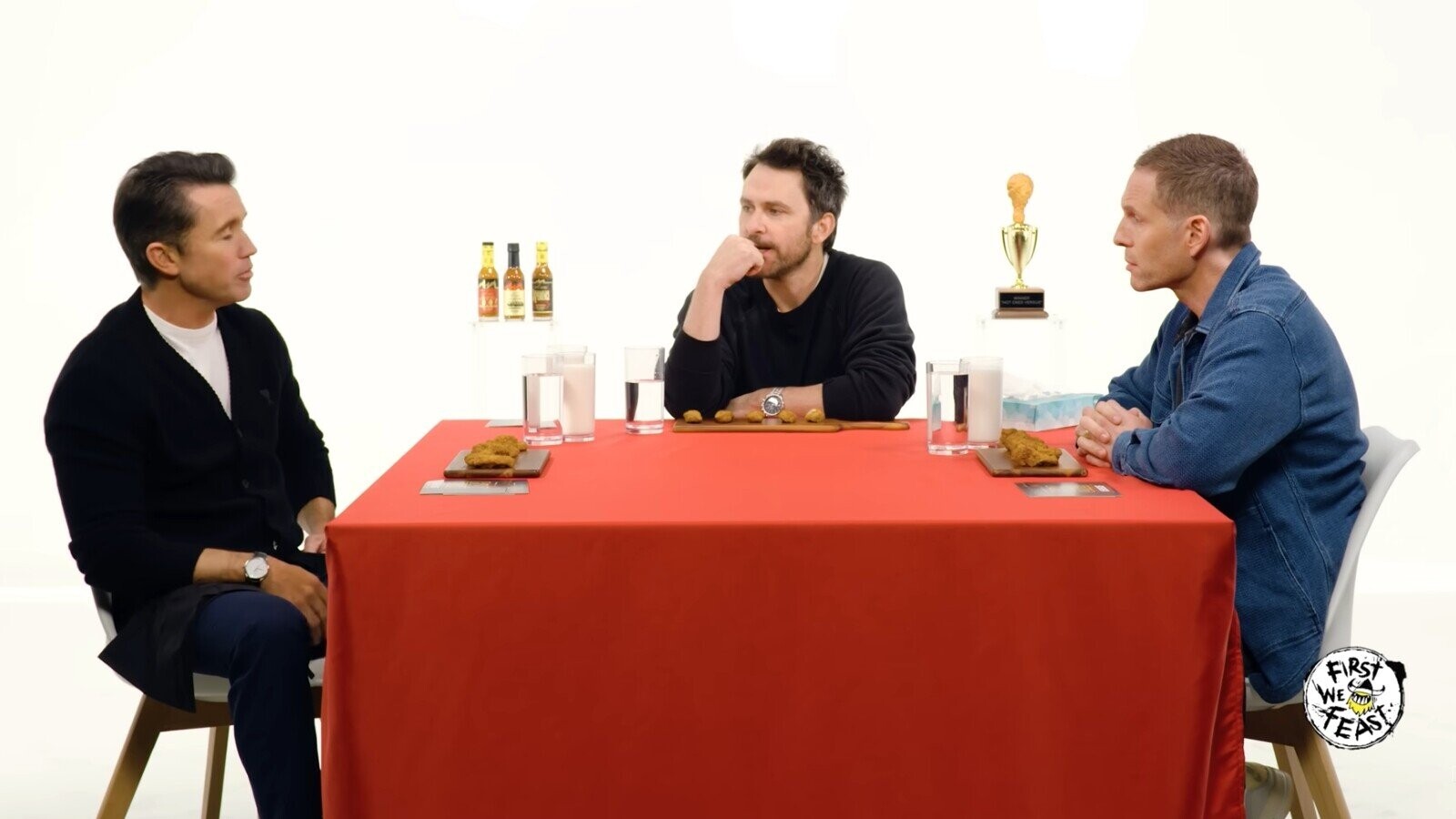
Rob McElhenney, Charlie Day and Glenn Howerton Want to Quit ‘It’s Always Sunny in Philadelphia’ Every Time They Write A New Season

Note: This article is based on real interviews, entertainment reporting, official FX information, and publicly available background about It’s Always Sunny in Philadelphia. Source links are not inserted in the publishable body.
For most television shows, the phrase “we almost quit” sounds like a crisis. For It’s Always Sunny in Philadelphia, it sounds suspiciously like a normal Tuesday in the writers’ room. Rob McElhenney, Charlie Day, and Glenn Howerton have spent two decades building one of the strangest, darkest, most stubbornly alive sitcoms in American TV history. Apparently, part of that survival ritual involves wanting to throw the whole thing into the Schuylkill River every time a new season needs to be written.
The headline is funny because it sounds dramatic. The reality is funnier because it sounds honest. During a promotional appearance tied to Season 17, the trio joked about how close they have come to calling it quits. The answer was not one single grand explosion, not a Hollywood feud, not an ominous “creative differences” press release written by a publicist in crisis mode. Instead, the answer was more human: writing a long-running comedy is exhausting, repetitive, argument-heavy, and occasionally makes even its creators wonder whether the Gang should finally lock Paddy’s Pub, toss the key into a sewer, and go become well-adjusted adults.
Of course, that would be terrible television. Nobody watches It’s Always Sunny in Philadelphia because they want the Gang to grow. They watch because Mac, Charlie, Dennis, Dee, and Frank keep discovering new ways to fail upward, sideways, and occasionally into a wall. The creators’ repeated urge to quit is not a sign that the show is broken. In a weird way, it may be one reason the show still works.
Why the “We Want to Quit” Confession Feels So Sunny
The charm of this story is that it matches the energy of the show itself. Always Sunny has never pretended to be a polished network sitcom with a moral lesson, a cozy couch, and a group hug before the credits. It is a show about five selfish people trapped in a loop of terrible ideas. The people making it, thankfully, are not those characters. But the creative process behind the series seems to involve a similar level of stubbornness, friction, and “absolutely not, we are doing it my way” energy.
Rob McElhenney, now often credited professionally as Rob Mac, created the series and has remained one of its central creative engines. Charlie Day and Glenn Howerton helped shape the show from its scrappy beginning into a full-blown cult institution. Together, they have written, acted, produced, argued, improvised, promoted, and revived the same fictional dump of a bar for longer than many real bars survive in major cities. That kind of longevity does not happen because everyone sits in a room and politely says, “Great idea, Glenn.” It happens because smart comic minds disagree, push, complain, leave emotionally, return physically, and eventually produce something deranged enough to air.
The trio’s comments about wanting to quit during the writing phase reveal something important about comedy: funny does not always feel funny while it is being made. A great Sunny episode may look loose, reckless, and half-drunk, but the writing has to be surprisingly precise. The Gang can be stupid; the scripts cannot. The characters can be chaotic; the structure has to land. That gap between apparent stupidity and actual craftsmanship is where the pain lives.
The Longest-Running Live-Action Comedy With the Shortest Fuse
It’s Always Sunny in Philadelphia premiered in 2005 on FX with a tiny budget, an aggressively unglamorous setting, and characters who seemed designed to make executives sweat through their shirts. The original creative spark came from McElhenney, Day, and Howerton making their own pilot with minimal resources. The show later added Danny DeVito as Frank Reynolds in Season 2, a move that helped turn a cult cable oddity into a comedy institution.
By the time Season 17 arrived, Always Sunny had become more than a long-running sitcom. It had become a durability test for American comedy itself. While other shows aged into nostalgia, Sunny aged into a kind of radioactive confidence. The premise stayed simple: a group of morally bankrupt friends run Paddy’s Pub in Philadelphia and regularly attempt schemes that reveal how little they understand about society, ethics, friendship, business, romance, politics, health, law, or basic human decency.
That simplicity is deceptive. The show has endured because it can absorb almost anything: recession anxiety, social media, award-show insecurity, political panic, true-crime obsession, sitcom clichés, sports culture, dating trends, and the terrifying concept of Frank Reynolds attempting romance. It is topical without becoming homework. It is offensive in a way that usually points the joke back at the characters’ ignorance rather than asking the audience to applaud it. That balance is harder to maintain than it looks, which may explain why the writers occasionally feel like walking directly into the ocean.
Glenn Howerton Came the Closest to Leaving
Among the core trio, Glenn Howerton has been the most visibly associated with the idea of leaving It’s Always Sunny in Philadelphia. Around the period leading into Season 12 and afterward, Howerton expressed concerns about whether the show had peaked and whether he had room to stretch creatively outside the series. His character, Dennis Reynolds, was even written into a potential off-ramp when Dennis left for North Dakota to be a father.
In classic Sunny fashion, that exit did not exactly become a noble farewell. Dennis returned, and the show treated his abandonment of responsibility with the icy casualness only Dennis could inspire. Behind the scenes, Howerton stepped back from the writers’ room for Seasons 13 and 14 while still appearing as an actor. Later, he resumed more of his creative involvement, pulled back by what he has described as the gravitational force of the show.
That phrase is useful. Sunny has gravity. It pulls people back because the premise is flexible, the cast chemistry is rare, and the creative ownership is unusually personal. For Howerton, Dennis is not just a role. He is a monstrous comic instrument: vain, brittle, manipulative, theatrical, and somehow still capable of surprising audiences after years of being terrible. Walking away from that kind of character is not as easy as quitting a gym membership, although Dennis would absolutely make quitting a gym membership sound like a hostage negotiation.
Rob McElhenney and Charlie Day Understand the Burnout Too
The newer twist is that McElhenney and Day have also admitted to their own moments of “maybe we are done.” That matters because it reframes the story. This is not simply Glenn Howerton versus the machine. It is three longtime collaborators facing the same creative wall from different angles.
McElhenney has carried the show’s identity from the beginning. He is creator, star, writer, producer, and the person most associated with fighting to keep Sunny strange. But even he has reportedly had moments during writing where he needed to step away. Day, meanwhile, brings a different comic rhythm: musical, frantic, absurdly specific, and often grounded in Charlie Kelly’s dirt-poor logic. If Day says the middle of a writing season is when everyone starts imagining escape, that sounds believable. The middle is where enthusiasm has worn off, the deadline is real, and every idea either feels too familiar or too insane.
The joke, of course, is that the group keeps returning. Maybe it is friendship. Maybe it is professional pride. Maybe it is money, as Day has joked. More likely, it is all of the above, plus the uncomfortable truth that creative people often complain most loudly about the work they cannot stop doing.
The Writers’ Room Is the Real Paddy’s Pub
Think of the Always Sunny writers’ room as the real-world version of Paddy’s Pub, except with laptops and fewer health-code violations. The writers gather, pitch schemes, reject each other’s logic, escalate arguments, and somehow turn bad behavior into structured comedy. The process sounds exhausting because it probably is. But it also sounds like the correct factory for this show.
Unlike many sitcoms, Sunny depends on the Gang being wrong in very specific ways. Mac cannot simply be dumb; he has to be dumb with confidence, insecurity, and a full-body commitment to whatever identity he is currently wearing like a sleeveless shirt. Charlie cannot merely be weird; his weirdness has to obey its own basement-dwelling internal law. Dennis cannot just be arrogant; he has to be terrifyingly articulate about his arrogance. Dee cannot just fail; she has to fail while believing she is the only normal person in the room. Frank cannot just be gross; he has to be gross with the spiritual freedom of a raccoon who found venture capital.
That level of character consistency takes work. Every new season asks the writers to solve the same puzzle again: How can these people remain themselves without the show repeating itself? The quitting impulse may appear when that question feels impossible. The final episodes exist because, eventually, someone finds a new door into the same horrible bar.
Why Exhaustion Can Be a Creative Filter
There is a useful lesson hiding underneath the jokes. Creative exhaustion is not always the enemy. Sometimes it functions as a filter. If an idea survives arguments, boredom, irritation, and the annual fantasy of quitting, maybe it is strong enough to become an episode.
That may help explain why It’s Always Sunny in Philadelphia has avoided becoming a soft museum version of itself. Long-running shows often become tribute bands. They repeat catchphrases, rebuild old plots, and wait for applause like a jukebox that has developed self-awareness. Sunny does use callbacks, but it also keeps testing its format. It has done musicals, bottle episodes, meta-commentaries, fake sitcom experiments, noir riffs, Ireland episodes, Super Bowl episodes, and crossovers that should not work on paper but somehow become part of the madness.
Season 17 continued that habit by leaning into pop-culture references and event-style storytelling, including the Abbott Elementary crossover. On paper, mixing the wholesome school comedy energy of Abbott with the moral sewage system of Paddy’s Pub sounds like putting a raccoon in a kindergarten class and hoping the raccoon respects the curriculum. But that tension is exactly why the idea generated attention. Sunny survives by finding new surfaces to scratch.
What Fans Should Take From the Quit Talk
Fans should not panic every time McElhenney, Day, or Howerton jokes about quitting. In a long-running creative partnership, “we are done” can mean many things. It can mean “this draft is not working.” It can mean “I need lunch.” It can mean “your idea is bad and I want history to record that I opposed it.” It can also mean “we have done this for 20 years and need to decide whether we still have something worth saying.”
The important detail is that the show’s creators appear to keep asking that question honestly. That is healthier than sleepwalking into another season simply because the brand still sells T-shirts. McElhenney has spoken in the past about a checklist: Are they still enjoying it? Are they still having fun? Are they still stretching creatively? Is the audience still there? As long as those boxes keep getting checked, the Gang keeps coming back.
That does not mean the show will last forever. Nothing does, except Frank’s confidence and maybe the smell of a closed bar at 10 a.m. But it does mean that Sunny is still being made by people who care enough to fight with the material. Strangely, that is reassuring.
The Secret Ingredient: They Still Like Each Other
The funniest part of the whole story may be the simplest: after all the arguments, the trio still seems to like one another. That is not a small thing. Hollywood is filled with creative partnerships that lasted three brilliant years and ended with lawyers communicating through carbon monoxide detectors. McElhenney, Day, and Howerton have survived youth, fame, family life, other projects, changing networks, changing comedy standards, and the burden of being associated forever with characters who should not be allowed near a blender.
Their friendship does not appear to be sentimental in a greeting-card way. It looks more like the friendship of people who know exactly how to irritate each other and have decided that irritation is part of the job. That dynamic is visible onscreen. The Gang’s chemistry feels lived-in because the actors and writers have spent years building timing together. The pauses, interruptions, glances, and sudden emotional betrayals have rhythm. You cannot fake that for 17 seasons.
Why the Show Still Matters in American Comedy
It’s Always Sunny in Philadelphia matters because it proved a sitcom could be ugly, cheap-looking, morally inverted, and still sharply written. It did not need likable heroes. It did not need a traditional romantic center. It did not need characters who learned lessons. In fact, the refusal to learn lessons became the point.
That approach influenced how audiences think about antiheroes in comedy. Before streaming made “terrible people doing terrible things” a full buffet category, Sunny was already serving the trash platter with confidence. It borrowed some DNA from Seinfeld and Curb Your Enthusiasm, then dragged that DNA through a Philadelphia alley and taught it to scream about milk steak.
The show also remains relevant because it keeps using bad characters to examine real-world absurdity. The Gang misunderstands politics, business, activism, identity, wellness, technology, and fame in ways that expose how ridiculous public conversations can become. The satire works best when viewers understand that the characters are not role models. They are warning labels with dialogue.
Specific Examples of Creative Survival
1. Dennis Leaving and Returning
Dennis Reynolds’ potential exit after Season 12 could have destabilized the show. Instead, the writers turned the uncertainty into part of the story. Dennis leaving for fatherhood sounded like growth, but his return restored the show’s core dynamic while also making the abandonment itself darkly funny. It was not graceful. That is why it fit.
2. The Meta Episodes
Episodes like “The Gang Tries Desperately to Win an Award” show how Sunny can turn industry frustration into comedy. The show has famously gone underrecognized by major awards bodies, so it made an episode about trying to become more award-friendly while remaining completely incapable of doing so. That is not just a joke; it is a mission statement.
3. The Musical Swerves
“The Nightman Cometh” remains one of the clearest examples of the show transforming nonsense into structure. Charlie’s bizarre musical could have been a throwaway gag, but it became one of the series’ defining creative moments. It worked because the show committed fully to the stupidity.
4. Season 17’s Pop-Culture Play
The later seasons show a willingness to engage with current television and culture without surrendering the show’s identity. Whether riffing on prestige TV, reality dating formats, or network crossovers, Sunny uses outside references as fuel for the Gang’s selfishness.
Experience-Based Reflections: What This Story Teaches About Creative Work
The annual desire to quit It’s Always Sunny in Philadelphia is funny, but it also feels familiar to anyone who has worked on a long creative project. The first stage is excitement. Everyone has ideas. The whiteboard is clean. Coffee tastes like ambition. Someone says, “This is going to be easy,” which is the kind of sentence that should legally require thunder in the background.
Then the middle arrives. The middle is where good ideas reveal their missing bones. The joke that sounded brilliant at dinner becomes thin on the page. The scene that made everyone laugh in conversation suddenly needs a beginning, middle, and end. People who love each other start defending tiny details with the intensity of medieval landowners. This is usually when someone says, “Maybe we should not do this.” That person is not always wrong. They are simply standing at the emotional checkpoint every serious project eventually reaches.
For a show like Sunny, that checkpoint must be brutal. Imagine trying to write new stories for characters who are designed not to evolve. Most shows can refresh themselves by letting characters mature, marry, move, have children, change jobs, or become better people. Sunny cannot rely on that. If Mac, Charlie, Dennis, Dee, and Frank became emotionally healthy, the show would be over by lunch. The writers must create the illusion of motion while keeping the moral engine beautifully broken.
That is a useful lesson for writers, business owners, artists, and anyone who has ever stared at a blank document and considered moving to a farm despite owning no farming skills. Wanting to quit does not automatically mean the work is doomed. Sometimes it means the work has reached the point where easy answers are gone. The frustration is not proof of failure; it may be proof that the project matters enough to hurt.
Another lesson is that disagreement can be productive when the collaborators trust the mission. McElhenney, Day, and Howerton do not appear to agree on everything. Good. Perfect agreement is suspicious. If three comic writers agree instantly on every joke, one of them is probably asleep or being held hostage by politeness. Comedy needs friction. Someone has to say, “That is too far.” Someone else has to say, “It is not far enough.” Then the group has to find the version that is shocking, funny, and true to the characters.
There is also a lesson in returning. The trio may joke about quitting, but they keep coming back to the room. That return is the unglamorous part of creative endurance. Not inspiration. Not genius. Not a magical muse wearing sunglasses. Just returning. Sitting down again. Reopening the document. Fixing the scene. Cutting the joke you loved because it did not work. Admitting your co-writer was right, but doing it quietly so nobody gets too much satisfaction.
In that sense, It’s Always Sunny in Philadelphia is not only a case study in sitcom longevity. It is a case study in surviving your own standards. The creators want the show to remain funny. They do not want to become a lazy version of themselves. That pressure creates burnout, but it also creates quality control. The quit impulse becomes part of the machine: a warning light that says, “Do not coast.”
Fans can laugh at the idea that the people behind TV’s most chaotic bar comedy regularly threaten to abandon ship. But they can also appreciate what the joke reveals. Every season exists because the creators reached the “we are done” moment and then found a reason not to be done. That is oddly inspiring. Very unhealthy if copied exactly, perhaps, but inspiring.
Conclusion
Rob McElhenney, Charlie Day, and Glenn Howerton wanting to quit It’s Always Sunny in Philadelphia every time they write a new season is not a scandal. It is the sound of a long-running creative engine refusing to idle. The show has lasted because its creators are not casually tossing episodes onto television like old bar peanuts. They argue with the work. They question whether it should continue. They worry about repeating themselves. Then, somehow, they return to Paddy’s Pub and find another terrible plan for the Gang.
That tension is why Sunny remains unusually alive after two decades. The people making it are tired enough to know the work is hard, proud enough not to phone it in, and connected enough to keep coming back after the latest creative explosion. In other words, they are not quitting. They are just practicing the sacred ritual of every ambitious writers’ room: threatening to quit, making jokes about quitting, briefly meaning it, and then writing the next episode anyway.