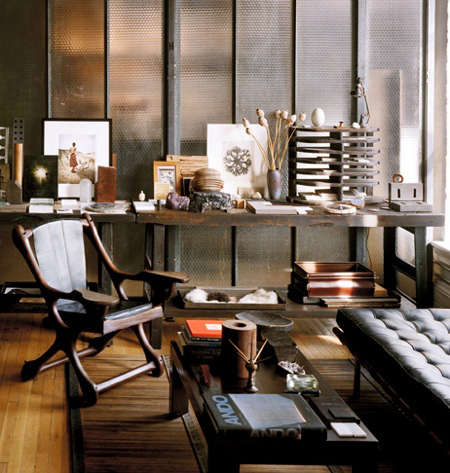

If most designers give you a room, Roman & Williams gives you a mood, a backstory, and the faint suspicion that someone glamorous just stepped out to buy flowers. Their interiors do not simply look finished. They look remembered. That is the magic trick. A Roman & Williams space can feel cinematic without turning into a movie set, luxurious without becoming brittle, and historical without smelling like a museum gift shop. In a design world that sometimes confuses “minimal” with “personality has left the building,” this studio has built a reputation on rooms that feel alive.
Founded by Robin Standefer and Stephen Alesch, Roman & Williams became one of the most influential design firms of the last two decades by refusing to choose between polish and soul. Their work moves comfortably between private homes, hotels, restaurants, retail spaces, and cultural institutions, but the through line is always the same: depth, atmosphere, material honesty, and a fascination with how people actually inhabit a place. That last point matters. Their rooms are not theoretical. They are meant to be used, touched, dimmed, leaned into, and lived with. The best of them make you want to stay for one more drink, one more chapter, one more hour.
Who Are Roman & Williams?
Before they were design-world heavyweights, Standefer and Alesch worked in film. That origin story explains a lot. They understand composition, pacing, drama, and the emotional charge of objects in space. But unlike a film set, which exists to be looked at and then struck, their interiors are built to last. Their move from Hollywood production design to real architecture and interiors gave them an unusual edge: they knew how to build atmosphere, but they also learned how to make it durable.
The firm’s name, famously borrowed from their grandfathers, sounds a little like an old law office and a little like a forgotten department store. Perfect, honestly. Roman & Williams has always excelled at creating spaces that feel steeped in time, even when they are brand-new. Their breakthrough came through residential work, but their influence exploded when they brought that layered sensibility into hospitality. Suddenly, hotels and restaurants no longer had to feel slick, anonymous, or aggressively futuristic. They could feel warm, storied, and specific.
From film logic to interior logic
You can see the cinematic DNA in how they build visual rhythm. A Roman & Williams room rarely relies on one big gesture. Instead, it develops like a scene. First you notice the light, then the patina on the metal, then the shape of a chair leg, then the way a rough plaster wall softens a polished table. The eye keeps traveling. The room keeps rewarding attention. That kind of sequencing is not accidental. It is design with narrative instincts.
The Signature Look: Old Soul, Sharp Brain
Trying to reduce Roman & Williams to a formula is a fool’s errand, but a few themes show up again and again. They love richly grained wood, warm metals, hand-finished surfaces, deeply considered lighting, and objects with visible human labor in them. They are suspicious of sterile perfection. They prefer materials that improve with age, or at least materials that are not offended by fingerprints. Brass that darkens, leather that softens, linen that relaxes, wood that shows its grain like it has nothing to hide.
They also know that nostalgia is a dangerous game. Too much of it and a room becomes costume. Roman & Williams usually avoids that trap by refusing to quote one period too literally. Instead, they pull emotional cues from many eras and recompose them into something that feels familiar but hard to pin down. It is one reason their spaces can feel timeless even when they are undeniably of the present. You sense references without getting trapped in them.
Why their rooms feel expensive in the right way
Luxury, in lesser hands, can become shiny, over-upholstered, and weirdly exhausting. Roman & Williams tends to define luxury differently. For them, luxury is not just cost. It is attention. It is proportion. It is the conviction that a hand-cast bronze pull, a beautifully turned lamp base, or the exact amber note of evening light matters. Their spaces feel expensive because so many decisions have been taken seriously, not because they are crowded with status objects waving for attention like overcaffeinated party guests.
The warmth factor
One reason people respond so strongly to the studio’s work is simple: warmth. Not just literal warm tones, though those show up plenty, but emotional warmth. Their interiors often soften urban hardness. They make large rooms feel intimate and intimate rooms feel quietly grand. There is usually some friction between rough and refined, but it is a humane friction. Nothing feels too precious to sit in. Nothing feels too aloof to enjoy.
Landmark Projects That Built the Legend
If you want to understand Roman & Williams, you have to look at the projects that pushed them into the cultural bloodstream. The Ace Hotel in New York helped define a whole era of downtown hospitality. It was influential not because it was tidy, but because it was textured, moody, and richly inhabited. It suggested that a hotel could feel like a private club, a bohemian apartment, a clubhouse, and a very stylish boarding house all at once. That approach rippled outward through hospitality design for years.
The Standard High Line and its Boom Boom Room showed a different side of the studio: glitz, theatricality, and nightlife swagger. Roman & Williams proved they were not stuck in one register. They could do grit, glamour, and gothic undertones without losing control of the room. Then came restaurants, where their instinct for mood became almost unfair. The Dutch, Lafayette, Le Coucou, and later La Mercerie all demonstrated that dining spaces could be immersive without becoming gimmicky.
The Met’s British Galleries
Perhaps the clearest evidence that Roman & Williams is more than a maker of fashionable rooms is the studio’s work on the Metropolitan Museum of Art’s British Galleries. This was not a simple decorating exercise. It required scholarship, restraint, and a nuanced understanding of narrative display. The project showed that their approach to atmosphere could succeed in a major cultural institution, where mood has to serve interpretation rather than overshadow it. In other words, they can do seduction, but they can also do discipline. That combination is rare.
RW Guild and La Mercerie
Then there is RW Guild, their Soho retail and dining concept, and La Mercerie, the adjoining restaurant that turns a meal into a tactile design argument. This may be the purest expression of the Roman & Williams worldview. Eat from the plate, then buy the plate. Sit under the lamp, then take the lamp home. Experience is not separate from object; commerce is not separated from atmosphere. In clumsy hands, that could feel like an upscale trap. In theirs, it feels like a total environment. You are not being sold a chair so much as invited into a way of seeing.
Their more recent work around Marcel at Sotheby’s extends that idea even further, blending restaurant design, art, retail, and institutional glamour into one choreographed environment. That move makes perfect sense for a studio that has always operated at the intersection of object, story, and setting.
What a Roman & Williams House Call Would Actually Look Like
Imagine the studio walking into a home. They are not starting with “What color should we paint the wall?” They are asking harder, better questions. What kind of life happens here? Where do people pause? What deserves a pool of light? Which materials will still look convincing in ten years? Which objects feel inherited, even if they are new? Roman & Williams does not treat a house like a container to be filled. They treat it like an ecosystem.
That means architecture matters. Openings matter. Thresholds matter. The feel of a stair rail matters. They tend to understand that domestic life is built from transitions as much as destinations. A hallway can have emotional weight. A breakfast nook can have ceremonial dignity. A powder room can flirt a little. Good design, in their universe, does not save all the drama for the living room.
Their homes are layered, not cluttered
There is a difference between a room with many elements and a room with too many ideas. Roman & Williams usually lands on the right side of that line because their layering is disciplined. A heavy wooden table is offset by softer upholstery. An antique note is sharpened by a cleaner silhouette. Pattern, when used, is not there to shout. It is there to deepen the room’s voice. The result is richness without chaos.
Lighting is never an afterthought
If there is one lesson homeowners should shamelessly steal from Roman & Williams, it is that overhead lighting alone is a misdemeanor. Their rooms live by lamp light, low glows, reflected surfaces, and carefully shaped illumination. They understand that people do not just see a room; they feel what the light is doing to it. A modest room with extraordinary lighting can outcharm a giant room with none. Roman & Williams has known that for years.
Design Lessons You Can Borrow Without Buying a $40,000 Bed
Good news: you do not need a museum budget or celebrity address to learn from this studio. Start with materials that age well. Swap out one disposable-looking item for something with heft, grain, or texture. Choose lighting that creates mood instead of interrogation. Mix polished and humble elements so the room has tension. Let objects breathe. Pick pieces that look like they belong to a life, not just a shopping spree.
Another Roman & Williams lesson is to stop fearing personality. A room does not need to be loud, but it should have a point of view. That point of view might come through books, art, old wood, handmade ceramics, or a single gloriously moody color. The goal is not trend compliance. The goal is resonance. Their best interiors do not say, “Look what I bought.” They say, “Here is the world I wanted to build.”
Why Roman & Williams Still Matters
Design trends move fast, often with the grace of a shopping cart rolling downhill. Roman & Williams has lasted because the firm is not just styling surfaces. It is arguing for atmosphere, craft, and emotional memory in a culture that often rewards speed and sameness. Their influence is visible across hospitality, residential design, and retail, but imitation has rarely matched the original. Plenty of rooms have copied the brass, the wood, the patina, the so-called collected look. Far fewer have captured the intelligence beneath it.
That intelligence is what makes a Roman & Williams house call feel so compelling. It is never only about beauty. It is about how beauty behaves when people start living around it.
Experiences Related to “House Call: Roman & Williams”
To understand the appeal of Roman & Williams on a more personal level, it helps to stop thinking like a critic for a moment and think like a guest. Picture walking into a home shaped by their sensibility. The first feeling is usually not “Wow, this is fancy.” It is something more physical and less polished. You exhale. The room has gravity. It holds you. The sofa looks deep enough for actual sitting, not just decorative suffering. A lamp in the corner casts a low amber circle that makes every book on the nearby shelf seem more interesting than it probably is. Somewhere, wood catches the light in a way that reminds you that trees were once involved in this process. Miraculous.
Then the details start to register. The hardware feels cool and substantial in your hand. A chair has the kind of curve that makes you wonder why so many modern chairs insist on being anti-back propaganda. There is probably a table with a surface that tells a story through its imperfections. Not damage. Character. Roman & Williams understands that people bond with texture. They know that a room becomes memorable when it offers little tactile moments that anchor you in the present.
There is also a distinct emotional effect. Their rooms often feel private, even when they are large. You can imagine conversation happening there without anyone raising their voice. You can imagine coffee in the morning, a storm in the afternoon, candles at night. That is one reason their interiors connect so deeply with people. They are not merely photogenic; they are suggestive. They imply a whole life around them. You begin to imagine yourself becoming the kind of person who writes letters, folds linen napkins correctly, or at least stops storing batteries in a random kitchen drawer.
A lot of contemporary interiors aim for clarity but end up feeling emotionally flat. Roman & Williams tends to do the opposite. Their rooms are layered enough to be intriguing, but not so crowded that you feel visually mugged. There is room for mystery. A hallway might feel slightly monastic, while a dining room glows like a set from a very tasteful old film. A bedroom might be quiet and spare, but with one dramatic gesture that keeps it from drifting into hotel blandness. Those contrasts are what make the experience stick.
What people often describe after spending time in a Roman & Williams-style environment is not just admiration but longing. They want to recreate the feeling at home, even if only in fragments. Maybe that means buying a better lamp, using heavier linen, choosing one beautiful handmade bowl instead of six forgettable ones, or finally admitting that bad overhead lighting has been the enemy all along. The experience teaches a subtle lesson: design is not about filling space with things. It is about building rituals, comfort, and memory. In that sense, a Roman & Williams house call is less about décor and more about permission. Permission to make home feel deeper, moodier, warmer, and more human.
Conclusion
Roman & Williams did not rise by chasing trends. They rose by creating rooms with pulse. Their work reminds us that beauty is more convincing when it is rooted in craft, memory, and use. Whether the setting is a hotel lobby, a museum gallery, a restaurant, or a private house, the studio’s best interiors feel inhabited before anyone even sits down. That is a rare skill, and it explains why their influence has outlasted so many design fads. A house call from Roman & Williams is not just a makeover. It is a recalibration of what a room can mean.
SEO Tags