
Interest rate cycles are the economy’s version of adjusting the thermostat: when things get too hot (inflation),
policymakers try to cool them down; when things get too cold (recession risk), they nudge the heat back up. In the
United States, that thermostat is mostly controlled by the Federal Reserve through the federal funds rate, a key
benchmark that ripples outward into everything from mortgage rates and car loans to credit cards and corporate
borrowing.
But interest rate cycles aren’t just a modern obsession for bond nerds and headline writers. They’ve been shaped by
wars, banking panics, oil shocks, financial crises, and the occasional moment when everyone collectively realizes,
“Wow, prices are going up… like, a lot.” This is a short historymeaning we’ll keep it moving, but we won’t pretend
the last century can fit on a sticky note.
What “Interest Rate Cycles” Actually Mean
An interest rate cycle is the broad pattern of rates rising and falling over time, usually driven
by the central bank’s effort to balance inflation and economic growth. Most cycles have recognizable phases:
- Tightening: rates rise to slow demand, curb inflation, and cool an overheating economy.
- Peak / Pause: policymakers stop hiking and wait for the “lag effects” to show up.
- Easing: rates fall to support growth, reduce unemployment risk, and stabilize financial conditions.
-
Floor / Unconventional era: if rates hit (near) zero, central banks may turn to tools like forward guidance
and quantitative easing (QE).
In theory, this is straightforward. In practice, it’s like trying to steer a bus using last month’s weather report.
Monetary policy works with delays, the economy constantly changes lanes, and inflation sometimes refuses to behave.
Before the Fed: When “Rates” Were Mostly a Banking Drama
Before 1913, the U.S. didn’t have a central bank with a modern mandate. Financial conditions were heavily shaped by
private banking, seasonal credit demand (especially tied to agriculture), and periodic crises. The Panic of 1907
is often cited as a key catalyst for reform: it revealed how fragile the system could be when confidence cracked and
liquidity vanished. That era’s “rate cycles” were less like a smooth wave and more like a staircase that occasionally
collapsed.
The Federal Reserve was created in 1913 to improve financial stability and provide a more elastic currency. That didn’t
magically remove cycles, but it did introduce a clearer, centralized lever for influencing short-term rates and credit
conditions.
The Early Fed and the Interwar Years: Learning by Doing
The Fed’s early decades were a trial run for modern monetary policywithout the benefit of modern data, models, or a century
of hindsight. The 1920s featured growth and innovation, but also financial excesses that culminated in the Great Depression.
The Depression era forced a rethinking of banking regulation, lender-of-last-resort responsibilities, and the broader role of
the Fed in stabilizing the economy.
Interest rate management during this period matters historically because it shaped the institution’s evolution. The central
lesson wasn’t “rates can solve everything.” It was more like: “If the financial system breaks, the economy doesn’t politely
wait for you to finish your meeting agenda.”
World War II and Yield Curve Control: When the Government Said, “Keep Rates Low.”
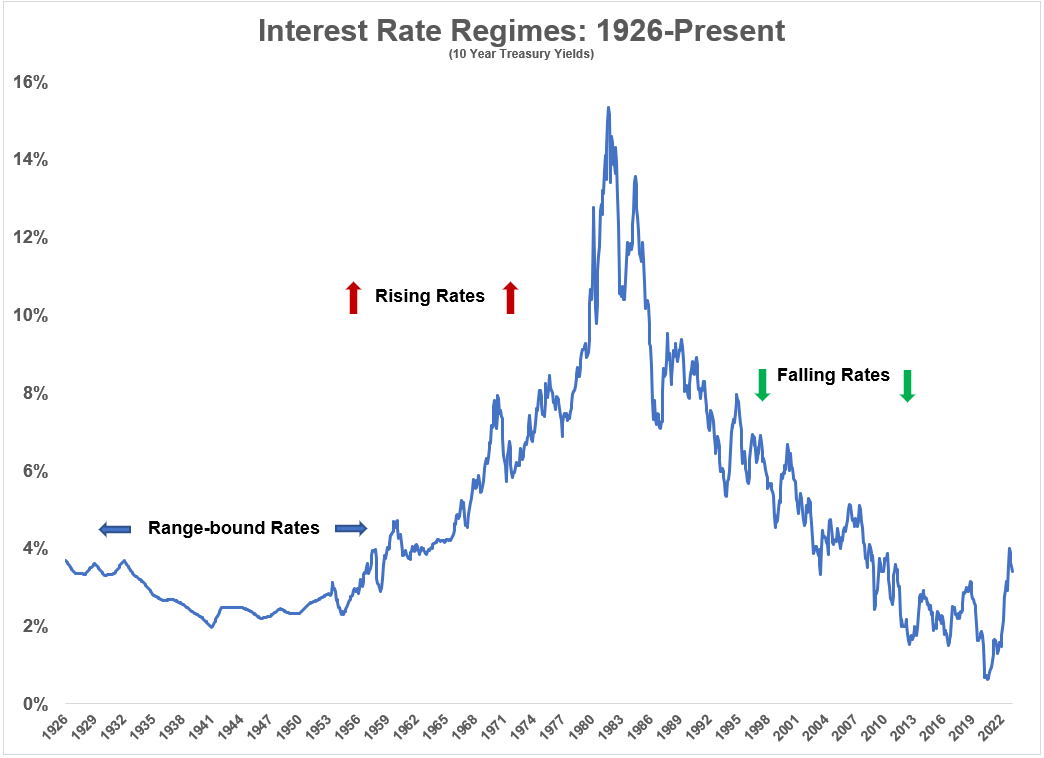
World War II financing changed the interest rate story dramatically. The U.S. needed to fund a massive war effort, and the Fed
supported the Treasury by capping yields across parts of the yield curvean early form of yield curve control.
Short-term Treasury bills were kept extremely low, and longer-term Treasury yields were capped as well.
This arrangement helped the government borrow cheaply, but it also blurred the line between fiscal needs (financing debt) and
monetary goals (controlling inflation and stabilizing the economy). After the war, inflation pressures and policy tensions grew.
The resolution arrived with the 1951 Treasury–Fed Accord, which re-established the Fed’s ability to conduct
monetary policy with greater independence from Treasury debt management. In the long run, that independence became a key ingredient
in how modern rate cycles are run: the Fed sets policy primarily based on macroeconomic conditions, not on keeping government borrowing
costs comfortable.
The Postwar Era: Building the Modern Cycle Playbook
After WWII and into the 1950s and early 1960s, the U.S. experienced strong growth and generally manageable inflation. Over time,
the Fed refined tools for influencing short-term rates via open market operations. This was also when the idea of “managing demand”
became more central to macroeconomic thinking.
Interest rate cycles in this period were increasingly tied to the business cycle: tightening when inflation or demand threatened
to run hot, easing when growth faltered. But the real stress test arrived in the late 1960s and 1970s.
The Great Inflation: When the Cycle Got Stuck on “Up”
From the mid-1960s through the early 1980s, the U.S. endured the Great Inflationa long, painful period marked by
rising and persistent inflation. Rates trended upward over time, and inflation expectations became increasingly embedded in wages,
prices, and public psychology.
A crucial point for understanding rate cycles: what matters isn’t just the level of rates, but whether rates are high enough in
real terms (after inflation) to restrain demand. If inflation rises faster than nominal rates, real rates can remain low,
which can unintentionally keep monetary conditions loose even while headline interest rates look “high.”
The 1970s also taught markets a harsh lesson: once inflation expectations become unanchored, restoring credibility can require
dramatic tightening. That brings us to the most famous tightening cycle in modern U.S. history.
Volcker and the Early 1980s: The Tightening Cycle That Became a Legend
In 1979, Paul Volcker became Fed Chair and helped shift U.S. monetary policy toward a more forceful anti-inflation stance.
The Fed adopted measures that emphasized controlling money growth and allowing interest rates to rise sharply. The result:
a brutal but effective attack on inflationalongside a severe recession and painful unemployment.
This era permanently shaped how people talk about rate hikes. “Volcker-style” tightening became shorthand for a central bank
choosing credibility over comfort. It also reinforced a core principle that still drives modern interest rate cycles:
expectations matter. If the public and markets believe inflation will come down, policy can sometimes do less.
If they don’t believe it, policy may need to do moreand faster.
The Great Moderation: Smaller Cycles, Bigger Confidence
From the mid-1980s until around the 2007–2009 period, the U.S. experienced what many economists call the Great Moderation:
relatively steadier growth, lower and more stable inflation, and less dramatic business-cycle volatility than earlier decades.
During this stretch, rate cycles often looked more measured. The Fed still hiked and cut, but in a world where inflation was lower and
expectations were more anchored, the central bank could often aim for “soft landings.” Markets became highly attuned to Fed communication.
Investors started reading statements, speeches, and even commas like they were clues in a mystery novel.
The downside of a calmer era is that it can breed complacencyespecially around financial risk. The next big chapter wasn’t triggered by
runaway inflation. It was triggered by a financial system that became dangerously fragile.
2007–2009: The Great Recession and the Race to Zero
As the financial crisis intensified, the Fed cut the federal funds rate aggressivelydropping from mid-2007 levels to a target range
near zero by late 2008. This was a defining moment for interest rate cycles because the traditional easing playbook hit a hard limit:
you can’t cut much below zero if the system is built around positive nominal rates.
Once the policy rate approached the zero lower bound, the Fed relied more heavily on “unconventional” tools:
- Forward guidance: communicating the likely future path of rates to influence longer-term borrowing costs.
- Quantitative easing (QE): large-scale asset purchases designed to lower longer-term yields and support financial conditions.
- Maturity extension: shifting the duration of holdings to influence the yield curve.
Importantly, this period expanded the meaning of “rate cycles.” The cycle wasn’t just hikes and cuts anymoreit was also about how the Fed
managed its balance sheet and guided expectations.
Normalization, Then Whiplash: 2015–2021
After years near zero, the Fed began a slow tightening process in the mid-2010s as the economy improved. Later, as growth concerns appeared,
policy shifted again toward easing. Then came 2020: the pandemic shock triggered emergency rate cuts back toward zero and a renewed wave of
asset purchases. The message was clear: when the economy falls into a sudden hole, the Fed doesn’t bring a shovelit brings a whole construction crew.
This era also highlighted how rate reminders show up in daily life. When rates are pinned near zero:
savers complain, borrowers celebrate, and anyone holding a “high-yield savings account” learns the meaning of the word “relative.”
The Post-Pandemic Inflation Surge and the Return of Old-School Tightening
After pandemic-era disruptions, inflation surged. Supply constraints, shifting demand, labor market tightness, and other factors combined to push
prices upward. The Fed responded with a rapid tightening cycle in the early 2020sbringing back a style of rate hiking that felt, to many, like
a throwback episode from the late 1970s (minus the disco, depending on your playlist).
This modern tightening cycle re-taught a classic lesson: when inflation is high, rate hikes matter not just for borrowing costs, but for
financial conditions more broadlyasset prices, credit spreads, bank lending standards, and business confidence.
Where Things Stood Entering 2026: From Peak Restriction to Easing
By late 2025, the Fed had begun easinglowering the target range for the federal funds rate to 3.50%–3.75% and signaling that
future moves would depend on incoming data, the outlook, and risk balance. That shift reflects a familiar late-cycle logic:
once inflation shows clearer signs of cooling and labor market risks rise, policy often transitions from “fight inflation at all costs” to
“don’t break the economy while you’re winning.”
The interesting twist is that rate cycles don’t exist in a political vacuum. Leadership transitions and debates about central bank independence
can add uncertainty, even when the underlying economic story is improving. In other words: sometimes the cycle is driven by inflation data,
and sometimes it’s driven by the fact that humans run institutions.
What History Suggests: Patterns That Repeat (Even If the Details Don’t)
Interest rate cycles are never identical, but a few themes show up again and again:
1) Inflation expectations are the hidden engine
When people believe inflation will fall, price-setting behavior calms down, wage demands soften, and policy can work with less drama.
When expectations slip, restoring credibility can require sharper tightening.
2) The “neutral rate” is a moving target
Policymakers talk about rates being restrictive, neutral, or accommodative. But the neutral rate (the level that neither stimulates nor slows)
changes with productivity, demographics, global savings, and risk appetite. That’s why “3%” can be restrictive in one decade and nearly neutral in another.
3) Financial stability can hijack the cycle
The Great Recession showed that a rate cycle can flip quickly when the financial system is stressed. Sometimes the Fed isn’t just adjusting demand
it’s trying to keep the pipes from freezing.
4) The long end of the yield curve has its own personality
The Fed controls a short-term policy rate, but households and businesses often borrow at longer-term rates. Those longer yields can move differently,
reflecting growth expectations, inflation forecasts, and investor demand for safety.
How to Read the Next Interest Rate Cycle Without Losing Your Mind
If you want to follow interest rate cycles like a pro (or at least like someone who doesn’t panic-scroll financial news at 2 a.m.), focus on:
- Inflation trend: not just the latest print, but the direction and breadth of price pressures.
- Labor market cooling: hiring, wage growth, participation, and unemployment claims.
- Financial conditions: credit spreads, lending standards, equity valuations, and housing affordability.
- Fed communication: statements, projections, and how officials describe risks.
- Timing and lags: rate changes take months to fully affect spending and investment.
And remember: the market is forward-looking. By the time a recession is obvious, rates have often already started moving. Rate cycles aren’t a documentary;
they’re more like live theatercomplete with improvisation.
Conclusion: The Cycle Is the StoryAnd the Story Is Always Changing
A short history of interest rate cycles is really a history of how the U.S. economy learns, forgets, and relearns the same lessons. The pre-Fed era showed
what instability looks like without a modern lender of last resort. WWII demonstrated that rates can be pinned downat a cost. The Great Inflation proved that
credibility matters. Volcker proved it can be restored, painfully. The Great Moderation made cycles feel tamer. The Great Recession expanded the toolkit.
The post-pandemic era reminded everyone that inflation isn’t “dead,” it was just taking a long nap.
If there’s one reliable takeaway, it’s this: interest rate cycles are not a simple up-and-down chart. They’re a negotiation between inflation, employment,
financial stability, and expectationsconducted in real time, with imperfect information, and watched by millions of people who would very much like their
mortgage payment to chill out.
Real-World Experiences: What Interest Rate Cycles Feel Like (500+ Words)
If you’ve ever wondered why economists talk about interest rates the way sports fans talk about playoff brackets, it’s because rate cycles don’t stay in textbooks.
They show up in regular lifequietly at first, then suddenly everywhere, like glitter.
The borrower experience: During a tightening cycle, the first place most people feel it is when they try to borrow. A friend who bought a home
“two years ago” becomes the most annoying person you knownot because they’re a bad person, but because they casually mention their low mortgage rate like it’s a
personality trait. Meanwhile, anyone house hunting learns a new emotional skill: falling in love with a property and then being politely rejected by the monthly
payment calculator.
Car loans and personal loans can get spicy too. In a rising-rate environment, you may notice the dealer’s “great financing offer” sounds less like a gift and more
like a polite shrug. Credit cards are even more brutal because many have variable APRs; when the policy rate rises, that APR can climb in the background while you’re
just trying to buy snacks and pretend it’s “budgeting.”
The saver experience: In a near-zero rate era, savers often feel like they’re being punished for being responsible. You park cash in a savings account
and earn an amount of interest roughly equivalent to finding a penny on the sidewalkexcept the sidewalk is your own bank statement. Then, as rates rise, suddenly
“high-yield savings” becomes a real category again. People rediscover CDs, money market funds, and Treasury bills like they’re new inventions, even though your grandparents
are quietly thinking, “Welcome back, kids.”
That said, saving in a rising-rate cycle comes with its own mini-drama: you lock a CD, rates go higher, and you feel like you bought concert tickets the day before
they went on sale. So people build laddersshorter maturities rolling into higher yieldsbecause rate cycles reward flexibility.
The investor experience: Bond investors live the cycle in two dimensions: yield and price. When rates rise, existing bonds can fall in price, which feels
unfair until you remember the tradeoff: higher future yields. Investors who hold bonds to maturity often care less about price swings, while those who mark-to-market watch
their portfolios like hawks. In a falling-rate cycle, the reverse can happen: bond prices rise, yields fall, and everyone acts surprised that “boring” can be profitable.
Stocks, too, feel the cycle through valuation math. Higher rates can lower the present value of future earnings, which is a fancy way of saying: the market starts acting
like it suddenly remembers the concept of gravity. When rates fall, risk appetite often returnssometimes prudently, sometimes with the enthusiasm of someone who just
discovered an app that lets them trade at lunch.
The small business experience: If you run a business, rate cycles can hit through lines of credit, inventory financing, and customer behavior. In easing
cycles, demand can pick up and financing feels cheaper. In tightening cycles, you might see customers hesitate, lenders get pickier, and cash flow management become an
Olympic sport. The irony is that the “best” policy outcomeslike a soft landingoften feel boring in real time, because boring is what stability looks like.
Ultimately, rate cycles are shared experiences. They change how people buy homes, how companies invest, how governments borrow, and how markets price risk. And while history
doesn’t hand you a cheat sheet for the next cycle, it does give you pattern recognition: the cycle turns when inflation, growth, and confidence turn. The details vary.
The human reactionshope, fear, frustration, and the occasional victory lapare remarkably consistent.