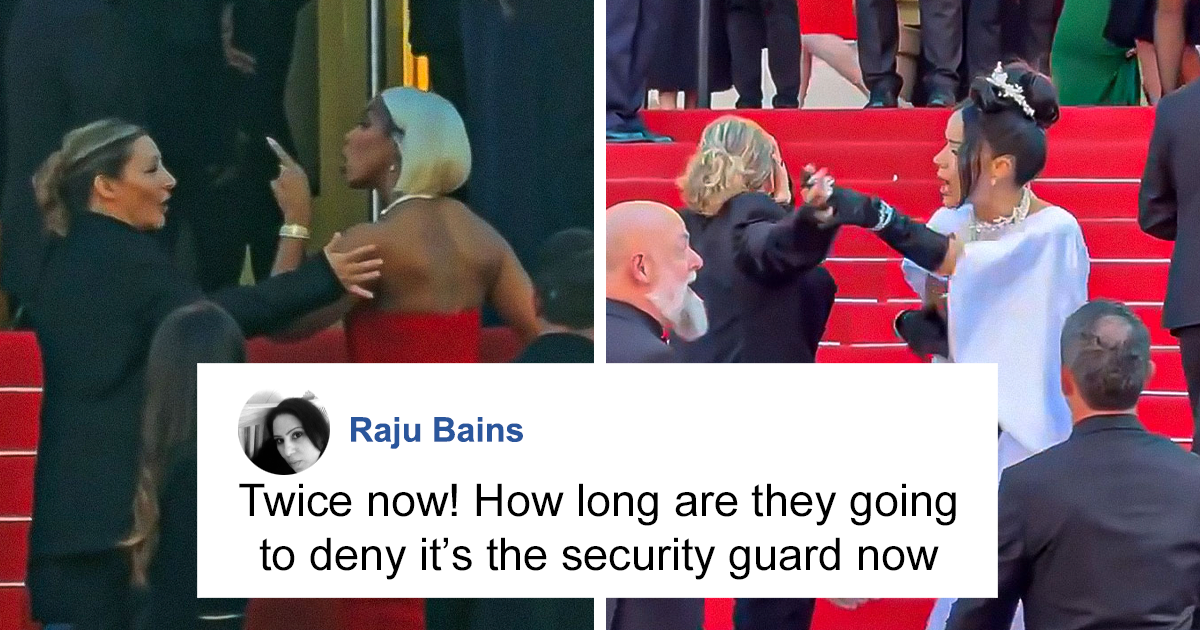
Another Spat On Cannes Red CarpetWith Same Security Guard That Scolded Kelly Rowland

The Cannes Film Festival red carpet is supposed to be the place where movie stars pause, pose, smile and somehow make climbing a staircase look like an Olympic event in couture. During the 2024 festival, however, one particular stretch of those famous red steps became better known for confrontation than choreography.
Just days after Kelly Rowland’s tense exchange with a female Cannes staff member went viral, Dominican actress, television personality and former beauty queen Massiel Taveras was filmed having another heated encounter with what multiple outlets identified as the same security guard.
Taveras had arrived with an outfit practically designed to make photographers hit the shutter button until their fingers complained. Its enormous train displayed an image of Jesus Christ, making it less of a conventional gown and more of a portable piece of dramatic religious art. When Taveras attempted to arrange the train for photographs, security personnel kept trying to move her toward the entrance.
What followed was awkward, physical and instantly perfect fuel for the internet.
What Happened Between Massiel Taveras and Cannes Security?
The incident occurred on May 22, 2024, when Taveras attended the Cannes premiere of The Count of Monte Cristo, the lavish French adaptation of Alexandre Dumas’ classic novel directed by Matthieu Delaporte and Alexandre de La Patellière.
Taveras walked the red carpet wearing a dramatic Giannina Azar creation with a lengthy train featuring a large depiction of Jesus Christ. She later said the design included thousands of Swarovski crystals. Whatever one’s opinion of the fashion statement, subtle it was not.
Video from the carpet showed Taveras attempting several times to spread out the train so photographers could capture the full design. Members of the festival staff, meanwhile, appeared focused on keeping her moving up the Palais des Festivals staircase.
That basic conflictI need a few seconds to display my dress versus please keep walkingquickly escalated.
Security personnel picked up portions of the train as Taveras moved upward. The female staff member who had already become recognizable from Kelly Rowland’s viral Cannes exchange held out an arm while directing Taveras toward the theater entrance.
Taveras repeatedly attempted to turn toward photographers. Near the top of the stairs, as the staff member continued blocking and guiding her forward, Taveras pushed the woman’s arm away. At another point, her hand appeared to move toward the staffer’s face while she protested the way she was being handled.
It was hardly the traditional Cannes combination of champagne, couture and sophisticated air-kissing.
Why the Security Guard Looked Familiar
The confrontation immediately attracted additional attention because viewers recognized the female usher from another Cannes red carpet video involving Kelly Rowland.
Kelly Rowland’s May 21 Red Carpet Incident
One day earlier, Rowland was attending the premiere of Christophe Honoré’s Marcello Mio. Footage showed the former Destiny’s Child singer smiling and posing before beginning her ascent up the famous staircase.
As Rowland climbed, festival staff appeared to encourage her to keep moving. During the interaction, a member of the security team appeared to step on the train of Rowland’s red gown. The female usher continued walking closely behind her and gesturing her forward.
Rowland suddenly turned around and addressed the staff member directly. Photographs captured her pointing a finger during the increasingly tense conversation.
Because the widely shared clips contained little or no usable audio, social-media users spent hours attempting to determine exactly what had been said. Predictably, amateur lip-reading became the internet’s newest unpaid profession.
Rowland later provided the more important explanation herself.
Speaking to Associated Press entertainment reporters at the amfAR gala on May 23, Rowland emphasized that she believed a personal boundary had been crossed. She said she had stood her ground and also raised concerns about whether she had been treated differently from other women on the carpet who did not look like her.
Her comments transformed the viral clip from ordinary celebrity-versus-security gossip into a wider discussion about respect, race, personal space and how event staff interact with high-profile guests.
Massiel Taveras Publicly Supported Kelly Rowland
After footage of her own encounter spread online, Taveras shared posts concerning Rowland’s confrontation and publicly expressed support for her.
Her message centered on respect and solidarity. Taveras suggested that people should speak up when they believe boundaries are being violated rather than quietly accepting treatment they consider inappropriate.
In a later interview, Taveras said she had wanted photographers to capture the religious imagery on her dress and felt security interfered with that moment. She framed her reaction as standing up for herself and for the message represented by the gown.
That does not establish why the usher acted as she did. It does, however, explain why the incident meant more to Taveras than simply losing a few seconds of posing time.
Then Yoona Entered the Cannes Security Conversation
The controversy grew again when footage circulated showing South Korean singer and actress Im Yoon-ah, widely known as Yoona of Girls’ Generation, interacting with the same female staff member.
Yoona was walking the staircase in a pink gown and appeared ready to pause and acknowledge photographers or spectators. The usher extended an arm and continued directing her toward the entrance.
Unlike the exchanges involving Rowland and Taveras, the interaction did not become openly confrontational. Yoona continued moving, although viewers interpreted her facial expression as surprise or frustration.
Fans quickly connected all three videos.
The fact that Rowland, Taveras and Yoona are women of color led some online commenters to accuse the security worker of racial bias. Rowland herself had already questioned whether appearance and race contributed to the difference in treatment she perceived.
Still, the available public videos cannot independently prove the motivation of the staff member. That distinction matters. A pattern can reasonably raise questions without automatically providing an answer.
Sawa Pontyjska Added an Even More Serious Allegation
The story became more complicated when footage involving Ukrainian model and presenter Sawa Pontyjska surfaced.
Video showed Pontyjska in a physical struggle with festival personnel near the top of the red-carpet stairs. The same female security worker appeared to restrain her with both arms while Pontyjska attempted to move away.
Pontyjska later alleged that she had been mistreated and pursued legal action against the festival, seeking damages for what she described as physical and psychological harm.
Those allegations significantly raised the stakes. What had initially looked like an isolated celebrity disagreement now included several separate encounters involving the same highly visible section of the Cannes arrival process.
The Other Side: Cannes Security Works Under Extraordinary Pressure
It is easy to watch a 15-second social-media clip and conclude that someone is obviously right and someone else is obviously wrong. Real event management is rarely so cooperative.
Cannes is not an ordinary movie premiere. Tens of thousands of accredited visitors attend the festival, while hundreds of hospitality employees and security personnel manage entrances, screenings, stars, press crews and large crowds.
The Palais staircase is essentially a glamorous traffic-management system covered in red carpet.
Timing matters. Films have scheduled screenings. Cast members arrive in groups. Photographers need clear sightlines. Large gowns create physical obstacles. Security teams must prevent bottlenecks while simultaneously allowing enough time for the photographs that make Cannes one of the most internationally recognizable entertainment events on Earth.
People described as colleagues of the unidentified usher defended her in press reports, saying she was working under significant pressure and was responsible for maintaining traffic flow and the event timetable. They rejected accusations that discriminatory motives were behind her behavior.
That perspective deserves inclusion even if it does not automatically excuse every physical interaction captured on video.
Why Cannes Red Carpet Timing Is Such a Big Deal
The Cannes staircase has become almost as famous as some of the movies shown inside the building. The ritual involves dozens of photographers positioned to capture guests as they climb toward the Grand Théâtre Lumière.
The result is an unavoidable contradiction.
Guests are invited to wear extravagant designer clothing partly because photographs generate enormous publicity for celebrities, designers, jewelry houses and the festival itself. Yet those same guests cannot remain indefinitely on the stairs because hundreds of other people must pass through.
A dramatic train makes fabulous photographs. It also makes terrible pedestrian infrastructure.
Cannes later made its stance on extremely voluminous outfits considerably clearer. Updated festival guidance has explicitly restricted outfits with unusually large trains when they interfere with guest circulation or theater seating. While those later rules should not be retroactively treated as the explanation for every interaction in 2024, they illustrate the logistical problem organizers face.
Red Carpet Boundaries Versus Red Carpet Protocol
The Kelly Rowland and Massiel Taveras controversies ultimately revolve around two legitimate concepts colliding with each other: event control and individual boundaries.
Security Personnel Need Guests to Move
Large events cannot function if everyone stops wherever they please. Ushers have to give directions, control crowds and occasionally be firm with people who are reluctant to move.
Guests Still Deserve Personal Space
Being famous does not erase someone’s right to object to unnecessary touching. Even when staff members have legitimate instructions to deliver, how those instructions are communicated matters.
An open hand indicating a direction is different from prolonged physical contact. A calm verbal request is different from aggressively crowding someone. The problem is that viral videos often begin after tensions have already developed, leaving audiences to reconstruct the missing seconds from facial expressions and body language.
Why the Massiel Taveras Video Went So Viral
The clip contained virtually every ingredient required for internet combustion.
- A globally famous red carpet.
- An enormous religiously themed designer gown.
- A recognizable security worker from an earlier viral confrontation.
- A physical dispute caught from multiple camera angles.
- A celebrity determined to pose for photographers.
- An existing debate involving Kelly Rowland and race.
Social media hardly needed an invitation.
Users slowed the footage down, compared different celebrities’ treatment, analyzed the guard’s arm movements and debated whether Taveras was protecting her boundaries or unnecessarily escalating an already tense situation.
Others argued that security personnel were simply trying to perform an unusually difficult job while celebrities attempted to maximize their limited time in front of photographers.
Both interpretations contain reasonable points, which is exactly why the story survived beyond one news cycle.
The Bigger Lesson About Viral Celebrity Confrontations
Red carpet videos create a powerful illusion of completeness. Viewers see clear faces, physical gestures and dramatic reactions, so it feels as though the entire event has been documented.
Usually it has not.
A camera might capture the shove but not the warning that preceded it. Another angle might show a staff member reaching toward someone without revealing whether that person had previously been asked repeatedly to move.
Likewise, security pressure does not mean every physical intervention is automatically reasonable.
The sensible approach is to separate observable facts from interpretation. Taveras tried to display her train. Staff repeatedly directed her forward. Physical contact occurred. She pushed the usher away. Those elements are visible.
Why individual people acted exactly as they did requires more caution.
Experiences and Practical Lessons From the Cannes Red Carpet Spats
Anyone who has attended, organized or even closely observed a major public event will recognize the uncomfortable dynamic behind the Cannes controversy: the person experiencing the moment and the person managing the event are operating according to completely different clocks.
For a guest, the red carpet may be a once-in-a-career opportunity. Months of planning can go into the dress, styling, makeup, jewelry and publicity strategy. A celebrity may have traveled thousands of miles knowing that thirty seconds of good photographs can circulate around the world.
For an usher, those same thirty seconds may represent a delay multiplied by another 100 arrivals.
This is why seemingly small interactions can become surprisingly emotional.
Imagine spending weeks preparing a custom gown specifically designed around a dramatic train. You reach the most photographed staircase in cinema, unfold it and finally turn toward the cameras. Before photographers capture the image you planned, someone immediately gathers the fabric and tells you to continue walking.
Frustration is understandable.
Now imagine being responsible for keeping that staircase clear while photographers encourage every guest to stop, turn around, wave again and perform one final pose. A screening is approaching, more cars are arriving outside and supervisors are telling you not to allow traffic to stall.
Your frustration is understandable too.
The experience suggests that better communication before guests ever reach the carpet could prevent many confrontations. Celebrities wearing unusually complicated outfits could be briefed about where they are permitted to stop and how long they have. Security personnel could be instructed to rely on clear verbal cues and directional gestures before physical guidance except when safety genuinely requires intervention.
Another useful lesson involves personal space. Event professionals routinely work close to celebrities because stairs, dresses and crowds create hazards. But repeated contact around someone’s back, shoulders, head or chest can easily feel intrusive, especially when that person is already signaling discomfort.
A guest saying noor physically moving away from contactshould be treated as meaningful information, not an obstacle to overcome.
The incidents also demonstrate why watching an entire sequence matters before judging a viral clip. Social platforms reward the three seconds that look outrageous, not the thirty seconds that explain them. One video may make a celebrity appear aggressive. A longer version may show repeated unwanted contact. Another camera angle may reveal staff managing a genuine obstruction.
The best habit for viewers is surprisingly simple: resist becoming a courtroom jury after watching one looping GIF.
Finally, the Cannes episodes offer a useful lesson for organizations. A single uncomfortable incident can be dismissed as a misunderstanding. When several videos involving the same employee or procedure emerge, management should examine the process even if the employee was technically following instructions.
The question is not merely, “Did the worker break a rule?” It is also, “Why does our system keep producing conflict?”
That distinction is important in hotels, airports, concerts, luxury events and film festivals alike. Procedures can be technically correct yet poorly designed for human behavior.
Celebrity red carpets may exist in a fantasy world of diamonds and couture, but the underlying lesson is wonderfully ordinary: give people clear expectations, respect physical boundaries and avoid turning a staircase into a wrestling subplot.
Conclusion
The 2024 Cannes Film Festival produced extraordinary movies, major premieres and plenty of glamorous fashion, but one of its most persistent viral stories happened before audiences even reached their seats.
Massiel Taveras’ confrontation with the female Cannes security worker became noteworthy because the same staff member had already been involved in Kelly Rowland’s widely discussed exchange. Subsequent footage involving Yoona and Sawa Pontyjska intensified scrutiny of how guests were being moved through the red carpet area.
Rowland publicly questioned whether she had received different treatment and emphasized her right to maintain personal boundaries. Taveras similarly argued for respect and defended her decision to stand her ground. At the same time, accounts defending the usher stressed the considerable pressure placed on Cannes personnel to maintain security, schedules and crowd movement.
The available evidence does not provide a simple answer about motive. What it does reveal is a recurring collision between strict event logistics and people who felt their personal space or red carpet moment was being unnecessarily controlled.
And perhaps that is the strangest irony of the entire Cannes red carpet spat: an event built around carefully directing everyone’s attention toward the stars accidentally made an anonymous usher one of the festival’s most talked-about figures.
SEO Data