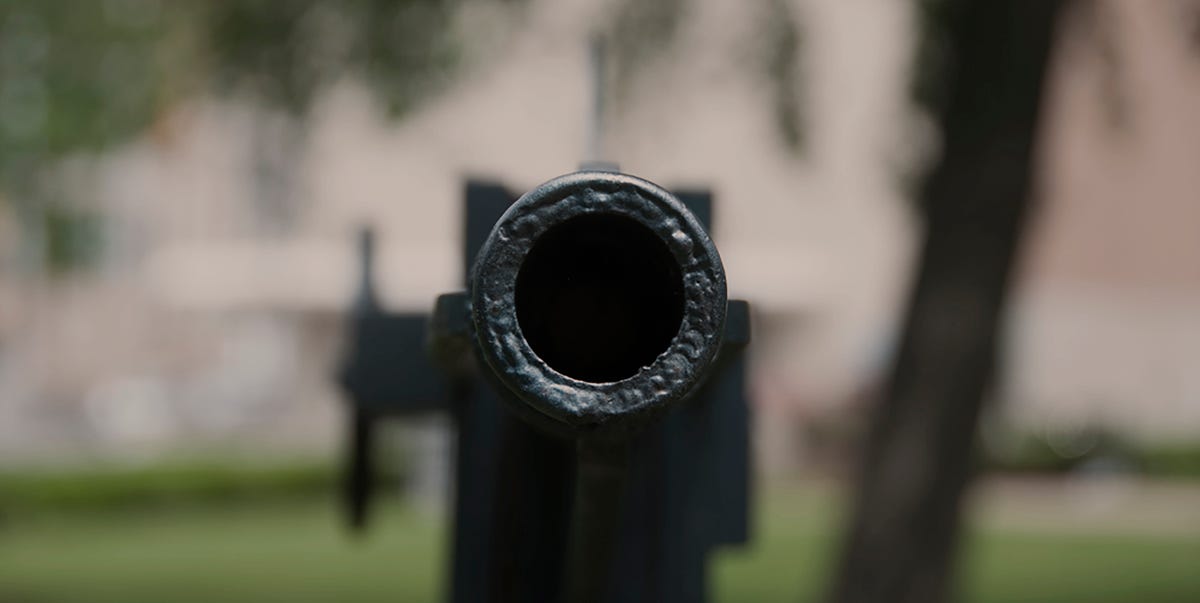

Some archaeological discoveries announce themselves with glittering gold, royal tombs, or a skeleton posed dramatically enough to make a museum curator spill coffee. Others arrive looking like a heavy, mud-covered tube on the floor of an old structure. That was the case in southern Arizona, where archaeologists uncovered what researchers describe as the oldest firearm ever found in the continental United States: a bronze wall gun linked to Francisco Vázquez de Coronado’s 1539–1542 expedition.
The phrase “oldest gun ever found in America” may sound like the opening line of a history-channel cliffhanger, but the discovery is very real. The artifact is not a revolver, rifle, or anything that looks like the firearms people imagine from Western movies. It is a 16th-century bronze cannon-like weapon, often called a wall gun, hook gun, hackbut, or rampart gun. Measuring about 42 inches long and weighing around 40 pounds, it was portable only in the same way a stubborn toddler is portable: technically movable, but not something you want to carry very far without help.
Found at the site of San Geronimo III, also known as Suya, in the Santa Cruz Valley near present-day Nogales, Arizona, the wall gun offers a rare physical connection to one of the earliest European expeditions into what is now the American Southwest. More importantly, it tells a bigger story about ambition, conflict, Indigenous resistance, early colonial technology, and the surprising way a single artifact can redraw the edges of history.
What Exactly Did Archaeologists Find?
The discovery was a bronze wall gun associated with the Coronado expedition, a Spanish entrada that moved north from New Spain in search of the legendary Seven Cities of Cíbola. Researchers Deni J. Seymour and William P. Mapoles published the find in the International Journal of Historical Archaeology, identifying the object as the first gun known to be connected to Coronado’s expedition and the oldest firearm recovered within the continental United States.
The weapon was found on the floor of a Spanish stone-and-adobe structure at San Geronimo III. That detail matters. Archaeologists do not simply point at an old object and say, “Yep, looks ancient enough.” Context is everything. The structure, the artifacts around it, the dating methods, and the broader historical record all helped connect the wall gun to the mid-1500s.
A Gun, a Cannon, or Both?
Calling the artifact a “gun” can be confusing because modern readers often picture a handheld weapon. This object is better understood as a small artillery piece. It was larger than a musket but smaller than a cannon mounted on a carriage. It could have been fired from a wall, rampart, tripod, tree fork, or another improvised support. In other words, it was the 16th-century version of “bring the heavy equipment, but make it expedition-friendly.”
Researchers describe it as a bronze, sand-cast weapon. Its plain design suggests it may have been produced in Mexico or the Caribbean rather than in a highly decorative European foundry. The casting marks, practical construction, and lack of ornamentation make it feel less like a royal showpiece and more like a working tool carried into difficult territory.
Why the Arizona Discovery Is So Important
The oldest gun ever found in America is not important simply because it is old. Plenty of old objects spend centuries underground without rewriting anything except a museum label. This wall gun matters because it connects several major historical threads in one compact artifact.
It Links Directly to the Coronado Expedition
Francisco Vázquez de Coronado led one of the most famous Spanish expeditions into North America. Beginning in 1540, his forces traveled through parts of what are now Arizona, New Mexico, Texas, Oklahoma, and Kansas while searching for wealth that did not exist in the way Spanish officials imagined. The rumored cities of gold turned out to be Pueblo communities, not treasure-loaded kingdoms waiting politely to be conquered.
For historians, the Coronado expedition has long been known through documents, chronicles, and scattered archaeological clues. A firearm tied to that expedition gives researchers a tangible object from the journey. It is not just “Coronado was here” written in a textbook. It is a 40-pound bronze reminder that people brought European military technology into a landscape already home to complex Indigenous societies.
It Sheds Light on San Geronimo III
San Geronimo III was a short-lived Spanish settlement in the Santa Cruz Valley. It was not a grand colonial city with plazas, cathedrals, and dramatic oil paintings waiting to happen. It was more like a vulnerable outpost, built during a risky campaign far from the comfort zone of Spanish power.
The site appears to have been attacked, and researchers connect that conflict with the Sobaipuri O’odham, an Indigenous community in the region. Archaeological evidence suggests the Spanish fled quickly, abandoning weapons and belongings. If history had a soundtrack, this would be the part where the confident brass section abruptly switches to panic flutes.
How Archaeologists Connected the Gun to the 1500s
One of the best things about archaeology is that it does not rely on a single “trust me, bro” clue. To connect the wall gun to the Coronado expedition, researchers looked at multiple forms of evidence.
Dating the Structure and Site
The stone-and-adobe structure where the gun was found was dated using scientific techniques, including radiocarbon dating and optically stimulated luminescence. These methods helped place the building within the period of the Coronado expedition. When the dating of the structure lines up with the artifact type and the historical record, the case becomes much stronger.
Matching the Artifact to Expedition-Era Equipment
The wall gun’s design fits the period. It was a type of lightweight artillery that could be transported during an overland expedition. Coronado’s group had to move people, animals, weapons, food, and supplies across rough terrain. A full-size cannon would have been wildly impractical. A smaller bronze wall gun, however, could be carried by people or animals and used for defense at temporary settlements.
The Surrounding Evidence
The site also produced other artifacts associated with Spanish expedition life, including weapon fragments and everyday items. Archaeology works best when objects speak in chorus. A single artifact can be intriguing; a whole pattern of objects in the right place and period becomes persuasive.
The Mystery: Why Was the Gun Left Behind?
Here is where the story becomes especially interesting. The wall gun was found unloaded and, according to reports, showed no clear evidence of having been fired in the battle. That raises a deliciously frustrating archaeological question: why would Spanish forces abandon such a valuable weapon?
One likely explanation is speed. If the settlement was attacked suddenly, the people responsible for using the gun may not have had time to load and fire it. A 40-pound wall gun is not exactly something you casually tuck under one arm while sprinting away. In a chaotic retreat, survival beats equipment recovery every time.
Another cannon found later at the site may tell a different story. Reports indicate a second cannon had damage suggesting it may have been fired and failed, possibly during the same violent episode. Together, the two weapons hint at a settlement overwhelmed quickly enough that even powerful European technology could not guarantee safety.
What the Oldest Firearm in America Reveals About Early Contact
This discovery is not just a “cool old gun” story. It is a contact-period story, and those are rarely simple. The Coronado expedition was driven by ambition, religious mission, imperial competition, and the fantasy of gold-rich cities. Indigenous communities, meanwhile, were not passive background characters in someone else’s adventure novel. They defended their homes, negotiated, resisted, adapted, and survived.
The wall gun reveals the imbalance of technology that Spanish expeditions attempted to bring into the region. But the abandonment of that same gun reveals the limits of technology. Bronze, gunpowder, horses, armor, swords, and crossbows did not automatically create victory. In the case of San Geronimo III, the evidence points toward Spanish defeat and retreat.
A Reminder That “Discovery” Is Complicated
It is tempting to describe Coronado and his men as “discoverers,” but that word can flatten the truth. The lands they entered were already known, named, farmed, traveled, defended, and remembered by Indigenous peoples. From an Indigenous perspective, the Spanish were not discovering a vacant world. They were arriving, often violently, in someone else’s homeland.
That is why the oldest gun ever found in America is more than a technological milestone. It is also evidence of early colonial conflict and Native resistance. The artifact helps historians move beyond romantic treasure-hunting narratives and toward a fuller picture of what the 1500s looked like on the ground.
Why Was Coronado Searching for the Seven Cities of Gold?
The background sounds almost like a medieval rumor that got out of hand because nobody had invented fact-checking yet. Spanish officials in New Spain heard stories about wealthy northern cities known as Cíbola. Earlier reports by Fray Marcos de Niza helped fuel the belief that rich settlements lay somewhere beyond the northern frontier.
Viceroy Antonio de Mendoza selected Coronado to lead an expedition north. The goal was partly exploration, partly conquest, partly missionary expansion, and partly the age-old human habit of hearing “gold” and suddenly becoming very interested in geography.
Coronado’s expedition did reach Pueblo communities, including Hawikuh, but the golden cities of Spanish imagination were nowhere to be found. The expedition continued across vast distances, eventually reaching the Great Plains. It became one of the most far-reaching journeys of the 16th-century Spanish borderlands, but as a treasure hunt, it was a spectacular disappointment.
The Wall Gun as a Piece of Technology
The bronze wall gun was practical, heavy, and intimidating. It was probably designed for defense rather than casual movement. Unlike ornate European cannons, this one appears plain and utilitarian. That simplicity helps researchers think about where it may have been made and how it might have been used.
Sand casting was a common way to produce metal objects. Molten bronze would be poured into a prepared mold, then finished after cooling. Marks left from the casting process can help researchers understand manufacture. In this case, the rougher details suggest a weapon made for use, not display.
Portable, But Only Technically
The gun’s size tells us something about expedition logistics. A 42-inch, 40-pound bronze tube does not stroll through the desert by itself. It required planning, animals, people, and a reason strong enough to justify hauling it through difficult country. Its presence at San Geronimo III shows that the Spanish expected danger and wanted a defensive tool powerful enough to protect a fragile settlement.
Yet the same object also shows the limits of planning. The gun may have been impressive, but it was abandoned. That contrast is what makes the discovery so human. History is full of people preparing for one kind of problem and then being surprised by another.
How the Discovery Changes the Story of American Archaeology
Before this find, the physical evidence for Coronado’s expedition was scattered and often debated. A firearm connected to San Geronimo III gives scholars a powerful data point. It strengthens the case for the site’s connection to the 1541 settlement and provides a rare surviving example of early European weaponry in what is now the United States.
The discovery also invites more careful public conversation. The phrase “oldest gun ever found in America” attracts attention, but the real value lies in what the object reveals: migration, myth, violence, technology, and resistance. It shows that the American Southwest was connected to global currents of empire and warfare much earlier than many casual readers realize.
Common Questions About the Oldest Gun Ever Found in America
Was it really the oldest gun in the United States?
Researchers identify it as the oldest firearm ever found within the continental United States. Because archaeological claims depend on available evidence, future discoveries could change the record, but this wall gun currently holds extraordinary importance.
Was the gun found by accident?
The discovery happened during archaeological investigation, including metal detector survey and excavation. “Accidentally” works in the sense that the team did not know such a rare firearm was waiting in that exact spot. Archaeology often combines careful planning with moments of surprise, which is why fieldwork can feel like detective work with more dust.
Where was it found?
It was found at San Geronimo III, or Suya, in the Santa Cruz Valley of southern Arizona near present-day Nogales.
Who used it?
The wall gun is associated with the Spanish expedition led by Francisco Vázquez de Coronado. It was likely part of the equipment used to defend the expedition’s temporary settlement.
Did it fire during battle?
The first cannon reported from the site appears to have been unloaded and unfired during the conflict. That detail suggests the attack may have happened too quickly for the weapon to be prepared and used.
Experience: What This Discovery Feels Like From the Ground
Imagine standing in the Santa Cruz Valley, where the desert light can make ordinary stones look like they are keeping secrets. The landscape is open, dry, and deceptively quiet. At first glance, it may not seem like the kind of place where a world-changing archaeological object would appear. There are no neon signs blinking “500-year-old cannon this way.” There is only earth, fragments, heat, and the patience to look closely.
That is what makes the discovery so compelling. Archaeology is not always dramatic in the movie sense. Nobody necessarily swings across a canyon, dodges a collapsing temple, or solves a riddle carved into a skull-shaped door. Most of the time, the work is careful, repetitive, and humble. You survey. You map. You dig. You document. You brush dirt from surfaces that may or may not matter. You try not to get sunburned into becoming part of the site record yourself.
Then something changes. A metal detector signal, a shape in the soil, a surface that does not belong to the surrounding rubble. At first, a large bronze object might be confusing rather than thrilling. Is it modern junk? A pipe? Farm equipment? Some deeply inconvenient mystery? Only through context does the excitement grow. The location, the structure, the material, the form, and the dating begin to line up. The object stops being “heavy old metal” and becomes a witness.
For anyone interested in history, that moment is electric. The wall gun is not just an artifact you observe from a safe intellectual distance. It pulls the 1540s into the present. Suddenly, Coronado’s expedition is not a paragraph in a school textbook. It is people sweating through Arizona, hauling supplies, hoping rumors of wealth were true, building a fragile settlement, and confronting communities who had every reason to resist intrusion.
The most powerful experience connected to this topic is the realization that artifacts do not speak with only one voice. To one person, the wall gun may represent early firearm technology in North America. To another, it represents Spanish colonial ambition. To another, it marks Indigenous victory and survival. To a field archaeologist, it may also represent years of patient work finally rewarded by a discovery that makes every mosquito bite and dust-filled boot feel worthwhile.
Visiting or studying a site like San Geronimo III also teaches restraint. The goal is not to turn the past into a simple adventure story. The goal is to listen carefully. A bronze gun found abandoned on a floor says something about fear. It says something about speed. It says something about plans falling apart. It also says something about the people who forced those plans to fail. The Spanish brought metal, animals, weapons, and imperial confidence. The Sobaipuri O’odham and other Indigenous peoples brought knowledge of the land, community organization, courage, and the will to defend their world.
That is why this discovery stays with people. It is exciting, yes. It is old, rare, and headline-friendly. But beneath the novelty is a deeper lesson: history is not buried because it is gone. It is buried because we have not yet learned where to look, how to ask, or how to recognize what the ground has been holding all along.
Conclusion
The accidental discovery of the oldest gun ever found in America is far more than a curious archaeological headline. The bronze wall gun from southern Arizona connects the Coronado expedition to a real place, a real conflict, and a real moment when European colonial ambition met Indigenous resistance. Its size, age, manufacture, and abandonment reveal how difficult and dangerous early expeditions could be, even for forces equipped with advanced weaponry.
In the end, the most fascinating part of the story is not that the Spanish brought a gun. It is that the gun was left behind. That abandoned bronze artifact turns a dusty floor in Arizona into a powerful historical document. It reminds us that the past is rarely as simple as myths of gold, conquest, or discovery. Sometimes, it is a 40-pound wall gun lying silent for nearly 500 years, waiting for archaeologists to ask the right questions.