Ariana Grande Reveals This Sweet ‘Wicked’ Nod Is Her Way of Coming “Full Circle”

Note: This original article is written for web publishing and synthesizes publicly reported information about Ariana Grande, Wicked, Glinda, and the emotional meaning behind her full-name credit.
Ariana Grande has spent years being known by a name that needs no extra decoration. Say “Ariana” in a room full of pop fans, theater kids, or people who have ever attempted a whistle note in the shower, and everyone knows exactly who you mean. But when Wicked arrived on the big screen, Grande chose to step into the credits with something more personal: Ariana Grande-Butera.
It may look like a small detail, the kind of thing only eagle-eyed fans pause the credits to spot. Yet for Grande, the name was not a branding decision or a Hollywood flourish. It was a quiet, sentimental nod to the little girl who first fell in love with Wicked long before she became one of the world’s biggest pop stars. In interviews surrounding the film, Grande explained that using her full birth name felt like a way to honor her younger selfthe child who saw the musical at age 10 and carried that dream for years.
That is why this “Wicked” nod feels so powerful. It is not loud. It is not dressed in glitter, though Glinda would certainly approve. It is a name, placed at the end of a movie, carrying the weight of childhood dreams, family roots, artistic growth, and a career that has looped back to where the magic began.
Why Ariana Grande Used Ariana Grande-Butera in the Wicked Credits
In the Wicked film credits, Ariana Grande appears as Ariana Grande-Butera, her full birth name. Grande has explained that this choice was deeply tied to the emotional nature of the project. She described it as her “little girl name,” the name she had when she first experienced Wicked as a child.
That explanation instantly changed the credit from a tiny production detail into a full emotional storyline. It was not about separating pop star Ariana from actress Ariana. It was about reconnecting them. The girl who loved Broadway, the teenager who trained her voice, the Nickelodeon performer, the global pop icon, and the woman stepping into Glinda’s bubble all met in one place.
For fans, the moment landed because Grande’s relationship with Wicked has never looked like a casual celebrity casting story. She has publicly admired the musical for years. She performed “The Wizard and I” during NBC’s A Very Wicked Halloween special in 2018, showing that her connection to the material ran deeper than a press-tour talking point. She also collaborated with Mika on “Popular Song,” a pop track that interpolated the musical’s famous “Popular.” In other words, before she wore Glinda’s crown, she had already been orbiting Oz for quite some time.
The Meaning Behind the “Full Circle” Moment
“Full circle” can be an overused celebrity phrase, but in this case, it fits like a perfectly pink Glinda gown. Grande first saw Wicked when she was young, long before chart-topping albums, Grammy wins, arena tours, and the kind of fame that makes every ponytail a news item. The show became part of her artistic imagination.
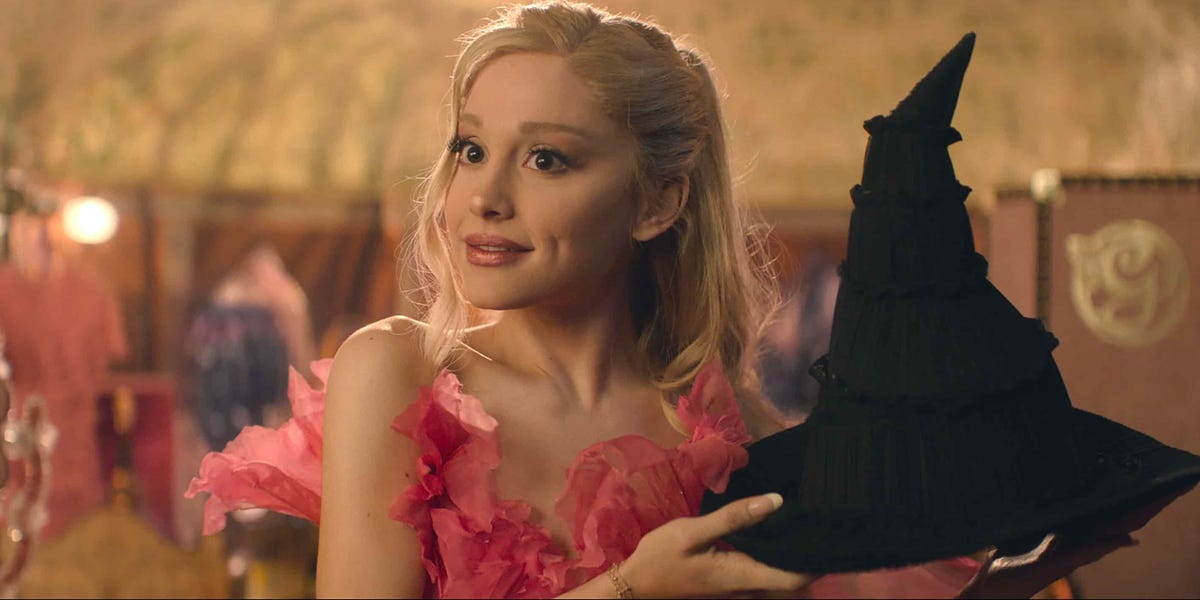
Years later, she was not simply attending Wicked; she was inside it. She was playing Glinda, one of musical theater’s most beloved roles, in a major film adaptation directed by Jon M. Chu and co-starring Cynthia Erivo as Elphaba. That is not just a career milestone. That is the theatrical equivalent of writing a wish in your diary and later discovering the universe kept the receipt.
The use of Ariana Grande-Butera also reflects the themes of Wicked itself. The musical is about identity, perception, friendship, labels, and the difference between who people think you are and who you actually become. Elphaba is branded “wicked” by a society that fears her. Glinda is celebrated as “good,” even while she must grow into the moral weight of that title. Grande choosing her full name mirrors that larger question: What does it mean to be seen fully?
How Wicked Became a Career Homecoming for Ariana Grande
Grande’s career has always included theater DNA. Before she became a pop superstar, she performed on Broadway in 13 and later became known to television audiences through Nickelodeon. Her vocal ability, comedic timing, and theatrical instincts were visible early, even when mainstream pop culture largely framed her as a singer first.
That is part of what made her Wicked casting so interesting. Some fans initially wondered whether the role of Glinda would be swallowed by the Ariana Grande brand. Could audiences see the character, or would they only see the pop star? Grande seemed aware of that skepticism and treated it seriously. Instead of leaning on her usual vocal style, she trained for Glinda’s classical soprano demands, softened certain pop instincts, and shaped a performance that served the character rather than her own celebrity image.
That discipline mattered. Glinda is not just bubbly comic relief in a tiara. She is charming, insecure, ambitious, funny, vulnerable, and morally complicated. She enters the story as someone who understands popularity better than justice, then gradually learns that being adored is not the same as being brave. Grande’s performance had to balance sparkle with self-discovery. Too much sugar, and Glinda becomes a cupcake with eyelashes. Too much seriousness, and the comedy disappears. Grande found room for both.
Glinda, Elphaba, and the Power of Being Seen
At the heart of Wicked is the friendship between Glinda and Elphaba. Their bond is messy, funny, tender, competitive, and transformative. They begin as opposites: Glinda is polished, admired, and socially fluent; Elphaba is brilliant, guarded, and misunderstood. Yet the story’s magic comes from watching them change each other.
Grande has spoken about learning from both Glinda and Elphaba, which makes sense. Glinda teaches the importance of lightness, presentation, and emotional openness, but Elphaba represents conviction, courage, and the refusal to shrink. Together, they create a mirror for anyone who has ever felt split between who they are, who the world rewards, and who they are trying to become.
That is why Grande’s full-name credit feels thematically rich. It suggests an artist reclaiming all parts of herself: the performer, the child, the daughter, the theater kid, the pop star, the actress, and the person behind the brand. In a story about names and reputations, her name becomes part of the storytelling.
The Kristin Chenoweth Connection
No discussion of Ariana Grande as Glinda is complete without mentioning Kristin Chenoweth, the original Broadway Glinda. Chenoweth originated the role in 2003 opposite Idina Menzel’s Elphaba, creating a performance so iconic that every future Glinda has had to walk carefully through a field of pink bubbles, high notes, and fan expectations.
Grande has long admired Chenoweth, and their connection has become part of the larger Wicked narrative. For longtime fans, seeing Grande step into a role associated with one of her inspirations added another layer of sweetness. It was not merely a younger star replacing an older one. It felt more like a torch being passed from one Broadway-loving powerhouse to another.
The Wicked film also honored the stage musical’s legacy with appearances from original Broadway stars and creative figures. These cameos served as a bridge between theater history and movie spectacle. For Grande, who approached the project as both performer and fan, those moments reinforced the idea that the film was a love letter to the original musical.
Why Fans Responded So Strongly to the Name Choice
Fans love big announcements, dramatic trailers, and red-carpet fashion. But sometimes the smallest details create the strongest emotional response. Grande using Ariana Grande-Butera in the credits gave fans something intimate to hold onto. It felt like a private signature inside a very public movie.
There is also something relatable about the gesture. Many people have versions of themselves attached to old names, childhood nicknames, school dreams, or family identities. A name can carry a history that no press release can summarize. Grande’s decision reminded fans that even global celebrities have inner-child moments, family connections, and dreams that began long before the world was watching.
That is why the credit did not feel like a gimmick. It felt sincere. It said: the girl who loved this musical is still here. She made it to Oz.
Ariana Grande’s Performance as Glinda: More Than Pink Bubbles
Grande’s Glinda required more than a pretty voice and a good blonde wig. The role demands comedy, precision, emotional intelligence, and a willingness to look ridiculous at exactly the right moment. Glinda’s confidence is often performative, and her charm can hide insecurity. Grande leaned into that tension.
Her version of Glinda is polished but not plastic. She understands that Glinda’s early obsession with popularity is funny because it is also painfully human. Who has not tried, at least once, to be liked a little too hard? Glinda simply does it with better hair accessories and a stronger commitment to dramatic entrances.
Musically, Grande’s approach also showed restraint. Rather than turning every song into a pop vocal showcase, she honored the Broadway roots of the score. That was especially important for “Popular,” a number that can become a wink-fest if mishandled. Grande’s comedic rhythm helped the song feel character-driven rather than self-referential.
Cynthia Erivo and Ariana Grande: The Friendship That Anchored the Film
The success of Wicked depends on the chemistry between Elphaba and Glinda. Without that bond, the story is just a very expensive trip to a green city with suspicious leadership. Cynthia Erivo and Ariana Grande brought emotional intensity to the friendship, both on screen and throughout the film’s promotional journey.
The two stars often appeared visibly moved while discussing the project. Their interviews became famous for tears, hand-holding, and the kind of emotional openness that made the internet both touched and slightly confused. Theater people, however, understood. When you spend years singing about destiny, rejection, friendship, and flying, you are allowed to cry into a microphone occasionally. It is practically in the contract.
Their connection also extended into symbolic gestures, including matching Wicked-inspired tattoos. Those permanent marks reflected how deeply the production affected them. For Grande, the experience was not just another film role. It was a creative relationship, a personal reset, and a tribute to the art that shaped her.
The Broader Cultural Impact of Wicked
Wicked has always been more than a musical about witches. Since opening on Broadway in 2003, it has become a cultural phenomenon because it reframes a familiar villain and asks audiences to question easy labels. Who decides who is good? Who benefits when someone is called wicked? What happens when popularity and truth point in different directions?
Those questions remain relevant, especially in an age of viral judgment and instant public narratives. Grande knows something about being watched, praised, criticized, misunderstood, and reinterpreted by strangers. That context gives her performance an extra layer. Playing Glinda allowed her to explore the tension between public image and private growth from inside a story built around exactly that theme.
The film adaptation introduced the story to new audiences while satisfying many longtime fans of the Broadway production. With Cynthia Erivo’s powerhouse Elphaba and Grande’s luminous Glinda, the movie became one of the most discussed musical adaptations in recent memory. It also helped remind Hollywood that audiences will show up for musicals when they are treated with sincerity, scale, and respect. Imagine that: people like songs when the songs are good. Revolutionary stuff.
Why the Full-Name Credit Works as a Personal Brand Moment
From an SEO and pop-culture perspective, “Ariana Grande-Butera” became a highly searchable phrase because it gave fans a new angle on a familiar star. But beyond search interest, the credit worked because it felt authentic to the project. Grande did not rebrand herself everywhere. She used the name specifically for Wicked, which made the gesture more meaningful.
That distinction matters. If she had suddenly used her full name for every appearance, it might have felt like a broad image strategy. Instead, it was tied to one role, one story, and one childhood memory. It marked Wicked as a special artistic chapter rather than just another line on a résumé.
In celebrity culture, where many choices are filtered through publicists, stylists, managers, and algorithmic predictions, a simple name can feel refreshingly human. Grande’s credit told a story without needing a speech. It was branding, yes, but the best kind: emotionally true, specific, and rooted in lived experience.
Specific Examples That Make the Nod Even Sweeter
1. She Saw Wicked as a Child
Grande has said the name Ariana Grande-Butera connects back to the time when she first saw Wicked at 10 years old. That childhood memory became the emotional foundation for her credit choice.
2. She Honored Her Theater Roots
Before becoming a pop superstar, Grande had theater experience and a long-standing love for musical performance. Using her birth name in the film credits acknowledged the version of herself that dreamed before the world knew her.
3. She Respected the Role of Glinda
Grande did not treat Glinda as a celebrity costume. She trained vocally, leaned into the character’s comic structure, and approached the role with visible reverence for the Broadway original.
4. She Connected the Film to the Stage Legacy
By joining a film that honored original Broadway figures like Kristin Chenoweth and Idina Menzel, Grande became part of a larger Wicked lineage. The full-name credit helped frame her performance as both personal and historical.
Experience Section: What This “Full Circle” Moment Teaches About Dreams, Identity, and Growing Up
There is something deeply moving about Ariana Grande’s Wicked story because it captures an experience many people understand: the strange, beautiful moment when your adult life brushes against a childhood dream. Most of us do not grow up to play Glinda in a blockbuster movie, unfortunately. Some of us grow up to answer emails with “circling back,” which is less glamorous and involves fewer bubble entrances. But the emotional pattern is familiar.
Everyone has a version of “little Ari.” It might be the child who wanted to be an artist, the teenager who wrote songs in a notebook, the student who loved science, the kid who watched old movies and imagined being part of them, or the young person who found comfort in a story during a confusing time. As people grow, those early versions can get buried under responsibilities, criticism, ambition, fear, and the practical business of becoming an adult.
Grande’s decision to use Ariana Grande-Butera is powerful because it suggests that success is not only about moving forward. Sometimes success is about returningreturning to the thing that first made you feel alive, returning to a name that carries family history, returning to a dream that once seemed too large to touch.
For anyone building a creative career, this is a useful lesson. The most meaningful projects are often the ones that connect skill with memory. Grande did not simply accept a famous role; she accepted a role that had lived in her imagination for years. That kind of connection can change the energy of the work. It adds tenderness. It raises the stakes. It makes the artist want to honor the material, not just appear in it.
The story also shows how identity can evolve without erasing the past. Ariana Grande the pop star is not separate from Ariana Grande-Butera the theater kid. They are part of the same person. One sold out arenas; the other sat in a theater seat and looked up at Glinda and Elphaba with wonder. The beauty of the Wicked credit is that it let both exist together.
That can resonate with readers who feel pressure to outgrow their earlier selves. In reality, growth does not always mean leaving the past behind. Sometimes it means bringing the best pieces of the past with you. The younger self who loved boldly, dreamed loudly, and believed in impossible things may still have something important to offer. Maybe that younger self had better instincts than the tired adult answering emails at midnight.
There is also a lesson about patience. Grande’s journey to Glinda did not happen overnight. She admired the musical for years, performed songs connected to it, built her vocal and acting career, faced skepticism, auditioned, trained, and finally stepped into the role. From the outside, celebrity opportunities can look instant. From the inside, they are often the result of years of preparation meeting one rare opening.
That is why “full circle” moments feel so satisfying. They are not random. They are the emotional payoff of devotion. They remind us that the things we love early in life can leave clues. Sometimes those clues lead nowhere obvious. Other times, years later, they form a yellow brick road.
Grande’s Wicked nod is sweet because it is small, but it carries a big truth: names matter, dreams matter, and the younger versions of ourselves deserve a seat in the theater when the credits roll.
Conclusion
Ariana Grande’s decision to be credited as Ariana Grande-Butera in Wicked is more than a charming detail for fans to discuss online. It is a personal tribute to her childhood, her family roots, her theater beginnings, and the dream that followed her into adulthood. By choosing her full birth name, Grande turned a movie credit into a quiet love letter to the little girl who once watched Wicked and imagined the magic from the audience.
That is what makes the moment so memorable. In a film filled with soaring songs, shimmering costumes, and grand cinematic spectacle, one of the sweetest details is simply a name. For Grande, Glinda was not just another role. It was a homecoming, a full-circle artistic milestone, and proof that sometimes the dreams we carry as children do not disappear. They wait, they sparkle, and if the timing is right, they float back in wearing pink.