
Some household hardware works very hard to disappear. Australian brass hooks and pulls have apparently declined that assignment.
These compact objects hold towels, open drawers, organize utensils, and occasionally make an ordinary cabinet look as though it has acquired a design degree. Rather than treating hardware as an afterthought, many Australian designers approach it as miniature sculpture: practical enough for everyday use, expressive enough to become part of the room’s visual identity.
The appeal is not simply that brass is golden and glamorous. The most interesting pieces use restrained geometry, hand-shaped surfaces, soft curves, and finishes that change gradually with touch. A ring pull can resemble jewelry. A curved wall hook can read like a line drawing. A sand-cast handle may preserve subtle irregularities that reveal how it was made.
Welcome to the Australia edition of artful brass hardware, where even the hook beside the laundry sink is allowed to have personality.
Why Australian Brass Hardware Feels Different
Australian interiors often combine modern architecture with materials that feel relaxed rather than overly polished. Pale timber, dark-stained wood, limestone, concrete, handmade tile, linen, and plaster provide calm backgrounds. Brass introduces warmth without demanding that the entire room become formal.
This contrast helps explain why sculptural brass hooks and cabinet pulls feel so comfortable in Australian homes. Their shapes may be precise, but their surfaces are frequently tactile. Their profiles may be minimal, but they rarely feel anonymous.
The best examples share several characteristics:
- Simple forms that remain visually interesting from different angles
- Enough weight to feel substantial in the hand
- Rounded or softened edges that improve comfort
- Finishes that complement wood, stone, tile, and painted cabinetry
- A willingness to let natural patina become part of the design
In other words, the goal is not to make a drawer pull shout across the kitchen. It should speak at a civilized volume while still having something worthwhile to say.
Six Brass Forms Worth Knowing
An influential Australian hardware roundup introduced design enthusiasts to pieces such as the Rowsaan U handle, cup handle, ring handle, circle hook, curved hook, and kitchen hook. Product availability has changed over time, but the shapes remain useful references for anyone selecting distinctive brass cabinet hardware today.
1. The U-Shaped Pull
The U pull is the dependable member of the family. Its two mounting points create a secure grip, while its uncomplicated silhouette works with contemporary flat-panel cabinets, traditional framed doors, and freestanding furniture.
Choose a slim U handle when you want a quiet architectural line. Select a thicker version when the hardware needs to stand up visually against wide drawers or strongly grained timber. On a large pantry door, an undersized pull can look apologetic. Hardware should be modest, not nervous.
2. The Cup Pull
Cup pulls bring a slightly more traditional character to cabinetry. Their enclosed shape is particularly practical on drawers because fingers can slip underneath the curved face without pinching.
Antique brass cup pulls suit farmhouse kitchens, utility rooms, built-in desks, and vintage-inspired furniture. A cleaner, minimally detailed version can also work in a modern Australian kitchen, especially against matte-painted cabinets or oak veneer.
3. The Ring Handle
A brass ring handle transforms a simple functional movement into a small ritual. Lift the ring, pull the door, release it, and try not to feel unreasonably elegant while retrieving the recycling bags.
Ring pulls work beautifully on wardrobes, sideboards, linen cabinets, and decorative furniture. They are less suitable for drawers that must be opened repeatedly with wet or greasy hands, so reserve them for locations where their sculptural quality can be enjoyed without creating unnecessary inconvenience.
4. The Circle Hook
A circular wall hook can be both hardware and wall composition. One large circle creates a focal point; several arranged together become a functional installation for coats, hats, scarves, bags, or towels.
Because the round form is visually soft, circle hooks pair well with the straight lines of paneling, shelving, and cabinetry. They are especially effective in entryways and bathrooms where practical storage often risks looking strictly utilitarian.
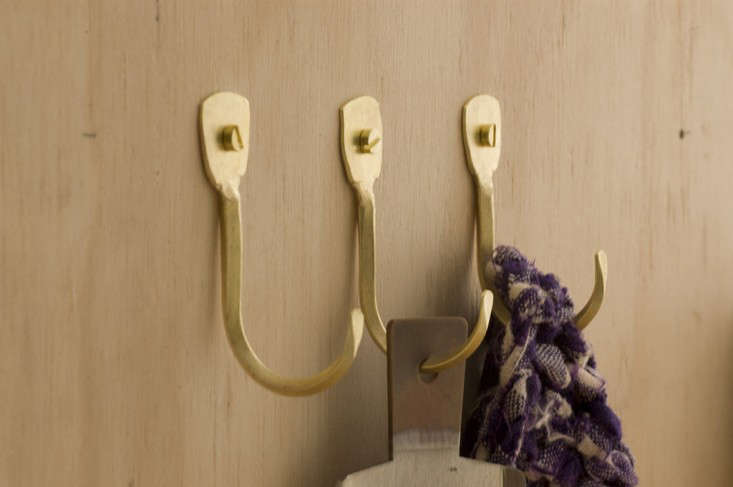
5. The Curved Hook
The curved brass hook is perhaps the purest example of functional sculpture. It may consist of little more than a bent piece of metal, yet the angle, depth, and termination of that curve determine whether it looks graceful or like an unfortunate plumbing incident.
Use curved hooks for hand towels, aprons, robes, lightweight bags, or cooking tools. Check the projection from the wall before ordering. A shallow design may be visually elegant but unable to hold a thick bathrobe, which is a rather expensive way to decorate the floor.
6. The Kitchen Hook
Small brass kitchen hooks are ideal for utensils with loops or eyeholes. Installed beneath a shelf, along a timber rail, or on a compact backsplash panel, they keep frequently used tools visible and within reach.
This is an excellent place to use brass sparingly. A row of tiny hooks adds warmth without competing with faucets, appliances, lighting, and cabinet hardware. It also gives the cook a legitimate reason to display the attractive copper ladle instead of hiding it behind three spatulas and a suspicious number of wooden spoons.
Solid Brass, Brass-Plated, or Brass-Look?
Not every gold-colored handle is solid brass. Product descriptions may refer to solid brass, brass-plated metal, brushed gold, satin gold, champagne bronze, or brass-effect finishes. These terms are not interchangeable.
Solid Brass
Brass is primarily an alloy of copper and zinc. Solid brass hardware generally offers satisfying weight, good durability, and the ability to develop an authentic patina. Scratches on an unlacquered solid-brass piece usually reveal more brass rather than a different base metal.
Brass-Plated Hardware
Plated hardware uses a thin brass surface over another metal. It can provide the desired appearance at a lower price, but aggressive polishing may damage the coating. Quality varies considerably, so examine the construction, warranty, finish specifications, and care instructions.
Brass-Look Finishes
Some products reproduce the color of brass using coatings or other metal finishes. These can be practical when consistency and low maintenance matter more than natural aging. They may also be useful when purchasing a large quantity of hardware on a restricted budget.
The smartest choice depends on location and expectations. Solid unlacquered brass suits homeowners who enjoy changing surfaces. A sealed finish may be better for anyone who would interpret the first dark fingerprint as a household emergency.
Understanding the Major Brass Finishes
Unlacquered Brass
Unlacquered brass has no clear protective coating, allowing air, moisture, skin oils, and cleaning habits to influence its appearance. It may deepen, darken, or develop variations around frequently touched areas.
This evolving surface is known as a living finish. It works particularly well in rooms intended to feel collected rather than pristine. The resulting patina can connect new hardware visually with vintage furniture, aged timber, and handmade materials.
Polished Brass
Polished brass is brighter and more reflective. It creates crisp contrast against black, navy, forest green, or richly stained cabinetry. In small amounts, it can introduce light to a dark kitchen or powder room.
A protective coating may help preserve the shine, although every manufacturer’s finish behaves differently. Always follow the specific care instructions supplied with the hardware.
Brushed or Satin Brass
Brushed brass has a softer, directional surface that reduces glare. It is often easier to integrate into relaxed contemporary interiors because it provides warmth without looking overly formal.
The finish pairs naturally with white oak, walnut, cream paint, handmade tile, terrazzo, and pale stone. It is also forgiving of minor fingerprints, a quality appreciated by anyone who actually intends to open the drawers.
Aged, Burnished, or Antique Brass
Darker brass finishes provide immediate character. They are effective in traditional homes, renovated period properties, rustic kitchens, and rooms with moody paint colors.
Because names vary among manufacturers, never assume two products labeled “antique brass” will match. One may lean brown, another greenish, and another suspiciously orange. Order finish samples whenever possible and view them beside the actual cabinetry in morning, afternoon, and artificial light.
How to Choose the Right Scale
Hardware must relate to the size and weight of the object it operates. A tiny knob on a deep pot drawer may look charming until the drawer is full of cast iron and requires the grip strength of a competitive climber.
A common starting point is to select a pull approximately one-third the width of a drawer, but this is a visual guideline rather than a building code. Long, uninterrupted pulls can emphasize modern cabinetry, while smaller pulls create a more traditional rhythm.
Before purchasing, evaluate:
- The overall length of the handle
- The center-to-center distance between mounting holes
- The projection from the cabinet face
- The clearance available for fingers
- The thickness of the door or drawer front
- The weight and frequency of use
People with limited grip strength may find D-shaped pulls easier to operate than small knobs. Rounded edges, generous finger clearance, and a comfortable projection improve usability for almost everyone.
Styling Brass Hooks and Pulls Room by Room
In the Kitchen
Use bar or U pulls on heavy drawers and reserve smaller knobs for upper doors. Cup pulls can introduce heritage character without turning the kitchen into a historical reenactment.
Brass looks especially rich against olive, charcoal, warm white, navy, and natural timber. It can also soften black-and-white kitchens by adding a warmer intermediate tone.
In the Bathroom
Coordinate vanity pulls, robe hooks, towel hardware, and mirror details without forcing every metal to match exactly. Brass can coexist with chrome, nickel, or black when each finish appears intentionally in more than one location.
Check whether the selected finish is recommended for humid environments. Dry splashes promptly and avoid abrasive cleaners.
In the Entryway
Sculptural brass hooks turn everyday storage into a welcoming wall feature. Mix one or two larger hooks for coats and bags with smaller hooks for keys, hats, or dog leads.
Mount them into studs, solid timber, or correctly rated anchors. A beautiful hook attached carelessly to drywall is merely a future hole wearing jewelry.
On Freestanding Furniture
Replacing plain hardware can revive an old dresser, wardrobe, or sideboard without removing its history. Ring handles and compact cup pulls are especially effective on vintage pieces.
Keep the original hardware in a labeled bag. Future owners may want it, and unlabeled mystery screws have a proven ability to reproduce inside junk drawers.
Installation Tips for a Professional Result
Measure existing hole spacing before ordering replacement pulls. The critical dimension is center-to-center: the distance from the center of one screw hole to the center of the other.
Whenever possible, choose new hardware that uses the existing holes. Filling and refinishing unwanted holes can be difficult, particularly on stained timber, veneer, or factory-painted cabinetry.
For new installations:
- Create or purchase a hardware template.
- Test the position using removable tape or a cardboard mock-up.
- Confirm that doors, drawers, and nearby handles will not collide.
- Mark every location carefully and check the measurements twice.
- Drill pilot holes with a sharp bit suited to the material.
- Use screws of the correct length for the door or drawer thickness.
- Install one sample piece before drilling the entire room.
For wall hooks, investigate what is behind the surface. Tile, masonry, timber paneling, and drywall each require different drill bits and fasteners. Heavy coats and bags create leverage, so decorative screws alone may not provide enough support.
How to Care for Brass Without Ruining It
Begin with the manufacturer’s instructions. Finishes that look similar may have completely different coatings and cleaning requirements.
For routine care, a soft dry cloth is often sufficient. When permitted, use mild soap with lukewarm water, then dry the surface immediately. Avoid abrasive pads, harsh chemicals, and enthusiastic experimentation with internet cleaning recipes.
Do not polish unlacquered brass unless you genuinely want to remove some patina and restore brightness. Polishing one handle while leaving the others untouched can produce a mismatched set that looks as though one drawer has been promoted.
Before using any polish, test it on a concealed area. Never assume a brass-plated or lacquered finish can tolerate the same treatment as solid, uncoated brass.
Hands-On Experience: What Living With Brass Hardware Is Actually Like
The showroom experience of brass hardware is wonderfully simple. Every pull is clean, every hook is perfectly illuminated, and nobody has just opened the cabinet after kneading pizza dough. Real life provides a more informative test.
The first lesson is that shape matters more than photographs suggest. A slender pull may look exquisite online but feel sharp if its back edge has not been softened. A thick cast handle may appear oversized in a product image yet feel perfectly balanced on a wide drawer. Whenever possible, order one sample before committing to thirty-two matching pieces.
Hold the sample as you would during ordinary use. Try it with dry hands, damp hands, and the edge of a dish towel between your fingers. Ask different members of the household to use it. A pull that feels elegant to one person may be difficult for a child, an older adult, or someone with limited hand mobility.
The second lesson is that finishes reveal personality only after installation. Unlacquered brass begins changing quickly in frequently touched areas. Kitchen pulls may darken around the center while the ends remain brighter. A ring handle develops wear where it repeatedly contacts its backplate. Wall hooks may age slowly unless wet towels or damp clothing regularly touch them.
This variation is not necessarily damage. It is evidence of use, and many homeowners find that it makes the room feel less manufactured. Those who prefer absolute uniformity should select a durable sealed finish from the beginning rather than repeatedly polishing a living finish into reluctant obedience.
The third lesson concerns placement. During one cabinet refresh, a beautiful pull was initially centered according to the drawer front rather than the actual drawer box. It looked correct when closed, but the screw landed directly beside an internal divider. The glamorous little handle suddenly became a lesson in cabinet anatomy.
Temporary placement prevents this kind of comedy. Attach samples with removable putty or painter’s tape, then live with them for a day. Open adjacent doors. Stand across the room. Check whether long handles create awkward visual lines or interfere with appliances. In an entryway, hang a real coat and bag from each proposed hook location to test spacing.
The fourth lesson is that mixing hardware can make a room feel more considered. In a kitchen, simple U pulls can serve working drawers while small round knobs appear on upper doors. A statement ring pull might be reserved for a pantry cabinet or built-in bar. The shared brass material maintains cohesion, while varied shapes respond to different tasks.
Finally, good hardware improves the emotional experience of an ordinary room. That may sound grand for an object secured by two screws, but touch is part of design. Cabinets are opened dozens of times a day. A comfortable, substantial pull quietly reinforces the sense that the room was planned with care.
Artful Australian brass hardware succeeds because it accepts this daily contact. It does not remain precious and distant. It gets handled, marked, darkened, cleaned, and used again. Over time, the hardware stops looking newly installed and begins looking as though it belongs to the house.
Conclusion: Small Hardware, Serious Character
Artful brass hooks and pulls prove that useful objects do not have to be visually silent. Australian designs are particularly compelling because they balance sculptural form with everyday practicality. A circle hook becomes wall art. A U pull becomes an architectural line. A simple kitchen hook turns a row of utensils into an organized display.
Focus on real material, comfortable grip, appropriate scale, secure installation, and a finish that suits your tolerance for change. Choose fewer, better pieces when the budget allows. Most importantly, remember that brass hardware is meant to be touched. The fingerprints are not staging errors; they are part of the story.