
Cave paintings are humanity’s first great art galleryminus the velvet ropes, gift shop mugs, and security guard telling you not to stand too close. Long before museums, cameras, books, or even written language, early humans walked into dark limestone chambers and left images that still make us stop and stare. Some painted animals. Some traced hands. Some created scenes that look like early storytelling, almost like the world’s oldest graphic novel, except the “paper” was a cave wall and the deadline was roughly 50,000 years ago.
For decades, many people imagined prehistoric art as something that began mainly in Europe, especially in famous places like Lascaux and Chauvet in France or Altamira in Spain. Those sites remain breathtaking and historically important. But recent research has shifted the spotlight toward Indonesia, especially Sulawesi and nearby islands, where some of the world’s oldest known cave art has been dated. In 2026, researchers reported a hand stencil in Liang Metanduno cave on Muna Island, southeastern Sulawesi, with a minimum age of about 67,800 years. That makes it one of the strongest candidates for the oldest reliably dated cave artwork in the world.
So, what do cave paintings tell us? They reveal that early humans were not simply surviving. They were observing, imagining, remembering, and communicating. In short, they were doing what humans still do: trying to make meaning, leave a mark, and maybe impress someone with a surprisingly good pig drawing.
What Are Cave Paintings?
Cave paintings are images, symbols, handprints, and scenes painted or drawn on the walls and ceilings of caves or rock shelters. They are part of a larger category called rock art, which can also include engravings, carvings, and markings made on exposed stone surfaces.
Most ancient cave art was created with natural materials. Red and yellow ochre came from iron-rich minerals. Black pigment often came from charcoal or manganese. Artists may have applied pigment with fingers, brushes made from plant fibers or animal hair, pads of moss, or by blowing powdered color through the mouth or a hollow tube. That last method is how many hand stencils were made: the artist placed a hand against the wall and sprayed pigment around it, leaving a ghostly outline.
These images were not random doodles. Many were placed deep inside caves, in areas that required planning, light, and physical effort to reach. That suggests intention. Whether the purpose was ritual, storytelling, teaching, identity, memory, social bonding, or something we have not yet imagined, cave paintings were meaningful to the people who made them.
The Oldest Cave Art: Indonesia Changes the Story
The 67,800-Year-Old Hand Stencil
The most recent major discovery comes from Liang Metanduno cave on Muna Island, near Sulawesi, Indonesia. Researchers dated a faded red hand stencil to at least 67,800 years old. The age was determined by analyzing mineral layers that formed over the pigment, which provides a minimum age for the artwork beneath. In simple terms: the painting must be older than the crust that grew on top of it.
This hand stencil is especially fascinating because it is not just a plain hand outline. Researchers noted that the fingertips appear pointed or modified, possibly transforming the human hand into something more symbolic, perhaps animal-like. That detail matters. It suggests that the artist was not merely recording “I was here,” but may have been creating an image with cultural or symbolic meaning.
If the dating holds up under continued scientific review, this discovery pushes the timeline of known cave art much further back than many people expected. It also strengthens the idea that early humans in Southeast Asia had rich artistic traditions long before some of the most famous European cave paintings were created.
The 51,200-Year-Old Sulawesi Narrative Scene
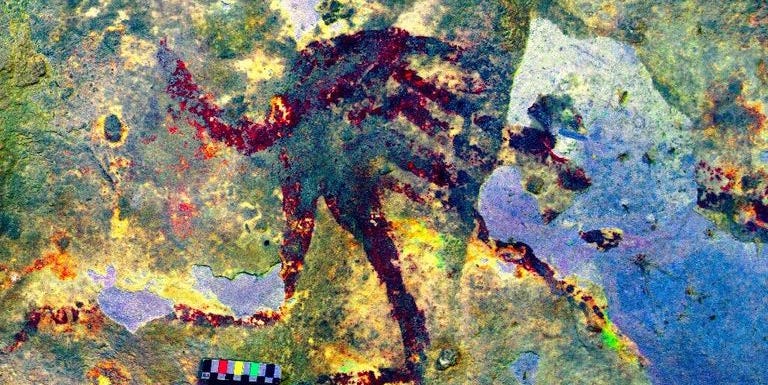
Before the 2026 hand-stencil study, one of the biggest headlines came from Leang Karampuang in Sulawesi. In 2024, researchers reported a cave painting at least 51,200 years old. The image appears to show three human-like figures interacting with a wild pig. That makes it not only one of the oldest known figurative artworks, but also one of the earliest known examples of visual storytelling.
This is a big deal. A single animal drawing already shows observation and representation. A scene with figures interacting suggests narrative: something is happening. The artist may have been showing an event, a myth, a ritual, or a hunting-related story. We cannot know the exact meaning, but the composition hints at a mind capable of arranging characters and action. In other words, early humans may have been telling stories with pictures tens of thousands of years before anyone wrote “Chapter One.”
Famous Cave Painting Sites Around the World
Lascaux Cave, France
Lascaux is one of the most famous cave art sites in the world. Discovered in 1940 near Montignac in southwestern France, it contains hundreds of images, including horses, bulls, deer, and mysterious signs. The paintings are often estimated to be around 17,000 years old, although dating prehistoric cave art can be complicated.
Lascaux is sometimes called the “Sistine Chapel of Prehistory,” and for good reason. The animals are dynamic, confident, and beautifully placed across the cave walls. The artists used the natural curves of the rock to suggest movement and volume. A painted bull seems to charge forward. Horses appear to run. The cave wall becomes part of the artwork, like nature and imagination had a very productive meeting.
However, Lascaux also teaches an important conservation lesson. After the cave opened to visitors, changes in humidity, carbon dioxide, and microbial growth threatened the paintings. The original cave was eventually closed to the public, and replicas were created so people could experience the art without accidentally loving it to death.
Chauvet-Pont-d’Arc Cave, France
Chauvet Cave, discovered in 1994 in southern France, contains some of the best-preserved and most sophisticated Paleolithic cave art in Europe. Many of its images date to roughly 30,000 to 32,000 years before present, making them far older than Lascaux. The cave includes lions, rhinos, mammoths, bears, horses, bison, and other animals.
What makes Chauvet so astonishing is its artistic skill. Some animals are drawn with shading, perspective, and overlapping forms. The cave lions look alert and alive. The rhinos seem to move in sequence, almost like an ancient animation frame. If you ever thought early humans could only manage stick figures, Chauvet politely clears its throat and asks you to reconsider.
Because of its fragile condition, Chauvet has never been opened to general public tourism. A replica allows visitors to see the images while protecting the original environment. This approach reflects a growing understanding: prehistoric art is not just old decoration. It is irreplaceable cultural evidence.
Altamira Cave, Spain
Altamira in northern Spain is another legendary cave art site, known especially for its colorful bison. Discovered in the 19th century, Altamira was initially met with skepticism. Some experts found it hard to believe that prehistoric people could have made art so refined. That disbelief says more about modern prejudice than ancient ability.
Eventually, Altamira helped transform how scholars understood Paleolithic creativity. The bison paintings use the cave ceiling’s natural shapes to create a sense of mass and movement. The artists were not simply painting on stone; they were collaborating with stone.
Why Did Early Humans Make Cave Paintings?
No one can interview the artists, which is rude of time but understandable. Archaeologists therefore work with clues: location, subject matter, pigments, dating, footprints, tool marks, and comparisons with later symbolic traditions. Several major theories help explain why cave paintings may have been created.
Storytelling and Memory
Some cave paintings may record stories, events, or shared cultural knowledge. The Sulawesi narrative scene is especially important because it appears to show interaction between human-like figures and an animal. Such images may have helped preserve myths, hunting knowledge, social identity, or spiritual beliefs.
Ritual and Spiritual Meaning
Many cave art sites are located deep underground, far from ordinary living areas. That has led researchers to suggest that some caves may have had ritual significance. Darkness, echoes, torchlight, unusual rock formations, and narrow passages could have created powerful sensory experiences. A cave was not just a room; it was a dramatic environment, basically prehistoric surround sound.
Teaching and Communication
Animal images may have helped communicate information about species, movement, behavior, or seasonal importance. This does not mean every painting was a hunting manual. But in societies closely connected to animals, images could have carried practical and symbolic knowledge at the same time.
Identity and Presence
Hand stencils may represent identity, belonging, or presence. A hand on a wall says, in the simplest possible visual language, “A person was here.” But it may also say much more: “This is our place,” “this is part of our story,” or “this hand belongs to a person within a group, a ritual, or a tradition.”
How Scientists Date Cave Paintings
Dating cave art is tricky because the pigment itself is not always easy to test. Charcoal can sometimes be radiocarbon dated, but mineral pigments like ochre usually cannot be dated directly in the same way. Scientists often rely on indirect methods.
One important method is uranium-series dating. When thin layers of calcium carbonate form over cave art, researchers can analyze those mineral deposits. Since the art must be older than the layer covering it, the mineral gives a minimum age. Newer laser-based methods allow scientists to sample tiny areas with greater precision, reducing damage and improving accuracy.
This is why recent discoveries in Indonesia are so important. Improved dating techniques have allowed researchers to re-evaluate rock art that may have been underestimated or overlooked. The result is a changing timeline of human creativity.
What Animals Appear in Cave Paintings?
Animals dominate many famous cave painting sites. In Europe, common subjects include horses, bison, aurochs, deer, mammoths, lions, bears, and rhinoceroses. In Indonesia, ancient artists painted wild pigs, anoa, and other local animals. The subject matter reflects the environment and the cultural world of the artists.
Interestingly, the animals painted were not always the animals most commonly eaten. At Chauvet, for example, dangerous animals such as lions and rhinos appear prominently. This suggests that cave art was not only about dinner. It was about attention, power, fear, respect, symbolism, and perhaps stories that connected humans with the animal world.
Were Cave Artists “Primitive”? Absolutely Not.
The word “primitive” tends to collapse under the weight of the art itself. Cave paintings show planning, technical skill, visual memory, social learning, and symbolic thought. Some artists used shading. Some used the rock’s natural curves to create three-dimensional effects. Some placed images in relation to cracks, bumps, and hollows. That is not random behavior. That is design.
Even simple hand stencils can be conceptually rich. They require pigment preparation, technique, and a decision about placement. More complex scenes require composition. A narrative image requires relationships among figures. These are the building blocks of visual culture.
Modern humans did not suddenly become creative after inventing cities or writing. Creativity is much older. The cave wall was one of our first screens, and the images on it still load after tens of thousands of years. Honestly, that is better long-term storage than most phones.
Why Cave Paintings Matter Today
Cave paintings matter because they connect us to the earliest known expressions of human imagination. They show that art is not a luxury added after survival. Art is part of how humans survive, organize meaning, and understand their place in the world.
They also challenge old assumptions about where creativity began. For a long time, Europe received most of the attention because sites like Lascaux, Chauvet, and Altamira were famous and heavily studied. But discoveries in Indonesia show that the story is global. Human creativity was not born in one famous cave and then politely handed out to everyone else. It appeared across landscapes, climates, and cultures.
Finally, cave paintings remind us that cultural heritage is fragile. A painting can survive 50,000 years in a stable cave and then be damaged in decades by tourism, pollution, climate shifts, or careless contact. Protecting these sites is not about locking away the past. It is about making sure the past still has a voice tomorrow.
Experience: What It Feels Like to Encounter Cave Paintings
Seeing cave paintings, even in a replica or museum-quality reproduction, is a different experience from looking at ordinary art. You do not simply think, “Nice horse.” You think, “Someone stood in darkness with a flickering flame and painted this animal before agriculture, before cities, before written history, before almost everything I consider normal.” That thought has a way of making your daily complaints feel slightly smaller. Your Wi-Fi buffering is annoying, yes, but at least you are not painting by torchlight while a cave bear considers becoming your roommate.
The first emotional reaction is often surprise. Cave paintings are older than expected, but they do not feel clumsy. Many animals look confident and alive. Lines curve with purpose. Bodies are placed with an understanding of movement. The artists clearly knew their subjects. They had watched animals run, turn, fight, graze, and stand alert. Their art came from close observation, the kind of attention modern people rarely give anything unless it comes with a notification sound.
There is also a strange intimacy in hand stencils. Animal paintings can feel grand and symbolic, but a handprint feels personal. It is nearly impossible to look at one without comparing it to your own hand. The gap of tens of thousands of years suddenly narrows. The person who made it had skin, fingers, breath, and probably a social life full of complicated group drama, because human beings have always been human beings.
Walking through a cave-art replica or studying high-resolution images can also change how you think about darkness. Today, darkness often means inconvenience. For Paleolithic people, caves may have created a powerful atmosphere. Torchlight would have made painted animals flicker and move. Shadows could turn rock shapes into bodies. Sound would echo. A painting was not just seen; it may have been experienced with the whole body.
That is why cave paintings still work on us. They are not only archaeological data. They are encounters. They remind us that the ancient world was not silent, empty, or emotionally flat. It was filled with attention, fear, humor, memory, skill, and imagination. The oldest artwork in the world is not just about the past. It is about the beginning of something still alive in us: the need to make marks, tell stories, and say, somehow, “I was here.”
Conclusion
Cave paintings are among the oldest and most powerful records of human creativity. From the 67,800-year-old hand stencil in Indonesia to the 51,200-year-old Sulawesi narrative scene, and from Chauvet’s dramatic animals to Lascaux’s unforgettable bulls and horses, these artworks reveal a deep history of imagination. They show that early humans were artists, observers, storytellers, and symbol-makers.
The oldest cave paintings are not dusty leftovers from a simple past. They are evidence of complex minds. They prove that long before written language, humans were already using images to communicate with each other, with the natural world, and perhaps with forces they believed existed beyond ordinary life. The walls have been speaking for thousands of generations. We are only now learning how to listen.