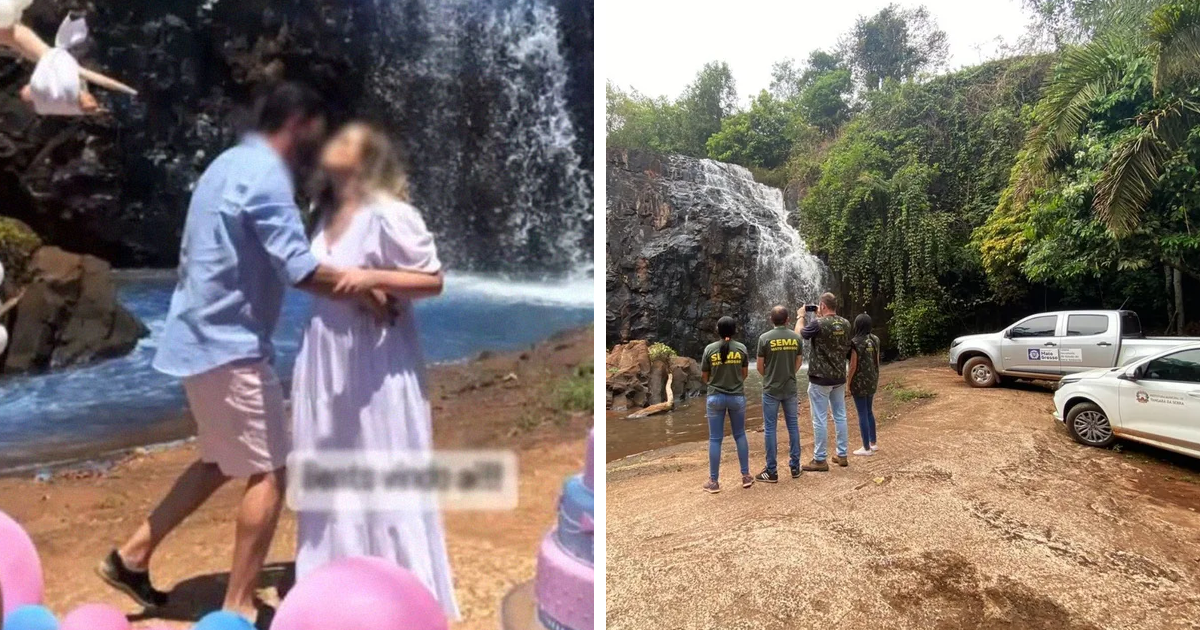
Couple Thought It Was A Good Idea To Dye A Whole Waterfall For Their Gender Reveal Party

Some parents cut a cake. Others open a box of balloons. One family in Brazil apparently looked at a 59-foot waterfall connected to a community water source and thought, “Yes, that should be blue.”
The result was a viral video, international outrage, an environmental investigation, a fine, and another unforgettable entry in the growing encyclopedia of gender reveal parties that should have remained ideas in a group chat.
What Happened at the Blue Waterfall Gender Reveal?
On September 25, 2022, an expectant couple hosted a gender reveal celebration at Cachoeira Queima-Pé, a scenic waterfall near Tangará da Serra in the Brazilian state of Mato Grosso. The gathering included blue and pink decorations, a giant balloon stork, colored smoke, cheering guests, and one extraordinarily questionable special effect.
As the guests watched, the normally clear waterfall suddenly became an intense electric blue, revealing that the couple was expecting a boy. Videos showed blue water cascading over the rocks while the future parents embraced and partygoers celebrated.
There was only one minor problem: the waterfall was not a rented projection screen, a backyard swimming pool, or a giant fondant cake. It was part of a living waterway.
The 59-foot Cachoeira Queima-Pé is formed by the Queima-Pé River, which has been described by local authorities as an important freshwater source for Tangará da Serra. The region had also experienced drought and water-supply concerns, making the decision to introduce an unknown coloring product into the river especially alarming.
The Internet Reacted Exactly as You Would Expect
The original posts were reportedly removed after criticism began pouring in. Unfortunately for the organizers, deleting a viral video from social media is rather like trying to put toothpaste back into the tube while thousands of strangers are screen-recording you.
Copies spread across multiple platforms. Viewers questioned why anyone would pour a substance into a natural waterway merely to announce information that could have been communicated with cupcakes, socks, flowers, a family photograph, or a polite sentence.
Environmental professionals also joined the criticism. The issue was not simply that blue water looked unnatural. No one outside the event initially knew what product had been used, how much had been released, whether it contained harmful ingredients, how far it would travel, or how it might affect aquatic organisms and downstream water users.
A colorful celebration can last an afternoon. An environmental mistake may continue moving downstream long after the guests have gone home.
The incident therefore moved rapidly from “strange viral video” to “matter for environmental authorities.” Mato Grosso’s environmental agency sent investigators to inspect the area, collect samples, and determine whether the stunt violated environmental regulations.
Who Actually Put the Dye in the Water?
Early headlines often described the couple as having dyed the waterfall. Subsequent reporting added an important detail: a relative of the expectant parents was identified as the person responsible for releasing the coloring product.
The relative reportedly told officials that the substance was a product known as “Blue Lake” or “Lagoa Azul,” designed to color ornamental ponds, lakes, or swimming pools. That explanation did not automatically make its use in a flowing natural river acceptable.
A product can be marketed as biodegradable, nontoxic, or suitable for controlled water features and still be inappropriate for release into an open ecosystem. A backyard pond has defined boundaries. A river moves through soil, vegetation, animal habitats, private property, public areas, and potentially water-treatment infrastructure.
Investigators reportedly found no immediate fish deaths and no measurable changes in certain physical water-quality parameters after sampling. That was reassuring, but it did not erase the underlying violation. Authorities fined the responsible relative 10,000 Brazilian reais, which was worth approximately $2,000 at the time.
Later legal action sought substantially greater compensation for alleged environmental harm. Reports concerning that later claim should be read carefully: a prosecutor’s requested amount is not necessarily the same thing as a final court judgment. The distinction matters, especially when viral stories are repeatedly reposted with increasingly dramatic headlines.
Why Dyeing a Waterfall Is an Environmental Problem
The Ingredients May Not Be Fully Understood
“It is just dye” is not a scientific risk assessment. Dyes and coloring products may contain pigments, carriers, stabilizers, salts, surfactants, or other ingredients. Their environmental effects depend on the chemical composition, concentration, amount released, water temperature, flow rate, exposure time, and sensitivity of local species.
Without the original packaging, safety data, purchase documentation, and a reliable measurement of the quantity used, investigators cannot simply look at blue water and calculate the risk by vibes.
Color Can Change an Aquatic Environment
Even when a colorant is not acutely poisonous, intense discoloration may reduce light penetration. Light supports photosynthesis in aquatic plants and algae, which are connected to oxygen production and the broader food web. The U.S. Environmental Protection Agency has recognized that excessive color in water can interfere with light penetration and aquatic processes.
A temporary visual change does not automatically mean permanent ecological destruction. However, it does justify caution, especially when the release is intentional, unnecessary, and performed without environmental approval.
Flowing Water Carries Decisions Downstream
A river does not respect the boundaries of an event venue. Once a substance enters moving water, it may disperse across a much larger area than the organizers anticipated. Dilution can reduce concentration, but it can also make cleanup practically impossible.
This is why environmental rules generally focus not only on whether visible damage occurred but also on whether a person released material into a waterway without authorization. Waiting for dead fish to appear before considering an action irresponsible would be a remarkably poor management strategy.
Community Trust Was Also Polluted
Waterways have ecological, recreational, cultural, and practical value. Residents should not have to wonder whether the bright blue river upstream is safe because someone wanted a dramatic social media clip.
Even when laboratory testing finds no major contamination, the public still bears the uncertainty, investigation costs, enforcement work, and anxiety created by the stunt. Environmental responsibility includes avoiding unnecessary risk, not merely hoping that the laboratory results will rescue the party afterward.
How Gender Reveal Parties Became Competitive Spectacles
The modern gender reveal trend began much more modestly. Blogger Jenna Karvunidis is commonly credited with helping popularize the idea in 2008 after she used a cake with pink filling to celebrate a long-awaited pregnancy milestone.
It was intimate, simple, and unlikely to require firefighters, environmental engineers, aircraft investigators, or a legal defense fund.
Social media changed the incentives. A cake may delight relatives, but it is not always considered spectacular enough to earn millions of views. As more reveals appeared online, some participants began escalating from balloons and confetti to explosives, vehicles, airplanes, pyrotechnics, wild animals, and industrial quantities of colored material.
Karvunidis later expressed regret over what the trend had become and questioned the rigid gender assumptions surrounding many celebrations. Her original idea had been transformed from a family moment into a competitive content genre in which each reveal was pressured to be louder, stranger, and more shareable than the previous one.
Other Gender Reveal Parties Have Caused Far Worse Damage
The Brazilian waterfall incident produced outrage and legal consequences, but it belongs to a wider pattern of hazardous gender reveal stunts.
The El Dorado Fire in California
In September 2020, a smoke-generating pyrotechnic device used during a family gender reveal photo shoot ignited dry grass at El Dorado Ranch Park in Yucaipa, California.
The fire spread across nearly 36 square miles, destroyed homes and other structures, injured people, forced evacuations, and killed U.S. Forest Service firefighter Charles Morton. In 2024, the father pleaded guilty to involuntary manslaughter and recklessly causing a fire. The parents were ordered to pay nearly $1.8 million in restitution.
That tragedy demonstrates why phrases such as “biodegradable,” “professional-grade,” or “we tested it once” are not substitutes for permits, site-specific safety planning, and basic judgment.
Explosions, Crashes, and Fatal Accidents
Other elaborate reveals have involved homemade explosive devices, accidental blasts, aircraft crashes, and serious injuries. An Iowa gathering in 2019 turned fatal when debris from an improvised explosive device struck and killed a family member.
The common thread is not celebration itself. It is the decision to introduce dangerous tools or uncontrolled environmental effects into a moment that never required them.
Celebrating a Baby Does Not Require Defeating Nature
Parents are allowed to be excited. Pregnancy can involve uncertainty, fear, medical appointments, financial planning, physical changes, and months of waiting. A joyful gathering can provide emotional support and create a meaningful family memory.
The problem begins when the event is designed primarily as a piece of viral content. Once the question becomes “How do we impress strangers online?” rather than “How do we celebrate safely with people we love?” common sense may be escorted out of the venue.
A memorable reveal does not need fire, smoke, explosives, aircraft, wild animals, waterways, public roads, or enough pigment to recolor a geographical feature.
Safer Gender Reveal Ideas
- Cut a cake or break open cookies: The original approach remains effective, affordable, and deliciously biodegradable in the correct locationthe human digestive system.
- Open a gift box: Use baby clothes, a book, flowers, or a small keepsake in the chosen color.
- Create a family scavenger hunt: End with a card or nursery item revealing the news.
- Use reusable decorations: Fabric banners, ribbons, colored lights, and washable tableware reduce waste.
- Record reactions at home: A genuine emotional response is often more memorable than a highly engineered stunt.
- Celebrate the baby rather than stereotypes: A “welcome, little one” party can focus on health, family, and support instead of assigning an entire personality based on a prenatal test.
Experiences and Practical Lessons From Outdoor Celebrations
People who organize outdoor weddings, pregnancy announcements, graduation photographs, and family reunions often discover the same lesson: a beautiful location is not an empty stage. It is a working environment with landowners, wildlife, weather, visitors, regulations, and cleanup responsibilities.
Consider a typical event-planning experience. A family finds a dramatic waterfall online and imagines a perfect video. The location appears remote, so they assume there are no rules. They ask the property manager whether they can gather there but describe the plan only as a “small family celebration.” They do not mention smoke devices, dye, drones, confetti, amplified music, or objects being released into the water.
On the day of the event, one enthusiastic relative unveils a surprise effect. Everyone cheers because the camera is rolling. Nobody wants to be the person who interrupts the moment by asking to see a safety data sheet. The video looks impressive for 20 seconds. Then the wind changes, the substance travels farther than expected, local visitors begin asking questions, and someone uploads the footage publicly.
That sequence is common in event failures: incomplete disclosure, unclear responsibility, social pressure, and no plan for what happens after the dramatic moment.
Experienced event coordinators prevent these problems by assigning one person final authority over all effects and decorations. Vendors must describe every product they intend to use. Property owners receive the complete plan in writing. Local restrictions are checked before anything is purchased. Cleanup is treated as part of the event rather than an optional activity for whichever cousin remains after sunset.
Outdoor photographers also learn to create drama through composition instead of destruction. They use natural light, camera angles, fabric, umbrellas, signs, reflections, and carefully placed reusable props. A photograph can appear cinematic without altering the location itself.
Another useful lesson concerns the phrase “eco-friendly.” Event products frequently use reassuring labels such as biodegradable, natural, water-soluble, or nontoxic. These terms may be meaningful under specific testing conditions, but they do not grant universal permission to release a product anywhere.
Biodegradable confetti can still become litter before it breaks down. Colored powder can still irritate lungs or stain property. Water-soluble dye still becomes part of the water. A product intended for a controlled decorative pond may not be approved for a river supplying a community.
Families who have planned successful low-impact celebrations usually describe the most memorable element as the reaction, not the mechanism. Grandparents cry. Siblings scream. Someone guesses incorrectly with unreasonable confidence. A toddler eats the frosting before the photograph. These unscripted moments are personal, funny, and difficult to manufacture.
The Brazilian waterfall incident offers a final experiential lesson: once an event becomes controversial, the original celebration is overshadowed. Instead of remembering the anticipation of a new child, the public remembers blue water, an investigation, and a fine. The spectacle wins, but the family story loses.
A strong celebration plan therefore asks three questions before approving any idea: Could this harm a person? Could this damage or contaminate the location? Would we still think it was sensible if environmental officers, firefighters, or a judge watched us do it?
When the answer to any of those questions is uncomfortable, choose the cake.
Conclusion: Let the Waterfall Remain Waterfall-Colored
The couple’s celebration at Cachoeira Queima-Pé became famous for all the wrong reasons. Although a relative was reportedly responsible for releasing the dye and investigators found no immediate fish deaths or major changes in certain sampled water parameters, the act still violated environmental rules and created a completely avoidable risk.
The incident was not a harmless example of creative parenting. It was a reminder that natural spaces are not disposable social media props. Rivers connect communities and ecosystems, and substances released upstream do not vanish merely because the video has ended.
Celebrate the baby. Invite the relatives. Take too many photographs. Serve a cake large enough to require structural engineering. Just leave the waterfalls, forests, airplanes, explosives, and municipal water sources out of it.