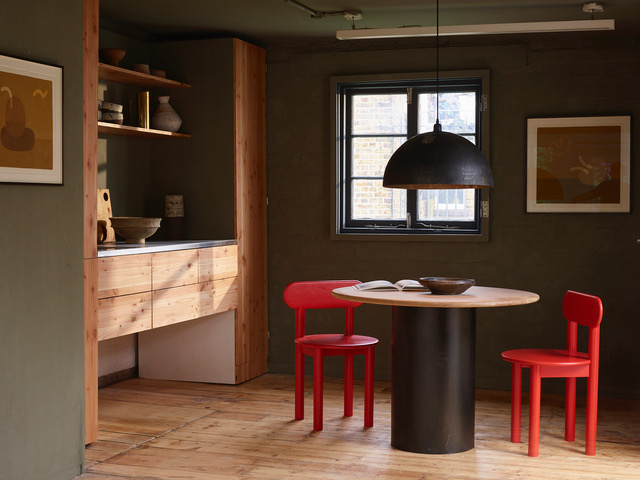

Some furniture showrooms feel as welcoming as an airport security line. The lighting is severe, the sofas appear frightened of fingerprints, and every object seems to whisper, “Please admire me from a respectful distance.” Fred Rigby Studio takes a refreshingly different approach.
Located near London Fields in East London, the studio brings furniture design, prototyping, production, client conversations, art, books, and everyday living together beneath one historic roof. It is less a conventional showroom than a carefully composed home where creative ideas are allowed to stretch their legs, make coffee, and occasionally leave sawdust on the floor.
A Historic London Workshop Begins a New Chapter
Fred Rigby Studio occupies a freestanding industrial building on Gransden Avenue in Hackney. Constructed in 1911, the property was originally associated with cabinetmaking, giving its modern use a satisfying sense of continuity. Instead of converting an old workshop into a polished space with no connection to its past, Rigby and his team returned furniture design and production to a building created for precisely that kind of work.
Finding an independent industrial building in densely developed East London is no small victory. It offers something especially valuable to a working furniture studio: freedom to make noise. Sanding, cutting, assembling, testing, and prototyping are not exactly spa treatments for the ears. A detached structure allows the team to work with fewer restrictions while keeping the major stages of design under one roof.
The building also had a place in Rigby’s memory before it became his headquarters. He had previously worked farther along the same road and regularly noticed the property while passing it. When it became available, its architectural character, practical layout, and history made it an unusually appropriate home for the growing practice.
More Than Adaptive Reuse
Adaptive reuse often focuses on preserving visible architectural details, but this project restores something less tangible: purpose. The building is once again a place where furniture is imagined, developed, handled, and discussed. Its industrial shell does not survive merely as a decorative backdrop for expensive chairs. It participates in the work.
That distinction matters. Old brick, exposed rafters, and steel-framed windows may look wonderful in photographs, but their value here goes beyond visual nostalgia. They create a productive bridge between traditional craftsmanship and contemporary furniture design. The result respects history without turning the studio into a museum where nobody is permitted to move the cushions.
Why Fred Rigby Avoids Calling It a Showroom
The studio’s most distinctive idea may be its rejection of the conventional showroom experience. Rigby has described the public-facing area as closer to an apartment or a home away from home. Visitors encounter furniture in domestic arrangements rather than isolated on platforms beneath intimidating spotlights. Rugs, artwork, ceramics, books, collected objects, prototypes, and working samples make the rooms feel inhabited.
This approach changes how people evaluate furniture. A sofa cannot be fully understood from a product image, no matter how beautifully the photographer fluffs its pillows. Its proportions become clearer when it shares a room with a table, a rug, artwork, and natural light. Visitors can sit down, notice the height of an armrest, feel the fabric, inspect the joinery, and determine whether the piece supports real life rather than merely looking heroic on a screen.
A Home-Like Space With Professional Purpose
The first-floor lifestyle area includes whitewashed brickwork, exposed roof structures, a kitchen, a meeting and library zone, and arrangements featuring furniture from the studio’s collections. Works and accessories from designers, artists, galleries, and brands connected to the practice add further layers. These relationships turn the space into a small creative ecosystem instead of a single-brand sales floor.
The apartment-like atmosphere is not an exercise in casual styling. It supports serious design consultations. Clients can spend time discussing a custom table, seating arrangement, or interior project while surrounded by physical references. Books can be opened. Material samples can be compared. A prototype can be carried into the room. Ideas can evolve through conversation rather than being trapped inside a presentation deck with 94 slides and one very nervous font.
Design, Making, and Display Under One Roof
The ground floor accommodates the working design studio and workshop, while the upper level presents completed pieces in a domestic setting. This vertical arrangement creates a direct connection between process and outcome. A visitor may experience a finished table upstairs and understand that its development, adjustment, and assembly are taking place nearby rather than in some mysterious furniture dimension.
For a small independent practice, this integration can improve both communication and experimentation. Designers can move between drawings, models, materials, prototypes, and finished environments. A curve that looks elegant on paper can be tested at full scale. A table that seems perfectly proportioned in a workshop can be placed beside actual chairs. A lamp can be viewed at different times of day instead of being judged under fluorescent lighting that makes everything look mildly ill.
Transparency Builds Confidence
Allowing clients to see where furniture is developed helps explain the time and skill behind made-to-order work. The price of handcrafted furniture can appear abstract when a consumer sees only the final object. A workshop makes the invisible labor more understandable: material selection, machining, sanding, finishing, upholstery, assembly, quality checks, and the repeated correction of tiny details that most people will never consciously notice but would certainly miss if they were wrong.
This openness also supports a more collaborative relationship. Clients are not simply selecting a product code. They can discuss scale, finishes, colors, room dimensions, traffic patterns, and daily habits. The conversation becomes less about purchasing an object and more about shaping how that object will behave in a home.
The Natural Design Language of Fred Rigby Studio
Although Fred Rigby’s practice is firmly based in London, much of its visual language reaches back to Dorset, where he grew up among fields, hills, rivers, and the English coast. Childhood experiences making treehouses, ramps, go-karts, and other improvised constructions helped establish a practical relationship with materials. Later studies in product and furniture design at Kingston University and work with artists and designers expanded that instinct into a professional practice.
Nature appears in the studio’s work through more than decorative leaf patterns. It is translated into mass, texture, rhythm, and silhouette. Pebbles suggest rounded tables and seating. Rain striking water becomes a family of overlapping surfaces. Clouds inspire generous upholstered forms. Coastal and rural structuresincluding towers, pylons, and other engineered objectsprovide references for smaller home accessories.
Curves That Invite Touch
Rigby’s furniture often uses softened edges and sculptural volumes that encourage physical interaction. Rounded tables naturally guide a hand along their perimeter. Deep seating communicates comfort before anyone sits down. Visible wooden structures reveal how a piece is supported, allowing construction to become part of its character.
The approach is playful without becoming cartoonish. A piece may resemble a pebble, raindrop, arthropod, or cloud, but it still needs to work in an everyday interior. That balance between imagination and practical use is central to the studio’s appeal. Nobody needs a coffee table that performs an interpretive dance every time a cup is placed on it.
The Everyday Collection and Honest Furniture
Launched as the studio’s first capsule furniture range, the Everyday Collection brought together sofas, chairs, tables, and other pieces intended to combine comfort, craftsmanship, flexibility, and character. Oak, wool, and steel contribute warmth and tactility, while modular configurations allow furniture to adapt to different rooms and changing household needs.
The Cove seating family demonstrates Rigby’s interest in making structure visible. Its solid outer frame surrounds softer cushions, creating a clear relationship between support and comfort. Rather than hiding every technical element beneath upholstery, the design allows the wooden shell to contribute to the overall expression.
The Raindrops tables translate the expanding rings of water into groups of rounded surfaces. Produced in multiple sizes, tops, and base finishes, they can be used individually or arranged as a small landscape. This configurability introduces personalization without requiring every order to begin as an entirely new custom project.
Furniture Designed for Real Rooms
The name “Everyday” is important. These are sculptural pieces, but they are intended to participate in ordinary routines: reading, talking, eating, working, hosting, or spending twenty minutes looking for the television remote that is directly beneath you.
Displaying the collection inside an apartment-like studio strengthens that philosophy. The pieces are not treated as untouchable art objects, even when they possess an artistic presence. They are shown in situations that reveal how they might coexist with books, ceramics, paintings, textiles, and the accumulated evidence of daily life.
A Space That Encourages Free Thinking
“Free thinking” can sound like the sort of phrase placed on an office wall immediately above a row of identical gray cubicles. At Fred Rigby Studio, however, the spatial organization supports the idea in practical ways.
The workshop permits physical experimentation. The library supplies visual and intellectual references. The home-like presentation area enables informal conversation. The kitchen encourages hospitality. Art and objects from collaborators introduce perspectives beyond the studio’s own catalog. Together, these elements create conditions in which ideas can move between drawing, making, testing, discussion, and use.
Books, Models, and Objects as Creative Tools
Books and collected objects are not included merely to make the shelves photogenic. Rigby has discussed the role of art, sculpture, photography, and unexpected publications in generating ideas. References may range from natural landscapes and industrial structures to figures such as Barbara Hepworth, Henry Moore, Donald Judd, Salvador Dalí, Ron Arad, and George Nakashima.
Models and maquettes are equally important. Rigby’s process typically begins with hand-drawn lines before moving into plans, small models, and full-scale prototypes. Starting away from the computer keeps the earliest stage loose enough for discovery. Digital tools may refine an idea, but they do not have to supervise its birth like an overly enthusiastic project manager.
The Studio as a Model for Modern Creative Work
Fred Rigby Studio offers lessons that extend beyond furniture. Many creative businesses separate their functions into disconnected environments: design happens in one office, production somewhere else, sales online, and client meetings in a rented room decorated with one courageous plant.
Bringing these activities closer together can produce a richer feedback loop. Makers understand how clients respond to finished pieces. Designers see production challenges earlier. Visitors gain insight into craftsmanship. Products can be evaluated in realistic surroundings. The business becomes more transparent, and the space communicates its values without requiring a lengthy manifesto beside the coat rack.
Hospitality as Part of Design
The studio also demonstrates that hospitality can be a design tool. Offering someone a comfortable seat, allowing time to browse, and creating an atmosphere where questions feel welcome can lead to better conversations. The relaxed setting does not reduce professionalism; it gives professional expertise room to become more human.
This is particularly relevant for bespoke furniture and interior design, where clients may need help articulating preferences they cannot yet name. A domestic environment allows reactions to occur naturally. Someone may discover that they prefer a lower seat, a warmer wood, or a rounder table simply by moving through the room.
Experiencing Fred Rigby Studio: What a Thoughtful Visit Can Reveal
A visit to Fred Rigby Studio can be understood as a sequence of experiences rather than a conventional shopping trip. The first impression begins with the building itself. Surrounded by East London’s dense urban fabric, the freestanding former workshop signals that making still has a physical place in the city. Before examining a chair or table, visitors encounter a story about continuity: furniture was once made here, and furniture is being made here again.
Moving through the working areas encourages a different appreciation of finished design. Materials are no longer anonymous ingredients. Wood has grain, weight, scent, and occasional opinions about humidity. Metal must be cut, formed, and finished. Upholstery requires structure beneath softness. Seeing even a portion of this process makes the completed furniture feel less like merchandise and more like the outcome of accumulated decisions.
Experience One: Slow Down Before Choosing
The apartment-like upper level encourages visitors to spend time with furniture rather than making an instant visual judgment. Sitting on a sofa for several minutes reveals more than standing beside it. Walking around a dining table clarifies circulation. Viewing a finish beside natural textiles and artwork shows how it might respond to other objects in a room.
This slower form of evaluation is useful in an era of rapid online purchasing. Dimensions and photographs provide information, but they cannot reproduce pressure, texture, balance, or bodily comfort. The studio reminds visitors that furniture is experienced through the entire body, not just the scrolling thumb.
Experience Two: Learn Through Contrast
The interiors combine old architecture with contemporary furniture, rough surfaces with soft upholstery, and functional objects with expressive art. These contrasts demonstrate that a coherent room does not require every item to match. Harmony may come from repeated curves, compatible materials, balanced proportions, or a shared emotional tone rather than identical colors and finishes.
For homeowners, this can be liberating. A room does not need to arrive as a complete showroom set. Vintage finds, personal books, contemporary furniture, handmade ceramics, and inherited objects can coexist when they are arranged with attention. Personality often appears in the conversation between objects, including the occasional friendly disagreement.
Experience Three: Participate in the Creative Process
Design consultations in the studio can become active working sessions. Instead of choosing from a narrow list of predetermined options, clients can respond to models, sketches, samples, prototypes, and reference images. A broad request such as “I want the room to feel calmer” can gradually become decisions about shape, spacing, texture, and material.
The setting supports experimentation because the evidence is close at hand. A sample can be carried toward a window. A chair can be moved beside another table. Books can supply an unexpected historical or sculptural reference. This process helps clients understand why good design often develops through patient adjustment rather than a single cinematic flash of inspiration.
Experience Four: See Creativity as Everyday Practice
Perhaps the studio’s most valuable lesson is that creativity does not need to be separated from ordinary life. It can occur beside a coffee cup, around a dining table, during a conversation, or while testing a small object made to hold keys. The space suggests that free thinking is not necessarily chaotic or theatrical. It can be supported by calm rooms, useful tools, tactile materials, trusted collaborators, and enough time to follow an idea beyond its first obvious solution.
That makes Fred Rigby Studio more than a destination for contemporary British furniture. It is an example of how a creative workplace can communicate identity, support production, welcome the public, and encourage meaningful exchange without dividing those activities into sterile categories.
Conclusion: A Living Expression of the Studio’s Philosophy
Fred Rigby Studio succeeds because the space and the furniture share the same values. Both combine function with warmth, structure with softness, and contemporary design with respect for craft. The historic Hackney workshop gives the practice room to sketch, build, test, display, host, and thinkall without pretending that creativity is a perfectly tidy process.
By replacing the traditional showroom with something closer to a home, the studio allows furniture to be understood through use. Visitors can touch materials, sit with ideas, observe craftsmanship, and imagine how a piece might become part of their own lives. The result feels personal without becoming precious and sophisticated without losing its sense of play.
In a design culture often dominated by quick images and instant purchasing, Fred Rigby Studio makes a persuasive case for slowness, physical experience, and thoughtful conversation. It is a place where furniture is not merely displayed. It is developed, questioned, lived with, and occasionally asked to make room for another stack of books.