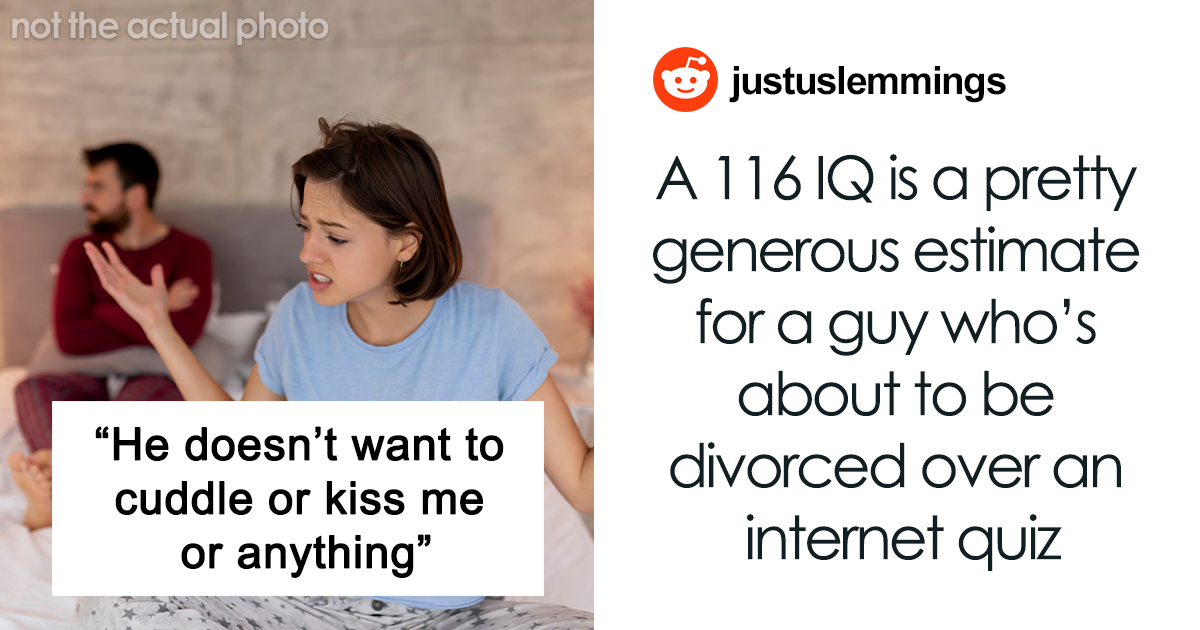
“He Denied Everything”: Woman Calls Out Husband’s Cold Behavior After IQ Test Changes Him

A casual online quiz is supposed to produce a score, a laugh, and perhaps a few minutes of arguing about whether question seven was badly written. It is not supposed to trigger a marital identity crisis. Yet that is what appeared to happen in a widely shared story about a husband whose behavior changed after his wife earned a higher IQ score.
According to the anonymous account, the husband encouraged both partners to take an IQ test. When the results challenged his assumption that he was the intellectually superior spouse, he reportedly became distant, questioned old interactions, and denied behaving differently when confronted. The couple eventually decided to take a break. Because the story originated anonymously online, its private details cannot be independently verified, but the emotional pattern resonated with thousands of readers.
The real issue was never a handful of points on a screen. It was what those points seemed to represent: status, masculinity, self-worth, power, and the uncomfortable realization that marriage is not a trivia tournament with matching bath towels.
How an IQ Test Became a Relationship Test
The husband reportedly entered the experiment expecting confirmation. Perhaps he imagined a playful competition in which his score would officially certify what he already believed about himself. Instead, his wife performed better.
That should have been a harmless surprise. A secure response might have sounded like, “Nice job,” or, “I demand a rematch after coffee.” Instead, the result reportedly changed how he interpreted their relationship. Behaviors that had once seemed normal were recast as evidence that his wife had secretly viewed him as less intelligent.
This kind of reaction illustrates how people can turn neutral information into a threat when it touches a fragile part of their identity. The test did not change either partner’s actual abilities overnight. It simply disrupted an existing personal story: he was the smart one, and she was apparently expected to remain in second place.
The Score Challenged More Than His Intelligence
When someone builds a large part of their identity around being smarter than others, losing an intellectual comparison can feel like losing social rank. The person may experience embarrassment, shame, or fear even when nobody is mocking them.
Research summarized by the American Psychological Association found that some men experienced lower implicit self-esteem when a female romantic partner succeeded, even when the couple was not directly competing. Another series of studies found that men could admire the idea of an intelligent woman from a distance yet become less attracted or more distant when interacting with a woman who actually outperformed them. These findings do not describe every man, but they help explain why a partner’s success may activate insecurity in someone whose self-worth depends heavily on comparison.
In other words, “I am intelligent” is a healthy belief. “I can only feel intelligent when my wife appears less intelligent” is a relationship problem wearing a lab coat.
What an IQ Score Canand CannotTell You
IQ tests are designed to measure selected cognitive abilities, often including reasoning, working memory, processing speed, verbal comprehension, and pattern recognition. Properly developed tests can provide useful information in educational, clinical, and research settings.
However, an IQ score is not a complete inventory of human intelligence. The American Psychological Association notes that conventional IQ testing compares a person’s performance with that of similar test takers but does not capture every form of intelligence or ability. Test interpretation also requires context, professional judgment, and awareness of measurement limitations.
Online Tests Deserve Extra Caution
An internet IQ quiz may offer entertainment or rough practice, but its dramatic-looking number should not automatically be treated like a professional psychological assessment. Mensa International explicitly states that its online challenge is a practice tool rather than an official qualifying IQ test.
Scores can also be affected by fatigue, distractions, familiarity with puzzle formats, language, anxiety, motivation, test conditions, and random variation. Even formal cognitive assessments contain some degree of measurement error. This means that a small difference between two scores may not represent a meaningful difference between two people’s overall intellectual abilities.
More importantly, IQ does not directly measure kindness, loyalty, creativity, patience, judgment, humility, practical competence, or the ability to notice that your spouse is upset before she starts communicating exclusively through aggressively closed kitchen cabinets.
Why His Cold Behavior Mattered More Than the Test
Feeling insecure is human. Everyone occasionally has an emotional reaction they are not proud of. The important question is what happens next.
A healthy partner can acknowledge discomfort without punishing the other person: “I know this is irrational, but that result embarrassed me. I think I have been tying too much of my self-worth to being the smartest person in the room.” That statement would show vulnerability and personal responsibility.
The reported husband instead became cold and then denied that anything had changed. That combination created a second problem. His wife was no longer dealing only with emotional distance; she was also being told that her perception of that distance was wrong.
Denial Can Make Conflict Deeply Confusing
Not every disagreement about what happened is gaslighting. Memory is imperfect, and two people can sincerely interpret the same conversation differently. The term should not be used as a decorative label for every irritating argument.
True gaslighting involves a repeated pattern of manipulation that causes another person to question their perceptions, judgment, or reality. Common tactics can include denying actions, shifting blame, trivializing concerns, withholding information, and insisting that the other person is imagining obvious changes.
Whether or not the behavior in this anonymous story meets that full definition, denial prevented meaningful repair. A problem cannot be discussed when one partner insists there is no problem and treats the other partner’s emotional experience like a software glitch.
The Warning Signs Hidden in the Husband’s Reaction
1. He Turned His Wife’s Success Into His Failure
Partners do not need identical strengths. One may be better with numbers, while the other can assemble furniture without producing three mysterious leftover screws. A healthy relationship treats individual strengths as shared assets rather than threats.
When one partner interprets the other’s achievement as humiliation, ordinary life becomes competitive. Promotions, compliments, income, education, friendships, and even casual games can become emotional land mines.
2. He Reinterpreted Their History
The husband reportedly began viewing earlier interactions differently after seeing the score. This suggests that the test activated a narrative of inferiority. Instead of asking whether that narrative was accurate, he looked backward for evidence supporting it.
That process can create confirmation bias. A harmless joke becomes disrespect. A correction becomes proof of arrogance. A confident opinion becomes an attempt to dominate. Soon, the insecure partner is not responding to the person in front of them but to a fictional rival assembled from selected memories.
3. He Withdrew Instead of Communicating
Emotional withdrawal may happen because someone feels overwhelmed, ashamed, or unable to explain what they are experiencing. In other cases, silence can be used to punish or control a partner. Intent matters, but the effect also matters.
Cleveland Clinic explains that the silent treatment can cause anxiety, guilt, confusion, and self-doubt. Even when it is not intended as abuse, repeated withdrawal indicates poor communication and conflict-resolution skills that need attention.
4. He Refused Accountability
Denial may protect a person’s ego for five minutes, but it usually extends the conflict for five days. Relationship research associated with the Gottman Institute identifies defensiveness as a destructive communication pattern because it redirects blame and prevents partners from resolving the original concern.
A marriage cannot improve when every complaint enters a courtroom where one spouse serves as defendant, attorney, judge, and suspiciously enthusiastic jury.
Intellectual Ability Is Not Emotional Intelligence
The story also highlights the difference between cognitive performance and emotional maturity. A person may solve abstract puzzles quickly yet struggle to identify shame, regulate jealousy, listen without interrupting, or apologize without adding a 20-minute presentation titled “Reasons This Was Technically Your Fault.”
Emotional intelligence includes recognizing emotions, regulating reactions, understanding other people’s feelings, showing empathy, and managing conflict effectively. Harvard Health notes that these abilities support communication and healthy relationshipsand, importantly, they can be developed through practice.
A higher IQ score does not make someone a better spouse. Neither does a lower score make someone less deserving of respect. In a relationship, the more useful question is rarely, “Who processes patterns faster?” It is, “Can we discuss uncomfortable feelings without humiliating, punishing, or dismissing each other?”
How Couples Can Handle Competitive Insecurity
Name the Emotion Beneath the Argument
Arguments about scores, salaries, degrees, or accomplishments often conceal a more vulnerable fear. The insecure partner may be thinking, “Will you respect me less?” “Do I still matter?” or “What if I am not special?”
Naming that emotion can lower the temperature of the discussion. It moves the conversation away from proving who is smarter and toward understanding why the comparison feels threatening.
Describe Behavior Without Attacking Character
Instead of saying, “You are an insecure jerk,” a partner might say, “Since we took the test, you have stopped talking to me at dinner and dismissed me when I asked what was wrong. I feel confused and shut out.”
This does not guarantee a productive response, but it creates a clear opportunity for accountability. Assertive communication focuses on specific actions, their impact, and the change being requested.
Set a Boundary Around Disrespect
Compassion does not require accepting punishment. Someone can understand that a spouse feels insecure while still saying, “I will not participate in conversations where my accomplishments are mocked or my experience is denied.”
Healthy boundaries clarify which behaviors are unacceptable and what action will follow if they continue. Mayo Clinic guidance emphasizes that boundaries support both individual well-being and healthier relationships.
Consider Couples Counseling
Counseling can help when the same conflict repeatedly ends in blame, contempt, denial, or withdrawal. A qualified therapist can help partners identify triggers, translate accusations into needs, and decide whether both people are genuinely willing to repair the relationship.
Therapy is not a magic customer-service desk where one spouse submits the other for repairs. It works best when both partners accept responsibility and practice new behavior outside the session.
Know When Distance Is Reasonable
Taking a break may be appropriate when conversations have become emotionally unsafe or impossible. Distance can provide clarity, especially when one partner needs to determine whether the problem is an isolated reaction or part of a broader pattern of control and disrespect.
If emotional cruelty, intimidation, isolation, threats, or other abusive behaviors are present, personal safety should take priority over relationship repair. Trusted friends, counselors, and domestic abuse resources can help someone evaluate the situation and create a safe plan.
Related Experiences: When a Small Comparison Reveals a Much Bigger Problem
Many couples experience a moment when an apparently trivial competition exposes an insecurity that had been quietly directing the relationship. It might be an IQ quiz, a promotion, a board game, a fitness challenge, or a conversation in which one spouse knows considerably more about the subject.
Imagine a couple named Marcus and Elena. Marcus has always described himself as “the analytical one,” while Elena is considered more socially intuitive. One evening, they complete a series of logic puzzles for fun. Elena solves most of them first. Marcus laughs initially, but later he begins correcting her unnecessarily, explaining simple concepts she already understands, and making jokes about how “lucky” she was.
Elena might first assume he is teasing. When it continues, she asks whether the game bothered him. Marcus replies that she is imagining tension and accuses her of bragging. The original puzzle has disappeared from the argument. The real conflict now concerns emotional honesty and respect.
A healthier version of Marcus would notice his reaction and say, “I felt embarrassed because I have always thought of logic as my territory. I know you did nothing wrong.” Elena could reassure him without shrinking herself: “Your strengths still matter, but I do not want either of us to need the other person to perform poorly.”
Consider another example involving professional success. Dana receives a promotion and begins earning more than her husband, Chris. He congratulates her publicly but becomes critical at home. He complains about small purchases, minimizes her workload, and suddenly insists that career accomplishments are shallow. Whenever Dana asks whether the promotion is bothering him, he says she has become arrogant.
Chris may genuinely feel afraid that the relationship’s balance is changing. That fear deserves honest discussion. It does not justify belittling Dana until she feels guilty for succeeding. A supportive partner can ask for reassurance, renegotiate household roles, or discuss financial expectations without converting insecurity into punishment.
These experiences show why patterns matter more than isolated moments. One grumpy evening after losing a game is not automatically evidence of emotional abuse. A repeated cycle of withdrawal, mockery, denial, and blame is more concerning.
People on the receiving end of this behavior often begin over-functioning. They carefully edit their opinions, understate accomplishments, and offer constant reassurance. They may stop correcting misinformation because accuracy is no longer worth the argument. Eventually, they become responsible for managing both their own emotions and their partner’s fragile self-image.
This creates an unequal relationship. One partner is allowed to grow, shine, and make mistakes. The other must remain small enough to preserve peace.
The solution is not to ban competition or pretend differences do not exist. Playful rivalry can be enjoyable when both partners feel secure. The solution is to build a relationship in which admiration moves in both directions. Each partner should be able to say, “You are excellent at something I value, and your excellence does not reduce me.”
That mindset requires humility. It also requires a definition of self-worth that is larger than any score. Intelligence is not a single throne that only one spouse can occupy. Two people can be capable in different ways, learn from each other, and occasionally lose a quiz without scheduling the collapse of civilization.
Conclusion: The Number Was Never the Real Problem
The viral IQ test story attracted attention because the husband’s reaction seemed wildly disproportionate to the event. Yet the underlying dynamic is familiar. When identity depends on superiority, a partner’s success can feel like a personal attack.
An IQ score did not transform this marriage. It appears to have exposed an expectation that was already present: the husband felt comfortable as long as he believed he occupied the superior intellectual position. When that belief was challenged, emotional distance and denial reportedly followed.
Healthy love does not require one person to lose so the other can feel valuable. It allows both partners to be intelligent, accomplished, uncertain, imperfect, and occasionally wrong. The most revealing test was therefore not the online quiz. It was whether the couple could face insecurity with honesty, empathy, and respect.
One partner may have received the higher cognitive score. The more important question was who could demonstrate the emotional intelligence needed to protect the relationship.