
Some people can sketch a croissant so realistically that you start looking for butter on your screen. Other people draw a banana that looks like a suspicious yellow boomerang. Both belong here.
This is your invitation to grab a pencil, pen, tablet, marker, crayon, eyeliner, or whatever artistic weapon is within reach, and attempt to draw any food item you can think of. It can be a fancy bowl of ramen, a lonely French fry, grandma’s legendary pie, a hot dog with way too much confidence, or a cookie that looks like it has seen things.
The goal is not perfection. The goal is to have fun, make something recognizable enough to cause hunger, and post the result for everyone to enjoy. Welcome to the food drawing challenge, where artistic talent is optional but enthusiasm is strongly encouraged.
Why Food Is the Perfect Thing to Draw
Food is one of the friendliest subjects in the art world. It sits still, does not complain about its angle, and usually smells better than a bowl of plastic fruit from a department store display. You do not need a professional studio or a dramatic mountain view. You just need a snack, a reference photo, or a powerful memory of the best sandwich you have ever eaten.
Food also comes with built-in personality. A strawberry has tiny seeds and a leafy hat. A burger is basically a stack of soft circles pretending to be architecture. Pizza is a triangle wearing cheese. A bowl of soup is a shiny oval filled with mysterious floating vegetables. Even a simple apple can become an artistic adventure once you notice its stem, its uneven shape, and the little highlight that makes it look juicy instead of like a red bowling ball.
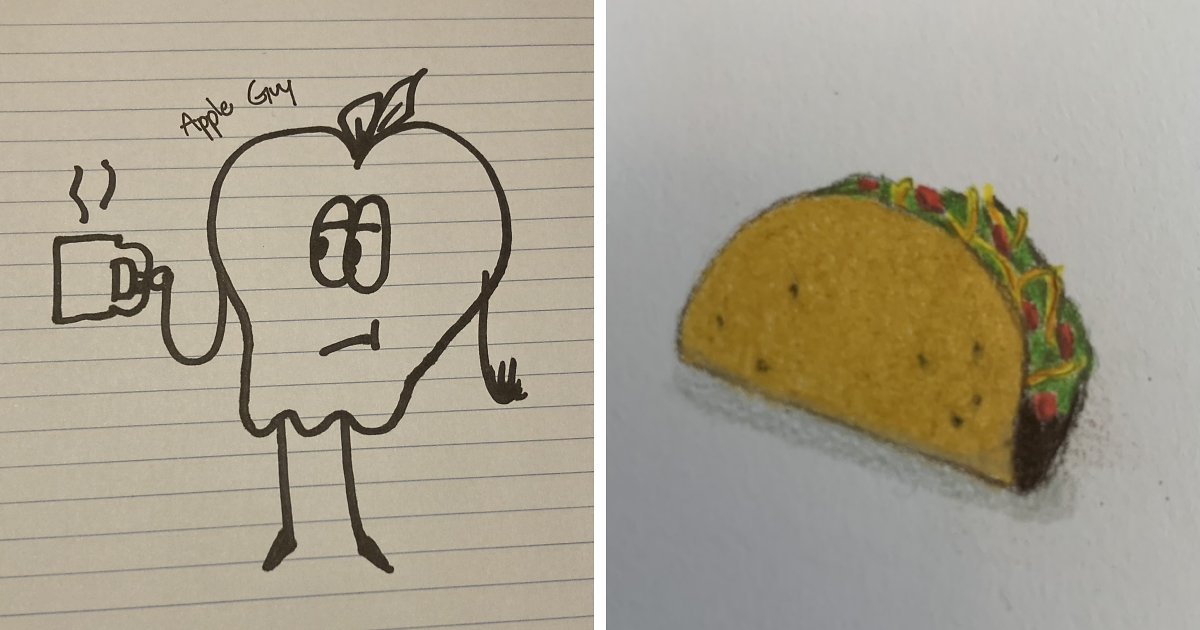
That is why food illustration is such a great challenge for beginners and experienced artists alike. You can make it realistic, cute, messy, dramatic, cartoonish, or completely bizarre. A donut can be a glamorous fashion model. A taco can be a tiny monster with lettuce hair. A bowl of cereal can be painted like a royal portrait. Nobody is stopping you, and that is the beautiful chaos of creative drawing.
The Rules of This Food Drawing Challenge
The rules are simple enough to fit on a napkin:
- Pick any food item.
- Draw it in your own style.
- Do not worry about whether it looks “good enough.”
- Post the result and tell everyone what you drew.
- Bonus points for accidental comedy.
Your food drawing can be made with pencil, colored pencil, paint, digital tools, charcoal, markers, crayons, collage, or a pen that you found at the bottom of your backpack. It can take three minutes or three hours. It can be a careful still life or a quick doodle during a meeting that definitely should have been an email.
The only real requirement is that you give it a try. Art does not need permission to begin. It just needs a surface and a first mark.
How to Choose a Food Item to Draw
Choosing your subject is often the hardest part because food is everywhere. Suddenly, your kitchen becomes an art supply store with calories. A good starting point is to choose something with a clear, simple shape.
Easy Food Ideas for Beginners
- An apple or orange
- A banana
- A slice of pizza
- A cupcake
- A fried egg
- A taco
- A donut
- A sandwich
- A bowl of noodles
- A single French fry
These foods are forgiving. A banana does not need to be perfectly curved. A donut is basically a circle with a hole, frosting, and dreams. A fried egg is almost impossible to mess up because egg whites already look like they were designed by a cloud that got nervous.
Food Ideas for Artists Who Want a Bigger Challenge
If you are feeling brave, try a ramen bowl with chopsticks, a plate of pancakes covered in syrup, a seafood boil, a stacked burger, a fruit basket, sushi rolls, a charcuterie board, or a slice of layered cake. These subjects are more complicated because they include texture, shadows, overlapping shapes, and plenty of tiny details that may test your patience.
But do not let complexity scare you away. You do not have to draw every sesame seed, noodle, crumb, or blueberry. Suggesting details is often more effective than trying to create a forensic food document. Let your viewer’s imagination fill in the rest.
Start With Shapes, Not Panic
One of the easiest ways to make a food drawing feel less intimidating is to break it into simple shapes. Before you draw the shiny tomato, draw a circle. Before you draw the waffle, sketch a rectangle. Before you draw a bowl of ramen, begin with an oval for the bowl and a few loose curves for the noodles.
This is not cheating. It is how artists keep a drawing from turning into a confusing pile of lines. Nearly every food item can be reduced to a few basic shapes:
- Circles for fruit, cookies, plates, and donuts
- Ovals for bowls, eggs, sushi, and bread rolls
- Triangles for pizza, cake slices, and tortilla chips
- Rectangles for toast, candy bars, and sandwiches
- Curved lines for noodles, drizzles, steam, and melted cheese
Once you have the big shapes in place, add the smaller details. This makes your drawing more balanced and helps you avoid the classic beginner mistake of spending twenty minutes drawing a perfect pickle before realizing the burger bun is the size of a bicycle tire.
Give Your Food Some Texture
Texture is what turns a flat sketch into something that feels tasty. You do not need to draw every detail exactly. A few smart marks can suggest crunch, shine, fluffiness, or gooeyness.
For example, short dots can suggest strawberry seeds or sesame seeds. Loose wavy lines can make noodles look soft and tangled. Tiny cracks can make a cookie appear crisp. Quick strokes around the edge of a piece of toast can suggest browning. A few bright white areas can make grapes, cherries, sauce, or frosting look glossy.
Think about how the food would feel if you touched it. Is it smooth like an apple? Bumpy like popcorn? Flaky like a croissant? Sticky like a cinnamon roll? Spiky like a pineapple that is clearly trying to protect its personal space?
Use your pencil, pen, or brush to hint at those qualities. You are not just drawing food. You are drawing crunch, softness, steam, crumbs, sugar, spice, and the possibility of needing a nap afterward.
Use Light and Shadow to Make Your Drawing Pop
You do not need to become a professional lighting engineer to improve a food sketch. Just pick one direction where the light is coming from. Maybe your imaginary kitchen window is on the left. That means the left side of your apple, cupcake, or burrito will be brighter, while the opposite side will be darker.
Start by lightly shading the areas that face away from the light. Then add a shadow underneath the food item so it does not look like it is floating through space like a carb-loaded UFO.
Even one soft shadow can make a huge difference. A plate suddenly sits on a table. A cookie suddenly has thickness. A cupcake suddenly looks like it could be purchased from a bakery instead of summoned from another dimension.
A Simple Shading Trick
Squint at your reference photo or real snack. When you squint, the darkest and lightest areas become easier to notice. Then keep it simple:
- Leave the brightest spot mostly white.
- Add a medium layer of shading across one side.
- Make the darkest area smaller and more concentrated.
- Add a cast shadow beneath the object.
That is enough to make your food drawing look more dimensional without turning the process into a stressful science experiment.
Color Can Make the Drawing More Delicious
Color is where food drawing becomes dangerously fun. Bright red strawberries, golden fries, creamy frosting, green avocado, orange cheese, purple grapes, and deep brown chocolate all bring instant personality to a page.
Still, you do not have to use realistic colors. Maybe your pizza is blue because it came from the moon. Maybe your watermelon is striped like a tiger. Maybe your soup is neon pink because it contains the secret ingredient: chaos.
If you want a more realistic food illustration, look for color changes rather than using one flat shade. A banana may have yellow, brown, green, and gray. Bread may have pale cream in the middle and darker gold around the crust. A tomato may have orange highlights, red shadows, and a tiny patch of green near the stem.
Small color variations make even simple food art feel richer. They also make you look extremely observant, which is useful when you want people to believe that you definitely meant to draw that strange shadow.
Make Your Food Drawing Funny, Cute, or Dramatic
This is not a formal art competition where everyone must whisper respectfully at a grape. Make the food yours.
Give your avocado a tiny face. Turn a bagel into a portal to another universe. Draw a cupcake with an evil mustache. Make a sad French fry who has been separated from the rest of the order. Draw a tomato wearing sunglasses because it is too cool for the salad bowl.
You can also create a scene. Put your taco on a tiny skateboard. Give a bowl of ramen a detective hat. Draw a cookie staring nervously at a glass of milk. Make a cheeseburger stand proudly on a mountain of onion rings like the ruler of Lunch Kingdom.
The more personal the drawing feels, the more memorable it becomes. A technically perfect sketch is impressive, but a waffle with eyebrows and a tiny cape? That is art people remember.
Post Your Food Art and Tell the Story Behind It
Once your drawing is finished, post it proudly. Include the name of the food, the materials you used, and maybe one sentence about why you chose it.
Did you draw your favorite childhood snack? A meal you miss from a vacation? A dessert that your family makes every holiday? A grocery-store cookie that had no business being as good as it was? Those little details make a food drawing more than an image. They make it a memory.
You can also share how long it took, what part was hardest, or what went hilariously wrong. Maybe the banana became a canoe. Maybe your cookie looks like a potato. Maybe your ramen bowl resembles a hat. That is not failure. That is the plot twist.
Creative communities are more fun when people share the imperfect attempts, the rough sketches, the strange experiments, and the unexpected wins. Post the drawing. Celebrate the effort. Compliment someone else’s artistic hamburger. The internet has enough arguments already; it could use more cheerful potatoes.
Final Bite: Draw the Snack, Share the Chaos
The best food drawing challenge is not about proving that you are the next great master of still life. It is about slowing down, noticing the colors and shapes around you, and turning an everyday meal into a tiny creative adventure.
So, Hey Pandas, choose any food item. Draw it with confidence, curiosity, or at least enough determination to make a potato look emotionally believable. Then post the result. We are ready for your masterpieces, your doodles, your accidental monsters, and your extremely dramatic grapes.
Experiences From the Food Drawing Table
My favorite thing about drawing food is that it makes ordinary moments feel strangely important. A snack that would normally disappear in five minutes suddenly becomes a serious artistic subject. You start staring at a cookie like it is a rare artifact in a museum. You notice the shadows under the chocolate chips. You see the uneven edge where the dough spread in the oven. You realize that your afternoon snack has texture, color, personality, and a very short life expectancy.
I once tried to draw a bowl of cereal because I thought it would be easy. It was not easy. The bowl was fine. The milk was manageable. The cereal pieces, however, slowly turned into a collection of tiny floating rocks. By the end, it looked less like breakfast and more like a geological discovery. Still, I liked it. The drawing was not perfect, but it captured the general spirit of cereal: chaotic, crunchy, and somehow always gone before you are emotionally ready.
Another time, I attempted to sketch a slice of pizza. I began confidently with the triangle shape, then added cheese, pepperoni, and a crust. Everything was going well until I tried to make the cheese look melted. My cheese became a group of suspicious yellow rivers flowing toward the pepperoni. The slice looked slightly haunted. But that is the magic of food art: even when the drawing goes wrong, it often becomes funnier and more interesting.
Food drawing can also bring back memories. A simple bowl of noodles might remind someone of late-night college meals. A piece of pie can bring back holidays, family kitchens, and the sound of people arguing over who gets the last slice. A fruit sketch can remind you of summer markets, lunch boxes, road trips, or the one apple that rolled out of your grocery bag and disappeared under the passenger seat for an alarming amount of time.
There is something comforting about drawing food because it is familiar. You do not have to invent an entire fantasy world. You can look at what is already in front of you and discover that it is interesting. A wrinkled pepper, a cup of coffee, a piece of toast, or a half-eaten donut can become the center of attention for a few quiet minutes.
The best part is seeing how differently people interpret the same food. One person may draw a realistic strawberry with careful shading and delicate seeds. Another may draw a strawberry wearing boots and carrying a sword. Both are valid. Both are wonderful. Both may inspire someone else to pick up a pencil and create something completely unexpected.
That is why this challenge works. It gives people a small, low-pressure reason to make art and share it. Nobody needs expensive supplies. Nobody needs formal training. Everyone has seen food, eaten food, remembered food, or stared into the refrigerator at midnight hoping for inspiration. Drawing turns that familiar experience into something playful.
So whether your food sketch looks delicious, confusing, adorable, dramatic, or like it escaped from a cartoon, post it anyway. A slightly lopsided cupcake can make someone smile. A wobbly taco can start a conversation. A bowl of noodles with googly eyes can become the most important thing on the internet for at least three minutes. And honestly, that sounds pretty great.