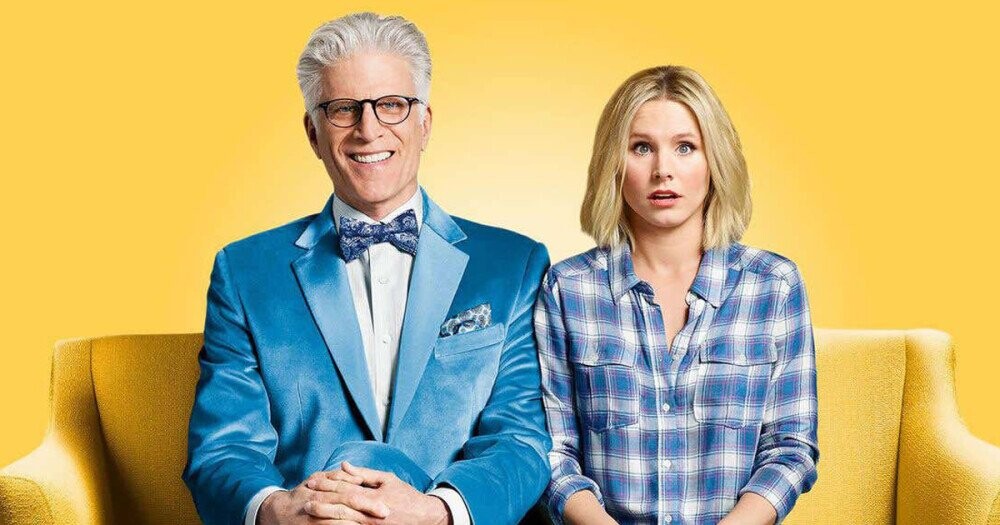

Editor’s note: Major spoilers ahead for all four seasons of The Good Place. Also, yes, we will be saying “fork” a lot. Prepare your moral philosophy notebooks accordingly.
The Good Place is one of those rare sitcoms that rewards both casual viewers and pause-button detectives. On the surface, it is a bright, fast, deeply funny NBC comedy about Eleanor Shellstrop, a proudly imperfect Arizona dirtbag who wakes up in the afterlife and realizes there has been a clerical error. Underneath the frozen yogurt, neighborhood rankings, Janet smiles, and Jason Mendoza chaos, the show is packed with hidden jokes, visual gags, philosophical callbacks, and tiny Easter eggs that make a rewatch feel like opening a moral philosophy piñata.
Created by Michael Schur, The Good Place ran for four seasons and became famous for blending ethics, fantasy, sitcom rhythm, and absurd world-building. But part of its genius is how many jokes happen in the corners of the frame. A sign in the background might reference another Schur show. A prop might contain a full joke that only appears for half a second. A number on a door might look random until the creator admits it was planted to mess with obsessive fans. Holy forkin’ shirt, indeed.
Below are 21 hidden jokes and Easter eggs in The Good Place that prove this show was not just written; it was engineered, polished, and lovingly stuffed with comedy snacks.
21 Hidden Jokes And Easter Eggs In The Good Place
1. The “forking” curse-word filter is the first big clue
The Good Place famously replaces swear words with harmless substitutes: “fork,” “shirt,” “bench,” and “ashhole.” At first, it feels like a network-TV-friendly joke. But it also tells us something important about the neighborhood: this place is not actually freedom. It is a controlled environment. Even Eleanor cannot say what she wants. The joke is silly, but the implication is sneaky. Heaven has autocorrect, and autocorrect is suspicious.
2. Frozen yogurt is not just dessert; it is low-grade torture
The neighborhood has frozen yogurt shops everywhere. That seems adorable until you remember Michael’s explanation: humans took something wonderful, ice cream, and ruined it a little so they could have more of it. That is one of the show’s best running jokes because it captures the whole fake-Good-Place vibe. Frozen yogurt is almost happiness, but not quite. It is dessert wearing sensible shoes.
3. The frozen yogurt flavors are tiny jokes hiding in plain sight
If you pause during the froyo scenes, the flavor boards get ridiculous. The show offers emotionally specific flavors like full cell phone battery, cancelled plans, empty inbox, inside jokes, and the perfect high five. They are funny because they are not flavors; they are micro-doses of human satisfaction. The joke works because every viewer understands that “empty inbox” would absolutely slap as a dessert flavor.
4. The food puns are a full comedy buffet
The Good Place uses restaurant names as a second script. Rebooted neighborhoods and background storefronts include glorious groaners such as Beignet and the Jets, Biscotti Pippen, Cake Canaveral, Knish from a Rose, The Pesto’s Yet To Come, Ziti of Stars, and You Do The Hokey Gnocchi and You Get Yourself Some Food. These are not throwaway jokes. They build the show’s afterlife like a theme park designed by a pun-drunk philosopher.
5. “Pobody’s nerfect” is dumb, sweet, and secretly perfect
The phrase “Pobody’s nerfect” sounds like something you would see on a mug at a gas station next to a keychain shaped like a dolphin. That is why it works. The joke is intentionally goofy, but it also fits the show’s central idea: people are messy, morality is hard, and improvement matters more than perfection. A stupid phrase becomes a tiny thesis statement in a tracksuit.
6. Season 1 quietly avoids the color red
One of the smartest hidden details appears before viewers know the truth about Michael’s neighborhood. The set and costume teams avoided red in Season 1 so the audience would not subconsciously connect the neighborhood to devils, demons, or hell. It is a tiny design choice with a big payoff. The world looks cheerful and pastel, while the secret Bad Place is sitting right there, smiling politely and offering you clam chowder.
7. The uncomfortable furniture was part of the torture
Eleanor’s Season 1 home looks whimsical, but several details are subtly wrong. The furniture is not truly comfortable, which makes sense once the twist reveals the neighborhood as a psychological torture experiment. The Good Place is excellent at hiding cruelty inside cuteness. It is like being trapped forever inside a luxury Airbnb where every chair was selected by someone who hates lumbar support.
8. The Swanson Safe Company nods to Parks and Recreation
Jason Mendoza’s death involves a botched robbery, a safe, a snorkel, and exactly the level of planning you would expect from a man who once threw a Molotov cocktail and immediately had a different problem. The safe is branded Swanson Safe Company, a wink to Ron Swanson from Parks and Recreation, another Michael Schur classic. It is a perfect crossover joke: sturdy, deadpan, and probably made of breakfast meat.
9. Snake Juice shows up in the Bad Place
Another Parks and Recreation Easter egg appears when Bad Place demons are seen with Snake Juice, the chaotic liquor created by Tom Haverford. It is an ideal background gag because Snake Juice already felt demonic in Parks and Rec. If any beverage belongs in the Bad Place, it is the one that turns adults into emotional raccoons wearing blazers.
10. Dennis Feinstein’s perfume exists in Eleanor’s world
In another Schur-universe nod, a magazine ad in Eleanor’s flashback references Glyde, a perfume connected to fictional Pawnee fragrance man Dennis Feinstein. This detail is especially fun because Jason Mantzoukas, who played Dennis Feinstein on Parks and Recreation, also plays Derek on The Good Place. That is not an Easter egg; that is a comedy nesting doll.
11. The “Existence’s Best Boss” mug salutes The Office
When Janet and Michael visit the accounting office, the head accountant Neil has a mug that echoes Michael Scott’s legendary “World’s Best Boss” mug from The Office. The updated version says “Existence’s Best Boss,” which is wonderfully absurd because only this show could make cosmic bureaucracy feel like a sad office kitchen with better lighting.
12. The magic panda is real
Jason once suggests catching a magic panda and using its powers. In most shows, that would be a quick joke and nothing more. In The Good Place, the visual effects team actually placed a teleporting panda in the background of multiple scenes. It pops up, causes chaos, and rewards viewers who inspect the frame like it contains state secrets. Jason was wrong about many things, but not about the panda.
13. Trevor keeps flying through the void
Adam Scott’s demon Trevor is launched into the afterlife void by the Judge, and the show later sneaks footage of him flying backward through the background of afterlife-system scenes. The gag is beautifully petty. Trevor is so annoying that even his eternal punishment becomes a reusable background asset. Somewhere out there, he is still screaming, and honestly, fair.
14. The numbers 12358 and 322 are deliberate misdirects
The neighborhood ID number 12358 uses the early digits of the Fibonacci sequence, while 322 references the number of people in the original neighborhood and a famously mysterious Skull and Bones number. Michael Schur has explained that these numbers were partly designed to lure fans into theorizing. In other words, the Easter egg is real, but the joke is on everyone with a corkboard and red string.
15. Michael’s final apartment keeps the number joke alive
In the finale, Michael’s apartment building number is 12358 and his apartment number is 322. That is a lovely final callback because it takes numbers once used to mislead the audience and places them in Michael’s new human life. The demon architect who built a fake heaven ends up in an ordinary apartment with extraordinary Easter eggs on the door.
16. Janet’s costume is a character clue
Good Janet’s look was inspired by 1970s airline staff uniforms, which makes perfect sense. Janet is helpful, serene, and always ready to provide information, objects, or emotional damage with a smile. Her purple color palette also suggests balance and neutrality. Bad Janet, meanwhile, gets a look inspired by Sandy’s black outfit in Grease. Even the costumes have punchlines.
17. Jason’s “Phil + Sophie” notebook joke is painfully Jason
During one of Chidi’s classes, Jason’s notebook reads “The History of Phil + Sophie” instead of philosophy. It is a blink-and-you-miss-it background gag, but it captures Jason perfectly. He is trying. He is present. He has supplies. He just believes philosophy may be two people named Phil and Sophie, possibly from Jacksonville.
18. Chidi’s philosophy props were fully written
The show did not fake its academic world with random squiggles. Essays, notes, and other paper props were actually created, even when the camera barely showed them. Tahani’s philosophy essay title and Jason’s childlike paper details are jokes most viewers would never catch. That invisible effort matters because Chidi’s world feels real, even when time looks like cursive spaghetti.
19. Tahani’s celebrity contacts are a joke machine
Tahani’s name-dropping is already one of the show’s best running jokes, but the phone and background details push it further. Her contacts and references include absurd levels of celebrity access, because Tahani does not merely know famous people; she knows the famous people behind the famous people. Somewhere in her phone, there is probably “Bono’s Hat – Emergency Only.”
20. Cowboy Skyscraper Buffet is visual satire with extra sauce
The America-themed restaurant in Australia, Cowboy Skyscraper Buffet, is packed with cartoonish U.S. references, from outrageous tabletop details to over-the-top decor. The joke is not just “America is weird.” It is that every place in The Good Place is a heightened comic strip version of reality. Australia gets kangaroo and koala jokes; Florida gets pool furniture chaos; America gets a restaurant that sounds like it was named by a fireworks stand.
21. The finale cameos are emotional Easter eggs
The finale includes meaningful appearances and callbacks that function like goodbye gifts. Nick Offerman appears in a woodworking-related moment, Mary Steenburgen appears as Michael’s guitar teacher, and philosophy adviser Todd May also shows up. These cameos are not random applause signs. They connect the show’s creative family, philosophical roots, and final message: life is made richer by the people who help us become better.
Why The Good Place Easter Eggs Matter
The hidden jokes in The Good Place are not just decorations. They are part of how the show thinks. The series is obsessed with consequences, intentions, systems, and moral improvement, so it makes sense that even the smallest props have purpose. A fake product ad can deepen the Schur comedy universe. A number can tease fan theories. A frozen yogurt flavor can summarize the ache of modern happiness. A demon flying through the void can remind us that sometimes justice is just Adam Scott screaming forever in the background.
This is why The Good Place hidden jokes remain so fun years after the finale. The show was built for rewatching. The first time, viewers follow Eleanor’s panic and Chidi’s stomachaches. The second time, they notice how the neighborhood is wrong. The third time, they start reading signs, scanning costumes, and treating Janet’s void like a museum exhibit. The show becomes more generous the more attention you give it.
Rewatch Experience: What It Feels Like To Hunt For These Jokes
Rewatching The Good Place for Easter eggs is a very specific kind of joy. It is not the relaxed, half-looking-at-your-phone experience that many sitcoms allow. This show politely grabs your phone, launches it into the Medium Place, and says, “No, babe, look at the background.” Suddenly, you are pausing on froyo menus, squinting at apartment numbers, and wondering whether a throwaway line in Season 1 is actually a philosophical land mine wearing a cardigan.
The best part of the rewatch is realizing how fair the show plays. The Season 1 twist is shocking the first time, but on a second viewing, the clues are everywhere. Michael is always a little too theatrical. The neighborhood is always a little too curated. The pleasures are just slightly disappointing. Frozen yogurt replaces ice cream. Soulmates feel forced. Houses look cute but do not quite comfort the people inside them. Once you know the secret, the fake Good Place does not look heavenly anymore. It looks like a mall designed by a demon with a Pinterest account.
That is where the hidden jokes become more than jokes. They become texture. The food puns tell us the neighborhood is artificial, but also playful. The Parks and Recreation references remind us that the show belongs to a larger comedy tradition where tiny details matter. Janet’s outfit, Michael’s bow tie, Jason’s notebook, and Tahani’s ridiculous social orbit all work like character footnotes. You can understand the story without them, but catching them makes the world feel handcrafted.
There is also something comforting about how much work went into details many people would miss. Someone wrote prop essays. Someone designed fake signs. Someone thought, “What if the magic panda actually appeared later?” That kind of effort feels generous. It tells the audience, “We know you are smart, and we left snacks for you.” Not every show respects viewers that way. Some shows hide Easter eggs as marketing bait. The Good Place hides them because the writers, designers, editors, and effects artists seem genuinely delighted by the possibility that one fan, somewhere, might pause at the exact right second and yell, “Wait, was that Snake Juice?”
Personally, the most satisfying experience is watching the show with someone who has never seen it before while silently waiting for them to notice the weirdness. You cannot say too much. You cannot point at the frozen yogurt and scream, “IT MEANS SOMETHING!” You just sit there, composed like Janet, while your friend laughs at the surface joke. Later, when the twist lands, the rewatch becomes inevitable. That is the magic of The Good Place Easter eggs: they make the show feel alive after it ends.
The final emotional trick is that the hidden jokes never undercut the heart of the series. The finale can include cameos, callbacks, and number gags, but it still lands as a meditation on love, completion, and letting go. That balance is hard. Too many Easter eggs can make a story feel like a trivia contest. The Good Place uses them like seasoning. A little magic panda here, a little Fibonacci there, and somehow the whole meal tastes like moral growth with a side of nachos.
Conclusion
The Good Place remains one of TV’s most rewatchable comedies because its best jokes do not always announce themselves. Some are loud, like “Bortles!” and “Ya basic.” Others are tucked inside signs, numbers, costumes, props, and background chaos. Together, these hidden jokes and Easter eggs in The Good Place create a world where every detail feels intentional, every rewatch feels rewarding, and every frozen yogurt shop looks just a little more suspicious.
So the next time you revisit the series, do not just follow Eleanor, Chidi, Tahani, Jason, Janet, and Michael. Watch the walls. Read the signs. Pause the menus. Scan the void for Trevor. Somewhere in the frame, a magic panda may be waiting to remind you that comedy heaven is real, and apparently it has a very aggressive prop department.