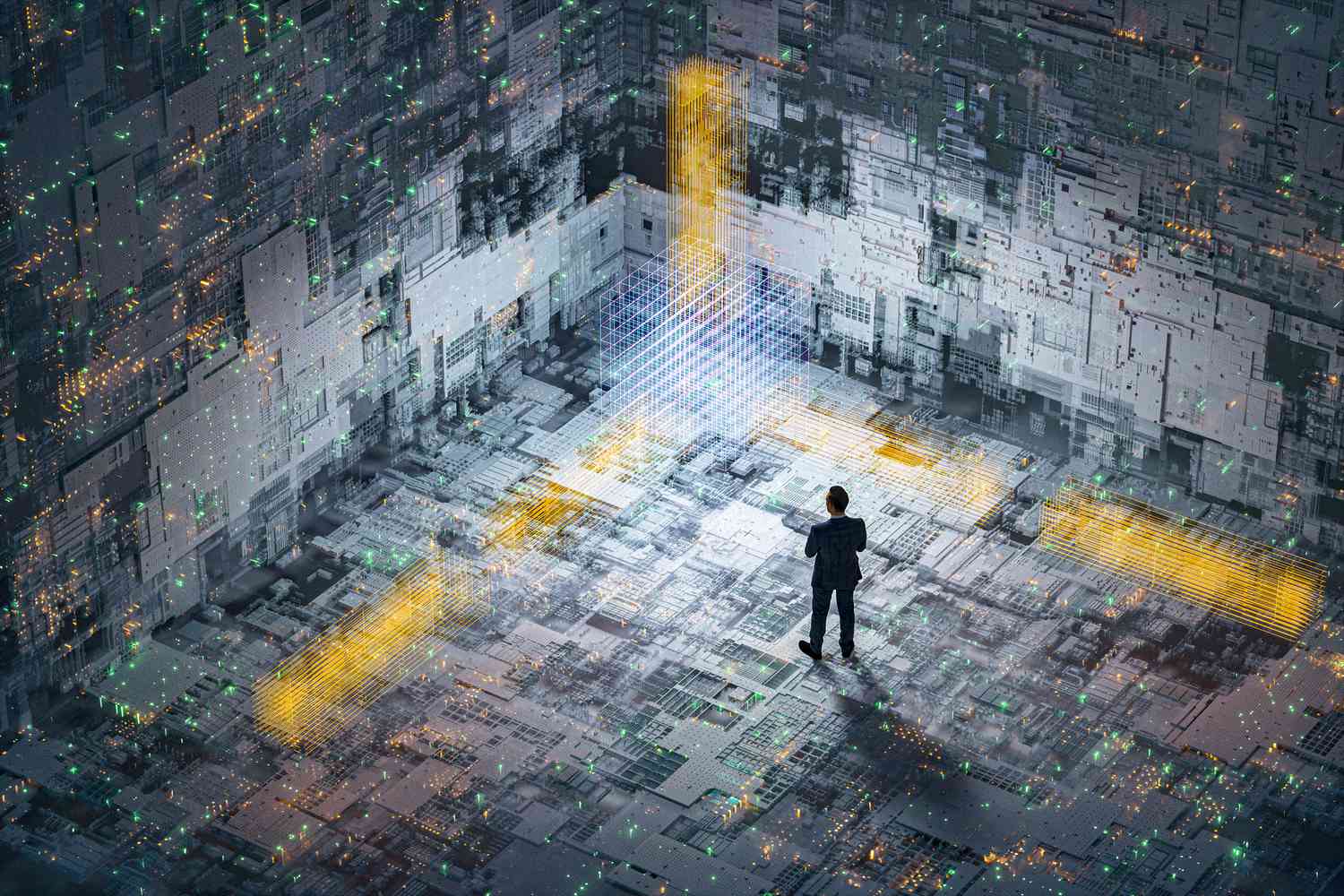

Here is the most unsettling possibility of the AI age: what if artificial intelligence does not just write emails, generate cat portraits, and help scientists analyze data, but eventually helps reveal that reality itself is coded? That is the basic thrill behind the simulation hypothesis, the idea that our universe could be an artificial environment running on some unimaginably advanced computational system.
Before anyone sprints outside yelling, “We’re in a giant laptop!”, let’s slow down. The simulation idea is not a settled scientific theory. It is a philosophical argument with scientific implications, not a lab result taped to the fridge. Still, it has survived for one simple reason: it is weird, but not obviously impossible. And now that AI is getting frighteningly good at spotting patterns humans miss, some thinkers wonder whether artificial intelligence could become the tool that finally finds evidence of a simulated universe.
That does not mean AI will wake up tomorrow, point at the sky, and say, “Yep, definitely code.” It does mean AI could become the most powerful anomaly detector ever created. If reality has glitches, shortcuts, compression tricks, rendering limits, or hidden rules that look suspiciously computational, AI may be the best bet for finding them.
What Is the Simulation Hypothesis, Really?
The modern conversation around simulation theory is often traced to philosopher Nick Bostrom’s famous argument: at least one of three things is likely true. First, advanced civilizations almost always go extinct before gaining the power to run detailed ancestor simulations. Second, civilizations that do reach that level rarely choose to run such simulations. Or third, if advanced beings do create many simulated worlds, then statistically we may be more likely to be inside one than in the original “base reality.”
Notice what this argument does not say. It does not say we have proof. It does not say the moon is a loading screen. It says that if future civilizations can simulate conscious beings at scale, the math starts feeling a little spooky. One original universe could, in principle, generate countless simulated ones. If that happened, simulated observers could vastly outnumber non-simulated observers.
That is why the simulation hypothesis keeps popping up in serious conversations about philosophy, cosmology, and technology. It sits at the uncomfortable intersection of probability, computing power, and the oldest human question of all: what exactly is reality?
Why AI Changes the Conversation
For years, the simulation debate lived mostly in philosophy departments, podcasts, and late-night dorm-room arguments powered by caffeine and overconfidence. AI changes that because it gives scientists new ways to examine enormous amounts of data, model hidden structures, and detect tiny irregularities that human researchers might miss.
In plain English, AI is good at three things that matter here: pattern recognition, anomaly detection, and model building. Those are exactly the skills you would want if you were trying to determine whether the universe behaves like a continuous, naturally occurring reality or like a computational system with limits and shortcuts.
Think of it like this: if our universe were a giant game engine, humans would be the characters walking around inside the world, admiring the scenery and occasionally arguing on social media. AI, however, could act more like a forensic tool that examines the texture files, frame timing, physics rules, and hidden constraints of the engine itself.
How AI Could Search for Signs of a Simulated Universe
1. Detecting Strange Patterns in the Laws of Physics
One of the boldest ideas in simulation theory is that reality might reveal signs of discretization. In computing, simulated environments often run on grids, pixels, units, or quantized steps. Some physicists have asked whether certain features of the universe, such as quantization in quantum mechanics or limits like the speed of light, could hint at underlying computational structure.
To be clear, these features are not proof of a simulation. They are also fully compatible with mainstream physics. But AI could help researchers test whether physical laws contain subtle regularities, cutoffs, or symmetries that look more like engineered constraints than naturally emergent properties.
For example, AI systems could sift through massive particle physics data sets to look for directional biases, lattice-like artifacts, or tiny deviations from expected energy distributions. If the universe were implemented using some kind of computational grid, high-energy particles might, in theory, expose traces of that structure. That is speculative, yes, but it is the kind of speculation AI is uniquely suited to test.
2. Looking for “Compression” in Reality
Every computer simulation has a problem: resources are finite. Even the most powerful system cannot compute infinite detail everywhere at once. So simulations rely on shortcuts. They compress data. They simplify distant backgrounds. They render what matters most to the observer.
If our universe worked that way, AI could search for signs of informational efficiency. Are there places where reality appears to use elegant shortcuts? Are some structures suspiciously compressible? Do certain patterns in nature repeat in ways that suggest algorithmic optimization rather than messy, brute-force complexity?
This does not mean trees are secretly JPEGs. It means AI could measure whether reality contains deep informational regularities that look like the output of efficient computation. Researchers already use machine learning to identify compressible structure in language, images, proteins, and physical systems. Extending that logic to the cosmos is a huge leap, but not a ridiculous one.
3. Finding Observer-Dependent Rendering Effects
One popular pop-science version of the simulation idea compares reality to a video game, where only the player’s active environment gets rendered in high detail. This analogy is often overused, but it raises an interesting question: does reality behave differently depending on observation, measurement, or attention?
Quantum mechanics already gives people plenty of material for dramatic eyebrow raises. Measurement matters. Outcomes can seem probabilistic until observed. That has inspired many sloppy claims that quantum mechanics “proves” simulation theory. It does not. But AI could help researchers investigate whether observer-related effects reveal consistent information-processing signatures.
If certain phenomena systematically changed based on measurement context in a way that suggested optimization rather than fundamental randomness, that would be astonishing. AI could help model these effects at scales too large and complex for traditional analysis.
4. Testing for Hidden Boundaries or Resource Limits
A simulated universe might not be infinite in the way it appears. It might have computational ceilings. It might preserve only the illusion of continuity. AI could help scientists search for weird thresholds: unexplained limits in precision, unexpected breakdowns in physical behavior, or correlations that emerge only at extreme scales.
In other words, AI could become the universe’s most relentless quality-assurance intern. No sleep. No coffee breaks. Just endless checking for bugs in reality’s source code.
Could AI Actually Prove It?
Here is where the headline needs a seatbelt. AI could help gather evidence, but “prove” is a much tougher word.
Scientific proof usually requires repeatable observations, strong predictive power, and the ability to rule out alternative explanations. If AI found a bizarre pattern in physical law, scientists would still need to ask whether it came from unknown natural processes rather than an artificial simulation. And if the simulation were sophisticated enough, its creators might intentionally hide the evidence. In that case, proving anything from inside the system becomes very hard indeed.
There is also the classic philosophical problem: a sufficiently advanced natural universe may look designed, while a sufficiently advanced simulation may look natural. AI could narrow the gap, but it may never close it completely.
So the more honest claim is this: AI could potentially produce the strongest empirical case ever made for the simulation hypothesis. That is not the same as courtroom-level certainty, but it would still be history-making.
What Evidence Would Be Most Convincing?
If AI ever pushed the simulation hypothesis from cocktail-party chaos into serious scientific crisis, the evidence would probably need to include several things at once.
Consistent Anomalies Across Independent Systems
One weird data point is a curiosity. A repeated anomaly appearing in cosmology, particle physics, quantum experiments, and information theory would be another story entirely. AI would be especially useful here because it can compare patterns across disciplines that humans often study separately.
Predictive Success
The strongest scientific theories do not just explain what we already know; they predict something new. If an AI-derived simulation model predicted a previously unknown physical effect and experiments later confirmed it, the conversation would get serious very quickly.
Evidence of Engineered Optimization
Random weirdness is not enough. Scientists would need evidence suggesting deliberate design choices, like computational shortcuts, memory-saving strategies, or non-natural boundary conditions. In other words, not just “that’s odd,” but “that is odd in a way that resembles computation.”
A Unified Framework
Any strong case would need a framework explaining how consciousness, physical law, information, and observed anomalies fit together. AI could help build or test such models, but the theory would still need human interpretation. No matter how smart the machine gets, somebody still has to write the paper title and survive peer review.
Why Skeptics Are Right to Stay Skeptical
There are good reasons many scientists remain unconvinced by simulation theory. For one thing, the hypothesis can slide too easily into unfalsifiable territory. If every possible result can be waved away as “what the simulators wanted,” then it stops behaving like science and starts behaving like cosmic improv.
There is also a major risk of anthropomorphism. Humans build simulations, so we imagine reality might work like our software. But the universe does not owe us that metaphor. Comparing the cosmos to a game engine may be clever, but clever is not the same as correct.
AI also introduces a danger of its own: false pattern detection. Machine learning systems are powerful, but they are not magical. They can overfit. They can hallucinate structure. They can confidently identify nonsense if trained poorly or interpreted badly. If researchers go hunting for cosmic glitches with enough enthusiasm, AI might hand them a basket full of statistical mirages.
So while AI could help search for evidence, it could also amplify human bias. The same system that finds a genuine anomaly could also produce the scientific equivalent of seeing a face in burnt toast.
What Happens If AI Finds Something Truly Weird?
If artificial intelligence uncovered evidence strongly suggesting we live in a computer simulation, the impact would be bigger than almost any scientific discovery in history. It would affect physics, philosophy, religion, computer science, ethics, and politics all at once.
Questions would explode overnight. Who built the simulation? Can it be modified? Are consciousness and identity still meaningful? Do moral rules change if reality is artificial? Can the simulation be paused, reset, or observed from outside? And, naturally, millions of people would immediately ask the truly essential question: can we get patch notes?
But even then, daily life might remain stubbornly ordinary. Bills would still exist. Coffee would still be necessary. Laundry would continue its reign of tyranny. If we are simulated, the simulation is still the only reality we directly inhabit, which means it remains morally and emotionally real to us. Love would matter. Suffering would matter. Choices would matter. The floor would still hurt if you stepped on a Lego.
The Most Likely Outcome
The most likely future is not that AI definitively proves we live in a computer simulation. It is that AI forces the question into sharper focus. It may help scientists test ideas that were once purely philosophical. It may reveal oddities in nature that lead to new physics, even if those oddities have nothing to do with simulation theory. And it may teach us something even more profound: that reality is stranger, more structured, and more information-rich than we realized.
That alone would be a huge result. Sometimes science does not answer the original question. Sometimes it replaces it with a better one.
So, could AI prove we live in a computer simulation? Maybe. But first it would need to do something even harder: distinguish genuine evidence from cosmic coincidence, scientific humility from technological hype, and profound truth from a very clever story humans love to tell themselves.
Until then, the simulation hypothesis remains what it has always been: a fascinating possibility, a philosophical stress test, and the ultimate reminder that reality may be under no obligation to feel intuitive.
What the Experience Might Feel Like If AI Ever Pointed to a Simulation
Imagine waking up to headlines that no longer sound like science fiction clickbait. A major research lab announces that an AI system analyzing decades of physical data has found repeated anomalies no standard model can explain. At first, most people shrug. The internet has cried wolf before. Then more labs replicate the findings. The anomalies show up in particle collisions, astronomical observations, and quantum experiments. For the first time, the phrase “simulation evidence” appears in serious scientific briefings instead of meme captions.
The public experience of such a moment would be bizarre. Some people would feel awe, as if humanity had finally peeked behind the curtain. Others would feel existential whiplash. If reality is coded, what does that make birthdays, grief, ambition, heartbreak, prayer, art, or memory? The funny thing is that most people would still have to go to work. The revelation would be cosmic, but the school run would still begin at 7:30 a.m.
There would also be a strange emotional split. One camp would say nothing changes because this world is still the only world we know. The other camp would insist everything changes because the meaning of “real” has cracked open. Dinner conversations would become philosophical cage matches. Therapists would be fully booked. Podcast microphones would overheat.
On a personal level, the experience might feel less like a movie twist and more like a long, uncomfortable adjustment. You would probably not stare at your hands and suddenly see code. You would still feel the weather, taste coffee, miss people, laugh at dumb jokes, and get annoyed by slow Wi-Fi. The emotional truth of everyday life would remain stubbornly intact. That might be the most surprising part. A simulated reality would still be your reality.
For scientists, the experience would likely be thrilling and exhausting in equal measure. Every field would want a piece of the puzzle. Physicists would test the anomalies. Computer scientists would build models. Philosophers would argue over what counts as proof. AI researchers would become accidental metaphysicians. It would be the nerdiest global emergency in history.
There would also be a temptation to romanticize the idea. If we are in a simulation, people might start imagining cheat codes, hidden messages, or ways to “hack” existence. Most of that would almost certainly be nonsense. Discovering evidence of a simulation would not automatically hand humanity admin access. More likely, it would give us a deeper mystery and a thousand new questions.
And yet the experience could also be strangely grounding. If reality turns out to be artificial, that does not make kindness artificial. It does not make pain fake or joy trivial. A song can be digitally recorded and still move you. A world can be computationally generated and still contain genuine stakes for the beings living inside it. In that sense, discovering a simulation might not erase meaning. It might force us to define meaning more carefully.
So the human experience of learning that AI had uncovered serious evidence for a simulated universe would probably be a mix of panic, fascination, denial, humor, and routine. There would be memes within minutes, moral debates within hours, conspiracy theories by lunch, and thoughtful books by the weekend. But by Monday, somebody would still be replying to emails, reheating leftovers, and wondering whether the people running the universe could at least fix traffic.
Conclusion
AI could become one of the most powerful tools ever created for testing the simulation hypothesis. It can search massive data sets, detect hidden patterns, compare anomalies across disciplines, and build models that humans alone might miss. But even if AI uncovers evidence that looks computational, turning that evidence into genuine proof would be incredibly difficult.
That tension is what makes the topic so compelling. It lives at the edge of philosophy, physics, and machine intelligence. Maybe AI will never prove we live in a computer simulation. Maybe it will simply help us discover new laws of nature that are weird enough to keep the theory alive. Either way, the search itself says something important about our moment in history: humans have built tools powerful enough to investigate not just what is in the universe, but what kind of thing the universe might be.
SEO Tags