
Here is the rude, slightly hilarious truth about investing: the stock market is often a group project where a tiny number of overachievers do most of the work, while hundreds of other stocks stand around looking busy. If you have ever wondered how many stocks actually outperform the stock market, the answer is not “most of them,” and it is definitely not “whichever ones were trending on social media last Tuesday.”
In fact, the long-term evidence points in the opposite direction. A surprisingly small percentage of stocks generate the market’s net wealth creation over time. That means a broad market index can be very hard to beat, even though it may not feel that way when everyone online suddenly becomes a stock-picking genius during a rally.
This matters for every investor. It shapes how we think about active investing, index funds, diversification, risk, and the difference between a stock that looks exciting and a stock that actually adds long-term value. So let’s dig into the real answer to the question: how many stocks outperform the stock market?
The Short Answer: Far Fewer Than Most Investors Think
If you mean over long periods of time, the answer is: only a minority of stocks truly outperform in a way that drives the market’s long-run wealth creation. Research on U.S. equities has shown that a very small slice of stocks accounts for the market’s entire net gain above cash-like Treasury bills. Another way to say it: the market’s return is not the result of all stocks pulling their weight equally. It is the result of a handful of superstar companies doing an absurd amount of heavy lifting.
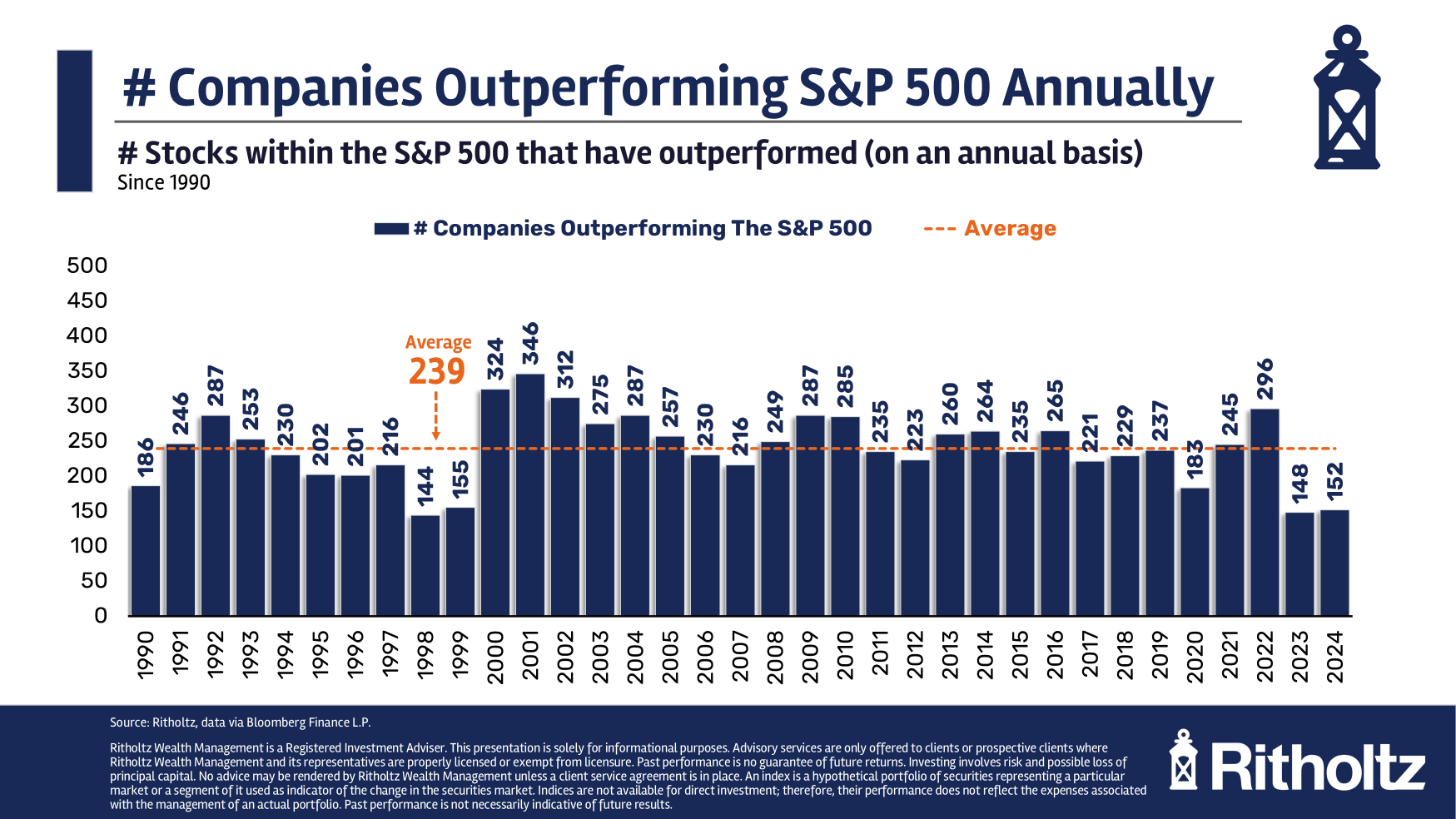
That does not mean only 4% or 5% of stocks beat the market in every calendar year. In any given year, plenty of stocks may outperform the S&P 500. But over full lifetimes and over decades, the market’s cumulative return tends to come from a narrow set of exceptional winners. Those winners become so large and so influential that they can pull the entire index upward while many other stocks trail behind.
So if your question is really, “How many individual stocks beat a broad market benchmark over the long run?” the honest answer is: not many. Fewer than intuition suggests. Fewer than stock-picking confidence suggests. And certainly fewer than financial television would like you to believe.
Why Beating the Market Is So Hard
The Market Is Not an Equal Vote
One reason the stock market is difficult to beat is that most major indexes are market-cap weighted. That means larger companies carry more influence. If the biggest winners keep winning, their weight in the index grows. In other words, the benchmark automatically gives more space to success. It does not need to guess who the future champions are. It already owns them, and when they rise, they become a bigger part of the portfolio.
That is a sneaky advantage. An individual investor or active manager has to identify the winning stocks before they become gigantic. The index simply holds everything and lets the winners self-promote. It is like owning the entire baseball league and then acting very smart when the MVP comes from one of your teams.
A Few Winners Dominate the Scoreboard
The long-run stock market does not behave like a tidy classroom where everyone scores somewhere between 70 and 90. It behaves more like a talent show where a tiny number of performers get standing ovations and the rest are forgotten by dinner. Exceptional companies can compound for years, sometimes decades. When they do, they create a wildly disproportionate amount of total wealth.
Think about some of the companies that have defined market eras: Apple, Microsoft, Amazon, Nvidia, Alphabet, and a handful of others. The point is not that these were easy to pick ahead of time. The point is that once a stock becomes one of those rare long-term compounding machines, it can influence the benchmark far more than dozens of mediocre or losing stocks combined.
This is why the stock market can rise nicely even while many stocks are doing little, and why a portfolio that misses a few monster winners can lag badly. Missing one or two huge compounders may not sound tragic at first, but over 10 or 20 years, that omission can feel like forgetting to bring your shoes to a marathon.
What the Research Really Suggests
The data on stock outperformance is striking. Long-horizon research on U.S. equities found that the majority of stocks delivered lifetime buy-and-hold returns lower than one-month Treasury bills. That is not a typo. Over a full stock lifetime, more than half of stocks did not even beat a very low bar. Meanwhile, the best-performing 4% of listed U.S. companies accounted for the entire net gain of the stock market over that long period.
An updated global study delivered a similar message. In the 1991 to 2020 sample, more than half of U.S. stocks underperformed one-month Treasury bills, and the top 2.4% of firms generated all net global stock market wealth creation. That is a breathtakingly concentrated outcome. It tells us that equity investing works largely because a very small subset of companies becomes phenomenally successful.
So when investors ask how many stocks outperform the stock market, they are often imagining a bell curve with lots of respectable winners. In reality, the market is much more skewed. A narrow tail of exceptional winners produces most of the magic, while the rest range from decent to disappointing to “please never mention this ticker again.”
Calendar-Year Winners vs. Lifetime Winners
There is an important distinction here. In a single year, a fair number of stocks can beat the market. During broad rallies, more than half of the stocks in an index may outperform certain benchmarks for stretches of time. During narrow rallies, fewer stocks may do so. Short-term breadth can change dramatically.
But long-term outperformance is a much tougher contest. A stock might beat the market for six months, one year, or even three years and still fail to become a true long-run winner. Plenty of companies look brilliant in one business cycle and ordinary in the next. Some are great businesses that were simply bought at silly valuations. Others are exciting stories that eventually collide with boring concepts like competition, profit margins, or the laws of mathematics.
That is why “How many stocks outperform the market?” needs a time frame. Over one year, the answer can vary widely. Over decades and across stock lifetimes, the answer shrinks dramatically, and the list of durable outperformers becomes much shorter.
Why Active Managers Usually Struggle
If only a small share of stocks drive most of the market’s wealth creation, active investing becomes a high-pressure game. To beat the market, a manager usually needs to do several things well at once: identify future winners, avoid permanent losers, size positions correctly, manage risk, keep fees under control, and remain patient while looking wrong for uncomfortable stretches of time.
That is hard enough before costs. After fees and taxes, it gets even harder. This helps explain why most actively managed funds fail to beat broad indexes over long periods. Recent scorecards continue to show that the majority of active U.S. equity funds underperform their passive benchmarks or passive peers. In other words, even professionals with teams, models, Bloomberg terminals, and more caffeine than a small airport often fail to outrun the index.
The problem is not that active managers are foolish. The problem is that the benchmark is stronger than it looks. It already owns the rare superstars, it reweights toward winners automatically, and it charges very little. That is a difficult opponent. Beating it consistently is like trying to outrun a conveyor belt that speeds up every time you get tired.
Market Concentration Changes the Game
Another reason this topic matters today is market concentration. In recent years, the biggest U.S. companies have come to represent a huge share of the major indexes. When leadership is concentrated in a handful of mega-cap stocks, the benchmark can look healthy even when the average stock feels much less impressive.
That creates a weird investing environment. An investor may own dozens of decent stocks and still trail the market because they are underweight the few giants pushing the index higher. This is one reason diversified but actively tilted portfolios can lag during narrow bull markets. The issue is not always stock selection in the broad sense. Sometimes it is simply that the benchmark’s largest names are doing almost all the headline-making.
Ironically, this can also create future opportunity. When concentration becomes extreme, broader parts of the market may eventually catch up. Equal-weight strategies, small caps, value stocks, and international equities can perform better when leadership widens. But the timing is never neat, and investors who get impatient often switch strategies right before the wind changes. The market, apparently, enjoys practical jokes.
What This Means for Everyday Investors
1. Diversification Is Not Boring. It Is Smart.
If a tiny group of stocks creates most of the market’s wealth, the most reliable way to own those future winners is broad diversification. You do not have to predict the next superstar with perfect accuracy if you already own the market. Index funds and broad ETFs give investors a simple way to capture the winners without knowing their names in advance.
2. Concentrated Portfolios Raise the Stakes
Owning 10 to 20 stocks can work brilliantly if your choices are unusually good. It can also go sideways if you miss the few giants that matter most. A concentrated portfolio is not automatically wrong, but it leaves less room for error. When the evidence says only a small share of stocks drive long-term outperformance, concentration becomes a much bolder bet than many investors realize.
3. Patience Matters More Than Cleverness
Because long-term winners can emerge slowly and then compound dramatically, patience is essential. Selling too soon can be just as damaging as buying the wrong stock. Many investors do not merely miss the winners; they abandon them before the really important years arrive. Long-term investing requires the emotional endurance to sit through volatility without mistaking temporary discomfort for permanent failure.
4. The Goal Does Not Have to Be “Beat the Market”
For many people, matching the market with low cost, wide diversification, and steady discipline is already an excellent outcome. The market is a very strong baseline. You do not need to “win” every year to build wealth. Often the better question is not “How do I beat the market?” but “How do I avoid sabotaging myself while the market does its job?”
So, How Many Stocks Outperform the Stock Market?
The most honest answer is this: some stocks beat the market in any given year, but over full lifetimes and long horizons, only a relatively small minority of stocks account for the market’s meaningful outperformance and wealth creation. The biggest winners matter far more than the average stock, and most investors are worse at identifying them in advance than they think.
That is why broad market investing remains so powerful. It is not giving up. It is acknowledging how the market actually works. A small number of exceptional businesses drive an enormous share of long-run returns, and owning a diversified basket increases your chances of capturing them before they become obvious.
Put differently, the stock market is not difficult because nobody can find good companies. It is difficult because a few extraordinary companies matter so much more than the rest. The challenge is not finding a winner. The challenge is finding the rare winners that become the market’s engines and then holding them long enough for the compounding to do its ridiculous, beautiful thing.
Investor Experiences: What This Usually Feels Like in Real Life
Here is where the topic gets personal. On paper, it sounds simple to say that only a small fraction of stocks drive market outperformance. In real life, investors experience that truth in much messier ways.
One common experience is the “I owned it, but not enough” problem. An investor buys a great company early, but it starts as a tiny position. The stock doubles, then doubles again, yet the portfolio barely changes because the original allocation was too small. Later, the investor tells the story as if they “called it,” but the actual portfolio result was more like a polite golf clap than a parade. This is one reason capturing outperformance is not just about being right. It is also about position sizing.
Another common experience is the “I sold way too soon” problem. A stock goes up 40%, and the investor feels brilliant. Then it goes up another 300% after they sell. That hurts, partly because the math is painful and partly because the human brain has a special talent for replaying missed opportunities at 2:00 a.m. The biggest market winners often look expensive, overhyped, or scary along the way. Many people exit before the real compounding years show up.
Then there is the opposite experience: holding onto a loser because it once looked like a future superstar. This is where investing stops being spreadsheets and starts being psychology. People anchor to old narratives. They remember the exciting product launch, the celebrity CEO, or the glorious chart from eighteen months ago. Meanwhile, the business weakens, competition rises, or debt becomes a problem. A stock can go from “the future” to “the cautionary tale” much faster than investors would like.
Many index investors have a different experience. They may feel boring during stock-picking booms because they do not have dramatic stories to tell at parties. But over time, they often discover something wonderful: boredom can be profitable. By owning the whole market, they quietly capture the few stocks that become monsters, avoid overcommitting to bad ideas, and spend less time trying to prove they are the smartest person in the room. There is real emotional relief in not needing to identify the next miracle stock before breakfast.
Even professional investors go through these same frustrations. They know diversification matters, but they also know underweighting a handful of giant winners can cause painful underperformance. They know concentration raises risk, but spreading out too much can make it harder to add value. They know valuation matters, but great businesses can stay expensive and still outperform. This constant tension is why beating the market looks easy on a whiteboard and difficult in an actual portfolio.
The biggest lesson from all these experiences is not that stock picking is impossible. It is that outperformance is rarer, more concentrated, and more emotionally demanding than it first appears. Investors who understand that tend to build better systems: broader diversification, lower costs, clear rules, periodic rebalancing, and more humility. And in markets, humility is not weakness. It is often the closest thing to a superpower.
Conclusion
So, how many stocks outperform the stock market? Enough to keep hope alive, but few enough to keep humility necessary. The market’s long-run returns are driven by a narrow band of exceptional companies, while many stocks fall short of the benchmark or even underperform low-risk alternatives over their full lifetimes. That reality is exactly why diversification, patience, and low-cost investing have remained so effective.
If you want the simplest takeaway, here it is: the market is hard to beat because its biggest winners matter more than almost everything else combined. Own them if you can identify them. Own the whole market if you cannot. For most investors, that second option is not settling. It is strategy.