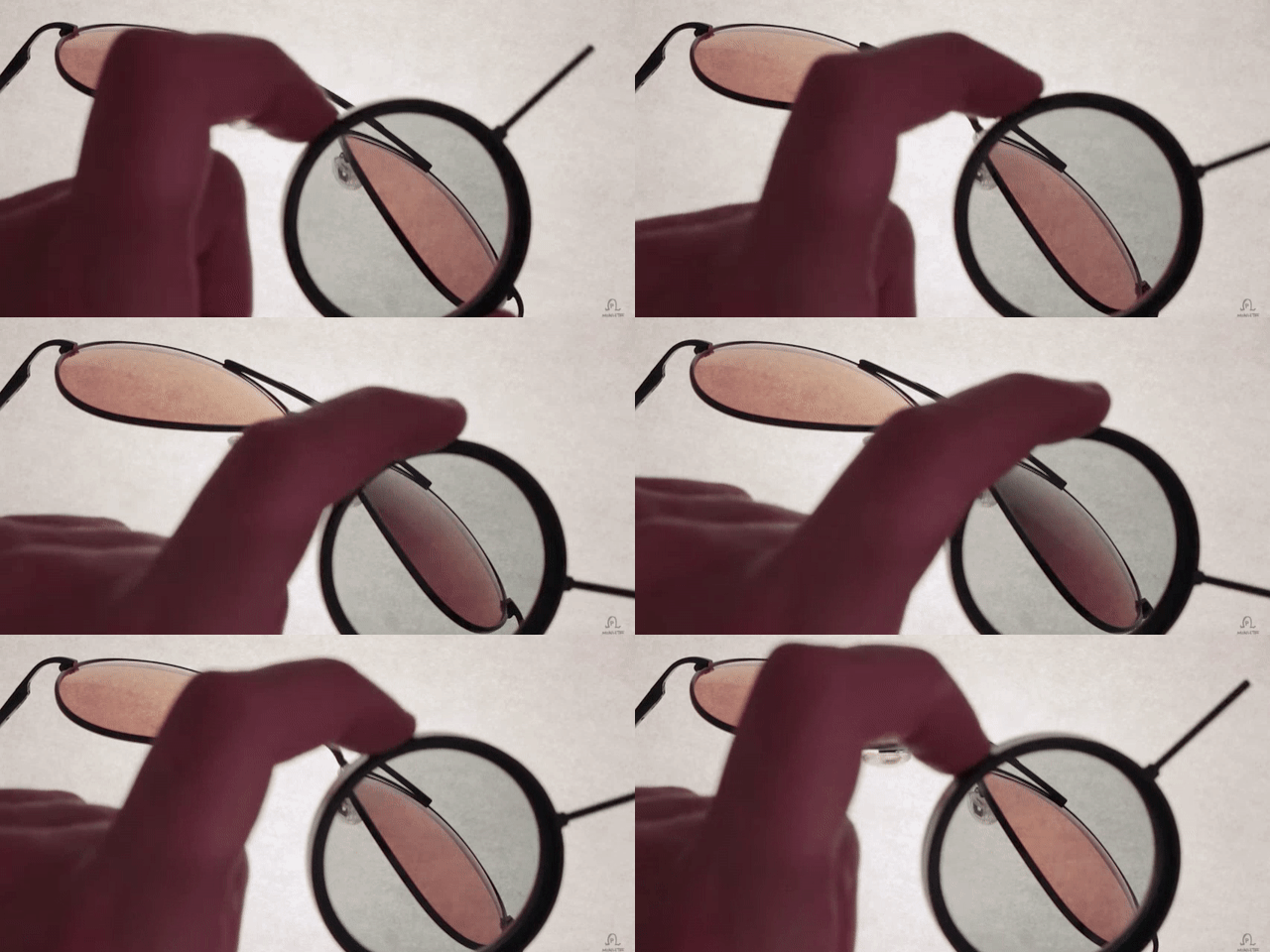

At first glance, polarized sunglasses look like ordinary eyewear with a cooler attitude. They sit on your nose, reduce annoying glare, make water look less like a sheet of angry aluminum foil, and help you drive without squinting like a suspicious detective. But hidden inside those stylish lenses is a surprisingly deep physics lesson. Polarizing sunglasses are not quantum computers, tiny particle accelerators, or magical portals to another dimension. Still, they give everyday people a hands-on doorway into ideas that sit very close to quantum mysteries: light waves, photons, measurement, probability, and the strange way nature answers questions only when we ask them in a particular way.
The main keyword here is simple: polarizing sunglasses. Yet the topic quickly stretches into related ideas such as polarized light, photon polarization, quantum mechanics, superposition, light measurement, and glare reduction. That sounds like a lot for a pair of beach sunglasses, but don’t worry. No lab coat is required. Flip-flops are optional.
What Polarizing Sunglasses Actually Do
Polarizing sunglasses are designed to reduce glare from reflective surfaces such as water, snow, wet roads, glass, and polished metal. Regular sunglasses simply dim the world. They turn down the brightness knob, which is useful, but not very selective. Polarized lenses are more strategic. They block much of the horizontally polarized light that bounces off flat surfaces and reaches your eyes as harsh glare.
Imagine a crowd leaving a stadium. Ordinary sunlight is like people walking in every direction, waving foam fingers chaotically. After light reflects from a flat surface, many of those waves become organized in a horizontal direction. Polarized lenses act like a tiny optical bouncer at the door. Vertically oriented light may pass; much of the horizontally oriented glare is refused entry. No wristband, no service.
This is why polarized sunglasses are especially helpful for fishing, boating, skiing, driving, and beach days. They do not just make the scene darker; they improve contrast and visual comfort by removing a particular orientation of light. That is also why they can sometimes make digital screens look weird or blacked out. Many screens use polarization too, and when two polarizing filters are crossed at the wrong angle, they can block each other dramatically.
The Physics Behind Polarized Light
Light is an electromagnetic wave. That means it has electric and magnetic fields oscillating as it travels. The electric field can vibrate in different directions. When the direction is random, the light is unpolarized. When the electric field has a preferred direction, the light is polarized.
A polarizing lens contains long molecular structures that absorb light waves vibrating in one direction while allowing waves in another direction to pass. A classic analogy is a picket fence. If you throw a flat object through the fence in the right orientation, it can pass between the slats. Rotate it the wrong way, and it gets blocked. Light is not literally a Frisbee, of course, but the idea works well enough to keep the universe from filing a complaint.
From Sunglasses to Quantum Mechanics
Here is where things become deliciously strange. In classical physics, we often think of light as a wave. In quantum physics, light also behaves as particles called photons. A photon is the smallest quantum of electromagnetic energy. It can act wave-like in some experiments and particle-like in others. This is called wave-particle duality, one of the great “please explain yourself, universe” ideas in modern science.
Polarization connects these two descriptions beautifully. A beam of light can be described as waves vibrating in certain directions. But a single photon can also have a polarization state. When a photon meets a polarizing filter, the filter effectively asks a question: “Are you aligned with this direction?” The photon does not hand over a résumé. It either passes through or it does not.
The Simple Experiment That Gets Weird Fast
Try this thought experiment with three polarizing filters. First, place one vertical polarizer in front of a light source. Some light passes through, and the transmitted light is now vertically polarized. Next, place a horizontal polarizer after it. Almost no light passes, because vertical and horizontal polarization are perpendicular.
So far, nothing spooky. Vertical light cannot pass through a horizontal filter. Case closed, detective sunglasses.
Now insert a third polarizer between them at a 45-degree angle. Strangely, some light appears again after the final horizontal filter. Adding another filter lets more light through than using only the two crossed filters. That feels wrong at first. Shouldn’t more filters mean less light? In daily life, yes. Put three curtains over a window and the room gets darker. But with polarization, the middle filter changes the measurement basis. It creates a new polarization state, allowing part of the light to pass through the final filter.
Why Measurement Matters
This experiment gets close to quantum mysteries because it shows that measurement is not always passive. In ordinary life, measuring something feels harmless. If you measure a table, the table does not become offended and change length. In quantum mechanics, measurement can affect the system being measured. With photon polarization, a filter does not merely reveal a pre-existing answer in the way we might expect. It selects and prepares a new state for the light that passes through.
That is why polarization is often used to teach quantum superposition. A diagonally polarized photon can be described as a superposition of vertical and horizontal polarization states. When measured with a vertical-horizontal filter, it has probabilities for passing or being blocked. But if measured with a diagonal filter aligned to it, it can pass with certainty. The answer depends on the question being asked.
Superposition Without the Sci-Fi Fog Machine
Superposition is often explained with mysterious language, but polarizing sunglasses make it more approachable. A photon is not necessarily “secretly vertical” or “secretly horizontal” before every measurement. Depending on how it is prepared, it may exist in a state that combines possible outcomes relative to a chosen measurement direction.
That does not mean your sunglasses are creating alternate realities every time you walk past a lake. Let’s keep the drama under control. It means the mathematics of photon polarization naturally involves probabilities and states that do not behave like tiny classical arrows hidden inside the light. The polarizer defines the kind of answer nature can give.
Probability: The Universe’s Favorite Dice Game
Polarization also introduces probability in a surprisingly clean way. If vertically polarized light hits a polarizer tilted at 45 degrees, about half the light intensity passes through. For single photons, this becomes a probability: each photon has a chance of being transmitted or absorbed. You cannot predict with certainty what one photon will do, but you can predict the pattern after many photons.
This is one of the central ideas of quantum mechanics. The theory does not always give definite outcomes for individual events. Instead, it gives extremely accurate probabilities. That may sound unsatisfying, like asking for a weather forecast and being handed a philosophical shrug. But quantum predictions are among the most precise and successful in all of science.
Entanglement and Polarization
Polarization is also important in experiments involving quantum entanglement. Entangled photons can have linked polarization properties even when separated by large distances. When one photon is measured, the results are correlated with measurements on the other photon in ways that cannot be fully explained by ordinary local hidden-variable theories.
This is connected to Bell tests, experiments designed to test whether the world can be explained by local realism. In simple terms, local realism says objects should have definite properties before measurement, and influences should not travel faster than light. Experiments with entangled photons have strongly supported quantum mechanics over classical local hidden-variable explanations. That does not mean sunglasses are entangling photons at the beach. But the same propertypolarizationis one of the tools physicists use to probe these deep questions.
Why Sunglasses Are Not Quantum Magic
It is important to be honest: polarizing sunglasses are classical optical devices used in everyday life. They are not measuring individual photons for quantum research, and they do not reveal hidden cosmic messages while you order iced coffee. Their purpose is practical: reduce glare, improve comfort, and help you see more clearly in bright reflective environments.
However, they are built on a property of light that becomes deeply quantum when studied at the single-photon level. That is what makes them fascinating. They are ordinary enough to buy at a store, yet connected to ideas that helped reshape physics in the twentieth and twenty-first centuries.
Everyday Examples of Polarization
Driving on a Sunny Day
When sunlight reflects off a road, windshield, or hood, it often creates strong horizontal glare. Polarized sunglasses reduce that glare, making lane markings, vehicles, and surface details easier to see. This is practical safety, not just fashion. Your sunglasses may not solve quantum gravity, but they can help you avoid missing a turn.
Fishing and Boating
Water is one of the best places to notice polarization. Without polarized sunglasses, the surface may look like a shiny mirror. With them, glare drops, and you can often see beneath the surface more clearly. Anglers love this because it helps them spot fish, rocks, weeds, and changes in depth.
Snow and Skiing
Snow reflects a large amount of light, creating intense glare. Polarized lenses can improve comfort, although skiers should choose eyewear carefully because seeing icy patches and screen displays may be important. Polarization is useful, but context matters.
Digital Screens
Look at a phone or dashboard screen through polarized sunglasses and rotate your head. The screen may dim, shift colors, or disappear. This happens because many displays use polarized light. When the lens polarization and screen polarization oppose each other, the light is blocked. Congratulations: you have performed a tiny optics experiment while checking your messages.
How Polarizing Sunglasses Help Explain Quantum Thinking
The biggest lesson from polarizing sunglasses is not that everything is mysterious. It is that the physical world is more structured than it appears. Light has orientation. Filters select certain states. Measurements can change what comes next. Probabilities are not just ignorance; in quantum physics, they can be built into the fabric of prediction itself.
That is why educators often use polarization to introduce quantum mechanics. It is visual, testable, and surprisingly elegant. You can stack filters, rotate them, and watch brightness change. Then you can reinterpret the same experiment using photons, probability amplitudes, and measurement operators. The math gets serious, but the doorway remains simple.
Common Misconceptions About Polarizing Sunglasses
Misconception 1: Polarized Means UV-Protective
Polarization and UV protection are different. Polarized lenses reduce glare; UV-blocking lenses protect eyes from ultraviolet radiation. Good sunglasses should clearly state that they block 99 to 100 percent of UVA and UVB or meet UV400 protection standards. A lens can be polarized but still needs proper UV protection.
Misconception 2: Darker Always Means Safer
Darker lenses are not automatically safer. A dark lens without UV protection can cause the pupil to open wider while still allowing harmful UV rays to enter. That is like opening the front door wider because the burglar wore a polite hat. Always check the UV rating.
Misconception 3: Polarized Sunglasses Are Best for Everything
Polarized sunglasses are excellent for many outdoor activities, but they are not perfect for every situation. Pilots, heavy-equipment operators, and some athletes may avoid them when screen visibility, instrument readability, or surface reflections are important. The best lens depends on the job.
Experiences Related to “How Polarizing Sunglasses Get Close To Quantum Mysteries”
The first time many people truly notice polarized sunglasses is near water. You put them on, glance at a lake, and suddenly the blinding silver glare disappears. The surface stops shouting at your eyeballs. Rocks, plants, and shadows below the water become visible. It feels almost like discovering a secret layer of reality. Nothing supernatural happened, but your lenses removed a specific kind of reflected light, revealing information that had been hidden by glare.
That experience is a perfect everyday metaphor for physics. The world does not always show itself clearly until you choose the right tool. A telescope reveals galaxies. A microscope reveals cells. A polarizing lens reveals the orientation of light. In quantum mechanics, the measuring device also matters. The question you ask shapes the answer you can receive. That is not just poetic; it is a serious feature of experiments involving photons and polarization.
A second memorable experience comes from rotating polarized sunglasses in front of a computer or phone screen. At one angle, the display looks normal. Rotate the lenses, and the screen darkens. Turn a little more, and it may nearly vanish. This simple moment can feel oddly powerful. You are not merely dimming light; you are filtering it according to direction. The screen emits light with a preferred polarization, and your lens either agrees with it or blocks it. It is like watching a password system made of light.
Another fun experiment uses two pairs of polarized sunglasses. Hold one pair in front of the other and look through both. Rotate one pair slowly. At some angles, plenty of light passes through. At 90 degrees, the view becomes much darker. Add a third polarized lens between them at an angle, and some light can return. This is the kitchen-table version of a concept that leads toward quantum measurement. It is simple enough for a curious child and deep enough to make a physicist smile knowingly.
Drivers often appreciate polarized lenses during golden-hour commutes, when sunlight bounces off windshields and wet pavement. The road becomes easier to read. Colors feel cleaner. Reflections calm down. In that moment, polarization is not an abstract concept. It is comfort, safety, and clarity. Yet the same principle points toward the behavior of single photons, where “passing through” becomes a probabilistic event rather than a smooth classical flow.
Beachgoers, anglers, photographers, hikers, and science teachers all meet polarization in different ways. For one person, it means spotting fish. For another, it means reducing eye strain. For another, it becomes the beginning of a lesson about photons, superposition, and the mystery of measurement. The beauty of polarizing sunglasses is that they do not require anyone to choose between practical usefulness and intellectual wonder. They can be both: a tool for clearer vision and a tiny invitation to think more deeply about light itself.
Conclusion
Polarizing sunglasses are far more interesting than their casual, beach-bag reputation suggests. They reduce glare by filtering polarized light, making outdoor scenes clearer and more comfortable. But they also provide a surprisingly accessible path toward quantum ideas. Through polarization, we can understand how light behaves as a wave, how photons carry electromagnetic energy, how measurement changes outcomes, and why probability plays such a central role in the microscopic world.
No, your sunglasses will not solve the mysteries of quantum entanglement while you sip lemonade. But they can help you glimpse why those mysteries exist. Every time polarized lenses cut glare from water or make a phone screen disappear at a certain angle, they demonstrate that light has hidden structure. And once you begin asking how that structure behaves one photon at a time, you are standing very close to the doorway of quantum mechanics.