
Note: This article is written for web publication in standard American English and is based on established SI metric prefix rules, dimensional analysis methods, and real classroom-style conversion practices.
Introduction: Why Unit Prefixes Are Less Scary Than They Look
Converting units with prefixes can feel like being handed a secret science password. One minute you are looking at meters, the next you are staring at millimeters, micrometers, nanometers, and something called a picometer that sounds like it belongs in a tiny bakery. The good news is that metric prefixes are not random. They are organized around powers of ten, which means once you understand the pattern, most conversions become a matter of moving decimals, using exponents, and not letting your calculator bully you.
The main keyword here is simple: how to convert units with prefixes. Whether you are working on chemistry homework, physics problems, engineering notes, medical dosages, electronics, lab reports, or everyday measurements, the same logic applies. A prefix changes the size of the unit. A kilometer is not a mysterious cousin of the meter; it is simply 1,000 meters. A milligram is not a fancy gram wearing a lab coat; it is one-thousandth of a gram.
This guide breaks the process into 14 practical steps, with examples you can actually use. By the end, you will know how to convert metric prefixes, use conversion factors, avoid common mistakes, and make your numbers look like they know where they are going.
What Are Unit Prefixes?
A unit prefix is a short word or symbol added before a base unit to make that unit larger or smaller. In the metric system, these prefixes are based on powers of ten. That is why metric unit conversion is usually cleaner than converting inches to feet or cups to tablespoons, where the numbers seem to have been chosen during a committee meeting held in a thunderstorm.
Common base units include meter for length, gram for mass, liter for volume, second for time, ampere for electric current, kelvin for temperature, and mole for amount of substance. Add a prefix, and the unit changes size. For example, kilometer means 1,000 meters, centimeter means one-hundredth of a meter, and millimeter means one-thousandth of a meter.
Common Metric Prefixes You Should Know
| Prefix | Symbol | Power of Ten | Decimal Value |
|---|---|---|---|
| giga | G | 109 | 1,000,000,000 |
| mega | M | 106 | 1,000,000 |
| kilo | k | 103 | 1,000 |
| hecto | h | 102 | 100 |
| deka | da | 101 | 10 |
| base unit | m, g, L, s | 100 | 1 |
| deci | d | 10-1 | 0.1 |
| centi | c | 10-2 | 0.01 |
| milli | m | 10-3 | 0.001 |
| micro | µ | 10-6 | 0.000001 |
| nano | n | 10-9 | 0.000000001 |
How to Convert Units With Prefixes: 14 Steps
Step 1: Identify the Starting Unit
Start by writing down the unit you already have. For example, suppose you have 5 kilometers. The starting unit is kilometers, or km. Do not rush past this step. Many conversion mistakes happen because people focus on the number and forget to track the unit. The unit is the GPS for the problem.
Step 2: Identify the Target Unit
Next, decide what unit you want. If the problem asks you to convert 5 kilometers into meters, your target unit is meters. If it asks for millimeters, your target unit is millimeters. Clear start, clear finish. Math loves boundaries. So do people trying to assemble furniture.
Step 3: Find the Prefix Value
Look up the value of the prefix. Kilo means 1,000, milli means 0.001, centi means 0.01, micro means 0.000001, and nano means 0.000000001. In exponent form, kilo is 103, milli is 10-3, micro is 10-6, and nano is 10-9.
Step 4: Convert the Starting Unit to the Base Unit
When you are unsure, convert to the base unit first. This method is slower than mental shortcuts, but it is dependable. For example, 5 kilometers becomes 5 × 1,000 meters, which equals 5,000 meters. If you are converting 8 milligrams to grams, remember that milli means one-thousandth, so 8 mg equals 0.008 g.
Step 5: Convert From the Base Unit to the Target Unit
Once you are at the base unit, move to the target prefix. For example, to convert 5,000 meters into centimeters, use the fact that 1 meter equals 100 centimeters. So 5,000 meters equals 500,000 centimeters. Yes, the number gets large. No, that does not mean you broke math.
Step 6: Use Conversion Factors
A conversion factor is a fraction that equals 1 because the top and bottom represent the same amount in different units. For example:
1 km / 1,000 m and 1,000 m / 1 km are both valid conversion factors.
Choose the version that cancels the unit you do not want. If you start with kilometers and want meters, place kilometers in the denominator so they cancel:
5 km × 1,000 m / 1 km = 5,000 m
Step 7: Cancel Units Like a Pro
Unit cancellation is one of the best ways to check your work. If the unwanted unit appears once on top and once on bottom, it cancels. If your final unit is not the unit you wanted, your conversion factor is probably upside down. This is the math version of putting your shirt on backward: fixable, but noticeable.
Step 8: Move Decimals Carefully
For common metric conversions, you can often move the decimal point. Moving from a larger unit to a smaller unit usually makes the number bigger. Moving from a smaller unit to a larger unit usually makes the number smaller. For example, 3.2 meters equals 320 centimeters because centimeters are smaller than meters, so you need more of them.
Step 9: Use Scientific Notation for Tiny or Huge Values
Scientific notation keeps big and tiny numbers readable. Instead of writing 0.00000045 meters, write 4.5 × 10⁻⁷ meters. This is especially useful with micro, nano, pico, mega, and giga. Scientific notation also reduces the chance of losing a zero, which is great because zeros are sneaky little characters.
Step 10: Convert Between Two Prefixed Units
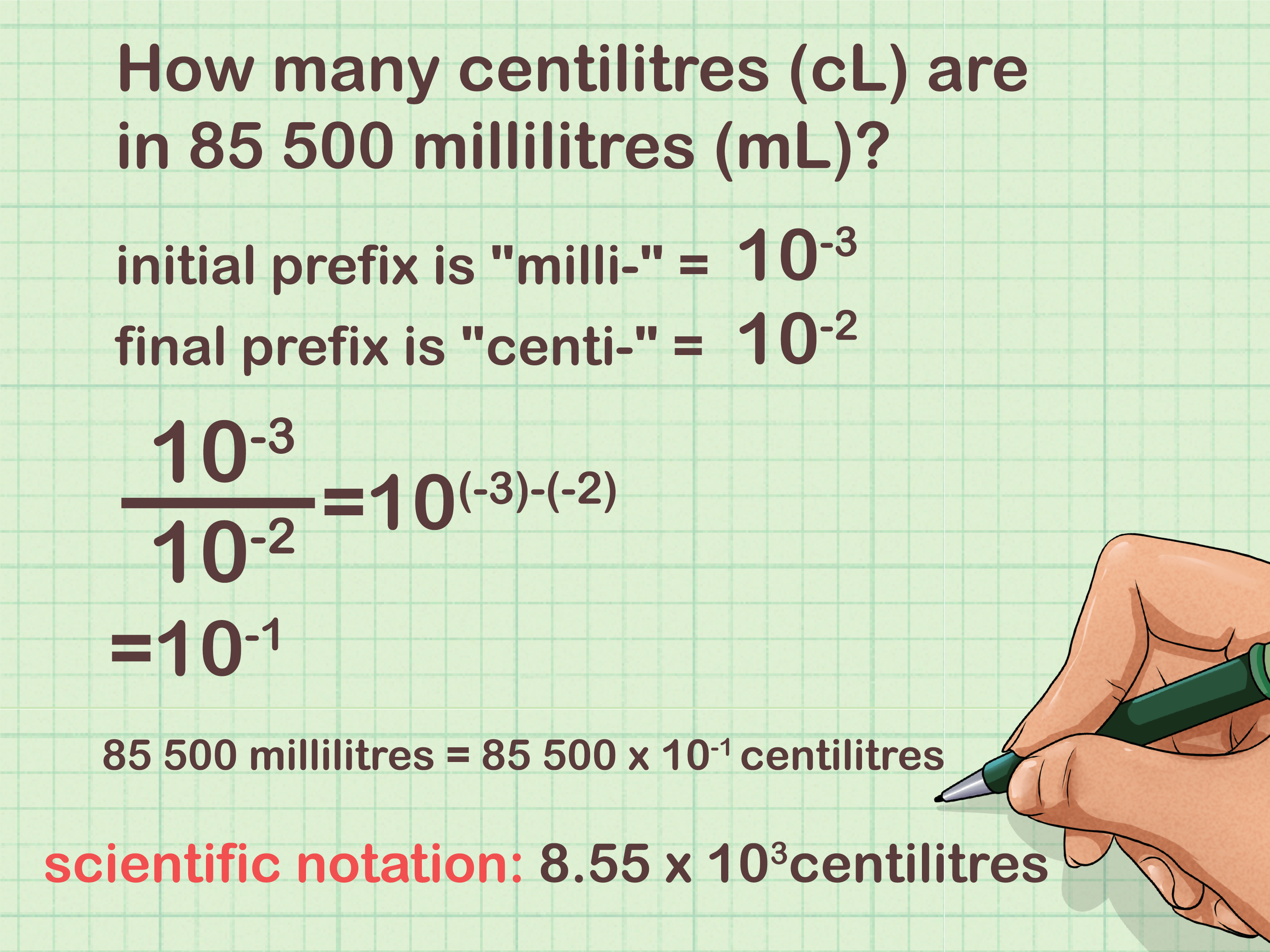
To convert directly between two prefixed units, compare their powers of ten. For example, convert 7 millimeters to micrometers. Milli is 10-3, and micro is 10-6. One millimeter equals 1,000 micrometers, so 7 mm equals 7,000 µm.
Step 11: Watch Capital Letters
Prefix symbols are case-sensitive. This is a big deal. Lowercase m means milli, or 10-3. Uppercase M means mega, or 106. That means 1 mg is one milligram, while 1 Mg is one megagram. Those are not close. One is a tiny mass; the other is 1,000 kilograms. Capital letters are not decorations here; they are the steering wheel.
Step 12: Do Not Stack Prefixes
Standard SI style avoids compound prefixes. For example, do not write something like millimicroseconds. Use nanoseconds instead. Prefixes are designed to keep measurement language clean, not to create unit lasagna.
Step 13: Check Whether the Unit Is Squared or Cubed
Area and volume conversions require extra care. If you convert centimeters to meters, 100 cm equals 1 m. But if you convert square centimeters to square meters, the relationship is squared: 10,000 cm2 equals 1 m2. For cubic units, the relationship is cubed. This is where many students accidentally drive into a ditch.
Step 14: Estimate Your Answer Before You Celebrate
Before you call the problem finished, ask: does the answer make sense? If you convert meters to millimeters, the number should increase. If you convert milligrams to grams, the number should decrease. Estimation catches errors before they become embarrassing, expensive, or both.
Examples of Converting Units With Prefixes
Example 1: Convert 4.5 Kilometers to Meters
Kilo means 1,000. So:
4.5 km × 1,000 m / 1 km = 4,500 m
Answer: 4.5 km = 4,500 m.
Example 2: Convert 250 Milliliters to Liters
Milli means one-thousandth. So 1 mL equals 0.001 L.
250 mL × 0.001 L / 1 mL = 0.25 L
Answer: 250 mL = 0.25 L.
Example 3: Convert 0.006 Grams to Milligrams
One gram equals 1,000 milligrams.
0.006 g × 1,000 mg / 1 g = 6 mg
Answer: 0.006 g = 6 mg.
Example 4: Convert 12 Nanometers to Meters
Nano means 10-9. So:
12 nm = 12 × 10-9 m = 1.2 × 10⁻⁸ m
Answer: 12 nm = 0.000000012 m.
Common Mistakes When Converting Metric Prefixes
Mistake 1: Confusing Milli and Micro
Milli is 10-3, while micro is 10-6. That means one millimeter equals 1,000 micrometers. Mixing them up can make your answer off by a factor of 1,000, which is not a rounding error; it is a math jump scare.
Mistake 2: Ignoring the Base Unit
Prefixes attach to units, but the base unit still matters. A kilogram, kilometer, and kiloliter all use kilo, but they measure mass, length, and volume. Prefixes tell you scale; units tell you what is being measured.
Mistake 3: Forgetting Squared and Cubed Units
Converting length is not the same as converting area or volume. A centimeter is 0.01 meters, but a square centimeter is 0.0001 square meters. Always apply the exponent to the conversion factor when dealing with squared or cubed units.
Mistake 4: Writing Unclear Symbols
Use standard symbols carefully. The symbol for second is s, not sec. The symbol for kilogram is kg, not KG. Clean symbols help readers understand your work and help search engines recognize technical accuracy in educational content.
Fast Method: Prefix-to-Prefix Power Comparison
Once you are comfortable with powers of ten, you can convert faster by comparing exponents. Here is the basic formula:
Value in target unit = starting value × 10(starting prefix exponent − target prefix exponent)
For example, convert 3 megawatts to kilowatts. Mega is 106, and kilo is 103. Subtract the exponents: 6 − 3 = 3. So multiply by 103.
3 MW = 3 × 10³ kW = 3,000 kW
Now convert 9 centimeters to meters. Centi is 10-2, and the base unit meter is 100. Subtract: -2 − 0 = -2. So:
9 cm = 9 × 10⁻² m = 0.09 m
Where Unit Prefix Conversions Are Used in Real Life
Metric prefix conversions are not just school exercises designed to test your patience. They appear in science labs, hospitals, computer hardware, electronics, nutrition labels, manufacturing, environmental data, and engineering drawings. A nurse may work with milligrams. A scientist may measure wavelengths in nanometers. A mechanic may read millimeters. A computer user may compare megabytes and gigabytes. A runner may track kilometers. A baker may measure milliliters, especially when a recipe decides to be internationally sophisticated.
Understanding prefixes improves accuracy and confidence. It also helps you communicate clearly. If a lab report says 0.005 L, you can recognize that as 5 mL. If a device specification lists 2.4 GHz, you know giga means billion, so the frequency is 2.4 billion hertz. Prefix literacy turns intimidating numbers into manageable information.
Practical Experience: What Learning Unit Prefixes Feels Like in Real Work
The first real experience many people have with unit prefixes is not elegant. It often begins with a worksheet, a blank stare, and the quiet suspicion that centimeters were invented specifically to ruin Tuesday. But after enough practice, a pattern appears. The conversions stop feeling like separate facts and start behaving like a connected system.
One helpful experience is working with a physical ruler. A meter may feel abstract when it lives only in a textbook, but 100 centimeters on a meter stick makes the relationship obvious. Then millimeters become easier to understand because you can see ten tiny divisions inside one centimeter. Suddenly, 1,000 millimeters in a meter is not just a number; it is a visible structure. The brain likes seeing what the math is talking about.
In a kitchen, prefix conversions show up in a friendlier costume. A measuring cup might list milliliters, while a nutrition label uses grams or milligrams. If a recipe calls for 500 mL of water, recognizing that as 0.5 L makes the measurement feel natural. The soup does not care whether you think in liters or milliliters, but your measuring cup certainly does.
In science classes, unit prefixes become more serious. Chemistry problems often use grams, milligrams, microliters, and moles. Physics problems may involve kilometers, meters, centimeters, milliseconds, and nanoseconds. The best habit is to write every unit through the whole calculation. It looks slightly slower, but it prevents chaos. A number without a unit is like a suitcase without a name tag: it might belong somewhere, but good luck proving it.
In electronics, prefixes become part of everyday language. People talk about kilohms, megahertz, gigabytes, milliamps, and microcontrollers. Here, capitalization matters a lot. A lowercase m and an uppercase M are not interchangeable. Confusing mA with MA would be like confusing a garden hose with a fire hydrant. Both involve flow, but the consequences are not the same.
Another useful experience is estimating before calculating. If you convert 2 meters into millimeters, you should expect a bigger number because millimeters are smaller units. If your answer is 0.002 mm, your math has probably taken a wrong turn and is now asking for directions. Estimation gives you a quick reality check before you submit homework, publish a report, or order the wrong size part online.
Students often improve fastest when they stop memorizing every possible conversion and instead learn the prefix powers. Kilo is 103, centi is 10-2, milli is 10-3, micro is 10-6, and nano is 10-9. Once those are familiar, most conversions become a comparison between exponents. That is the moment unit prefixes start to feel less like a vocabulary quiz and more like a useful tool.
The biggest lesson from real practice is simple: write it down, cancel units, and check the direction of the conversion. Nobody becomes fluent by staring at a prefix chart once. Fluency comes from using the system repeatedly until the relationships feel automatic. With enough examples, even nanometers and megagrams stop looking dramatic. They are just meters and grams wearing different-sized hats.
Conclusion: Prefix Conversions Are a Pattern, Not a Puzzle
Learning how to convert units with prefixes becomes much easier when you remember the core idea: prefixes change units by powers of ten. Start with the given unit, identify the target unit, use the prefix values, build a conversion factor, cancel units, and check whether your answer makes sense. The process is reliable, repeatable, and much less mysterious than it first appears.
Metric prefixes help us describe extremely large and extremely small quantities without drowning in zeros. Instead of writing 0.000001 meters, we can write 1 micrometer. Instead of writing 1,000,000 watts, we can write 1 megawatt. That is not just convenient; it is clear communication. And in science, engineering, medicine, and everyday measurement, clarity is the whole game.
If you remember only one thing, remember this: larger units produce smaller numbers, and smaller units produce larger numbers. Add unit cancellation and a quick estimate, and you have a dependable method for nearly any metric prefix conversion problem.