
If you’ve ever opened a box, seen a black wire, and thought, “Ah yes, ground,” you’re not alone… and you’re also
living dangerously. In most U.S. household wiring, black usually means hot, not ground. But wires get
repurposed, DIY happens, devices get swapped, and mistakes get made. So the only grown-up way to settle the argument
is to testnot guess.
This guide shows you practical, real-world ways to confirm whether a black wire is acting as a ground in a
circuitusing a multimeter and a couple of simple checks. We’ll also cover the “gotchas” that lead to false results,
plus when to stop DIY-ing and call a licensed electrician (because “I learned electricity on YouTube” is not a
recognized credential).
First: Is a Black Wire Even Allowed to Be Ground?
In typical U.S. residential AC wiring, equipment grounding conductors are commonly green or bare copper,
neutrals are commonly white or gray, and black is commonly used for line/hot. That’s why
eHow’s “black ground wire” scenario is usually about a wire that’s colored black but connected to ground by mistake
(or used in a way that doesn’t follow expectations). The key lesson: wire color is a clue, not proof.
Also, context matters:
- Home AC wiring: black is commonly hot; “black ground” often means miswire or nonstandard use.
- Automotive / DC systems: black is often negative/ground. (Different world, different rules.)
- Appliances / fixtures: internal wiring colors may not match house wiring conventions.
Safety Setup: Don’t Be the Test Instrument
Some tests require the circuit energized (voltage tests). Others require power OFF (continuity/resistance tests).
Mixing those up is how people “learn a valuable lesson” in the most annoying way possible.
Before you touch anything
- Decide which test you’re doing (voltage vs. continuity). That choice controls whether power is ON or OFF.
- Use the right tools: a digital multimeter with AC voltage and continuity/ohms, and ideally a non-contact voltage tester.
- If you’re opening a box: turn off the breaker, label it if needed, and keep everyone else from flipping it back on.
- Verify the meter works on a known source before/after a “dead” test. (Meters and leads fail. Electricity does not.)
If any of this feels unfamiliarlike you’re reading it and thinking, “Wait, what’s COM?”that’s a perfectly valid sign
to stop and call a pro. The goal is to confirm grounding, not to become a temporary smoke machine.
What You’re Really Trying to Prove
A ground wire should be a low-resistance path back to the grounding system. Depending on where you test, you might be proving one (or more) of these:
- Continuity to a known ground point (power OFF): does the wire connect to ground with very low resistance?
- Voltage behavior (power ON): does the wire behave like ground when compared to hot and neutral?
- Functional grounding: does it actually trip protection devices or show correct outlet test results?
Method 1: The eHow Voltage Check (Quick Answer, Live Circuit)
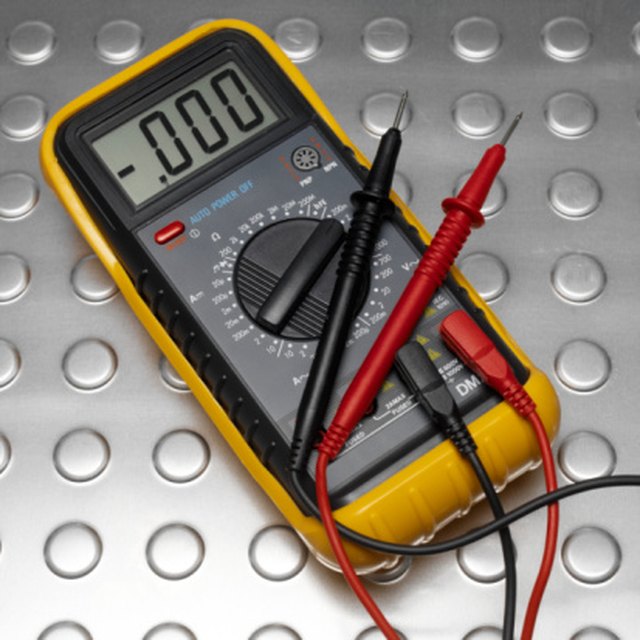
eHow describes a simple energized test using a multimeter: measure voltage between the black wire you’re investigating and a nearby neutral (white/gray).
The idea is straightforward:
- If the black wire is truly ground and the white/gray is truly neutral, the voltage between them should be near 0V (maybe a tiny reading).
- If the black wire is actually hot, you’ll see around 110–120V in a typical U.S. home circuit.
How to do it (AC voltage test)
- Set your multimeter to AC voltage in a range suitable for household voltage (many meters use 200V or 600V ranges; eHow mentions a range around 100–150V).
- Touch one probe to the black wire under test.
- Touch the other probe to a white or gray wire believed to be neutral.
- Read the display:
- ~0V (or very low) suggests the black wire is at ground potential (or bonded to neutral somewhere).
- ~110–120V suggests the black wire is hot.
Why this test can mislead you
Neutral and ground are bonded at the main service equipment in most homes, so they often sit close together electrically.
That means you can sometimes see low voltage between a miswired “ground” and neutral and feel falsely reassured.
Also, if the white/gray wire you chose is not actually neutral (because the box is miswired), your reading may be nonsense.
Use the eHow-style voltage check as a quick screenbut back it up with the power-OFF continuity method below, especially if your results look “too convenient.”
Method 2: Continuity to a Known Ground (Power OFF, Best for Confirmation)
Continuity testing is the “tell me if these two points are connected” mode. It’s great for checking whether a wire
actually connects back to the grounding systembut only when the circuit is de-energized.
Step-by-step
- Turn OFF the breaker and verify the circuit is dead with a non-contact tester or a voltage test at the device.
- Set your multimeter to continuity (or ohms/Ω if continuity isn’t available).
- Pick a known ground reference:
- The ground bar in the service panel (best, but not always practical).
- A properly grounded metal box or grounding screw (only if you’re confident it’s actually grounded).
- A known grounded point in the same system (like a verified grounding conductor).
- Touch one probe to the black wire under test (bare copper end or terminal).
- Touch the other probe to the known ground reference.
- Interpret:
- Beep / near-zero ohms suggests a solid connection to ground.
- No beep / high resistance suggests it’s not ground (or there’s a break, loose connection, or you chose a bad reference point).
Pro tip: isolate the wire if you can
Continuity can “find a path” through connected devices, bulbs, or electronics. If possible, disconnect the wire end you’re testing
so you’re not measuring through other components. That helps avoid false continuity.
Method 3: The Three-Point Voltage Reality Check (Hot–Neutral–Ground)
If you’re testing at an outlet or a box with hot/neutral present, a simple set of comparisons can reveal what the black wire really is.
This method uses AC voltage and assumes you can identify a hot conductor (or the outlet hot slot).
What to measure (power ON)
- Hot to Neutral: typically ~120V.
- Hot to Ground: typically ~120V if the ground is real and intact.
- Neutral to Ground: typically ~0V (may show a small value depending on load and wiring).
If your “black ground wire” shows ~120V to neutral, it’s acting hot. If it shows ~120V from known hot to that black wire,
that black wire is behaving like neutral/ground (or is bonded incorrectly). Your goal is consistency: measurements that match
expected relationships, not one flattering number.
Common Traps That Make You Think You Have a Ground (When You Don’t)
1) Open ground
The ground conductor exists but is broken or not connected. Voltage tests can still look “sort of okay” due to phantom voltages,
capacitive coupling, or backfeeds through devices. Continuity to a solid ground reference usually exposes the problem fast.
2) Bootleg ground (neutral tied to ground downstream)
This is when someone ties neutral and ground together at an outlet/device instead of only at the service equipment. It can trick basic testers
into showing “grounded” while creating shock hazards and weird behavior. If your readings are confusingor the outlet tester says “correct”
but other symptoms persistthis is one reason to bring in a licensed electrician.
3) You assumed the “neutral” wire is neutral
In older homes or modified circuits, wire colors can be misleading (or repurposed). A white wire can be hot if re-identified, and a black wire
can be used as a switched leg. If you aren’t sure what you’re touching, slow down and verify each conductor.
Testing a Black “Ground” Wire in Automotive or DC Circuits
In many automotive and low-voltage DC systems, black commonly represents ground/negative. The testing mindset changes slightly:
Quick DC checks
- Continuity to chassis: With power off, continuity from the black wire to bare metal chassis often confirms ground.
- Voltage drop test under load: With the circuit operating, measure voltage between the black wire point and the battery negative.
A good ground typically shows a very small voltage drop (high drops suggest corrosion, loose bolts, or broken strands).
DC ground problems are famous for being “intermittent.” If the reading changes when you wiggle the harness or tap the connection,
that’s not your imaginationthat’s the problem.
When to Call a Pro (No Shame, Just Safety)
Call an electrician if:
- You measure unexpected voltage between neutral and “ground” that doesn’t make sense.
- The breaker trips, sparks appear, insulation looks charred, or anything smells “toasty.”
- You suspect bootleg grounds, aluminum wiring issues, or panel problems.
- You’re working in a wet area or near plumbing and you don’t have proper GFCI protection.
The goal of testing is clarity. If testing creates more mystery, that’s the universe politely recommending professional help.
FAQ: Fast Answers to Common “Black Ground” Questions
Why does my meter show 1–2 volts between neutral and ground?
Small readings can occur due to normal impedance, load on the neutral, or meter sensitivity. But “small” shouldn’t be “mystery big.”
If you see a meaningful voltage that persists, investigate further.
Can I just use an outlet tester instead of a multimeter?
Plug-in testers are handy for quick checks (open ground, reversed polarity, etc.). But they can’t diagnose every wiring error and can be fooled by certain miswires.
A multimeter and proper method give you deeper truth.
If the black wire isn’t ground, what is it likely to be?
In home wiring, black is often hot, switched hot, or part of a multi-wire/switch loop. In DC systems, black is often ground. Context is everything.
Real-World Testing Stories and “Yep, Been There” Moments (Extra Experience Section)
Ask ten DIYers why they’re testing a “black ground wire,” and you’ll get eleven storiesbecause at least one person will blame the dog.
The most common scenario is classic: someone replaces a light fixture or outlet, sees a black wire loose in the back, and assumes it must be ground
because “it’s the one that looks… important.” Then the breaker trips, the lights flicker, or the outlet tester throws a little LED tantrum.
One real-world pattern that comes up again and again is the “old house surprise.” You open a metal box expecting bare copper ground,
and instead you find cloth-insulated conductors, maybe a rusty clamp, and a metal box that might be grounded… or might just be
a decorative container for your anxiety. In those situations, people often get a continuity beep between the black wire and the box and think,
“Boom. Ground confirmed.” But that beep can be sneaky. If the wire is still connected to a device (a lamp, a transformer, a smart switch),
you can get continuity through an unintended path. It’s like asking for directions and being told, “Yes, there is a way to get there,”
but nobody mentions it involves a canoe.
Another frequent “experience” is phantom voltageespecially when someone uses a high-impedance digital meter on a long run of cable.
The meter reads a spooky 30V or 60V on a wire that “should be dead,” and suddenly the project becomes a paranormal investigation.
Usually, it’s induced voltage from nearby energized conductors, and it disappears under load or with a different testing approach.
The lesson: voltage readings should be interpreted like weather forecastsuseful, but not the full story until you confirm with a second method.
Then there’s the “helpful previous owner” situation: an outlet shows “correct” on a plug-in tester, but devices still tingle, dim, or behave oddly.
Sometimes the culprit is a bootleg ground: neutral tied to ground at the receptacle. It can fool a basic tester, but it’s not a real ground,
and it can create hazardsespecially if the neutral connection becomes loose, turning metal parts into surprise hot surfaces. When a multimeter reveals
weird neutral-to-ground behavior, it’s a sign the wiring story has plot twists.
In automotive and DC work, the experiences are different but equally memorable. Grounds corrode. Bolts loosen. Paint gets between ring terminals and chassis.
Everything works fine until you hit a bump, then your radio resets, your lights flicker, and you start negotiating with the universe. The best “experienced”
move in DC troubleshooting is a voltage drop test under loadbecause a ground can look perfect at rest and fail the moment current needs to flow.
That’s why so many real fixes are boring: clean the metal, tighten the connection, add a star washer, and suddenly the “mysterious electrical gremlin”
packs its bags.
The biggest takeaway from all these scenarios is simple: if a wire’s identity matters, test it two ways.
Use a voltage comparison when energized, and confirm continuity to a known ground when de-energized. When both stories match,
you’ve got confidencenot just a lucky guess.
Conclusion
A “black ground wire” is usually a clue that something is nonstandardeither a miswire, a repurposed conductor, or a system where black really does mean
ground (like many DC applications). The good news is you don’t need superpowers to confirm the truth. A multimeter, a safe process, and a little skepticism
will get you there. Test like a pro: verify the meter, pick the right mode, confirm your reference points, and double-check with a second method.
Electricity respects preparationand punishes assumptions.