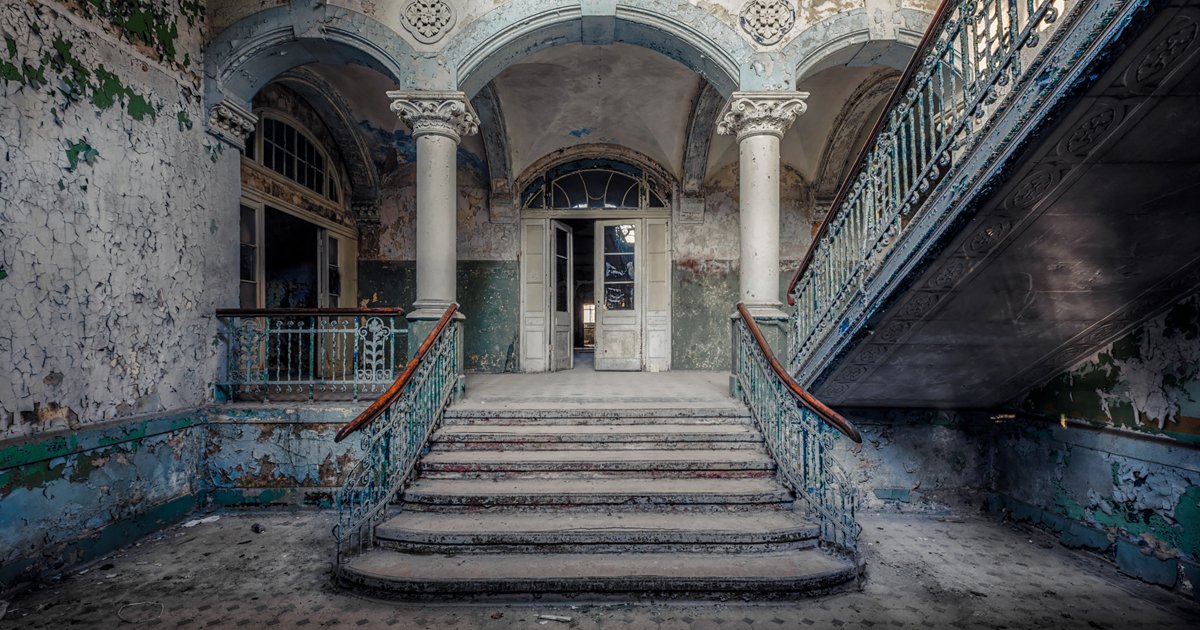

Europe is famous for castles, cathedrals, cobblestone streets, and cafés where one espresso somehow costs the emotional equivalent of a mortgage. But my favorite corners of the continent are usually the ones missing from postcards: abandoned buildings, empty sanatoriums, silent factories, forgotten churches, old railway stations, deserted hotels, and villas where vines have become the new interior decorators.
I search for abandoned buildings all around Europe and photograph them because decay tells a story that polished tourism often hides. A renovated palace shows what people want remembered. A peeling ballroom shows what time refuses to forget. In urban exploration photography, also called urbex photography, every cracked tile, collapsed ceiling, dusty piano, and sunbeam through a broken window feels like a sentence in a very old diary.
This is not about “breaking into spooky places for likes.” Responsible abandoned building photography is part research, part patience, part architectural appreciation, and part safety lecture from your inner grandma. The goal is simple: document forgotten spaces without damaging them, stealing from them, revealing sensitive locations, or treating history like a disposable background prop.
Why Abandoned Buildings in Europe Are So Fascinating
Europe is layered like a historical lasagna: Roman foundations, medieval walls, industrial-age factories, Soviet-era monuments, Art Nouveau hotels, Cold War bunkers, and modern developments that never quite made it to opening day. When a building is abandoned, those layers become visible. Paint falls away. Later renovations crack. Old signs resurface. A hospital corridor becomes a timeline. A theater balcony turns into archaeology with velvet seats.
Some abandoned places were left behind because industries moved. Others were emptied by war, disaster, political change, population decline, or plain old economics. Former spa towns in Georgia, disused hospitals in Germany, neglected churches in Italy, and empty industrial sites in Hungary all reveal different versions of the same truth: buildings are never just buildings. They are containers for work, belief, leisure, sickness, hope, vanity, and occasionally extremely questionable wallpaper.
What I Look For Before I Photograph an Abandoned Place
The search usually begins long before I touch a camera. I study old maps, local history pages, preservation reports, museum notes, travel writing, satellite imagery, and local news. I look for signs that a place can be visited legally, whether through permission, guided access, public heritage routes, restoration projects, or official photography arrangements.
Good urbex photography does not start with a crowbar. It starts with homework. I want to know what the building once was, why it mattered, why it closed, and whether anyone still has a claim to it. “Abandoned” does not always mean ownerless. In many cases, a site may be privately owned, structurally unstable, protected as heritage, inhabited by displaced people, or actively monitored. A place can look empty and still be full of responsibilities.
The Three Questions I Ask First
Before planning a shoot, I ask three questions. First, can I access this location legally and respectfully? Second, is the structure safe enough to approach? Third, does photographing it help tell a meaningful story, or am I just chasing creepy wallpaper with dramatic breathing?
The best abandoned buildings in Europe are not always the most famous. Sometimes the most powerful image comes from a small chapel in a rural Italian village, a forgotten factory office in Belgium, or a shuttered hotel lobby where moss has politely taken over the reception desk.
Real Places That Shape the Way I See Abandoned Europe
Every region has its own flavor of abandonment. In Germany, Beelitz-Heilstätten is one of the most famous examples: a vast former sanatorium complex that began in the late nineteenth century and became part medical site, part military history, part forest-covered ruin. Its long corridors and weathered operating rooms remind photographers that beauty and discomfort often arrive in the same frame.
In Bulgaria, the Buzludzha Monument rises on a mountain like a concrete flying saucer designed by ideology and bad weather. Opened in 1981, it was built as a political monument and later fell into disuse after the collapse of the communist regime. Today, its mosaic-covered interior and storm-battered exterior have become symbols of both decay and preservation debate.
In Ukraine, Pripyat remains one of the most widely recognized abandoned cities in the world. Evacuated after the 1986 Chernobyl disaster, it is not simply a “ghost town aesthetic.” It is a place connected to displacement, radiation, memory, science, and tragedy. Any photographer approaching stories like this needs humility. A rusting Ferris wheel is not just a cool composition; it is a reminder that real people left real lives behind.
In Georgia, Tskaltubo’s Soviet-era spa hotels and sanatoriums show another complicated side of abandoned architecture. Some structures fell into ruin after the Soviet collapse, while others became shelter for displaced families after conflict in Abkhazia. That changes everything. A photographer must pay attention not only to architecture, but to human dignity. Laundry in a hallway is not “atmosphere.” It may be someone’s home.
In Spain, Canfranc International Station proves that abandonment is not always the final chapter. Once a grand railway station in the Pyrenees, it spent years as a symbol of faded ambition before restoration helped transform it into a hotel and renewed landmark. That is one of the most hopeful parts of photographing abandoned buildings: sometimes the image becomes a record of the pause before rebirth.
The Ethics of Urban Exploration Photography
Urbex has a famous rule: take only photographs, leave only footprints. I like the spirit of it, though I would add: leave fewer footprints if possible, and maybe do not post the exact coordinates of a fragile stained-glass chapel to an audience of bored vandals. Responsible explorers often keep sensitive locations private because exposure can invite theft, graffiti, vandalism, and unsafe copycat visits.
The ethics are not complicated, but they do require discipline. Do not break windows. Do not force doors. Do not steal objects, even tiny ones. Do not move personal items just to make a scene look more dramatic. Do not stage fake “discoveries.” Do not treat abandoned places like free movie sets. A dusty book, a chair, a medical chart, or a child’s toy may look cinematic, but it belongs to the history of the site.
Respect Is Better Than Shock Value
A responsible abandoned building photographer knows when not to take the shot. If people are living in or near the structure, privacy comes first. If a site is sacred, dangerous, contaminated, or legally restricted, the camera stays in the bag. The most powerful image is not worth harming a place, a person, or yourself.
Safety Comes Before the Perfect Shot
Abandoned buildings are beautiful because time has been working on them. Unfortunately, time is a terrible contractor. Floors rot. Stairs collapse. Roofs leak. Metal rusts. Glass hides under leaves. Old paint may contain lead. Insulation may contain asbestos. Damp rooms may contain mold. Industrial sites may contain chemical residues. Wildlife may also object to your artistic vision.
I treat every location as unstable until proven otherwise. I wear sturdy boots, gloves, long sleeves, and a respirator when dust or mold is a concern. I carry a flashlight, backup light, charged phone, basic first aid, and water. I never climb weak stairs for a “better angle,” because gravity is an editor with no undo button.
I also avoid going alone. A quiet ruin can become a serious problem if you twist an ankle, step through a floor, or get lost in a basement where every room looks like the previous room’s depressed cousin. Urbex photography is not a solo superhero activity. It is a slow, careful documentary practice with a healthy respect for cracked concrete.
How I Photograph Abandoned Buildings
My favorite abandoned architecture photos usually begin with natural light. I look for windows, broken roof panels, doorways, and shafts of sunlight that reveal texture. Dust in the air can soften a scene. Ivy can frame a corridor. A single chair in a large room can create scale and loneliness without needing melodrama.
Wide-angle lenses help capture interiors, but I avoid making every room look like a haunted mansion ballroom for giants. Straight vertical lines matter in architectural photography, so I keep the camera level whenever possible. A tripod is useful in dark spaces, but only if the floor is stable and the location allows it. In cramped or risky areas, I raise ISO, open the aperture, and accept a little grain. Grain is better than becoming part of the rubble.
Details Tell the Human Story
Big rooms are impressive, but details often carry the emotion: a numbered key hook, a cracked religious statue, a factory time clock, a faded hotel menu, a medical cabinet, a school map, a curtain moving in the wind. These details remind viewers that the building was once useful. People worked there, prayed there, slept there, argued there, recovered there, danced there, or waited for trains that no longer came.
Editing Without Turning Reality Into a Video Game
Abandoned buildings already have drama. They rarely need radioactive-green shadows, neon-orange walls, or HDR so crunchy it looks like the image was deep-fried. My editing goal is to preserve mood while staying believable. I correct perspective, balance highlights, recover shadow detail, and keep colors close to what I felt on location.
Sometimes the most honest edit is quiet. A pale winter room with a soft gray window can say more than a thunderstorm sky pasted behind a broken roof. The building does not need to scream. It has been whispering for decades.
Why Europe Is Perfect for Abandoned Building Photography
Europe’s abandoned places are incredibly diverse. In one trip, a photographer might encounter a Baroque chapel, a modernist bus station, a Soviet mosaic hall, a textile factory, a seaside casino, a mountain railway hotel, and a farmhouse made of stone older than several countries. Each one reflects a different historical pressure: industrialization, migration, conflict, changing travel habits, religious decline, economic downturns, or preservation struggles.
That diversity makes European urbex photography more than a collection of eerie interiors. It becomes a way to study the continent through what it has stopped using. Abandoned buildings show what societies valued, what they outgrew, what they could not afford to maintain, and what they may one day choose to save.
What Abandoned Buildings Teach Us About Preservation
Not every ruin can be saved, and not every building should become a boutique hotel with artisanal soap and a lobby playlist called “melancholy jazz for investors.” Still, many abandoned structures have cultural, architectural, or community value. Photographing them can help document their condition before demolition, restoration, or further decay.
In places like Puglia, old masserie farmhouses have found new life as restored retreats and hospitality projects. In other regions, former churches become community spaces, railway stations become hotels, factories become museums, and industrial sites become parks. Adaptive reuse is not just about nostalgia. It can reduce waste, preserve craftsmanship, and keep local identity from being flattened into generic development.
My Favorite Moments While Searching for Forgotten Places
My favorite moment is always the first quiet minute inside. Not the photo. Not the social media reaction. The silence. You step into a room and wait for your eyes to adjust. The building seems to be deciding whether to trust you. Then small things appear: a line of light across tiles, green moss on a staircase, a swallow’s nest in a chandelier, the outline of missing furniture on wallpaper.
I have stood in rooms where trees grew through windows like they had simply misunderstood the concept of indoors. I have photographed staircases so elegant they looked offended by their own decay. I have seen theaters where the seats were still arranged for an audience that would never return. I have also backed out of plenty of places because the floor felt wrong, the air smelled dangerous, or the legal situation was unclear. A good photographer knows when the best shot is the one you do not take.
How to Start Photographing Abandoned Places Responsibly
If you want to photograph abandoned buildings in Europe, begin with legal and accessible places. Look for official heritage sites, restored ruins, guided tours, open-air museums, former industrial parks, and public locations with documented history. Build your eye before chasing secrecy. Learn architectural photography basics. Study light. Practice composition in old train stations, historic neighborhoods, and legal ruins before entering fragile spaces.
Research local laws, ask permission, respect barriers, and avoid publishing precise locations when a site is vulnerable. Travel light, dress safely, and bring a friend. Most importantly, remember that the building is the subject, not your ego. Urbex photography works best when curiosity is stronger than performance.
500 More Words From the Road: What This Work Feels Like
Searching for abandoned buildings across Europe has changed the way I travel. I still enjoy famous landmarks, of course. I can admire a cathedral façade with the best of them, especially if there is a bakery nearby doing suspiciously good things with butter. But the places that stay with me are often quieter. They sit behind overgrown fences, at the edge of towns, beside railway lines, in forests, or on hills where the wind seems to know more history than the guidebooks.
One of the strangest experiences is how quickly fear turns into attention. From the outside, an abandoned building can look intimidating. Inside, if access is legal and safe, the mood often becomes less scary and more intimate. You notice craftsmanship: hand-painted ceilings, iron railings, patterned tiles, carved doors, old electrical switches, and window frames built by people who expected the building to last. Then you notice what time has done. Water stains become maps. Wallpaper curls like old leaves. Dust softens sharp corners. Nature does not invade all at once; it negotiates, then moves in permanently.
Weather also becomes part of the story. On rainy days, abandoned buildings sound alive. Drops fall through broken roofs into buckets, basements, and stairwells. Wind pushes loose shutters. Trees scrape walls. In winter, the cold makes every room feel sharper. In summer, plants grow so aggressively that a corridor can become a greenhouse with better drama. Morning light is gentle and forgiving; late afternoon light can turn a ruined hall gold for five minutes, which is generous considering the building has been waiting years for that exact angle.
The emotional part is harder to explain. Some locations feel peaceful, as if they have accepted their fate. Others feel interrupted. A hotel lobby with keys still hanging behind the desk feels different from an empty factory floor. A schoolroom with faded drawings has a different weight than a power station control room. Abandoned buildings are not all “creepy.” Some are sad, some are grand, some are funny, and some are oddly comforting. I once found a room where someone had carefully placed a plastic chair beneath a skylight. It looked like the building had arranged a small waiting area for the sun.
The camera teaches patience. You cannot rush these places. You walk slowly, listen carefully, and let your eyes adjust to low light. You take wide shots to show scale, then close shots to show touch: a cracked handle, a dusty label, a stair edge worn down by thousands of feet. The best photographs often come after the obvious ones. First you shoot the grand staircase. Then you notice the tiny green plant growing from the third step, and suddenly that becomes the real image.
This work has also made me less romantic about decay. Ruins are beautiful, but abandonment can come from pain: economic collapse, war, illness, migration, disaster, neglect, or failed planning. A responsible photographer should never forget that. My job is not to make loss look trendy. My job is to notice, document, respect, and share the story with enough honesty that viewers feel wonder without forgetting the people connected to the place.
Conclusion
I search for abandoned buildings all around Europe and photograph them because they reveal a continent beyond the brochure. These forgotten places show how architecture ages, how communities change, how nature returns, and how memory survives even when doors close. From sanatoriums and stations to churches, factories, villas, and spa towns, abandoned buildings ask us to look slowly. They remind us that beauty is not always polished, history is not always tidy, and silence can be surprisingly loud.
The best urbex photography is not about trespassing, danger, or collecting trophies. It is about respect: for the structure, for the people who used it, for the communities around it, and for the future of the place. A great abandoned building photograph should make viewers curious, not careless. It should preserve a moment without damaging what remains.
Note: This article is original editorial content based on real urban exploration, architectural photography, safety, and preservation knowledge. It encourages legal, respectful, and safety-first photography practices.