
Jamestown has always been good at secrets. Some are the big, dramatic ones you learned in school:
a precarious English foothold on a swampy river, a brutal “Starving Time,” and the start of a colony that would
eventually reshape a continent. Others are quieterlike a slab of dark stone that spent centuries being admired,
misunderstood, moved around, and politely labeled “black marble,” as if that explained anything.
Now, archaeologists and geologists say this famous “black tombstone” didn’t just come from across the Atlanticit likely
came from Belgium. Yes: the stone in Virginia had a European passport, and the evidence was hiding in plain sight
inside the rock itself. Think of it as CSI: Colonial Edition, where the witnesses are microscopic fossils and the suspect is
a 400-year-old supply chain.
What Is Jamestown’s “Mysterious Black Tombstone”?
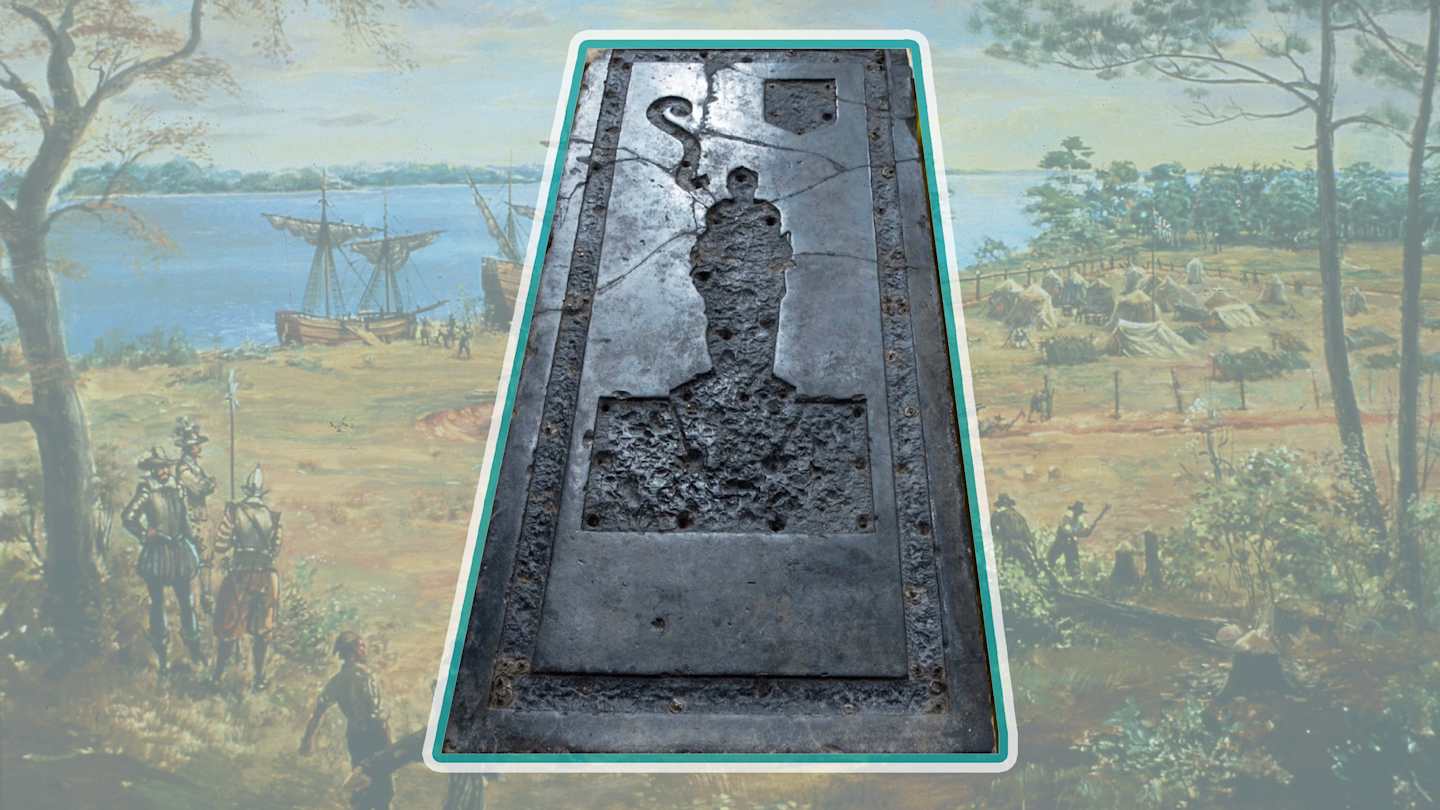
The artifact at the center of the story is often called the Knight’s Tombstonea large, dark ledger stone that once marked
the grave of an elite colonist in early Jamestown. “Ledger stone” is a fancy term for “flat slab laid over a grave,” the kind
you could literally walk across in a church floor (because 17th-century people had different ideas about interior designand
also about personal space).
The stone’s surface includes carved recesses that once held engraved brass inlaysdecorative metal plates that could depict
a knightly figure, heraldic shield, scrollwork, and border details. Today, those brasses are gone, leaving behind neat, purposeful
voids like missing puzzle pieces. The effect is haunting: the outline of a status symbol, minus the status-y bits.
It’s big, heavy, and dramaticexactly what you’d expect from a person who wanted their memorial to whisper (or shout),
“I was important.” Historically, the tombstone is tied to Jamestown’s church complex, where multiple churches were built
and rebuilt on the same footprint over decades. In other words, the neighborhood kept getting renovated, and the tombstone
kept getting relocated like a piece of furniture everyone is afraid to throw away.
Why Was Its Origin Such a Head-Scratcher?
For one thing, the stone looks nothing like common local building stone in coastal Virginia. It’s jet-dark, fine-grained, and can take
a high polishtraits associated with certain European limestones that were marketed (then and now) as “black marble.”
That phrase is the first clue: it’s a historical nickname, not a precise geology term.
In the 1600s, “marble” often meant “a stone you can polish into something fancy,” not necessarily the metamorphic rock your
high school Earth science teacher loves. So when old records called it marble, they weren’t lyingthey were just using the
broader, vibe-based definition. And vibes are not great for sourcing stone across oceans.
Archaeologists long suspected the tombstone was imported, because hauling a giant slab long distances was usually more expensive than the stone itself.
If you’re moving a thousand-pound rock in the 1600s, you’re not doing it “because it was on sale.” You’re doing it because money,
influence, and ego have teamed up like an unstoppable colonial superhero squad.
The Breakthrough Came From… Tiny Fossils
Here’s where the story gets delightfully nerdy: researchers examined microfossils embedded in fragments of the stoneespecially
foraminifera, single-celled marine organisms that leave behind distinctive shells. These fossils are basically nature’s timestamps.
Different species appear in specific geological periods and regions, so a combination of them can point to where a limestone formed.
The research team identified multiple foraminifera species that don’t co-occur in North American rocksbut do co-occur in parts
of Europe formed during the Carboniferous Period (roughly 340 million years ago, give or take a geological minute). That matters
because a true marble usually loses fossils when heat and pressure rearrange everything. This stone, however, preserved its fossil “fingerprints,”
which is a strong hint it’s limestone masquerading as marble.
In plain English: the tombstone wasn’t just dark and fancy. It was also a fossil scrapbook from a European sea, pressed into stone long before Jamestown existed,
and then shipped back across the Atlantic as a luxury object.
So Why Belgium Specifically?
Microfossils can narrow down the geological “where,” but researchers also used historical context to narrow down the human “how.”
Belgium has long been known for high-quality black limestone (often sold under names like “Belgian black” in later centuries), and
there is evidence of an established stone industry and export networks feeding into major trade hubs.
The likely journey looks something like this:
- Quarried and cut in what is now Belgium (the stone’s geology points to Europe, and historical sourcing suggests Belgium).
- Transported to a major port/trade hub and then transshipped through London, where specialized carving and brass-inlay work were available.
- Crossed the Atlantic to Virginiapossibly serving as ship ballast part of the way (because even luxury has to multitask).
- Installed in Jamestown as a church-floor grave cover in the early 1600s, an unmistakable symbol of status.
This isn’t just a fun “where did it come from?” trivia question. It suggests that by the 1620s, colonists weren’t only importing necessities like tools and cloth.
They were also importing prestigethe same way people today buy an Italian espresso machine not because they can’t boil water, but because the machine says something.
What the Tombstone Says About Wealth, Taste, and the Atlantic World
Jamestown’s early decades were harsh, violent, and uncertain. Yet even in that environmentmaybe especially in that environmentstatus mattered.
For elite English colonists, the church was not only a religious space; it was a social scoreboard. Burials inside or near the church, especially near the chancel,
signaled rank. A monumental ledger stone with decorative brass inlays was the 17th-century equivalent of reserved seating plus a glowing review on Yelp.
Choosing a black “marble” (really limestone) slab wasn’t random. Dark, highly polished stone stood out against lighter floors and walls. It was visually striking,
expensive to obtain, and fashionable in parts of England. A colonist who had connections to London could copy elite memorial styles from the old world and plant them
in the new oneliterally setting their identity in stone.
The Belgian origin also hints at how early and how complex transatlantic trade already was. We tend to imagine supply chains as a modern inventionbarcode scanners,
spreadsheets, and a warehouse robot named something cheerful like “Marty.” But early modern trade was sophisticated too, just slower and riskier. A stone like this
implies knowledge of materials, access to artisans, shipping logistics, and the ability to pay for all of it while everyone else is trying to survive mosquitoes and
malnutrition.
Who Was the “Knight,” Really?
The tombstone is traditionally attributed to a prominent Jamestown figureoften named as Sir George Yeardley, a colonial governor who died in 1627.
That date lines up with the tombstone’s historical placement, and Jamestown research has long tried to connect elite burials, church locations, and documentary references.
But here’s the honest archaeological answer: the identity is strongly suggested, not tattooed on the stone in permanent ink (especially since the brasses are missing).
Researchers have explored multiple lines of evidencechurch context, status indicators, historical references, and burial locations uncovered during excavations.
In recent years, archaeologists have investigated high-status graves in the church area in hopes of confirming identities through careful excavation and, where possible,
DNA analysis.
That uncertainty doesn’t weaken the storyit strengthens it. It reminds us that archaeology is less like reading a finished biography and more like assembling a
family photo album after someone spilled coffee on half the captions. The Belgian sourcing tells us something solid about trade and taste even while the “who”
remains a serious (and ongoing) research question.
Not Just a Tombstone: A Lesson in How Archaeology Works
One of the coolest parts of this discovery is the method. Provenance studiesfiguring out where a material came fromoften use chemistry or mineral “signatures.”
But fossils can be just as powerful, especially for limestones. Microfossils act like tiny, durable clues that survive long after humans have forgotten paperwork,
lost shipping records, or, in Jamestown’s case, rebuilt the same church site several times.
Why that matters beyond Jamestown
If fossils can pinpoint the origin of one famous tombstone, they can also help trace other early colonial materials: stone used in buildings, grave markers,
decorative objects, and trade goods that moved through the Atlantic world. Each sourcing success is a small victory against the kind of historical amnesia that
happens when documents disappear but artifacts remain.
And there’s a bigger takeaway: the “mystery” wasn’t solved by one dramatic clue, but by stacking different types of evidencegeology, paleontology, archaeology,
and historical contextuntil a clear pattern emerged. That’s the real magic trick: not guessing, but testing.
What It’s Like to Experience the Belgian Tombstone in Virginia
Reading about a transatlantic tombstone is fun. Seeing it (or even just knowing where it sits) is a different kind of experiencepart history lesson, part
time travel, part “wow, humans have been doing expensive personal branding forever.”
At Historic Jamestowne, the church space is more than a postcard backdrop. It’s layeredphysically and emotionally. Multiple church phases overlap, and the ground
under your feet holds centuries of rebuilding, burials, and reinterpretation. When you step inside the Memorial Church and learn that a black stone in the floor
is tied to the colony’s early elite, you start noticing how architecture and memory work together: who gets placed in the center, who gets named, who gets a marker,
and who disappears into unmarked earth.
The tombstone’s dark surface is the first thing that grabs you. Even without the missing brass inlays, the carved recesses feel intentionallike the ghost of a
design. It’s the absence that tells the story: something ornate once lived here, and time (plus human chaos) took it away. That emptiness invites imagination, but it
also invites empathy. Someone wanted to be remembered with glittering detail. Instead, we remember them through gaps.
Pairing the tombstone story with the site’s archaeology museumthe Archaeariumadds another layer. Museums can sometimes feel like tidy endings, but this one is more
like a “current chapter.” Artifacts recovered from Jamestown excavations show daily survival alongside global connections: personal items, tools, trade goods, and
evidence of the colony’s fragile beginnings. After you’ve seen everyday objectsthings people touched, used, lostyou return to the tombstone with different eyes.
It becomes less of a standalone celebrity rock and more of a single, dramatic line in a much bigger human paragraph.
If you’re the kind of visitor who likes interactive “spot the clue” moments, the tombstone delivers. You can look for the outlines of the former brasses, imagine the
shine of polished metal against black stone, and think about the logistics: a slab quarried in Europe, moved through ports, carved and inlaid by specialists, shipped
across an ocean, and installed in a church floor in a colony that was still figuring out how to reliably feed itself. It’s almost funny in its audacitylike importing
a grand piano into a tent. Almost.
The most lasting “experience,” though, is the way the tombstone rewires your sense of early America. Jamestown can feel mythicnames, dates, big themes.
The Belgian origin makes it tangible. It tells you that early colonists weren’t isolated pioneers living off the land in a historical snow globe.
They were participants in a fast-growing Atlantic system of trade, fashion, and symbolismone that connected Virginia not just to England, but to continental Europe
and its industries. You leave with a simple, sticky thought: history is not a straight line; it’s a shipping route.
Conclusion
Jamestown’s black “marble” tombstone is no longer just a local mystery or a dramatic relic with missing pieces. It’s evidenceof geology, of trade, of taste,
and of how quickly the early colony plugged into a wider Atlantic world. Microfossils helped crack the case, pointing researchers toward Europe and, most likely,
Belgium as the source. In the process, the stone shifts from “old grave marker” to “global artifact,” connecting a Virginia church floor to ancient seas and early
modern shipping lanes.
The irony is perfect: a memorial meant to pin one person in place now tells a story about movementof materials, money, and ideas crossing borders long before
anyone invented the word “globalization.” If that’s not a plot twist worthy of a knightly ledger stone, what is?