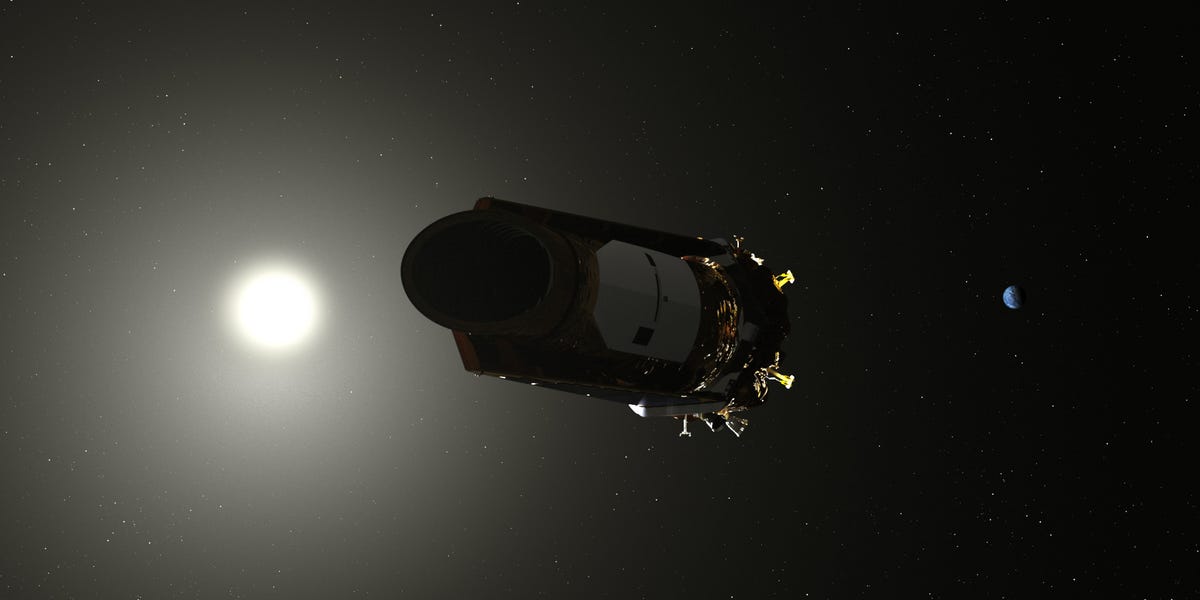

The Kepler Space Telescope did not go out with a dramatic explosion, a Hollywood-style countdown, or a heroic astronaut tapping the dashboard and whispering, “Come on, old friend.” Its ending was quieter, stranger, and in many ways more beautiful: after nearly a decade of staring at the stars, NASA’s legendary planet-hunter simply began running out of fuel.
That may sound almost ordinary. Cars run out of gas. Lawn mowers run out of gas. Your phone runs out of battery at the exact moment you need to show a boarding pass. But Kepler was not sitting in a driveway. It was trailing Earth in an orbit around the Sun, millions of miles from home, with no cosmic service station nearby and absolutely no roadside assistance plan.
When NASA announced that Kepler was almost out of fuel, it marked the approaching end of one of the most successful space missions in modern astronomy. Kepler changed the way scientists think about planets beyond our solar system. Before Kepler, exoplanets were exciting but rare discoveries. After Kepler, the universe looked crowded, lively, and wonderfully suspiciouslike every star might be hiding a few planetary secrets.
Why Kepler Running Out of Fuel Was Such Big News
Kepler launched in 2009 with a bold mission: find Earth-size planets orbiting other stars, especially planets that might sit in the “habitable zone,” where temperatures could allow liquid water to exist. That does not mean Kepler was finding little blue Earth twins with oceans, ducks, and suspiciously familiar coffee shops. It means the telescope was helping scientists answer a much bigger question: are planets like Earth common?
The answer Kepler delivered was stunning. Planets are not rare decorations sprinkled around a few lucky stars. They are everywhere. NASA later reported that Kepler led to the discovery of more than 2,600 planets and observed more than half a million stars during its mission. In plain English, Kepler helped move humanity from “Maybe there are other worlds out there” to “The galaxy is basically a planet factory, and business is booming.”
So when the Kepler Space Telescope was almost out of fuel, the news mattered because this was not just another spacecraft reaching the end of a checklist. It was the slow farewell of a machine that rewrote our cosmic address book.
How Kepler Found Planets Without Taking Pictures of Them
One of the funniest things about Kepler’s success is that it did not usually “see” planets directly. It was not snapping gorgeous close-ups of alien beaches or mountain ranges. Instead, Kepler used the transit method, which is both scientifically brilliant and charmingly sneaky.
Here is the basic idea: when a planet passes in front of its star from our point of view, it blocks a tiny bit of starlight. Kepler watched stars carefully, looking for those tiny dips in brightness. If the dips repeated at regular intervals, scientists could infer that a planet was orbiting the star. It is a little like noticing someone walking past a lamp again and againnot by seeing the person clearly, but by watching the lamp dim for a moment each time.
This method allowed Kepler to detect thousands of exoplanet candidates. Some were massive gas giants. Some were small rocky worlds. Some orbited close to their stars and were probably hotter than a pizza oven with ambition. Others sat farther out, in regions where water might potentially remain liquid under the right conditions.
The Fuel Problem: Why Kepler Could Not Just Keep Going Forever
Kepler’s fuel was not used like gasoline in a car engine. The telescope needed fuel mainly to control its orientation in space. To collect science data, Kepler had to point precisely. To send that data back to Earth, it had to turn its antenna toward our planet. Without enough fuel, Kepler could not reliably aim its instruments or communicate its discoveries.
NASA knew the end was coming. In March 2018, the agency explained that Kepler’s fuel supply was running low and that the spacecraft would likely reach the end of its operations within months. By July 2018, Kepler’s team placed it into a hibernation-like state to preserve fuel long enough to download science data from its latest observing campaign. That decision shows how carefully mission managers treated every remaining drop. Kepler was not being casually parked; it was being rationed like the last cookie in a house full of teenagers.
Later, as pointing performance degraded, NASA again placed Kepler into a stable sleep mode to protect valuable science data. The goal was simple: do not waste fuel, do not lose data, and squeeze every final scientific gift from a spacecraft that had already exceeded expectations.
From Kepler to K2: The Telescope That Refused to Quit
Kepler’s story would already be impressive if it had ended after its original mission. But the telescope had a second act worthy of applause.
In 2013, Kepler suffered mechanical problems when it lost the use of a second reaction wheel. Reaction wheels help spacecraft point steadily without constantly using fuel. Losing them could have ended the mission completely. Instead, engineers developed a clever workaround using pressure from sunlight to help stabilize the spacecraft. The revived mission became known as K2.
K2 observed different regions of the sky in campaigns, each lasting roughly a few months. This second mission expanded Kepler’s scientific reach beyond its original field of view. It studied planets, stars, supernovae, young stellar systems, and other cosmic targets. In other words, Kepler had the space-telescope version of a second career and somehow made retirement look optional.
By the time fuel finally became the limiting factor, Kepler had already survived hardware setbacks, cosmic radiation, years of deep-space operations, and the general inconvenience of being a delicate observatory in a very hostile universe.
What Happened When Kepler Finally Ran Out of Fuel?
On October 30, 2018, NASA announced that Kepler had run out of the fuel needed for further science operations. The spacecraft was retired in a safe orbit around the Sun, away from Earth. No fiery crash. No splashdown. No final dramatic plunge into a planet. Kepler remained in space, quiet and distant, like a retired librarian who had already handed over shelves of priceless books.
The decision to retire Kepler was practical and responsible. Without fuel, the spacecraft could no longer reliably point itself to gather data or send information home. NASA’s job was to preserve what had been collected, close the mission safely, and allow scientists to continue studying the enormous archive Kepler left behind.
And that archive is still valuable. Kepler’s observations continue to support new research. Scientists have gone back into old Kepler and K2 data to identify additional planet candidates and refine what we know about planetary systems. The telescope stopped operating, but its data did not stop speaking.
Kepler’s Greatest Legacy: A Galaxy Full of Planets
Before Kepler, the search for exoplanets was like looking for coins in a dark room with a tiny flashlight. After Kepler, scientists had statistical evidence that planets are common throughout the Milky Way. That may be the mission’s greatest legacy.
Kepler showed that many stars have planets. It revealed systems with tightly packed worlds, planets orbiting close to their stars, planets smaller than Neptune, and rocky planet candidates that challenged old assumptions about how solar systems form. Our own solar system began to look less like the universal template and more like one example among countless possible arrangements.
This matters because every planet discovery adds a new piece to the puzzle of cosmic history. How do planets form? How common are rocky worlds? What kinds of stars are most likely to host small planets? How often do planets appear in habitable zones? Kepler did not answer every question, but it gave scientists enough evidence to ask better ones.
Kepler and the Search for Earth-Like Worlds
The phrase “Earth-like planet” can be tricky. In headlines, it sometimes sounds as if astronomers have found another Earth with trees, weather forecasts, and maybe a suspiciously overpriced airport sandwich. In science, it usually means something more careful: a planet may be similar in size to Earth and may orbit in a region where liquid water could exist.
Kepler helped identify many small planet candidates and confirmed worlds that shaped the study of potentially habitable planets. Some discoveries suggested that Earth-size planets may be common around certain types of stars. Other findings showed that planets can exist in systems very different from our own.
The important point is not that Kepler found “Earth 2.0” ready for moving day. It is that Kepler proved the search is worth continuing. The telescope gave future missions a roadmap, a database, and a reason to keep looking.
What Replaced Kepler?
Kepler’s retirement did not end the hunt for exoplanets. NASA’s Transiting Exoplanet Survey Satellite, better known as TESS, launched in 2018 and began scanning bright nearby stars for planets. While Kepler focused deeply on a specific region of the sky during its original mission, TESS was designed to survey a much larger area.
That makes TESS a natural next step. Kepler told us planets are common. TESS helps find nearby planets that can be studied in more detail by other observatories. Together with powerful tools such as the James Webb Space Telescope and large ground-based telescopes, TESS discoveries can help scientists study planet atmospheres, star systems, and possibly the ingredients linked to habitability.
In that sense, Kepler did not leave the stage empty. It passed the microphone.
Why the “Almost Out of Fuel” Moment Was Surprisingly Emotional
People get attached to space missions. That might sound strange because spacecraft are machines, not pets. Kepler did not wag its tail, complain about dinner, or sleep on anyone’s clean laundry. But missions like Kepler represent years of human effort, patience, creativity, and hope.
Engineers designed it. Scientists dreamed of what it might discover. Mission teams kept it alive through problems. Data analysts searched its light curves for faint planetary signals. The public watched as the number of known worlds grew from a few hundred to thousands. Kepler became more than hardware. It became a symbol of persistence.
So when NASA said the Kepler Space Telescope was almost out of fuel, the announcement felt like hearing that an old explorer had reached the final page of a journal. Sad, yesbut also satisfying. Kepler had done the job. Actually, it had done more than the job. It had gone above and beyond, which is exactly the sort of behavior that makes humans give emotional speeches about metal objects in space.
Lessons From Kepler’s Final Days
1. Great Science Requires Patience
Kepler’s discoveries came from repeated observations, careful measurements, and patient analysis. The telescope watched stars over long periods, waiting for patterns. In a world addicted to instant results, Kepler was a reminder that some of the best answers arrive slowly.
2. Engineering Creativity Can Save a Mission
The K2 mission showed how creative problem-solving can extend the life of a spacecraft. When mechanical failures threatened Kepler, engineers found a way to use sunlight itself as part of the stabilizing strategy. That is not just clever; that is “using the universe as a tool” clever.
3. Data Can Outlive the Machine
Kepler stopped collecting new observations, but its data archive remains scientifically rich. Space missions do not always end when the spacecraft goes quiet. Sometimes the real treasure keeps producing discoveries for years.
4. The Universe Is More Crowded Than We Imagined
Perhaps Kepler’s biggest lesson is that planets are normal. The Milky Way is filled with worlds, and every new discovery makes Earth feel both more special and less alone.
Personal Reflections and Experiences Related to Kepler’s Final Chapter
Thinking about the Kepler Space Telescope running out of fuel feels a little like watching a beloved old explorer return from a long expedition with dusty boots, a battered notebook, and stories that permanently change the map. The machine itself was never glamorous in the usual sense. It did not send back colorful portraits like Hubble’s famous nebula images. It did not land on Mars. It did not scoop soil, drill rocks, or roll across alien landscapes. Kepler’s magic was quieter. It watched light. It waited. It noticed tiny changes most of us would never see.
That quietness is part of what makes the mission so powerful. In everyday life, we often expect discovery to look dramatic. We imagine thunderclaps, fireworks, and someone shouting “Eureka!” while knocking over a coffee mug. Kepler’s work reminds us that discovery can also look like a small dip in starlight measured again and again until a hidden planet reveals itself. There is something deeply encouraging about that. It suggests that patience is not passive. Sometimes patience is the most active form of curiosity.
Kepler’s low-fuel period also offers a surprisingly human lesson about limits. Every mission, project, career, and creative effort has fuel of some kind. Time, energy, money, attention, health, motivationnone of it is infinite. Kepler’s team did not panic when the spacecraft neared the end. They prioritized. They protected the most valuable data. They used what remained wisely. That approach applies far beyond space science. When resources are low, the smartest move is not always to sprint blindly; sometimes it is to pause, preserve what matters, and make the final effort count.
There is also a sense of humility in Kepler’s story. The telescope showed us thousands of worlds, yet each discovery also revealed how much we still do not know. Are any of these planets truly habitable? Do they have atmospheres? Oceans? Magnetic fields? Stable climates? Could any support life? Kepler opened doors, but it did not pretend the rooms beyond them were fully explored. That is good science: not a vending machine for easy answers, but a lantern that makes the next question visible.
For readers who love astronomy, Kepler’s final days can feel bittersweet. The phrase “almost out of fuel” sounds like an ending, and it was. But it was also proof of success. The spacecraft lasted far longer than its original planned mission. It survived problems that could have ended its work earlier. It helped transform exoplanet science from a niche frontier into one of astronomy’s most exciting fields. If a mission must end, that is a pretty magnificent way to do it.
In a broader sense, Kepler changed the emotional texture of looking at the night sky. Before, a star could be beautiful. After Kepler, a star also became a possible sun with planets of its own. Some might be scorched. Some frozen. Some gaseous and enormous. Some rocky and quiet. Some perhaps waiting for future telescopes to study their atmospheres. Kepler made the sky feel populated, not empty.
That may be the most lasting experience connected to this mission: the feeling that the universe is not just vast, but full of places. Kepler ran out of fuel, but it left behind a new kind of imaginationone grounded not in fantasy, but in data. And honestly, that is a pretty spectacular final gift from a telescope that spent its life watching stars blink.
Conclusion: Kepler’s Fuel Ran Out, But Its Legacy Did Not
The story of the Kepler Space Telescope being almost out of fuel is not simply a story about a spacecraft reaching the end of its operational life. It is a story about how far careful science can go, how creative engineering can extend a mission, and how one telescope changed humanity’s understanding of the galaxy.
Kepler proved that planets are common, that distant solar systems come in astonishing variety, and that the search for potentially habitable worlds is not science fictionit is a serious scientific pursuit. Its final months were managed with care, as NASA conserved fuel, protected data, and prepared for the inevitable end. When Kepler was finally retired, it left behind more than numbers. It left behind a new way of seeing the stars.
The telescope may be silent now, drifting safely around the Sun, but its discoveries continue to shape astronomy. Kepler ran out of fuel. It did not run out of meaning.