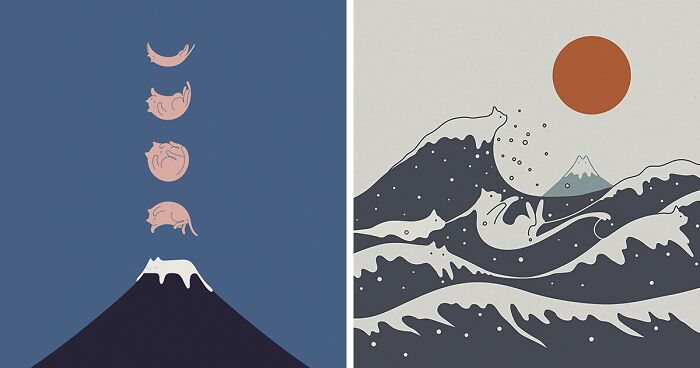

Some artists paint cats sitting on windowsills. Some draw them curled on pillows. And then there is the wonderfully sneaky world of minimalist cat landscape illustrations, where a sleeping feline becomes a mountain range, a curled tail turns into a wave, and a pair of pointy ears quietly photobombs the horizon. Suddenly, the landscape is not just a landscape anymore. It is a game of “Where’s the cat?” with better composition and fewer striped sweaters.
The idea behind “My 25 Minimal Illustrations That Blend Cats Into Landscapes And Other Scenes” feels simple at first glance: combine cats with natural settings and everyday scenes using clean shapes, soft colors, and clever negative space. But the charm is deeper than cuteness. These illustrations work because they understand both cats and minimalism. Cats are naturally sculptural animals. They stretch into long lines, fold into perfect circles, perch like tiny monuments, and sleep with the confidence of ancient royalty. Minimal illustration, meanwhile, rewards anyone who can say more with less.
Inspired by the broader tradition of feline art and modern minimal design, this collection turns the familiar cat silhouette into a visual surprise. The result is a series of quiet, funny, and strangely calming scenes that invite viewers to slow down, look twice, and enjoy the tiny thrill of discovery. It is art for cat lovers, design fans, daydreamers, and anyone who has ever looked at a fluffy pet sprawled across the floor and thought, “That looks exactly like a hill with whiskers.”
Why Minimal Cat Illustrations Are So Appealing
Minimal illustrations have a special kind of confidence. They do not shout. They do not throw twenty-seven textures, neon gradients, and a motivational quote at your face before breakfast. Instead, they use restraint. A curved line, a flat block of color, a carefully placed sun, or a tiny tail can do the emotional heavy lifting.
That restraint is exactly why cats fit so beautifully into minimalist artwork. A cat’s body can be recognized from just a few shapes: a rounded back, triangular ears, a curling tail, alert eyes, or a loaf-like pose that every cat owner knows far too well. You do not need a detailed fur rendering to understand “cat.” In fact, the fewer details there are, the more playful the image can become.
The Magic of Recognition
One reason these cat landscape illustrations work is that the viewer completes the image. A shape may look like a hill at first. Then the ears appear. Then the tail. Then your brain joyfully announces, “That mountain is a cat.” This small moment of recognition creates delight. It is visual comedy, but quiet enough to hang above a sofa without making the room feel like a cartoon convention.
This is also why the collection feels accessible. You do not need an art degree to enjoy it. You only need curiosity and, preferably, a soft spot for animals who knock pens off desks while maintaining eye contact.
The Art of Blending Cats Into Landscapes
The best images in this style do not simply paste a cat into a scene. They merge the cat and the environment so naturally that both ideas become one. A sleeping cat can become a desert dune. A stretching cat can become a bridge. A curled-up cat can become an island beneath a moon. The trick is not just drawing a cat; it is noticing where feline anatomy already echoes the shapes of nature.
Mountains, waves, clouds, hills, caves, trees, moons, and rivers all contain curves. Cats are basically walking collections of curves with opinions. When those forms meet, the illustration begins to feel inevitable, as if the cat was hiding in the landscape all along and the artist simply found it.
Example 1: The Cat as a Mountain Range
One of the most natural pairings is the sleeping cat and the mountain landscape. A cat lying on its side creates a soft ridge line. The back becomes a slope, the head becomes a peak, and the ears become twin summits. Add a small rising sun behind the body, and suddenly the scene becomes both peaceful and funny. It is the kind of image that says, “Nature is majestic, but also possibly demanding treats.”
Example 2: The Cat as an Ocean Wave
A curling tail can easily become a rolling wave. In a minimal illustration, a single sweeping line can suggest both water and movement. When a cat’s body becomes the shoreline and the tail becomes surf, the image creates a gentle visual pun. It also captures the cat’s personality: calm one second, dramatic tidal force the next.
Example 3: The Cat as a Moonlit Island
A curled-up cat has the perfect shape for an island or moonlit hill. Place it in a dark blue setting, add a small crescent moon, and the scene becomes dreamy. The viewer may see the landscape first, then notice the cat’s ears or tail tucked into the composition. That delayed discovery gives the artwork its charm.
Example 4: The Cat Hidden in Everyday Scenes
The same idea works beyond landscapes. A cat can become steam rising from a coffee cup, a shadow under a chair, a plant shape in a pot, a cloud outside a window, or the curve of a blanket on a quiet bed. These everyday scenes make the artwork feel personal. Anyone who lives with a cat knows they have a talent for turning ordinary objects into cat furniture. A cardboard box? Cat palace. A laptop? Cat throne. A clean shirt? Clearly a luxury mattress.
Negative Space: The Secret Ingredient
Negative space is one of the most important tools in minimalist design. It refers to the empty or open areas around and between the main visual elements. But “empty” does not mean useless. In strong minimalist art, negative space gives the eye room to breathe. It makes the important shapes more visible and allows the viewer to focus on the idea without distraction.
In cat landscape illustrations, negative space often does two jobs at once. First, it keeps the composition calm and clean. Second, it helps hide or reveal the cat. A blank sky may outline the animal’s back. A pale moon may emphasize the ears. A simple ground plane may make the tail easier to spot. The artwork becomes a conversation between what is drawn and what is left out.
Why Less Detail Can Feel More Emotional
Detailed art can be beautiful, of course. But minimal art has a different emotional effect. Because it removes unnecessary visual noise, it leaves more space for mood. A tiny sun behind a cat-shaped hill can feel peaceful. A single sleeping figure under a wide sky can feel cozy. A small cat hidden inside a large landscape can feel playful and poetic at the same time.
That balance is one reason minimalist cat art has become popular for wall prints, stationery, digital wallpapers, and social media. It is cute without being chaotic. It is clever without trying too hard. It is decorative but still memorable.
Cats Have Always Belonged in Art
While these modern minimal illustrations feel fresh, cats have a long history in visual culture. Ancient Egyptian art famously included cats in sculpture, amulets, and symbolic objects. In later centuries, cats appeared in paintings, prints, drawings, cartoons, posters, and domestic scenes. They have been symbols of mystery, independence, elegance, mischief, comfort, and occasionally complete household domination.
What makes the modern minimalist approach interesting is that it does not portray cats only as pets. Instead, it treats them as forms, moods, and visual ideas. The cat becomes landscape, weather, architecture, decoration, and atmosphere. That transformation gives the artwork a surreal quality while keeping it friendly and easy to enjoy.
From Museum Walls to Internet Culture
Cats have also thrived in digital culture. Long before many people learned the phrase “viral content,” cats were already winning the internet with sleepy faces, questionable decisions, and the emotional range of tiny theatrical villains. Minimal cat illustrations benefit from that shared affection. Viewers already understand the humor of cats. The artist can therefore use only a few shapes and still trigger a strong response.
But unlike quick memes, these illustrations have staying power because they are built on design principles: composition, balance, color harmony, silhouette, rhythm, and visual surprise. They may be adorable, but they are not accidental.
The Role of Color in Minimalist Cat Landscape Art
Color plays a major role in the mood of these illustrations. Minimal art often uses limited palettes, which makes every color choice matter. Soft pastels can create a calm, dreamy feeling. Warm oranges and yellows suggest sunrise, comfort, and optimism. Deep blues and purples bring night, mystery, and quiet. Greens can make a cat-shaped hill feel fresh and natural.
Because the shapes are simple, color becomes emotional punctuation. A small red sun can make the whole scene feel Japanese-inspired and graphic. A pale pink sky can make a sleeping cat feel tender. A dark background can turn a simple silhouette into something elegant and almost magical.
Why Soft Colors Work So Well
Soft colors pair beautifully with cats because they match the mood many people associate with feline relaxation. A cat napping in a sunbeam is not exactly a high-adrenaline event, unless you are the dust particle being hunted in its dreams. Gentle colors help communicate warmth, quiet, and comfort. They also make the artwork easy to use in home decor, where loud visuals can overwhelm a room.
25 Illustration Ideas That Make the Collection Feel Fresh
A series of 25 minimal illustrations needs variety. If every image were just a cat-shaped hill under a sun, the charm would wear thin faster than a cat’s patience during bath time. The strength of this concept comes from exploring many scenes while keeping the same visual language.
Possible scenes include a cat as a mountain, a cat as a wave, a cat as a cloud, a cat as a sleeping island, a cat as a desert dune, a cat as a crescent moon, a cat as a bridge, a cat as a tree shadow, a cat as a cave opening, a cat as a waterfall curve, a cat as a teacup swirl, a cat as a bookshelf silhouette, a cat as a city skyline, a cat as a mushroom cap, a cat as a blanket fold, a cat as a garden hill, a cat as a snowy slope, a cat as a sunset ridge, a cat as a river bend, a cat as a window reflection, a cat as a campfire shadow, a cat as a planet, a cat as a rainbow arc, a cat as a quiet doorway, and a cat as the secret shape inside a starry night.
Each idea works because it begins with shape. The artist first asks, “What does this cat posture resemble?” Then the scene grows from that answer. This method keeps the collection coherent while allowing each image to bring a new little surprise.
Why These Illustrations Feel So Calming
There is a reason people are drawn to this kind of art during busy, noisy, notification-heavy days. Minimal cat landscape illustrations offer a small pause. They are simple enough to understand quickly, but clever enough to reward longer looking. They give the viewer something gentle to solve.
That calming quality comes from three elements working together: familiar animals, peaceful scenery, and uncluttered design. Cats bring personality. Landscapes bring openness. Minimalism brings order. Together, they create an image that feels like a deep breath with whiskers.
The Cozy Humor Factor
Humor matters too. These illustrations are not loud jokes, but they have a wink built into them. The joke is not “cats are funny,” although cats have certainly built an impressive legal case for that statement. The joke is that a cat can be everywhere once you start looking. Hills become cats. Clouds become cats. Coffee steam becomes cats. Your chair may be a cat. Your sweater pile may already be a cat colony.
This cozy humor makes the artwork friendly. It invites viewers in instead of making them feel as if they need to decode a complicated theory. The design may be sophisticated, but the experience is warm and playful.
How Minimal Illustrations Improve Storytelling
Storytelling in minimalist illustration depends on suggestion. Instead of explaining everything, the artist gives the viewer just enough information to imagine the rest. A tiny house near a cat-shaped mountain suggests scale. A small moon above a curled feline island suggests nighttime. A little boat beside a sleeping cat wave creates a world in only a few elements.
This is powerful because viewers enjoy participating. When the artwork leaves room for imagination, it becomes more personal. One person may see a peaceful vacation scene. Another may remember their childhood cat sleeping in impossible positions. Someone else may simply think, “I would buy that print for my kitchen,” which is also a valid emotional response.
The Importance of Visual Rhythm
Visual rhythm helps connect the cat and the scene. Repeated curves can guide the eye from the landscape into the animal shape. A round sun may echo a curled body. A series of hills may repeat the curve of a tail. These small relationships make the image feel intentional rather than random.
In minimal art, rhythm is especially important because there are fewer elements on the page. Every line has a job. Every shape must earn its place. A successful illustration feels effortless, but that usually means the artist has done the hard work of removing everything that does not belong.
What Artists Can Learn From This Style
Artists who want to create minimal cat illustrations can learn several lessons from this concept. First, start with observation. Watch how cats actually sit, sleep, stretch, crouch, and curl. Their bodies make shapes that are funnier and more elegant than anything invented from memory.
Second, sketch in silhouettes before adding details. If the cat shape is recognizable in black and white, it will likely work in color. Third, choose a simple scene that naturally matches the posture. A loafing cat may become a hill. A stretching cat may become a bridge. A curled cat may become a moon, island, or sleeping planet.
Finally, edit without mercy. Minimalism is not about drawing less because you ran out of time. It is about removing what weakens the idea. If a tree, texture, cloud, or decorative pattern does not help the cat-landscape illusion, it may need to go. Harsh? Maybe. But cats remove things from tables every day, so consider it artistic revenge.
Why Cat Lovers Connect With These Images
Cat lovers know that cats already blend into the world in strange ways. They disappear into laundry piles, melt into blankets, become shadows under beds, and somehow occupy the exact center of every important document. Minimal cat landscape illustrations exaggerate this real behavior into a poetic visual concept.
The images also respect the cat’s mysterious personality. Dogs often announce themselves with enthusiasm. Cats prefer atmosphere. They enter a room like punctuation. They sit in silence and somehow make the furniture look temporary. Turning cats into landscapes feels right because cats already behave like small weather systems: calm, unpredictable, beautiful, and occasionally destructive near glassware.
Personal Experience: Living With the Idea Behind the Illustrations
The more time I spend with the idea of cats blended into landscapes and everyday scenes, the more I notice cat shapes everywhere. A folded blanket on the couch becomes a sleepy hillside. A cloud with two sharp corners becomes a sky-cat drifting toward lunch. A shadow under the table suddenly has the suspicious curve of a tail. Once the eye learns the game, the world becomes full of hidden felines.
That is one of the most enjoyable experiences connected to this topic: it changes how you look. Minimal illustration trains the eye to simplify. Instead of seeing every detail, you begin to notice the essential shape of things. A mountain is no longer only rock and trees; it is a curve, a silhouette, a mood. A cat is no longer only fur and whiskers; it is posture, attitude, geometry, and timing. When those two ways of seeing overlap, ordinary scenes become more imaginative.
I also think this style captures something emotionally true about living with cats. Cats are masters of becoming part of the room. They can sit so still in a patch of sunlight that they seem like a warm decorative object. Then, without warning, the decorative object sprints across the house at 2 a.m. as if late for an appointment with chaos. Minimal cat art freezes the peaceful half of that personality. It shows cats as calm presences, quietly shaping the world around them.
There is also a meditative pleasure in creating or viewing these images. Because the compositions are simple, the viewer has time to rest inside them. You are not being asked to process a crowded scene. You are being invited to notice one clever transformation. That small act of noticing can feel surprisingly satisfying. It is like finding a secret door in a familiar room.
For artists, the experience can be even richer. Drawing this kind of illustration requires patience. You may sketch ten versions of a cat-shaped hill before one feels natural. Move the ears too high, and the image becomes too obvious. Hide them too well, and nobody sees the cat. Make the tail too decorative, and it stops belonging to the landscape. The sweet spot sits somewhere between clarity and surprise.
That balance teaches a valuable creative lesson: clever art does not have to be complicated. Sometimes the strongest idea is the one that feels inevitable after you see it. Of course a sleeping cat looks like a mountain. Of course a curled tail looks like a wave. Of course a cat belongs in the moon, the garden, the teacup, the skyline, and probably the laundry basket you just emptied. The artist’s job is to reveal that connection with grace.
These illustrations also make excellent reminders to slow down. In a world full of fast images, loud content, and endless scrolling, a minimal cat landscape asks for a softer kind of attention. It says, “Look again.” That is a lovely message. It is also very cat-like. Cats have always expected us to look at them, admire them, and understand that the universe is better when arranged around their nap schedule.
In the end, the experience of these 25 minimal illustrations is not only about cats or landscapes. It is about discovery. It is about finding humor in simple shapes and comfort in quiet design. It is about seeing the familiar in a new way. And yes, it is also about the undeniable fact that almost anything can be improved by adding a hidden cat.
Conclusion
“My 25 Minimal Illustrations That Blend Cats Into Landscapes And Other Scenes” celebrates the sweet spot where clever design, feline personality, and peaceful scenery meet. These artworks are simple, but they are not empty. They use negative space, clean silhouettes, limited color, and visual surprise to create images that feel calm, funny, and memorable. Whether a cat becomes a mountain, a wave, a moonlit island, or a quiet shadow in an everyday room, the result is a delightful reminder that art does not always need more detail to say more.
For cat lovers, the collection feels instantly relatable. For design fans, it demonstrates how powerful minimal illustration can be when every shape has purpose. For everyone else, it offers a charming visual game: look once for the landscape, then look again for the cat. The second look is where the magic happens.
Note: This article is written as original, web-ready editorial content based on publicly available information about minimalist cat landscape art, Lim Heng Swee’s cat landscape concept, negative space in design, and the long tradition of cats in visual culture.