
The 1970s were a golden age for electronics hobbyists: a time when breadboards smelled faintly of warm phenolic, project magazines were treated like sacred scrolls, and a simple integrated circuit could make a garage bench feel like mission control. Long before every blinking LED required a firmware update, analog circuits did real work with resistors, capacitors, transistors, and a mysterious little triangle on the schematic called the operational amplifier.
The Hackaday-style idea behind “Op Amp Contest: A Slice Of The ’70s” captures that exact spirit. It is not just about building another circuit. It is about revisiting a moment when the op amp became affordable, flexible, and wonderfully hackable. A single chip could amplify a weak signal, build an oscillator, create a timer, shape audio, compare voltages, or help produce noises that sounded like a robot cat complaining from inside a lunchbox. And honestly, that is engineering poetry.
This article explores why op amps became such a defining part of hobby electronics, how a retro-inspired op amp sound generator reflects the charm of the 1970s, and why analog design still deserves a front-row seat in a world obsessed with microcontrollers.
Why the Op Amp Became the Hobbyist’s Swiss Army Knife
An operational amplifier, or op amp, is essentially a high-gain differential amplifier. In normal-person language, it compares two input voltages and produces an output based on the difference. By itself, that sounds like a tiny electronic drama queen. But when paired with feedback components, it becomes one of the most useful building blocks in electronics.
With only a few resistors and capacitors, an op amp can become an inverting amplifier, non-inverting amplifier, buffer, integrator, differentiator, active filter, oscillator, comparator, or signal conditioner. That flexibility explains why op amps are found in audio gear, measurement instruments, sensor circuits, power supplies, synthesizers, medical equipment, and countless lab experiments where someone says, “This should only take five minutes,” and then disappears until midnight.
The 1970s: When Analog ICs Became Fun, Cheap, and Dangerous to Free Time
The 1970s gave electronics hobbyists access to a growing selection of analog integrated circuits. Parts that were once expensive or specialized became common enough to appear in magazines, kits, school labs, and home workshops. The op amp moved from professional instrumentation into the hands of tinkerers who wanted to build sound effects, light sensors, tone generators, electronic organs, radios, filters, and strange little gadgets with no commercial purpose except delight.
The famous 741 op amp had already helped establish the monolithic op amp as a standard part by the late 1960s. It was not perfect by modern standards. It needed thoughtful power supplies, did not swing rail-to-rail, and could complain if treated like a modern low-voltage CMOS part. But it was understandable, available, and tough enough to teach generations of builders how feedback really works.
Then came devices like the LM324 family, which helped make single-supply analog design more practical. With four op amps in one package, designers could build multi-stage projects without filling a board with individual chips. For hobbyists, that meant more weird sound generators, better sensor circuits, and fewer moments of asking, “Where did I put the other IC?”
The Featured Project: A Retro Sound Generator With Analog Personality
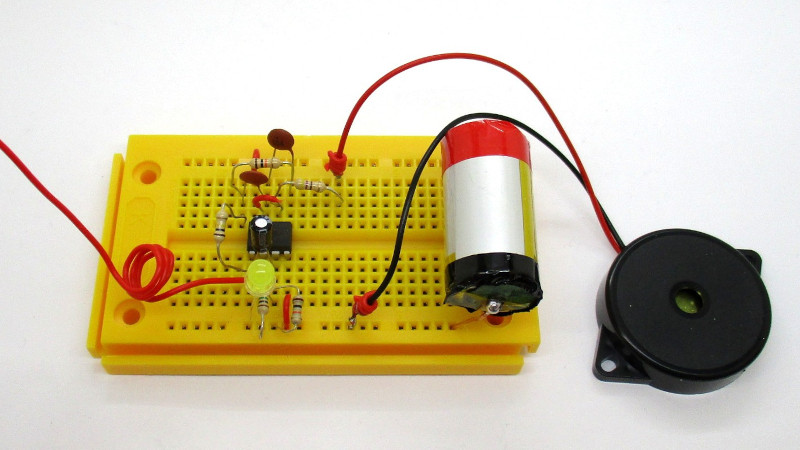
The project that inspired this “slice of the ’70s” discussion is a triggered sound generator built around classic analog ideas. Instead of using a microcontroller to read an input, calculate a waveform, and send it to a speaker, the circuit uses op amps to create timing and oscillation behavior directly in hardware.
The concept is charmingly simple. A small trigger signal starts the action. That signal might come from hum, a sudden light change, or another tiny voltage event. One op amp section acts like a timer, creating a control voltage for another op amp circuit configured as a phase-shift oscillator. The oscillator then drives a piezo speaker, producing a quirky sound that feels less like polished consumer audio and more like a small electronic creature objecting to being poked.
That is the beauty of the design. It does not need a bootloader. It does not need a USB cable. It does not need a cloud dashboard, a mobile app, or a privacy policy written by three lawyers and a caffeine-powered intern. The circuit simply responds, oscillates, and makes noise because physics says so.
How an Op Amp Timer Works Without Digital Logic
In many retro analog circuits, timing is built using capacitors charging and discharging through resistors. An op amp can monitor that changing voltage and switch its output when the voltage crosses a certain threshold. This is the same broad family of thinking behind many analog timers, relaxation oscillators, and threshold detectors.
For a triggered sound generator, the timer section decides when the sound should start and how long it should last. A capacitor may hold a voltage briefly, then gradually discharge. The op amp responds to that changing level and controls the next stage. The result feels almost digital because something turns on and off, but the mechanism is entirely analog. No clock cycles. No code. Just voltage wandering around with purpose.
Phase-Shift Oscillators: The Elegant Way to Make a Tone
A phase-shift oscillator is a classic analog oscillator that uses an amplifier and a feedback network made of resistors and capacitors. The RC network shifts phase at a particular frequency, and when the loop conditions are right, the circuit oscillates. In other words, the circuit sings because the feedback path encourages one frequency to keep reinforcing itself.
In the 1970s, oscillator circuits were everywhere in hobby literature. They created alarms, metronomes, test tones, music effects, toy sounds, and experimental synthesizer voices. A phase-shift oscillator has a lovely educational quality because it teaches gain, frequency, phase, feedback, and stability all at once. It is the electronics equivalent of learning to cook by making soup: simple ingredients, deep lessons, and a real chance of making something weird but memorable.
Why This Contest Matters in the Microcontroller Age
Today, many builders reach for a microcontroller first. That is understandable. Modern boards are cheap, powerful, and easy to program. A small microcontroller can read sensors, generate waveforms, log data, drive displays, connect to Wi-Fi, and possibly make coffee if you stare at the datasheet long enough.
But analog circuits teach something different. They force builders to understand the behavior of signals in real time. Voltage is not just a number in a variable. It has impedance, noise, offset, drift, slew rate, saturation, and bandwidth. Capacitors do not wait politely for the next line of code. Feedback can stabilize a circuit beautifully or turn it into a tiny radio-frequency gremlin.
An op amp contest is valuable because it reminds makers that analog design is not obsolete. It is foundational. Every sensor connected to a digital system still lives in the physical world first. Temperature, light, sound, pressure, vibration, and current are analog before they become data. Without analog front ends, the digital world would be extremely confident about very bad measurements.
What the 1970s Got Right About Learning Electronics
The best 1970s electronics projects were hands-on, immediate, and slightly chaotic. You could build a circuit from a magazine, power it from a battery, and see or hear the result right away. The documentation often included a schematic, a parts list, a short explanation, and maybe a photograph of a finished board that looked like it had survived a minor kitchen accident.
That style of learning had a major advantage: it encouraged experimentation. Change a capacitor and the tone shifts. Swap a resistor and the timing changes. Touch the input and the circuit reacts to hum from your body. Use an LED as a crude photodiode and suddenly light becomes a trigger. These projects showed that electronics was not just theory. It was a conversation with components.
The modern maker movement often returns to that same philosophy. Breadboards, kits, open-source hardware, and online project logs all carry the spirit of those old magazines. The tools are better now, but the thrill is familiar: connect a few parts, apply power, and hope the smoke stays imaginary.
Key Op Amp Lessons Hidden Inside a Funny Sound Project
1. Feedback Is the Whole Game
Op amps become useful when feedback tells them what to do. Negative feedback creates controlled gain, buffers, filters, and stable amplifiers. Positive feedback can create switching behavior, hysteresis, and oscillation. A sound generator demonstrates both the usefulness and the mischief of feedback.
2. Small Signals Can Trigger Big Events
The featured retro-style circuit can respond to very small input voltages. That is a classic op amp strength. Whether the input comes from a sensor, a microphone, or environmental hum, the op amp can make weak signals useful.
3. Analog Timing Feels Alive
Capacitor-based timing has a natural, continuous quality. The voltage rises and falls smoothly, and the circuit reacts as thresholds are crossed. This gives analog sound circuits a personality that can feel more organic than perfectly timed digital beeps.
4. Imperfection Can Be a Feature
Modern engineering often aims for precision. Retro analog projects remind us that oddness can be delightful. A slightly unstable tone, a warbling oscillator, or a trigger that reacts differently depending on light and nearby noise can make a circuit feel playful.
Practical Examples of Op Amp Circuits Inspired by the Era
A beginner who wants to explore this world can start with a few classic op amp circuits. A voltage follower teaches buffering and input impedance. An inverting amplifier shows how resistor ratios set gain. A non-inverting amplifier demonstrates gain without flipping signal polarity. An active low-pass filter helps smooth noisy signals. A comparator-style threshold detector can turn an analog signal into a clean on/off behavior.
From there, the builder can move into oscillators, envelope generators, tone controls, and simple synthesizer circuits. A light-triggered sound maker is especially satisfying because it connects the physical world to an audible output. Shine a flashlight, wave a hand, or expose the circuit to changing room light, and the speaker responds. It is a tiny performance piece pretending to be a learning exercise.
Choosing Parts for a Retro-Style Op Amp Build
For a historically flavored project, a builder might experiment with classic parts such as 741-style op amps or LM324-family devices. However, it is important to understand their limitations. Older op amps may need higher supply voltages, may not work well near the power rails, and may have input and output constraints that surprise beginners. That surprise usually arrives right after the phrase, “But the simulator said it works.”
Modern op amps can make the same ideas easier to build on low-voltage supplies. Rail-to-rail input and output devices, low-power CMOS op amps, and precision amplifiers can all perform better than vintage parts. Still, using an older general-purpose op amp can be educational because it forces careful thinking about supply voltage, biasing, signal range, and output swing.
Why Analog Still Feels Magical
Digital electronics is powerful because it abstracts the world into ones and zeros. Analog electronics is powerful because it refuses to forget that the world is messy. A microphone does not produce a neat digital sentence. A thermistor does not announce, “The temperature is 72.4 degrees.” A guitar pickup, photodiode, strain gauge, or current shunt produces a changing signal that must be amplified, filtered, protected, and interpreted.
That is why op amps remain relevant. They are the translators between physical reality and electronic decision-making. Even in advanced systems filled with processors, wireless modules, and software, analog circuits still sit close to the sensors, quietly doing the difficult work.
Experience Notes: Building and Learning From a ’70s-Style Op Amp Project
Working with a retro op amp sound circuit is a different experience from uploading code to a development board. With code, mistakes often appear as compiler errors or frozen serial monitors. With analog circuits, mistakes appear as silence, squeals, heat, distortion, or a waveform that looks like it is trying to escape the oscilloscope. This can be frustrating, but it is also deeply educational.
The first lesson is that power matters. Many beginners wire an op amp as if it can magically output any voltage they imagine. It cannot. The output depends on the supply rails and the op amp’s internal design. A 741-style device, for example, is not the best choice for a tiny single-cell battery project. It prefers more breathing room. Learning this early prevents a lot of mysterious “dead circuit” moments.
The second lesson is that layout matters, even at humble frequencies. Long breadboard wires add stray capacitance and resistance. Loose connections create intermittent behavior. A phase-shift oscillator may refuse to oscillate, oscillate at the wrong frequency, or make a sound that suggests a haunted smoke alarm. Shorter wiring, solid grounding, and decoupling capacitors near the IC can turn chaos into musicor at least into intentional beeping.
The third lesson is that analog debugging rewards patience. A multimeter tells part of the story, but an oscilloscope reveals the personality of the circuit. Watching a capacitor voltage rise and fall makes the timer understandable. Watching the oscillator output grow, clip, or collapse shows how feedback and gain interact. Even a low-cost scope can make the difference between guessing and learning.
The fourth lesson is that component values invite play. Change a capacitor in the timing section and the sound lasts longer or shorter. Change resistors in the oscillator network and the pitch moves. Add a potentiometer and suddenly the circuit becomes an instrument. This is where the 1970s spirit really comes alive: the project is not a sealed product. It is a platform for curiosity.
The fifth lesson is that analog circuits make failure more interesting. A digital project often either works or does not. An analog project may half-work in strange ways. It may chirp once, squeal continuously, respond only when touched, or change behavior when a desk lamp turns on. These “bugs” are often clues. They teach sensitivity, noise pickup, grounding, impedance, and threshold behavior better than a clean diagram ever could.
Finally, building a circuit like this gives the maker a deeper respect for older electronics publications. Those vintage project books were not primitive; they were efficient. They taught powerful concepts with minimal parts. A triggered op amp sound generator may look simple, but inside it are lessons about amplification, timing, oscillation, sensing, and feedback. That is a lot of education from a handful of components and one small speaker making suspicious animal noises.
Conclusion: The Op Amp Never Really Went Out of Style
“Op Amp Contest: A Slice Of The ’70s” is more than a nostalgic headline. It is a reminder that good electronics design does not always require the newest chip, the fastest processor, or a software stack large enough to need its own emotional support group. Sometimes the most satisfying project is a clever analog circuit that turns a tiny trigger into a sound, a flash, a measurement, or a surprise.
The op amp earned its place in electronics history because it is both simple and deep. Beginners can use it to build a first amplifier. Experts can use it to design precision instruments. Hobbyists can use it to make a light-triggered sound generator that feels like it escaped from a 1970s project magazine. That range is rare, and it is why the op amp remains one of the most important components ever made.
In a world filled with digital shortcuts, analog projects teach patience, intuition, and respect for real signals. They remind us that electronics is not only about processing information. It is also about listening to the physical world and shaping its tiny voltages into something useful, measurable, or delightfully weird.