Paris Hilton Just Said She And Britney Invented The Selfie, And Here’s 24 Best Reactions From Twitter

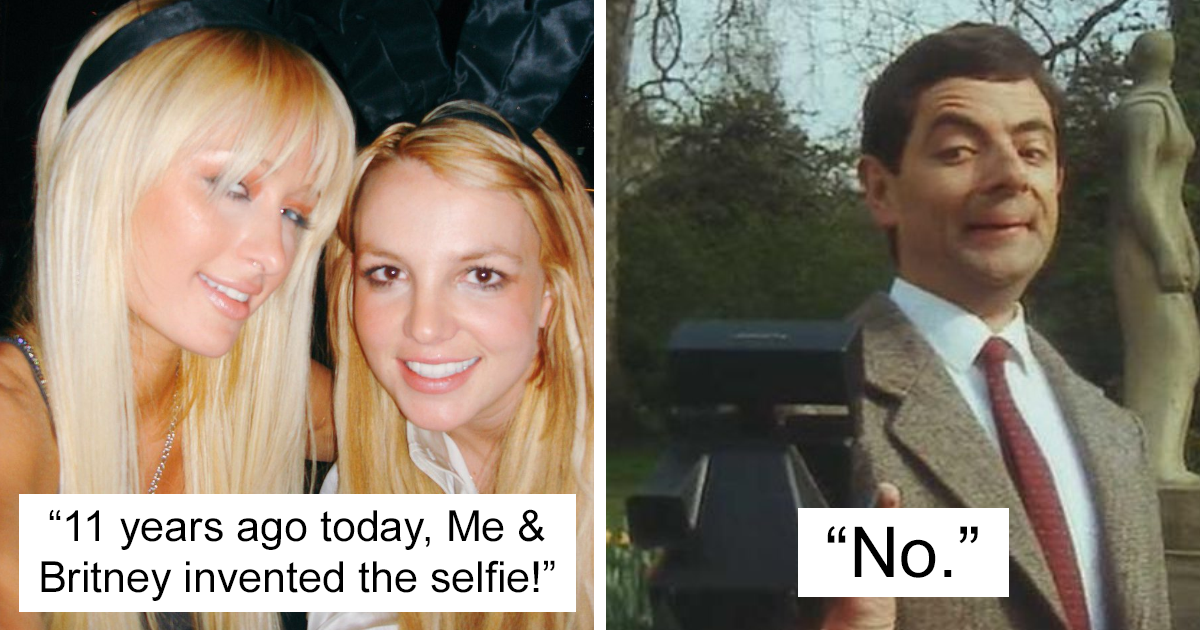
Lskin smoothing, and the unsettling ability to count individual pores, Paris Hilton and Britney Spears were already posing like the internet was watching. In 2017, Hilton looked back at two photos of the pair from 2006 and made a wonderfully modest announcement: “11 years ago today, Me & Britney invented the selfie!”
The internet reacted exactly as the internet always does when a celebrity makes a giant historical claim: it opened a museum, hired a fact-checker, found several sitcom screenshots, and began throwing centuries of evidence into the replies. The result was a near-perfect collision of Y2K nostalgia, photography history, celebrity branding, and Twitter comedy.
Technically, Paris and Britney did not invent the selfie. Culturally, however, the claim is more interesting than a simple true-or-false quiz. They helped define an era in which famous people stopped appearing only in polished magazine portraits and started presenting themselves through personal-looking snapshots. That shift eventually became the visual grammar of Instagram, influencer marketing, and the modern celebrity feed.
What Paris Hilton Actually Said About Inventing the Selfie
On November 19, 2017, Paris Hilton shared two throwback images of herself with Britney Spears. The pictures dated to 2006, a time of tiny digital cameras, glossy lip products, oversized sunglasses, low-rise everything, and nightlife photos bright enough to guide aircraft.
Hilton’s caption credited the pair with inventing the selfie eleven years earlier. The line fit her public persona perfectly: confident, funny, glamorous, and delivered with absolutely no visible concern that a nineteenth-century photographer might object.
This was not a random claim pulled from a rhinestone-covered hat. Earlier in 2017, Hilton had joked that she would have taken selfies with a beeper if it had contained a camera. She has continued revisiting the idea in anniversary posts, including later celebrations of the same 2006 photos. The “invention” has become part historical joke, part personal branding, and part recognition that Hilton understood self-documentation before social media turned it into a profession.
Who Really Invented the Selfie?
Robert Cornelius Entered the Frame in 1839
The strongest historical candidate is Robert Cornelius, a Philadelphia photography pioneer who created a daguerreotype self-portrait in 1839. He had to prepare the camera, move into position, and remain still through a long exposure. There was no screen preview, no burst mode, and no opportunity to delete the picture because one eyebrow looked emotionally unavailable.
The Library of Congress describes the image as the earliest surviving American portrait photograph. Cornelius therefore beats Hilton and Spears by roughly 167 years, although his picture received considerably fewer likes on Instagram.
The Word Arrived Much Later Than the Behavior
People had been making self-portraits for centuries before anyone called one a “selfie.” The modern term is commonly traced to an Australian online post from 2002. Oxford Dictionaries selected “selfie” as its Word of the Year in 2013, reflecting how smartphones and social networks had transformed an old artistic impulse into an everyday communication habit.
That distinction matters. Inventing the photographic self-portrait, inventing the word, popularizing the pose, and turning the selfie into a personal-branding tool are four different achievements. Paris did not win the first category, but she has a much stronger case in the last two.
Why the Paris Hilton and Britney Spears Selfie Claim Went Viral
The post worked because it was just believable enough to be funny. Paris Hilton was one of the most photographed people of the early 2000s. Britney Spears was the era’s defining pop superstar. Together, they were central figures in a celebrity ecosystem driven by paparazzi, tabloid blogs, fan forums, and early social networks.
Their 2006 images also look surprisingly modern. They are close, direct, informal, and imperfect in a way that suggests personal access. Today, that style is standard. In the mid-2000s, it helped blur the line between a celebrity photograph and a friend’s snapshot.
Twitter users understood both sides of the joke. Some treated Hilton as the rightful empress of the front-facing camera. Others arrived with historical counterexamples. Many did both at once: correcting the record while admitting that Paris and Britney made the selfie feel iconic.
24 of the Best Twitter Reaction Styles
The following entries are original, paraphrased summaries of the reaction themes and visual receipts that circulated around the viral claim. They are not presented as verbatim tweets.
-
1. Robert Cornelius Would Like a Word
The most devastating replies introduced the 1839 self-portrait by Robert Cornelius. Imagine spending minutes motionless beside an experimental camera, only to have your achievement reassigned to two women wearing fabulous Y2K accessories.
-
2. The Renaissance Painters Filed an Appeal
Users widened the debate from photography to self-portraiture. Artists had been painting themselves centuries before smartphones, proving humanity has always wanted to say, “Here is my face, carefully arranged for public review.”
-
3. Rembrandt Had an Entire Selfie Phase
Rembrandt created numerous self-portraits across his career. His version simply required oil paint, patience, and artistic genius rather than a bathroom mirror and seventeen attempts.
-
4. Van Gogh Brought Emotional Lighting
Historical-art replies effectively argued that Vincent van Gogh had mastered the expressive selfie long before filters. His portraits had texture, mood, and no sponsored caption inviting followers to shop the look.
-
5. Frank Sinatra Had Already Found His Angle
Older celebrity self-portraits, including images of Frank Sinatra, appeared as evidence. Hollywood stars apparently understood flattering angles long before ring lights became a standard household appliance.
-
6. George Harrison Stretched the Arm First
A 1960s photo of Beatle George Harrison taken at arm’s length offered recognizable evidence: face near camera, arm extended, background included, and no photography assistant required.
-
7. Paul McCartney Entered the Beatles Evidence Folder
Paul McCartney also appeared among the throwback receipts. Twitter’s unofficial legal argument was becoming clear: the Beatles may not have invented everything, but they apparently arrived before Paris in this category.
-
8. Madonna Had Already Struck the Pose
Vintage Madonna imagery provided another pop-culture counterexample. Long before Instagram, she understood the power of controlling her own image, which is the deeper idea behind the modern selfie.
-
9. Buzz Aldrin Raised the Stakes to Outer Space
Why settle for a nightclub selfie when an astronaut took one during a spacewalk? Buzz Aldrin’s 1966 space self-portrait made the debate wonderfully unfair. Paris had Britney and bunny ears; Aldrin had Earth.
-
10. Mr. Bean Supplied the Comedy Archive
Some users abandoned strict history and reached for fictional proof. Mr. Bean imagery fit perfectly because any modern invention feels older once Rowan Atkinson has performed a confused version of it.
-
11. Joey and Chandler Demanded Recognition
A Friends reference placed Joey and Chandler among the supposed pre-2006 pioneers. Sitcom screenshots are not museum documents, but on Twitter they can defeat an argument with remarkable efficiency.
-
12. Mirror Users Formed a Class-Action Lawsuit
Countless people photographed themselves in mirrors before 2006. These replies represented every teenager who once pointed a compact camera at a bedroom mirror and hoped the flash would not erase their entire face.
-
13. Disposable Cameras Asked for Respect
Hilton has recalled taking self-portraits when she was young, possibly with disposable cameras. That weakens the literal 2006 claim while strengthening her broader point: she had practiced the behavior for years.
-
14. MySpace Users Remembered the Bathroom Era
Early social-network veterans knew mirror shots, overhead angles, dramatic bangs, and aggressively visible flash photography were already common online. The selfie existed; it simply had worse resolution and more song lyrics in the caption.
-
15. Camera-Phone Engineers Requested Royalties
Other reactions implicitly credited the people who put cameras into phones. Without that engineering, the selfie might have remained a specialized hobby instead of the fastest way to confirm everyone attended brunch.
-
16. The Front-Facing Camera Claimed Partial Custody
Modern selfie culture accelerated once users could see themselves while taking the picture. The front-facing camera did not create vanity, but it made vanity significantly easier to center and crop.
-
17. Ellen’s Oscar Selfie Brought a Famous Receipt
The star-packed 2014 Academy Awards selfie became one of the format’s best-known examples. It showed how quickly a casual-looking group photograph could become a worldwide media event.
-
18. Kim Kardashian Entered as the Commercialization Expert
Kim Kardashian turned selfies into a publishing project, branding device, and business language. The discussion naturally raised another question: even if Paris pioneered the celebrity style, who industrialized it?
-
19. Britney Fans Said, “Leave Her Out of the Patent Dispute”
Some reactions playfully treated Spears as an innocent co-inventor added to a surprise historical claim. She smiled for two pictures and suddenly found herself competing with nineteenth-century photography.
-
20. Paris Fans Accepted the Claim on Spiritual Grounds
Literal accuracy was irrelevant to devoted fans. Their position was essentially that Paris Hilton invented the selfie because the statement felt correct, and vibes have overturned weaker constitutions.
-
21. Grammar Detectives Briefly Changed Departments
A few internet citizens inevitably focused on wording rather than history. This is a classic social-media phenomenon: a debate begins with photography in 1839 and ends with strangers arguing about punctuation.
-
22. The Patent-Office Jokes Wrote Themselves
People imagined royalty payments, licensing fees, and official ownership of duck face. Under this system, every brunch group in America would owe Paris several cents and one rhinestone accessory.
-
23. The “Invented Versus Popularized” Crowd Restored Order
The most sensible reactions separated invention from influence. Hilton and Spears were not the first people to photograph themselves, but their images represented the casual, shareable celebrity style that later dominated social media.
-
24. Everyone Agreed the Confidence Was Historically Significant
Even skeptics had to admire the delivery. Claiming a universal cultural behavior with one cheerful caption is peak Paris Hilton: outrageous enough to attract attention, playful enough to survive correction, and memorable enough to resurface for years.
Did Paris Hilton and Britney Spears Actually Change Selfie Culture?
Yes, although not in the way the original caption suggested. Paris Hilton was performing influencer culture before “influencer” became a standard career label. She turned public visibility into a brand, used repeated visual signatures, understood the value of being photographed, and made apparent access to her lifestyle part of the product.
Britney Spears brought a different kind of cultural weight. She was one of the most famous performers on Earth, and casual images of her felt intimate because so much of her public identity had been managed through music videos, concerts, magazine shoots, and relentless tabloid coverage. A close, informal picture with Paris appeared to offer a small opening into a world audiences normally saw through paparazzi lenses.
Together, the photos anticipated a social-media formula that remains powerful: famous person, recognizable friend, informal setting, direct eye contact, and a caption that turns a private-looking moment into public mythology.
Experiences and Lessons From the Paris-and-Britney Selfie Debate
The Best Online Jokes Contain a Little Truth
Anyone who has watched a playful post become a serious argument will recognize what happened here. A person says something exaggerated, half the audience laughs, and the other half begins assembling a documentary. The lesson is not that humor fails online. It is that humor travels beyond the group that understands your tone.
Paris Hilton’s sentence worked because it could be read in several ways. As literal history, it was wrong. As celebrity satire, it was excellent. As a comment on cultural influence, it was surprisingly defensible. That ambiguity kept the post alive because people could debate it without ever fully exhausting it.
Taking a Selfie Is Really an Exercise in Editing Identity
Most people have experienced the small performance involved in taking a selfie. You lift the camera, test an angle, change your expression, notice the laundry in the background, move three feet, try again, and finally select the image that feels most like “you”even though it may have required twelve rejected versions to find it.
That does not automatically make selfies fake. Portraits have always involved choices about pose, clothing, background, lighting, and mood. Smartphones simply compressed the photographer, subject, editor, publisher, and audience analyst into one person holding a device.
Nostalgia Can Turn Ordinary Photos Into Cultural Artifacts
In 2006, Paris and Britney’s pictures were snapshots. Years later, they became evidence of a vanished media era. The low-resolution texture, clothing, makeup, and poses now communicate “Y2K” instantly. Many people have had the same experience with their own digital photos: an image that once seemed disposable suddenly becomes a time capsule.
This is one reason old celebrity selfies attract so much attention. They preserve not only faces but also technologies, social habits, friendships, and standards of coolness. A blurry camera can sometimes reveal an era more clearly than a flawless modern image.
Online Correction Works Best When It Entertains
The reactions succeeded because users did not merely type “wrong.” They brought visual evidence: early photographs, paintings, musicians, astronauts, sitcom characters, and pop stars. The correction became a collaborative history lesson disguised as a meme contest.
That approach offers a useful communication lesson. Facts are easier to remember when they arrive with a story or joke. Many people who had never heard of Robert Cornelius learned about his 1839 portrait because Paris Hilton made an outrageous claim nearly two centuries later. History found a distribution partner in celebrity Twitter.
Influence Is Often More Important Than Being First
The internet loves assigning invention credits because “first” sounds clean and decisive. Culture is usually messier. One person experiments, another names the behavior, someone else builds the technology, and a celebrity makes millions of people want to copy it.
Paris Hilton and Britney Spears were not first in the technical sense. Their importance lies in visibility, imitation, and symbolism. They represented the moment when self-photography was becoming less like a formal portrait and more like social currency. The image said: we are here, we are together, and you are getting a glimpse.
That is also the experience behind modern social posting. People rarely share only to document what happened. They share to shape how the moment will be understood. A selfie can communicate friendship, confidence, humor, status, vulnerability, or simply proof that the lighting was unusually cooperative.
Conclusion: They Did Not Invent It, but They Made It Iconic
Robert Cornelius holds the stronger historical claim to the earliest American photographic self-portrait. Artists explored self-representation centuries before him, and camera users had been turning lenses on themselves long before 2006. On the facts, Paris Hilton and Britney Spears did not invent the selfie.
Yet Hilton’s joke survives because it captures a cultural truth. She and Spears belonged to a generation of celebrities who helped transform personal-looking photographs into media events. Paris, in particular, understood that fame could be produced through constant visibility, recognizable poses, informal access, and a carefully maintained persona. In other words, she did not invent the selfiebut she helped invent the world in which a selfie could become a brand.
Twitter’s response made the moment even better. The historical corrections, pop-culture screenshots, astronaut evidence, and affectionate mockery turned one bold caption into a collective tour through the history of self-portraiture. That is the internet at its best: excessively confident, unexpectedly educational, and always prepared with a picture of Mr. Bean.
Note: This article discusses a viral 2017 social-media post and summarizes reaction themes in original language. The numbered reactions are paraphrased commentary rather than verbatim reproductions of individual tweets.