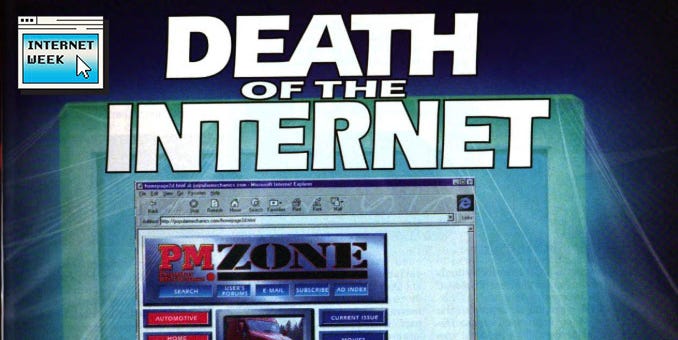

Predicting the internet is a little like predicting what a toddler will do with a permanent marker: you can identify the general direction of danger, but the final result will still surprise everyone. Across several decades, Popular Mechanics tried to imagine how computers, networks, virtual reality, smart homes, streaming media, and connected devices would change daily life. Some forecasts were impressively accurate. Others arrived wearing jet boots, carrying a hydrogen fuel cell, and asking where the neighborhood virtual-reality theme park had gone.
That uneven record is not a reason to mock old technology predictions. It is what makes them valuable. They show which inventions were technically imaginable, which social changes were underestimated, and why timing is often harder to predict than technology itself.
Why Popular Mechanics’ Internet Predictions Still Matter
Popular Mechanics has spent more than a century explaining inventions to general readers. That mission naturally requires looking forward. A technology magazine cannot merely announce that a new machine has buttons; it must also ask what those buttons might eventually do to homes, workplaces, hospitals, transportation, and entertainment.
The magazine’s archived predictions reveal a recurring pattern. Writers often recognized the right technological direction years before it became mainstream. They saw homes becoming automated, entertainment becoming personalized, airplanes gaining internet access, televisions connecting to data networks, and virtual reality supporting interactive games. The mistakes usually appeared in the details: the expected device was wrong, the interface was awkward, the adoption date was optimistic, or consumers simply preferred another solution.
In other words, the destination was frequently visible. The road map looked as though it had been drawn on a restaurant napkin during turbulence.
1984: The Smart Home Before the Home Was Online
In April 1984, Popular Mechanics described home-control systems capable of managing appliances, lighting, telephones, alarms, and security features. These products did not require the cloud, a smartphone app, or a monthly subscription that mysteriously increased after the introductory period. They relied on stand-alone electronic controls and conventional telephone connections.
The prediction was fundamentally correct. Modern smart homes combine connected thermostats, lights, cameras, locks, speakers, doorbells, sensors, and appliances. Wi-Fi and interoperable networking standards eventually supplied the missing nervous system. Instead of installing one giant control panel, homeowners now scatter small computers throughout the house and then spend Sunday afternoon trying to remember which app controls the porch light.
The forecast also missed an important side effect: privacy and cybersecurity. Connected home devices can collect sensitive information, depend on manufacturer updates, and become vulnerable when support ends. The imagined automated house arrived, but it brought passwords, software patches, data policies, and the unsettling possibility that a refrigerator could become a cybersecurity concern.
1986: A Virtual Journey Inside the Human Body
A 1986 vision placed a surgeon inside a patient’s circulatory system through a helmet, microscopic sensors, remote controls, and miniature surgical equipment. The doctor would effectively “travel” through blood vessels and repair internal problems from a first-person perspective.
That exact experience remains science fiction. Surgeons do not normally hear blood rushing around them through an immersive headset while piloting a tiny repair craft toward the heart. Medicine has, however, moved in the predicted direction. Robotic-assisted systems, catheter-based procedures, advanced imaging, augmented reality, and three-dimensional models are used for surgical planning, navigation, education, and selected procedures.
The prediction therefore confused visualization with sensation. It correctly anticipated that physicians would use increasingly detailed digital views and remotely controlled instruments. It overestimated how immersive the interface needed to become. Surgeons generally want precise information, reliable controls, and minimal nauseanot a medical version of a theme-park simulator.
1993: Pocket Computers, Styluses, and the PDA Era
By December 1993, devices such as Apple’s Newton and other personal digital assistants were being presented as revolutionary pocket communicators. The pen-like stylus was expected to replace the keyboard and make mobile computing feel natural.
The PDA did become an important bridge between desktop computers and smartphones. Products such as the PalmPilot proved that people wanted portable calendars, contact lists, notes, applications, and synchronized personal information. What failed was the assumption that handwriting would dominate the interface.
Modern smartphones validate the larger prediction while quietly rearranging its furniture. They fit in a pocket, manage communication, store personal information, connect to the internet, run software, display books, play media, and occasionally remind us that a meeting started ten minutes ago. Most users rely on touchscreens and virtual keyboards rather than styluses, although digital pens remain useful for artists, note-takers, and people who enjoy carrying one more accessory.
The PDA forecast was not truly wrong. It identified the category before the hardware, wireless networks, batteries, and software ecosystems were mature enough to complete it.
1994: Networked Gaming and Virtual Reality
In early 1994, Popular Mechanics connected the developing “information superhighway” with multiplayer games and head-mounted displays. This was an excellent prediction. Online gaming later became a major entertainment industry, while virtual-reality headsets moved from research laboratories and arcades into ordinary homes.
The terminology changed, of course. “Head-mounted display” remains technically accurate, but “VR headset” is much easier to say while ducking imaginary arrows in the living room. The underlying forecastthat faster two-way networks would support shared games, specialized controllers, and immersive digital environmentswas remarkably strong.
What forecasters could not fully anticipate was the social layer surrounding online games. Players do not merely compete. They stream matches, build communities, buy digital costumes, attend virtual events, argue about balance updates, and watch professional tournaments. The network did more than connect machines; it connected identities, audiences, and economies.
1994: Streaming Video Before “Streaming” Became a Verb
The same period produced another accurate forecast: video on demand delivered from large digital servers to a box connected to the television. That description closely resembles modern streaming, even though the imagined hardware sounded more like a desktop computer hiding inside a cable box.
Netflix launched its streaming service in 2007, and competing platforms later transformed television distribution. Viewers now expect enormous libraries of movies, series, news, sports, and short videos to appear almost instantly on televisions, phones, tablets, laptops, and in-car screens.
The prediction successfully identified the server, network, set-top device, and on-demand selection model. It did not foresee the modern inconvenience of discovering that the one movie you want is available only through a service you canceled last month.
1995: The Virtual-Reality Theme Park That Never Took Over
By 1995, virtual-reality rides and motion simulators were expected to spread through malls, theaters, multiplexes, and neighborhood entertainment centers. The concept promised theme-park thrills without requiring hundreds of acres, enormous roller coasters, or a two-hour line beside a family wearing matching vacation shirts.
Motion simulators survived, and immersive attractions became part of many amusement parks, museums, arcades, and specialized entertainment venues. Yet the neighborhood virtual-reality theme park never displaced physical rides. Consumers continued to value speed, height, scale, shared spaces, and real movement.
The prediction underestimated the practical problems of communal VR: expensive equipment, maintenance, hygiene, motion sickness, limited content, rapid hardware obsolescence, and the difficulty of persuading customers to wear a headset previously worn by several dozen strangers.
VR found a more sustainable home in gaming, training, design, simulation, and specialized experiences. The technology survived; the proposed business model mostly did not.
1997: Would Too Many Users Break the Internet?
In January 1997, concern grew that explosive user growth might overwhelm internet infrastructure. Dial-up connections were slow, network capacity was limited, and congestion could make popular services painfully difficult to reach.
The fear was reasonable. The internet did require vast upgrades in backbone capacity, data centers, fiber networks, routing technology, wireless systems, compression, caching, and content-delivery infrastructure. Broadband gradually replaced dial-up for many households, and network operators learned to distribute traffic more efficiently.
The internet did not collapse under its own popularity, but congestion never vanished. It simply evolved. Today’s equivalent may be a buffering video, overloaded ticketing site, failed game launch, cloud outage, or household argument over who is consuming all the bandwidth.
The strongest part of the prediction was that the internet would become as socially important as the telephone network. That may have been too conservative. Internet access now supports education, banking, employment, health services, government systems, entertainment, shopping, transportation, and approximately fourteen daily attempts to sell each user a mattress.
1997: Television and the Internet Were Supposed to Separate
Another 1997 prediction suggested that television and the internet might move apart because traditional TV offered rich multimedia while early web pages looked slow, static, and visually unimpressive. At the time, this argument made sense. Television screens had low resolutions, web connections were sluggish, and browsing with a remote control was an ergonomic punishment.
Instead, televisions and the internet merged. Smart TVs, streaming sticks, game consoles, and connected set-top boxes turned the television into an internet endpoint. The web did not compete with television by remaining a collection of text pages. It absorbed television’s best features: video, live programming, advertising, subscriptions, celebrity culture, and endless debates about what to watch.
This miss demonstrates a classic forecasting error: comparing a mature technology with an immature one as though neither will change. Early web video was terrible, but it did not remain terrible.
2000: Internet Access at 30,000 Feet
At the turn of the millennium, in-flight internet was limited by cost, connection speed, aircraft systems, and satellite capacity. One practical proposal involved storing selected web pages on onboard servers rather than providing unrestricted live access.
That transitional idea was logical, but network development moved beyond it. Many commercial aircraft eventually gained wireless connectivity, allowing passengers to message, browse, work, and stream during flights. Airlines also built extensive onboard entertainment libraries delivered through seatback displays or personal devices.
The prediction was accurate about demand and cautious about timing. Travelers clearly wanted connected flights. The main surprise is that, after gaining access to a global communications network while traveling hundreds of miles per hour above the clouds, many passengers use it to send a message saying, “We haven’t taken off yet.”
2005: A Forecast of Life in 2025
In 2005, Popular Mechanics imagined a world twenty years ahead. Its writers expected personalized media, access to movies and news from nearly anywhere, advanced military networks, household robots, hydrogen-powered vehicles, human progress toward Mars, and even space tourism.
What the 2025 Forecast Got Right
Personalized digital media became ordinary. Recommendation systems customize music, video, news, shopping, advertising, and social feeds. Movies and information are available almost anywhere a usable connection exists. Smartphones became the pocket computers earlier predictions had been circling for decades. In a major U.S. survey conducted in 2023, Pew Research Center found that 95 percent of adults used the internet, 90 percent owned a smartphone, and 80 percent subscribed to home broadband.
Robots also entered homes, although most are less humanoid than science fiction promised. Robotic vacuums, lawn machines, cameras, toys, and kitchen devices perform narrow tasks. They do not usually fold laundry, wash every dish, or politely explain why they became trapped beneath a dining chair.
What Had Not Arrived by 2025
Humans had not landed on Mars. NASA’s current Moon-to-Mars strategy treats lunar exploration and technology development as preparation for future human missions to the red planet. The goal remains active, but the timetable proved far more demanding than an enthusiastic magazine spread could capture.
Hydrogen vehicles reached commercial production, yet adoption remained concentrated in limited markets with fueling infrastructure. The U.S. Department of Energy still describes fuel-cell vehicles and their supporting stations as being in an early implementation phase.
Space tourism exists in a limited and expensive form, but orbital hotels are not placing chocolates on zero-gravity pillows for ordinary vacationers. Unless those chocolates are secured, they would float away anyway, creating both a housekeeping issue and a fairly disappointing amenity.
Why Technology Predictions Become Inaccurate
Forecasters Extend Existing Trends Too Neatly
Predictions often assume that a visible trend will continue in a straight line. If stylus devices are improving, everyone will eventually use a stylus. If VR arcades are opening, every mall will soon contain one. Real markets are messier. Competing technologies improve, prices change, regulations intervene, and consumers choose convenience over technical elegance.
They Predict Devices Better Than Human Behavior
It is easier to imagine a networked television than to predict binge-watching, influencer culture, subscription fatigue, viral memes, live-streamed shopping, and algorithmic recommendations. Hardware follows engineering constraints. Human behavior follows fashion, status, habit, emotion, and whatever makes it possible to avoid leaving the couch.
They Identify Capabilities but Miss Ecosystems
A single device rarely changes society by itself. Smartphones became powerful because they were supported by wireless networks, app stores, cloud computing, digital payments, cameras, location services, social platforms, and millions of developers. Early predictions often recognized one object without seeing the entire ecosystem required to make it useful.
They Confuse “Possible” With “Ready”
A laboratory demonstration can prove that something works without proving that it is affordable, safe, maintainable, scalable, or desirable. Virtual surgery, hydrogen transportation, immersive entertainment, and human Mars missions are technically serious ideas. Their difficult path to mass adoption does not make them fantasies; it makes them engineering projects.
What Living Through These Predictions Feels Like
Reading old internet predictions creates a peculiar mixture of nostalgia and disbelief. The predictions sound futuristic, yet many of the objects they describe now sit unnoticed around an ordinary home. A connected doorbell records the porch. A television retrieves video from distant servers. A phone provides maps, banking, games, news, music, photography, and video calls. None of this feels especially dramatic while someone is standing in the kitchen using the same device to search for “how long can cooked rice stay in the refrigerator?”
The experience also shows how quickly astonishing inventions become boring. The first time a person makes a clear video call across an ocean, the technology can feel miraculous. After a few years, the same person becomes irritated because a coworker’s microphone is muted. Streaming once eliminated the need to visit a video store; now viewers complain that scrolling through thousands of choices is exhausting. Wireless internet freed computers from cables, then created a new household ritual: restarting the router while staring at it accusingly.
Old forecasts also encourage humility. It is tempting to laugh at predictions involving pen-controlled PDAs, cached airplane websites, or neighborhood VR centers. Yet those ideas were based on real limitations. A writer in 1993 could imagine pocket computing but could not assume cheap mobile broadband, modern lithium-ion batteries, capacitive touchscreens, cloud storage, powerful processors, and global application marketplaces. Predicting the finished smartphone required predicting several industries at once.
There is also a lesson in the technologies that arrived quietly. Smart-home automation did not enter as one dramatic robot but as dozens of small devices. Streaming did not instantly destroy television; it gradually became television. Online gaming did not simply allow distant players to compete; it created social spaces, careers, marketplaces, and spectator events. The biggest changes often happen through accumulation rather than a single cinematic breakthrough.
Living through these predictions makes today’s forecasts feel less certain. Artificial intelligence, augmented reality, autonomous transportation, quantum computing, brain-computer interfaces, and space travel may all become important. However, their most influential uses may look nothing like current demonstrations. The winning product may not be the most technically ambitious one. It may be the version that is cheaper, simpler, safer, or just slightly less annoying.
That is perhaps the most useful experience these old predictions provide: they teach us to separate direction from detail. A forecaster can correctly identify that homes will become connected while missing the role of Wi-Fi. A writer can anticipate pocket computers while choosing the wrong input method. A magazine can foresee on-demand video without anticipating the subscription maze surrounding it.
The future rarely arrives exactly as ordered. It substitutes ingredients, changes the packaging, delays delivery, and occasionally charges an additional platform fee. Yet when the box is finally opened, the original idea is often still visible inside.
Conclusion: PopMech Was Wrong in Productive Ways
Popular Mechanics did not predict the internet perfectly, but perfection is the wrong standard. Its forecasts captured many of the forces that would define modern digital life: automation, portable computing, broadband infrastructure, immersive entertainment, streaming, connected televisions, online gaming, in-flight connectivity, robotics, and personalized media.
The inaccurate details are as informative as the successful ones. They reveal how forecasters overvalue visible hardware, underestimate supporting ecosystems, misjudge adoption speed, and struggle to anticipate human behavior. A failed prediction can still identify an important possibility, inspire development, or explain what engineers and consumers wanted at a particular moment.
The next time a confident expert explains exactly how the internet will look in twenty years, remember the smart home without Wi-Fi, the stylus that was supposed to replace keyboards, and the virtual-reality center expected to conquer the local mall. The future may recognize the predictionbut it will probably arrive using a different device, a different business model, and a password nobody remembers.
Editorial note: This original article was developed from historical reporting and research published by Popular Mechanics, the Computer History Museum, Pew Research Center, Netflix, the IEEE, and U.S. agencies including the FDA, NASA, FCC, FAA, FTC, NIST, and Department of Energy.