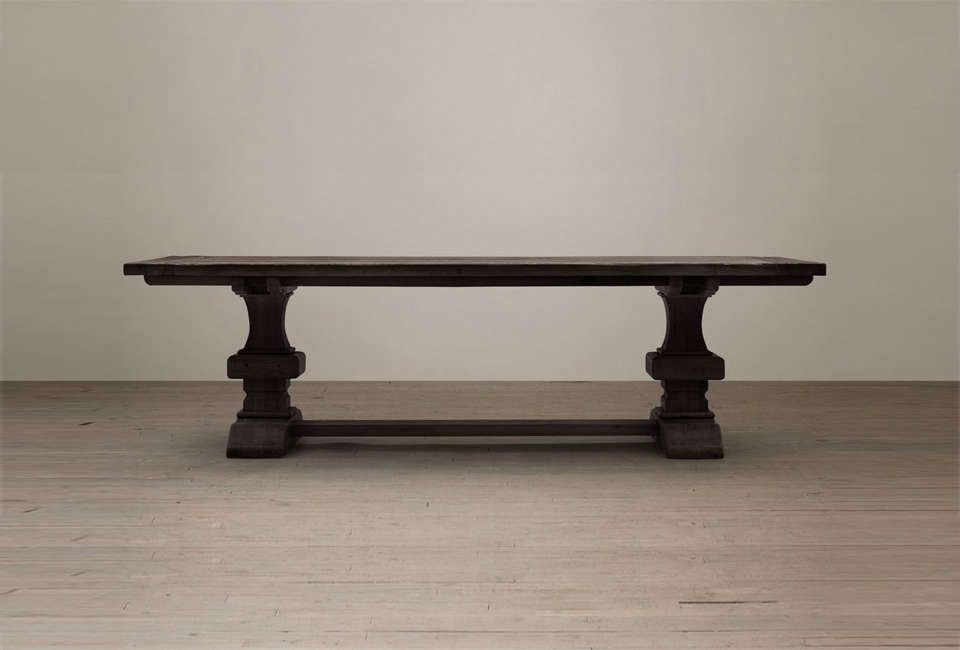

A dining table can be a place to eat, a place to work, or the unofficial headquarters for homework, birthday candles, tax receipts, and that one serving bowl nobody remembers buying. The Reclaimed Russian Oak Baluster Rectangular Extension Dining Table was designed for all of the above, but with considerably more architectural drama.
Originally offered by RH, this substantial trestle table combined salvaged white oak, sculptural baluster supports, and removable breadboard extensions. Its appeal was not based on daintiness. This was furniture with the confidence of an old European banquet hall, translated for modern homes that still need somewhere to put pizza boxes on Friday night.
Because the original model is no longer in RH’s active collection, shoppers now tend to encounter it through archived product pages, design references, and secondhand listings. That makes accurate dimensions, condition checks, and care knowledge especially important. Here is a detailed look at what made the table distinctive, how it functions, where it fits, and what ownership is likely to involve.
What Makes This Reclaimed Russian Oak Dining Table Special?
Solid Reclaimed White Oak With Visible History
The table was handcrafted from solid reclaimed white oak timbers salvaged from decades-old buildings in Russia. Reclaimed wood is not a separate tree species; it is existing lumber recovered from an earlier structure or product and prepared for a new use. In practical terms, every tabletop can display a different combination of grain, checking, knots, nail evidence, color variation, and old surface wear.
Those marks are not defects in the ordinary sense. They are the visual language of reclaimed furniture. A perfectly uniform top would actually miss the point. Buyers attracted to this table generally want character that cannot be printed convincingly onto a thin decorative layer.
A 17th-Century-Inspired Trestle Silhouette
RH credited the design to artisan Theo Eichholtz and connected its form to dining and banqueting furniture dating to the 17th century. Its most recognizable details are the hefty baluster-shaped supports, broad feet, and long stretcher joining the two bases. Together, they create the appearance of a refectory or monastery table without requiring the dining room to contain tapestries and a suit of armor.
The trestle construction also gives the piece visual balance. The thick rectangular top feels appropriately supported, while the center stretcher reinforces the table’s strong horizontal line. It reads as rustic from a distance, but the turned architectural shapes provide enough refinement for tailored or formal interiors.
Dimensions, Extensions, and Seating Capacity
Archived specifications show that the rectangular version was produced in several sizes. Most configurations were approximately 30.5 inches high, placing the table close to standard dining height. Width increased on the larger models, while pairs of removable breadboard extensions added either 30 or 36 inches to the overall length.
| Closed Size | Extended Length | Extension Leaves | Approximate Seating |
|---|---|---|---|
| 60 × 36 inches | 90 inches | Two 15-inch leaves | 4 closed; 6 extended |
| 72 × 36 inches | 102 inches | Two 15-inch leaves | 6 closed; 8 extended |
| 84 × 36 inches | 120 inches | Two 18-inch leaves | 8 closed; 10 extended |
| 96 × 39.5 inches | 132 inches | Two 18-inch leaves | 8 closed; 12 extended |
| 108 × 39.5 inches | 144 inches | Two 18-inch leaves | 10 closed; 12 extended |
| 120 × 39.5 inches | 156 inches | Two 18-inch leaves | 12 closed; 14 extended |
These seating figures assume relatively streamlined side chairs. Wide upholstered chairs, generous armchairs, or guests who object to dining shoulder-to-shoulder may reduce capacity. For comfortable planning, allow roughly 20 to 24 inches of table edge per person.
Why the Breadboard Extensions Matter
A removable extension system lets the table behave like two pieces of furniture. Closed, it can handle everyday meals without dominating every available square foot. Extended, it creates room for holidays, game nights, or the annual family gathering where everyone politely avoids discussing politics until dessert.
Before buying a secondhand example, confirm that both extensions are included, match the finish, align correctly, and have been stored flat. Replacement leaves can be difficult to reproduce because reclaimed boards vary naturally in tone and texture.
Why Reclaimed Oak Works So Well for a Dining Table
Strength, Texture, and a Forgiving Surface
Oak has long been favored for furniture because it offers strength, prominent grain, and a surface that can age attractively. Reclaimed oak adds another advantage: it arrives with an established personality. Minor new scratches are less visually alarming on a distressed top than on a flawless high-gloss surface. In other words, this table is less likely to make you gasp dramatically when somebody puts down a set of house keys.
That does not make it indestructible. Solid wood continues to exchange moisture with the surrounding air, so seasonal humidity changes can contribute to small gaps, movement, checking, or slight shifts in alignment. These effects may be more visible in wide planks and should be understood as part of owning substantial natural-wood furniture.
A Sensible Reuse StoryWith a Few Caveats
Reusing sound building materials can keep useful wood in circulation, reduce demand for newly processed lumber, and divert recoverable timber from the waste stream. Still, the environmental story depends on responsible salvage, processing, transportation, finish chemistry, and product longevity. “Reclaimed” is meaningful, but it is not a magical green sticker that excuses every other decision.
The strongest sustainability argument for a table like this is durability. A well-made solid-wood piece that remains useful for decadesand can be repaired rather than discardedhas the potential to outlast several rounds of cheaper replacement furniture.
Available Finishes and Natural Variation
Archived RH materials show versions in reclaimed natural oak, reclaimed brown oak, and reclaimed black oak. Other historical references mention gray-toned versions during different collection periods. Because finishes and availability changed over time, secondhand buyers should judge the actual table rather than relying exclusively on the name in a listing.
Natural oak emphasizes grain, pale weathering, and warm honey tones. Brown oak produces a richer, more traditional appearance that works well with leather, linen, aged brass, and dark metal. Black oak makes the carved supports feel more graphic and can create a striking contrast in pale, contemporary rooms.
Reclaimed boards may absorb stains differently, so color variation across the top is expected. The extension leaves may also appear slightly different from the main surface if they spent years stored away from light. That contrast is not automatically evidence of damage, although buyers should make sure it is subtle enough for their preferences.
How the Baluster Table Fits Different Interior Styles
Rustic and Modern Farmhouse Rooms
This is the easiest match. Pair the table with linen slipcovered chairs, woven seats, aged brass lighting, or a simple bench. Keep accessories restrained so the grain and carved supports remain the focus. Too many distressed objects in one room can make the space look less “collected over time” and more “barn-themed restaurant gift shop.”
Modern Organic Interiors
Contrast the heavy oak with cleaner forms such as curved dining chairs, plaster walls, a linear pendant, or a low-profile sideboard. The table supplies warmth and irregular texture, while contemporary pieces prevent the room from feeling historically literal.
Traditional and European-Inspired Spaces
The baluster bases naturally suit paneled walls, patterned rugs, upholstered host chairs, ceramics, and antique case goods. A tailored chandelier can sharpen the composition. Matching every object to the table’s old-world mood is unnecessary; a little tension between periods usually makes a room more interesting.
Industrial Lofts
Reclaimed oak also works beside blackened steel, brick, concrete, and large factory windows. Choose chairs with lighter frames to avoid creating a room in which every piece appears capable of surviving a small earthquake.
How to Measure Your Room Before Buying
A large extension table needs more than enough floor area for its top. Plan for chairs, walking paths, nearby cabinets, and the fully extended configuration. A useful baseline is about 36 inches of clearance between the table edge and walls or other furniture. More room is preferable behind chairs used frequently.
- Measure the table both closed and fully extended.
- Mark its footprint on the floor with painter’s tape.
- Add the depth of your actual dining chairs, not imaginary tiny ones.
- Check doorways, elevators, stair turns, and delivery access.
- Confirm that the chandelier remains centered over the configuration used most often.
- Decide where the two extension leaves will live when they are not in service.
The 84-inch version may sound manageable until it becomes 120 inches long for Thanksgiving. Likewise, the 120-inch model extends to 156 inchesan impressive span that deserves a genuinely large room, not optimism and a tape measure held at a flattering angle.
What to Inspect When Buying One Secondhand
Because the original table is discontinued, condition varies from carefully maintained to “survived three moves and a toddler with a fork.” Request detailed photographs and inspect the table in person whenever possible.
The Top and Finish
Look for deep stains, cloudy heat marks, large splits, lifted boards, sticky coatings, and uneven refinishing. Natural checking and old nail marks can be appropriate; active structural separation is different. Ask whether the surface has been sanded, waxed, oiled, sealed, or coated with an aftermarket product.
The Base and Joinery
Gently test for side-to-side movement. Inspect the stretcher, feet, fasteners, and points where the top attaches to the base. A heavy table should feel planted, not seasick. Loose hardware may be repairable, but cracked structural members deserve professional evaluation.
The Leaves and Extension Hardware
Install both extensions before completing the purchase. Check that connectors engage, edges sit level, and the color difference is acceptable. Make sure the leaves are not warped and that the supporting hardware has not been replaced with improvised parts.
Authenticity and Delivery Logistics
Compare measurements and construction with archived specifications, and ask for receipts or manufacturer labels when available. Confirm whether the base separates from the top. Professional movers are usually a wise choice because solid reclaimed oak and large trestle bases are not ideal equipment for an improvised staircase workout.
Care and Maintenance for Reclaimed Oak
Good care is mostly unglamorous, which is excellent news. Dust the surface with a soft, dry or barely damp cloth. Blot spills promptly instead of allowing red wine to conduct a long-term compatibility test with the finish. Use coasters, placemats, trivets, and felt pads beneath objects that may trap moisture or cause scratches.
Avoid harsh cleaners, bleach, ammonia, abrasive pads, and mystery furniture cocktails from social media. Commercial oils and silicone-heavy polishes can leave residue, attract grime, darken the surface, or complicate future refinishing. Follow the finish-specific instructions supplied with the table when available. Otherwise, consult a qualified furniture conservator or refinisher before applying a new treatment.
Position the table away from intense, prolonged direct sunlight whenever possible. Light and heat can alter finishes and create uneven color changes, especially when extension leaves spend most of their time in storage. Keep indoor temperature and humidity reasonably stable, and avoid placing the table directly against a powerful heating vent or radiator.
When moving the table, lift it from structurally sound points rather than dragging it by the top or stretcher. Remove the leaves and, if the construction permits, separate the top from the base. Solid wood is strong; gravity remains stronger and has never apologized.
Is the Reclaimed Russian Oak Baluster Table Still Worth Considering?
For the right room and buyer, yes. The table offers authentic material variation, a memorable architectural base, generous extension options, and sufficient scale to anchor a dining space. It is especially appealing to people who prefer furniture that develops a patina instead of pretending daily life never happened.
Its disadvantages are equally real. The piece is heavy, visually dominant, potentially expensive to move, and unsuitable for many tight dining areas. Reclaimed surfaces require comfort with irregularity, while secondhand examples demand closer inspection than a new table protected by a current warranty.
The best buyer is not simply someone who likes rustic furniture. It is someone who has measured carefully, appreciates old timber, needs expandable seating, and accepts that a century-inspired dining table may occasionally behave like wood rather than a sheet of laboratory glass.
Final Thoughts
The Reclaimed Russian Oak Baluster Rectangular Extension Dining Table earned attention because it combined practical expansion with serious visual presence. Its salvaged white oak, turned baluster supports, and long trestle form made it feel historic without becoming a museum piece. Closed, it served ordinary dinners. Extended, it could host a crowd. Throughout, the reclaimed surface kept the mood relaxed enough for real life.
As a discontinued design, it now rewards informed shopping. Verify the size, test the leaves, examine the joinery, plan professional delivery, and make peace with natural variation. Do that, and the table can become the kind of furniture that collects stories faster than it collects dustwhich, for a dining table, is exactly the right job description.
A Real-World Ownership Experience: From Tuesday Dinner to Holiday Mode
The day-to-day experience of living with this table begins with scale. Even the smaller versions feel substantial because the baluster bases and thick oak top occupy visual space, not just floor space. On an ordinary Tuesday, that presence can make a simple dinner feel more intentional. A bowl of pasta, two mismatched glasses, and a folded dish towel suddenly look like a still life. The table does some of the decorating for you, which is helpful on evenings when your design energy is limited to moving the mail into a neater pile.
For daily use, the reclaimed surface is reassuring. You still use coasters and wipe spills quickly, but you do not feel compelled to protect the table beneath a permanent layer of plastic. Grain changes, old marks, and color variation soften the emotional impact of normal wear. A faint scratch from a serving platter usually joins the existing texture instead of flashing like a warning beacon. That quality makes the table especially comfortable in a busy home where meals, laptops, crafts, and conversations share the same square footage.
The extension ritual is where the table’s practical personality becomes obvious. Before guests arrive, you clear the top, retrieve the leaves, and recruit another adultpreferably one who understands that “solid oak” is not a metaphor. The breadboard extensions add meaningful seating rather than a token few inches. Once installed, the table changes from family scale to banquet scale. The transformation feels satisfying, although the leaves need a safe storage location and should not be treated like oversized sleds by younger household members.
Seating takes a little planning. Slim side chairs fit more naturally along the long edges, while wide armchairs work best at the ends. Guests near the trestle supports may need to adjust their chair positions, so it helps to test the layout before everyone is holding a full plate. A bench can create a casual look and accommodate children efficiently, but adults generally appreciate individual chairs during long meals. Comfort, unlike rustic charm, cannot be achieved through optimism alone.
After dinner, cleanup is straightforward: remove crumbs with a soft cloth, blot moisture, and avoid flooding the plank seams. The top looks best when it is cared for but not fussed over. Over time, sunlight, use, and cleaning may create subtle tonal changes. Leaves stored in darkness can age differently, so installing them occasionally helps reveal any developing contrast. Some owners will love that evolution; others may prefer professional finish advice to keep the appearance more consistent.
The strongest experience is social. A long trestle table naturally encourages shared dishes, lingering conversation, board games, and people pulling up “just one more chair.” It turns the dining room into a destination rather than a corridor with furniture in it. Yes, it is heavy. Yes, moving it requires planning. And yes, the carved base may collect dust in decorative corners you did not know furniture could possess. Once the room is full, however, those inconveniences feel minor. The table succeeds because it looks important without demanding formal behavior. It can host linen napkins and takeout cartons with equal dignity, which is a rare and genuinely useful talent.
SEO Tags