Somebody Just Asked People To Post Examples Of Double Standards, And 45 Responses Were Spot-On

Double standards are the little potholes of civilized life: everyone claims to hate them, yet somehow we keep driving straight into them. One person is called “confident,” another is called “bossy.” One parent is praised for ordering pizza, another is judged for not making a three-course dinner with a side of emotional availability. One worker takes a smoke break and nobody blinks; another steps outside for fresh air and suddenly the office has discovered the Constitution.
That is why a viral prompt asking people to share examples of double standards hit such a nerve. The responses were funny, sharp, slightly painful, and embarrassingly recognizable. People talked about parenting, dating, gender roles, workplace rules, money, attractiveness, social media outrage, and the strange way society can apply two completely different rulebooks to the same behavior.
The best part? Many of the examples were not abstract debates. They were everyday moments: who gets praised, who gets punished, who is believed, who is mocked, who is expected to sacrifice, and who gets congratulated for doing the bare minimum. In other words, double standards are not just “internet drama.” They are social habits hiding in plain sight, usually wearing a very convincing fake mustache.
What Is a Double Standard?
A double standard happens when the same action is judged differently depending on who does it. The behavior may be identical, but the reaction changes because of gender, age, status, wealth, race, attractiveness, job title, relationship role, or simple favoritism.
At its core, a double standard is a fairness problem. It says, “Rules apply to you, but not to me,” or “This is acceptable when our group does it, but unacceptable when their group does it.” Sometimes it is blatant. Sometimes it is subtle. Sometimes it is disguised as tradition, professionalism, family values, common sense, or “just how things are.” Translation: the old rulebook is dusty, but someone keeps putting it back on the shelf.
Why These 45 Responses Felt So Spot-On
The viral responses resonated because they captured situations many people have experienced but rarely see stated so plainly. People are excellent at noticing unfairness when it affects them. We are less excellent at noticing when unfairness benefits us. That is not because everyone is secretly evil; it is because social norms are powerful. They teach us what looks “normal” before we ever stop to ask whether normal is fair.
Double standards also survive because they are convenient. If one person is expected to cook, clean, soothe, remember birthdays, plan appointments, and refill the paper towels, everyone else gets to call that “natural.” If a powerful person breaks a rule and faces no consequences, the system gets to call that “complex.” If a popular person behaves badly and is forgiven instantly, fans get to call that “misunderstood.” It is amazing how flexible language becomes when accountability enters the room carrying a clipboard.
Everyday Examples Of Double Standards People Recognize Immediately
1. The “Fun Dad” Versus “Lazy Mom” Standard
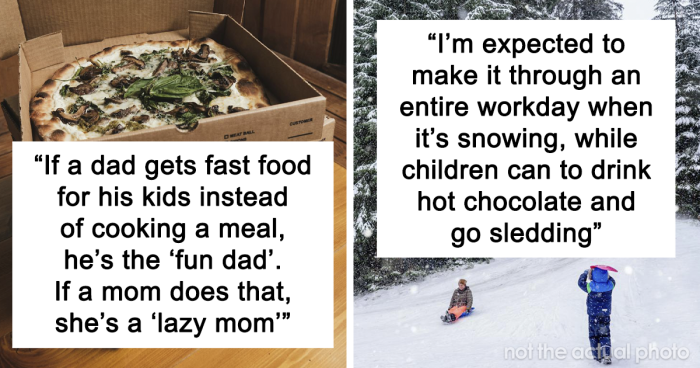
One of the most common examples involves parenting. A father orders fast food for dinner and may be praised as relaxed, spontaneous, or fun. A mother does the same thing and may be judged as careless or lazy. The pizza did not change. The cheese did not suddenly develop a moral position. The social expectation changed.
This double standard comes from long-standing gender roles that treat mothers as default caregivers and fathers as occasional helpers. When dads do routine parenting tasks, society sometimes throws a parade. When moms do the same tasks, society asks why the parade route was not cleaner.
2. The Career-And-Family Question
Another classic example: working mothers are frequently asked how they “balance” career and children, while working fathers are less often asked the same question. The hidden assumption is that a mother’s ambition needs explanation, while a father’s ambition is expected. The mother is treated as dividing her loyalty; the father is treated as providing.
This is not just awkward small talk. It can affect promotions, leadership opportunities, and workplace trust. When employees are judged through different assumptions, performance is no longer the only thing being evaluated. The invisible checklist starts doing push-ups in the background.
3. The “Bossy” Woman And The “Strong” Man
Leadership is another double-standard playground. A man who gives direct feedback may be described as decisive. A woman who gives the same feedback may be labeled abrasive. A man who pushes for a raise is ambitious. A woman who does it may be seen as difficult. Same words, same meeting, different soundtrack.
This is why workplace bias can be so hard to challenge. It often hides inside adjectives. “Passionate” becomes “emotional.” “Confident” becomes “aggressive.” “Detail-oriented” becomes “controlling.” The behavior is filtered through expectations before anyone evaluates the results.
4. The Chore Gap At Home
Housework double standards remain painfully familiar. In some families, daughters are expected to clean, cook, babysit, and help manage the household, while sons are allowed to treat chores like optional side quests in a video game. Everyone lives in the house, but somehow only certain people are expected to know where the mop is.
This kind of double standard is often defended as tradition. But tradition is not automatically wisdom. Sometimes tradition is just peer pressure from dead people with strong opinions about laundry.
5. The “Single Dad Hero” And The “Single Mom Problem”
Single parents also face uneven judgment. A single father may receive praise for doing basic caregiving, while a single mother may be judged for struggling under the same responsibilities. People may assume a father is noble for staying, while assuming a mother should have managed everything quietly.
The unfairness is obvious once stated: parenting is hard no matter who does it. Diapers do not become easier because society applauds you. Homework does not grade itself because strangers call you inspirational.
Workplace Double Standards: Where Fairness Goes To Attend A Meeting About Synergy
6. Breaks, Smoke Breaks, And The Five-Minute Mystery
Many people relate to the workplace break double standard. Someone can step outside for a cigarette and it is treated as normal. Someone else steps outside to breathe, stretch, or avoid saying something career-ending in a staff meeting, and suddenly it is suspicious.
The real issue is consistency. If short breaks are allowed, they should not depend on whether someone is holding a cigarette like a permission slip. A healthy workplace should not accidentally reward the least healthy excuse.
7. Rule Enforcement For Employees Versus Managers
Another popular example is the manager who bans phone use while holding a phone. Or the supervisor who lectures people about punctuality after arriving late with a coffee large enough to require its own parking space. Rules lose credibility when they travel downward only.
Good leadership means modeling the standard, not hovering above it in a swivel chair of exemption. Employees can usually tolerate strict rules better than selective rules. What destroys trust is watching the rulebook become a trampoline for the people in charge.
8. “Family Comes First” Unless You Do Not Have Children
Childfree workers often report another double standard: employees with children may be excused for family needs, while employees without children are expected to cover shifts, stay late, or be endlessly flexible. Of course, parents need support. But non-parents also have families, health needs, personal emergencies, commitments, and lives that do not begin only after someone packs a school lunch.
A fair workplace does not pit parents against non-parents. It creates policies that respect human beings, not just human beings with tiny shoes in the hallway.
Dating And Relationship Double Standards
9. Cooking, Care, And “Wife Material”
Dating double standards often appear around domestic expectations. A woman may be expected to cook, clean, be emotionally supportive, look attractive, earn money, and somehow remain effortlessly relaxed. Meanwhile, a man who remembers one anniversary may be treated like he just discovered fire.
The “wife material” standard is especially revealing. It often demands service while pretending to measure love. A healthy relationship is not a job interview for unpaid household management. If someone wants a private chef, therapist, calendar app, and cheerleader, they should say that clearly and bring a salary package.
10. Body Comments That Hurt “Differently”
People also pointed out double standards around body comments. Sometimes one partner feels free to make jokes about the other’s appearance, but reacts with outrage when the same energy is returned. The lesson is simple: if a joke only works when aimed in one direction, it is not harmless banter. It is a one-way toll road, and the other person is tired of paying.
Respect should not depend on gender. Everyone has insecurities. Everyone deserves boundaries. “I was just joking” is not a magic spell that turns a hurtful comment into comedy.
Beauty, Popularity, And The Halo Effect
One of the sharper responses in the viral discussion noted that attractive or popular people often get away with behavior that average people cannot. This is closely connected to the halo effect, a cognitive bias where one positive trait influences how we judge unrelated traits.
Attractive people may be perceived as kinder, smarter, more trustworthy, or more capable before they have done anything to earn those assumptions. Popular people may receive more forgiveness because others want to stay close to their status. Meanwhile, less popular people can make the same mistake and be judged much more harshly.
In plain English: if the charming person is late, they had a wild morning. If the awkward person is late, they are irresponsible. Same clock. Different courtroom.
Money And Justice: The Most Expensive Double Standard
Some double standards are funny until they are not. The justice system is one area where unequal treatment can change the course of a person’s life. People with money can often afford stronger legal representation, pay bail, take time off work, and navigate complex procedures. People without money may face harsher practical consequences before guilt or innocence is even determined.
The principle of equal treatment sounds simple: similar cases should be treated similarly. But in reality, resources matter. A person with a well-paid attorney and financial cushion may experience the legal system very differently from someone living paycheck to paycheck. That is not a small social annoyance. That is a structural fairness problem with teeth.
Online Double Standards: Accountability Or Team Sports?
Social media has made double standards easier to spot and easier to perform. People call out hypocrisy, share screenshots, debate fairness, and occasionally turn minor disagreements into courtroom dramas where everyone is both judge and snack vendor.
The problem is that online accountability can become selective. If a disliked public figure says something foolish, people may demand consequences. If a beloved public figure says something similar, fans may explain context, growth, nuance, trauma, satire, lighting, Mercury retrograde, and twelve other emergency exits.
This does not mean accountability is bad. It means accountability should not depend entirely on whether someone is on our team. A fair standard must survive contact with people we like.
Why Double Standards Make People So Angry
Double standards irritate people because they violate one of our deepest expectations: fairness. Most people can accept losing, being corrected, or facing consequences when the rules are clear and evenly applied. What people resent is being told the rules are sacred right up until someone else breaks them.
They also create emotional exhaustion. If you are constantly judged by a harsher standard, you learn to over-prepare, over-explain, and over-apologize. You start carrying invisible paperwork for your own existence. That is tiring. Frankly, even printers would complain.
How To Spot A Double Standard In Real Life
A useful test is to swap the people involved. Would the reaction be the same if a man did it instead of a woman? If a woman did it instead of a man? If a rich person did it instead of a poor person? If a manager did it instead of an employee? If your favorite celebrity did it instead of someone you dislike?
If the answer changes dramatically, you may have found a double standard. The goal is not to become a walking fairness robot who ruins every dinner party. The goal is to notice when judgment is being smuggled in under the name of “common sense.”
How To Push Back Without Starting World War Group Chat
Calling out a double standard works best when it is specific. Instead of saying, “You are being unfair about everything,” try, “I noticed the same behavior is being treated differently here. What is the reason?” That question forces the hidden rule into the open.
At work, ask for written policies and consistent enforcement. At home, divide responsibilities clearly instead of relying on assumptions. In relationships, set boundaries before resentment becomes a permanent roommate. Online, pause before defending someone only because you like them or attacking someone only because you do not.
Fairness does not require perfection. It requires a willingness to use the same measuring stick even when it becomes inconvenient.
Personal Experiences And Reflections On Double Standards
Most people do not need a textbook to understand double standards. They have lived them in small, memorable ways. Maybe you were the responsible sibling who had to follow every rule while another sibling floated through life on a cloud of excuses. Maybe you were the employee who finished work early and got questioned, while a louder coworker did less but looked busier. Maybe you watched someone receive praise for doing the exact thing you were criticized for last week.
One of the most common experiences is the “tone” double standard. A person raises a valid concern, but instead of addressing the concern, others critique how it was delivered. This happens often to people who already feel ignored. They speak calmly and are overlooked. They speak firmly and are called rude. They stay silent and are told they should have spoken up. At that point, the acceptable tone appears to be “quiet enough to be convenient.”
Another familiar experience is the double standard around emotional expression. Some people are allowed to be angry and are seen as passionate. Others express frustration and are labeled unstable, dramatic, or unprofessional. The emotion may be the same, but the interpretation changes depending on who is showing it. This teaches people to edit themselves constantly, not because they lack self-control, but because they know the room grades them differently.
Family life offers plenty of examples too. Many people grow up watching daughters get trained for responsibility while sons get rescued from it. A daughter is told to help with dinner because she “needs to learn.” A son is excused because “he does not know how.” But that is exactly the point: he does not know because no one required him to learn. The double standard then becomes self-fulfilling, which is very convenient for anyone hoping to avoid dishes.
Friend groups have their own versions. One friend is “honest” when they make sharp comments, while another is “too sensitive” for objecting. One person cancels plans and receives compassion; another cancels and is called flaky. Often, the difference is not behavior but status within the group. The favorite gets context. The outsider gets judgment.
Even personal growth can be judged unevenly. When some people set boundaries, they are praised for self-care. When others set boundaries, they are accused of being selfish. This is especially common when someone has been the reliable helper for years. The moment they stop overextending themselves, everyone suddenly becomes a philosopher of generosity.
The uncomfortable truth is that we have all probably benefited from a double standard at some point. Maybe someone gave us extra patience because they liked us. Maybe we judged a stranger harshly for something we excused in a friend. Maybe we demanded nuance for ourselves and offered none to someone else. Recognizing that does not make us villains. It makes us responsible.
The best response is not to pretend we are perfectly objective. We are not. The best response is to slow down and ask better questions. Am I judging the action or the person? Would I react the same way if someone else did this? Am I defending a principle, or am I defending my favorite person? Am I applying a rule, or just protecting my comfort?
Double standards will not disappear because one viral thread made everyone nod aggressively at their phones. But noticing them is a start. Naming them helps. Laughing at the absurd ones can make the conversation easier. Challenging the harmful ones can make homes, workplaces, relationships, and communities fairer. And if nothing else, we can all agree on one universal standard: if pizza night is lazy, then it is lazy for everyone. If pizza night is fun, pass the plates.
Conclusion
The viral collection of double standards worked because it turned everyday unfairness into something visible, discussable, and occasionally hilarious. From parenting and chores to workplace breaks, dating expectations, beauty bias, legal inequality, and online accountability, the responses reminded readers that fairness is not just a slogan. It is a practice.
Double standards thrive when people stop questioning them. They shrink when we compare reactions, challenge assumptions, and apply rules consistently. The goal is not to make life humorless or to turn every conversation into a courtroom. The goal is to stop pretending that unequal expectations are natural just because they are familiar.
In the end, the most spot-on responses were not just clever complaints. They were tiny fairness audits. And judging by how many people recognized themselves, their workplaces, their families, and their group chats in those examples, society may be overdue for a very large receipt check.