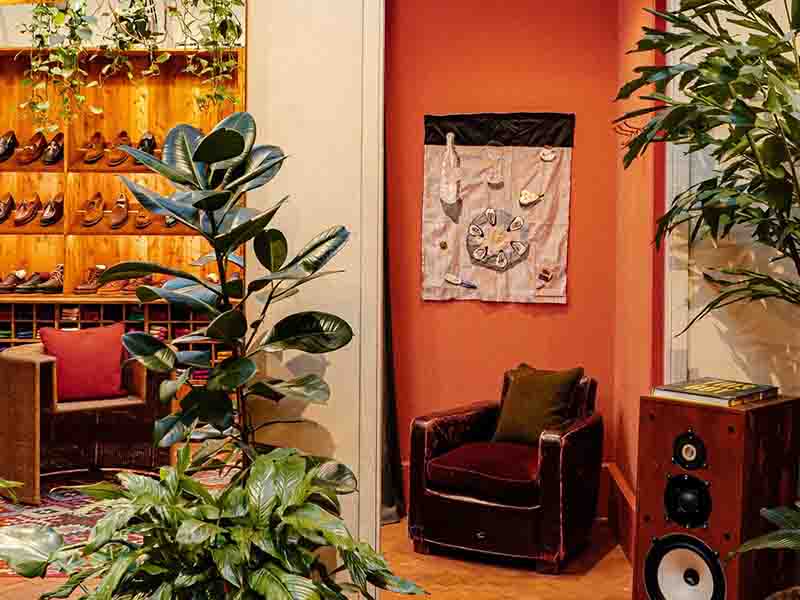

Still Life With Oysters And Olive turns an elegant seafood spread into something unexpected: a handmade fabric composition stitched from materials that might otherwise have been forgotten. Created by Andrew Pierce Scott in 2024, the original appliqué uses fabric offcuts from British menswear label Drake’s and measures approximately 93 by 74 centimeters. Instead of oil paint, polished panel, and painstakingly glazed highlights, Scott works with seams, frayed edges, patterns, and pieces of cloth that already had a life before becoming art.
The result feels like a Dutch banquet painting wandered into a tailor’s workshop and decided to stay for dinner. Oysters circle a lemon on a central platter, a bottle stands at the left, delicate glasses float above the table, a knife waits near the bottom edge, and one small olive sits apart from the main event. It is luxurious, humorous, slightly crooked, and far more emotionally alive than a table without diners has any right to be.
What Is Still Life With Oysters And Olive?
Still Life With Oysters And Olive is a contemporary textile still life by American-born, London-based artist and maker Andrew Pierce Scott. The work is constructed through appliqué, a technique in which pieces of fabric are cut, layered, and attached to a larger textile surface. The official artwork record identifies it as an original made with Drake’s fabric offcuts in 2024. It has since been sold.
Scott studied studio art and classics before completing a master’s degree in Design Products at the Royal College of Art in 2021. His practice moves freely among fabric, scrap metal, wood, and paper. Across these materials, he is especially interested in objects that have been overlooked, discarded, or dismissed as too ordinary to deserve attention.
That philosophy is essential to understanding this piece. It is not simply an image of a meal rendered in cloth. It is also an artwork about transformation. Tailoring remnants become wine glasses. Patterned scraps become oyster shells. A narrow patch of color becomes a blade, a bottle label, or the shining interior of a lemon. Material that once seemed incomplete suddenly looks perfectly suited to its new role.
A Closer Look at the Composition
The Oyster Platter Takes Center Stage
The visual anchor is a round platter positioned near the lower center of the composition. Oysters radiate around a yellow lemon, creating a loose circular rhythm. Their irregular fabric shapes prevent the arrangement from becoming too formal. Each shell feels slightly different, as real oysters do; nature has apparently never heard of identical place settings.
The pale oyster bodies stand out against darker edging and the muted tabletop. Rather than attempting photographic realism, Scott lets the viewer recognize the food through a few well-chosen shapes, colors, and textures. The result is representational but relaxed. You know exactly what is being served, even though no one has bothered to iron the seafood.
A Table Seen From an Unsteady Angle
The tabletop is presented from above, but not with the controlled geometry of an architectural plan. Bottle, glasses, knife, olive, and platter seem to occupy slightly different angles. The spatial inconsistencies make the scene feel remembered rather than measured.
This tilted perspective is a recurring quality in Scott’s textile table scenes. He has described an interest in the moment just before a shared meal begins, when the table remains inviting and full of possibility. His compositions often use an awkward viewing angle, as though the observer were standing beside the table instead of looking at a perfectly staged arrangement from a fixed position.
The Singular Olive as Visual Punctuation
The title does not say “olives.” It says “olive,” and the composition gives that lone object a surprisingly memorable role. Positioned away from the central platter, the small olive behaves like a period at the end of a long and delicious sentence.
Its isolation creates balance. The large circular dish dominates the center, while the olive quietly activates the lower corner. It also rewards slow viewing. At first, the oysters and glasses attract attention; then the eye finds the tiny green form and realizes that the title has been keeping a miniature joke in plain sight.
How Andrew Pierce Scott Turned Scraps Into a Feast
Scott’s textile still lifes began while he was studying at the Royal College of Art. Fashion students left behind large quantities of excess fabric, and he collected what he could carry. One patterned scrap reminded him of fish scales, prompting him to cut a fish shape and then build a table scene around it. What started as an experiment developed into an ongoing series of seafood, drinks, fruit, flowers, charcuterie, and tableware.
This origin story explains why the material feels so active. Scott does not begin with an unlimited fabric catalog and order the exact shade required for a predetermined sketch. He often responds to what is already available. A scrap suggests an object, and the object suggests a composition.
Chance therefore becomes a collaborator. An inconvenient pattern may become the most interesting shell. A frayed edge can suggest reflected light. A piece that would appear flawed in a conventional sewing project may provide precisely the roughness needed for a knife handle or oyster rim.
Scott has explained that working with available materials makes him less precious and more playful. Rather than forcing a material to obey a rigid plan, he tests what it can do and allows its properties to influence the finished result.
Connections to Dutch and Flemish Still Life Painting
The oysters, lemon, glasses, knife, and dark upper background connect the work to the long history of European banquet and breakfast still lifes. Seventeenth-century Dutch and Flemish painters frequently arranged shellfish, imported fruit, expensive vessels, bread, wine, and olives across tables that appeared both abundant and strangely temporary.
In historical paintings, oysters were associated with luxury and sensual pleasure. Lemons demonstrated both wealth and artistic skill, since their twisting peels, bright color, and glossy surfaces allowed painters to show off. Imported olives could also indicate access to costly goods and international trade.
Osias Beert’s early-seventeenth-century table scenes, for example, celebrate abundance through carefully painted oysters, fruit, wine, porcelain, and sweets. Willem Claesz Heda used a more restrained palette, transforming silver, glass, shellfish, and pale table linen into studies of reflected light. His banquet compositions could also contain reminders that pleasure does not last: broken glass, extinguished candles, abandoned food, and objects balanced at the edge of disaster.
Scott borrows the visual vocabulary without producing a historical imitation. His table is flatter, softer, less stable, and visibly handmade. The stitched edges interrupt illusion. Fabric patterns refuse to disappear completely into the objects they represent. Instead of pretending to be paint, the cloth proudly remains cloth.
That distinction gives the work its contemporary energy. A traditional banquet painting may advertise valuable foods and possessions. Scott depicts similar pleasures using leftovers. Luxury is reconstructed from remnants, which makes the feast feel both glamorous and resourceful.
Why Fabric Changes the Meaning
Oil paint can imitate the slippery surface of an oyster or the hard reflection of a wine glass. Fabric cannot create those illusions in quite the same way, so it offers something else: touch. Even when viewed online, the work encourages the imagination to feel its surfaces.
A smooth piece of cloth may suggest liquid or glass. Heavier material can give a bottle visual weight. Loose threads add movement around a shell. Seams function as outlines, shadows, and evidence of labor all at once. The viewer does not merely see the objects; the viewer sees how they were assembled.
This visible construction places the work within a broader history of textile art that challenges old distinctions between fine art, craft, design, decoration, and domestic labor. Museums increasingly present weaving, appliqué, quilting, fiber sculpture, and textile installation as major artistic languages rather than supporting acts performed somewhere behind the important canvas. Artists such as Anni Albers and Sheila Hicks helped establish textiles as powerful modern and contemporary media in their own right.
Scott adds humor and informality to that history. His composition is neither a perfectly finished decorative textile nor a solemn museum lecture sewn into fabric. It is a social image. The table seems to be waiting for friends who are late but have at least chosen excellent drinks.
Sustainable Art Without the Scolding
The use of offcuts gives Still Life With Oysters And Olive an environmental dimension, but the artwork does not behave like a poster telling viewers to recycle. Its argument is embedded in the pleasure of the object.
Textile waste is a substantial material problem. The U.S. Environmental Protection Agency estimated that Americans generated about 17 million tons of municipal textile waste in 2018, while approximately 11.3 million tons went to landfills. Those figures include discarded clothing and other textile products.
One appliqué cannot solve industrial waste, of course. The oysters are impressive, but they have not yet developed municipal policy. What the work can do is change perception. It demonstrates that scraps are not automatically useless. Their irregular sizes, unusual patterns, and previous histories may create aesthetic possibilities that pristine materials cannot.
Creative reuse has long been part of textile practice. Cooper Hewitt’s exhibition Scraps: Fashion, Textiles, and Creative Reuse highlighted designers who transformed remnants through appliqué, weaving, and other processes while combining sustainability with sophisticated design. Scott’s work belongs to this larger conversation, although his approach remains personal, improvisational, and closely tied to food and social memory.
Food, Friendship, and the Missing Diners
No people appear in Still Life With Oysters And Olive, yet the image feels social. The glasses imply multiple drinkers. The platter is too generous for a lonely snack. The knife suggests preparation, while the bottle promises that the evening may become more talkative after the second pour.
Scott has connected his table scenes to the experience of sharing food with family, friends, and new acquaintances. He began developing them during a period when restaurants and communal dining were restricted, making the imagined table a form of anticipation.
The absence of figures allows viewers to enter the scene mentally. We are not watching strangers eat; we are arriving before the guests. The meal has not yet been disturbed, but it does not feel sterile. The uneven perspective and handmade forms prevent the table from looking like an advertisement. It feels more like a memory of hospitalityspecific enough to be believable, open enough to become our own.
Why the Artwork Works in Contemporary Interiors
At approximately 36.6 inches tall by 29.1 inches wide, the work has enough scale to command attention without swallowing a room. Its vertical format suits dining rooms, kitchens, lounges, reading corners, and other spaces where a traditional horizontal still life might feel predictable.
The muted table color and dark background give it visual calm, while the oysters, lemon, bottle, glasses, and olive create smaller points of contrast. The textile surface also softens a room. Unlike framed glass, it does not produce harsh reflections, and its flexible edges make it feel less formal than a conventional painting.
That informality is part of the charm. A luxurious seafood subject might sound overly grand, but the visible stitching keeps the work approachable. It can coexist with antique furniture, contemporary design, natural wood, patterned upholstery, or a slightly chaotic shelf of cookbooks. In fact, it may prefer the chaotic cookbooks. They look like they know where dinner is happening.
Experiencing Still Life With Oysters And Olive in a Real Space
To understand the emotional effect of this textile still life, imagine encountering it away from a bright gallery screen. It hangs against a warm wall, slightly above a chair or side table. From across the room, the first impression is simple: a dark-backed dining scene with a pale platter at its center. The image reads quickly, almost like a sign promising oysters and wine nearby.
Walk closer, however, and the meal begins to break apart into material decisions. The bottle is no longer merely a bottle; it is a stack of differently colored fabric shapes. The glasses are not transparent at all, yet a few narrow pieces convince the eye that they contain reflections. The oyster shells reveal uneven outlines and subtle differences in size. The tabletop may contain folds or stripes that have nothing to do with a real wooden surface but make perfect sense within this sewn world.
This change between distant recognition and close-up construction is one of the most enjoyable experiences the work offers. From far away, it behaves like a picture. Up close, it becomes an object. Step back again, and the dinner magically returns.
The single olive is especially rewarding in person. It may not be the first element anyone notices, but once found, it becomes difficult to ignore. Its scale is almost comic beside the grand oyster platter. It resembles the quiet guest at a crowded table who says very little and then delivers the funniest line of the evening.
The work also changes with its surroundings. In a dining room, it can amplify anticipation before a meal. In a dressing area, its connection to Drake’s fabric offcuts becomes more visible: cloth once associated with garments now performs as bottle, shell, glass, and table. In a kitchen, it celebrates food without repeating the usual decorative vocabulary of painted fruit bowls and inspirational signs ordering everyone to “gather.” The oysters are already gathered. They need no typography.
Living with the piece would likely produce a slower appreciation than seeing it once. New patterns become noticeable over time. A seam that initially looked functional begins to resemble a shadow. A loose edge starts to suggest movement. The imperfections become familiar, much like scratches on a favorite table or variations in handmade dishes.
There is also a satisfying contradiction in experiencing an image of perishable food made from durable remnants. Real oysters must be eaten quickly. Wine disappears. Lemons dry out. Dinner parties end, glasses are washed, and someone discovers that nobody remembered to buy dessert. Scott’s textile meal remains suspended at the moment before consumption. It preserves appetite rather than aftermath.
Yet the artwork does not feel frozen or mournful. Its uneven construction keeps it lively. It suggests that memory is not a polished photograph but an assembly of textures, colors, smells, and small details. We may forget what everyone discussed at dinner, but remember the black bottle, the glint of a knife, the lemon in the middle of the oysters, and one olive sitting mysteriously on its own.
That is ultimately the richest experience offered by Still Life With Oysters And Olive. It transforms discarded fabric into a scene of abundance and turns an empty table into evidence of human connection. The diners never appear, but their arrival feels imminent. The work waits with themand for us.
Conclusion
Still Life With Oysters And Olive succeeds because it combines several histories without becoming trapped by any of them. It recalls Dutch and Flemish banquet paintings, participates in contemporary textile art, celebrates the culture of shared meals, and demonstrates the creative potential of discarded materials.
Andrew Pierce Scott does not reproduce luxury in the conventional sense. He rebuilds it from fragments. Oysters emerge from scraps, glasses from stitched outlines, and atmosphere from an intentionally unstable table. The result is warm, witty, and materially intelligenta feast that asks viewers to enjoy what they see while reconsidering what they normally overlook.