
Hollywood, we need to talk. Not a hostile talk. Not an intervention with stale coffee and a folding chair circle. Just a firm, loving, slightly exasperated chat about sequel titles. Specifically: why are studios so committed to giving sequels the exact same title as the original movie?
It keeps happening. A new installment arrives, it is absolutely not a remake, absolutely not the first film, and yet it strolls into theaters wearing the original title like it borrowed somebody else’s jacket and forgot to return it. Halloween. Scream. Candyman. Texas Chainsaw Massacre. At this point, opening a streaming app feels less like browsing and more like taking a pop quiz designed by a trickster god.
Yes, I understand the logic. Studios want the power of brand recognition without the baggage of a giant number at the end. “Part 5” can scare off casual viewers. “The Original Title Again” sounds cleaner, more modern, and more “event cinema.” But there is a difference between clever branding and making everyone sound ridiculous in conversation. If I have to say, “No, not Scream Scream, the other Scream,” something has gone deeply wrong.
This is not just a movie nerd problem either. It is a marketing problem, a search problem, a cataloging problem, a word-of-mouth problem, and, above all, a common-sense problem. So let us say it clearly, with feeling: stop giving sequels the same title as the original, dammit.
Why Studios Keep Doing This in the First Place
The answer is simple, annoying, and a little bit brilliant. Same-title sequels are designed to make old franchises feel new again. They are often sold as “legacy sequels” or “rebootquels,” which means they continue the original continuity while also trying to invite fresh viewers to jump aboard without needing a PhD in franchise lore.
From a business standpoint, that makes sense. A title like Scream 5 tells newcomers there are four homework assignments waiting for them. A title like Scream says, “Relax, just buy popcorn and figure it out as you go.” One title sounds like a continuation; the other sounds like a relaunch. Hollywood loves relaunches because they smell like accessibility, nostalgia, and ticket sales.
There is also an ego element involved. Calling the new film by the original name is a way of saying, “This one matters. This is the true heir. Forget the messy middle chapters. We are back to basics now.” In theory, that sounds bold. In practice, it sounds like a studio is trying to erase its own franchise history with a Sharpie.
And then there is the branding advantage. The original title already has cultural muscle. People recognize it instantly. The poster looks familiar. The trailer triggers nostalgia. The social media buzz writes itself. For a studio, reusing the title can feel like putting the movie on easy mode.
Unfortunately, what is easy for the studio becomes irritating for literally everyone else.
Why This Trend Is So Ridiculously Confusing
It breaks normal human conversation
Try saying this out loud to a friend: “I liked Halloween, but I think Halloween is still better than Halloween.” That is not film criticism. That is a system error.
Same-title sequels force everybody into awkward verbal gymnastics. We end up adding release years, actor names, or explanatory footnotes just to talk like functional adults. “No, I mean Halloween from 2018, not Halloween from 1978.” A good title should clarify. It should not require timestamp-based hostage negotiation.
It makes streaming and search messier
Digital platforms are supposed to make discovery easier, but duplicate titles often do the opposite. Search results become cluttered. Recommendation rows become messy. Casual viewers click the wrong movie, back out, click again, and start wondering whether they are losing their minds. Spoiler: they are not. The title system is.
And yes, the year usually appears somewhere on a service page. But that is not a defense. That is a patch. If your title only works because a tiny release date bails it out, your title does not work.
It muddies critical identity
Titles are supposed to distinguish works from one another. That is the job. When a sequel recycles the original name, it blurs the identity of both films. Reviews become less searchable. Rankings look weirder. Essays read like puzzles. Archive systems groan in pain. Somewhere, a librarian stares out a window and questions every life choice that led to this moment.
The Repeat Offenders: A Few Famous Examples
Halloween (2018)
This may be the patron saint of the trend. The 2018 film was a direct sequel to John Carpenter’s 1978 classic, while ignoring a big chunk of the franchise’s tangled continuity. Creatively, that back-to-basics move made sense. Titling it Halloween again, however, was a choice that launched a thousand clarifications.
Did it work commercially? Sure. Did it also create endless confusion for anyone trying to discuss the franchise in plain English? Absolutely. This is the cinematic equivalent of naming your second child “Steve 2” but then insisting everybody call him “Steve.”
Scream (2022)
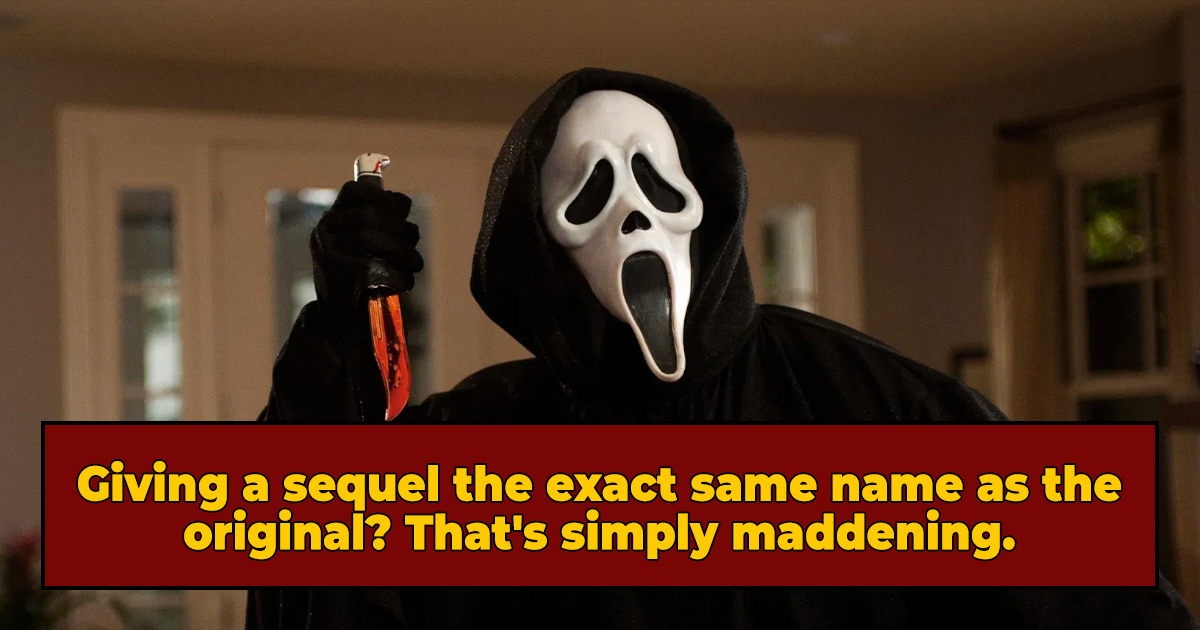
This one was especially funny because the Scream franchise has always been meta enough to know exactly what it was doing. The fifth film ditched the obvious Scream 5 label and went with Scream, a title that practically dared the audience to start arguing online.
To be fair, the movie itself understood the “requel” trend and satirized it. But self-awareness does not erase inconvenience. A movie can mock a bad idea and still be participating in it. That is like making fun of cargo shorts while actively wearing cargo shorts.
Candyman (2021)
The 2021 Candyman was not a lazy retread. It was a thoughtful continuation that expanded the mythology and pushed the story in new thematic directions. But the title still created instant ambiguity because it shared its name with the 1992 original.
This is the part where people say, “But the movie is smart.” Great. Wonderful. Love that for it. A smart movie can still have a title that behaves like a smoke machine in a library.
Texas Chainsaw Massacre (2022)
Another direct sequel to an older classic, another reused title, another audience forced to add a year every single time. The movie may have aimed to reconnect the franchise to its roots, but the naming strategy mostly reconnected viewers to the universal feeling of mild irritation.
There is a pattern here. These films are usually trying to say, “This is the important sequel. This is the one that returns to the original spirit.” Fine. Then say that with a subtitle instead of playing identity theft with the first movie.
Why the Strategy Feels So Desperate
Here is the uncomfortable truth: giving a sequel the original title often feels less like confidence and more like insecurity. It suggests the studio does not fully trust the movie to stand on its own while also not fully trusting audiences to handle a sequel number. So it splits the difference by hiding the sequel-ness in plain sight.
That sends a strange message. It says the franchise history matters enough to profit from, but not enough to name honestly. It is a little like inviting your entire family to dinner and then pretending you are an only child.
There is also a broader Hollywood issue in play. Franchises now live on branding discipline. Every piece of packaging is optimized to reduce friction. If a subtitle seems too specific or a number seems too intimidating, executives start reaching for the cleanest, simplest label possible. But “simple” is not the same as “clear.” Sometimes the minimalist option is just the laziest one wearing nice shoes.
How Studios Could Fix This Without Losing the Brand
The funny part is that this problem is incredibly easy to solve. No one is asking Hollywood to reinvent language. We already have tools.
Use a subtitle
Subtitles are your friends. They add identity, flavor, and searchability. Top Gun: Maverick sounded like an event. Blade Runner 2049 sounded specific. Creed spun off from Rocky with confidence and a personality of its own. These titles signal connection without causing a migraine.
Use a meaningful number if the franchise is established
Sometimes a number is not scary. Sometimes it is useful. People understand franchises. They can count. Trust them. If your audience can decode multiverse timelines, they can survive a “5” at the end of a title.
Create a distinct identity for each era
If the goal is to relaunch a property for a new generation, then give that generation a title they can actually claim. A new chapter deserves a name of its own. Otherwise the whole enterprise feels like a cover band introducing itself with the original band’s exact name and hoping nobody asks questions.
What a Good Sequel Title Actually Does
A good sequel title performs three jobs at once. First, it signals continuity. Second, it establishes individuality. Third, it helps the audience understand where the movie fits. That is not too much to ask from a few words on a poster.
Think of the best sequel titles and how easily they stick. Aliens. Terminator 2: Judgment Day. The Dark Knight. Mad Max: Fury Road. Before Sunset. These titles do not just continue a brand. They expand it. They feel like chapters, not filing errors.
That is the real frustration with same-title sequels. It is not merely that they are confusing. It is that they are boring. They skip an opportunity to say something interesting about the new movie. A title can create anticipation, suggest tone, hint at theme, or define a new era. Reusing the original title does none of that. It just shrugs aggressively.
From the Streaming Trenches: A 500-Word Experience Report on Why This Is So Annoying
I have now lived through enough same-title sequel confusion to report, with complete confidence, that this trend creates tiny daily absurdities that add up fast. You notice it most when you are not trying to be a critic or an analyst. You notice it when you are just trying to watch a movie on a Friday night without needing a whiteboard.
Picture the scene. You are on the couch. Someone says, “Let’s watch Scream.” Reasonable request. Except now the room divides into factions. One person means the 1996 original. One means the 2022 sequel. One has only seen the poster with Jenna Ortega and assumes that is the first one. Someone else says, “Wait, is that the remake?” Then the horror fan in the room, already exhausted, launches into a continuity explanation that somehow includes the words “legacy sequel,” “soft reboot,” and “it still counts, technically.” Congratulations. Your movie night has become office hours.
The same thing happens with streaming menus. You scroll past a title you know, click it, and then realize halfway through the synopsis that this is not the movie you thought it was. So now you are backing out, reopening pages, checking years, and asking yourself why a major studio made title selection feel like digital archaeology. The whole point of a title is to reduce friction. Instead, duplicate-title sequels add just enough confusion to annoy you without ever becoming dramatic enough to be funny. They are the paper cuts of franchise culture.
It gets worse in group chats. Somebody posts, “I finally watched Halloween.” Great. Which one? The original? The 2018 sequel? The Rob Zombie remake? Did they love Jamie Lee Curtis in 1978 or 2018? Are they talking about one of horror’s foundational classics or a modern legacy sequel that deliberately ignored parts of the series canon? There is no reason a single sentence should require a follow-up questionnaire.
And then there is the recommendation problem. Recommending movies used to be easy. Now you have to recommend with parentheses. “Watch Candyman (1992) first, then Candyman (2021).” That is not elegant. That is admin work.
What bothers me most is that all of this is avoidable. Nobody is asking sequels to be less ambitious, less nostalgic, or less tied to the original. We are just asking them to have names that function in the wild. A title should help audiences find the movie, talk about the movie, remember the movie, and separate the movie from the other movie with the exact same name sitting three inches away on a streaming interface.
So yes, this may sound like a small complaint. But it is the kind of small complaint that reveals a larger habit in modern franchise filmmaking: the habit of treating branding as more important than clarity. And once you notice it, you cannot un-notice it. Every recycled title starts to feel like Hollywood looking directly into the camera and saying, “You’ll sort it out.” Honestly? We should not have to.
Conclusion
Same-title sequels are not the end of cinema, but they are an unmistakable sign of how modern franchise logic works. Studios want the comfort of nostalgia, the accessibility of a fresh start, and the authority of the original brand, all at once. What they often get instead is a title that creates confusion, weakens identity, and makes ordinary conversation more complicated than it needs to be.
The best sequels build on the past while confidently announcing themselves as something new. Their titles should do the same. So the next time a studio decides the boldest possible name for a follow-up is just the original title again, maybe someone in the room should stand up, clear their throat, and say the obvious thing: “Absolutely not. Give it a subtitle.”