The British Tabloids Say ‘South Park’ May Have Caused a Rift in Meghan Markle and Prince Harry’s Marriage

Editorial note: The claim that a South Park episode caused a rift in Meghan Markle and Prince Harry’s marriage was never supported by verifiable evidence. This article examines how the rumor developed, what the episode actually said, and why celebrity speculation can spread faster than confirmed facts.
When South Park turns its attention to a public figure, subtlety usually packs a suitcase and leaves town. The animated comedy has roasted politicians, musicians, actors, tech moguls, religious leaders, and nearly anyone else famous enough to have an overconfident publicist.
In February 2023, the show aimed its satirical flamethrower at fictional Canadian royals who looked, sounded, dressed, and behaved an awful lot like Prince Harry and Meghan Markle. Almost immediately, British tabloids and royal commentators began reporting that the episode had left Meghan upset, pushed the couple toward legal action, and possibly created tension in their marriage.
There was only one inconvenient problem: the most dramatic claims were not backed by named sources, documents, public statements, or observable evidence.
The result was a classic modern celebrity-news cycle. A television comedy made jokes about media branding. The media turned those jokes into stories about the subjects’ private reactions. Other outlets then reported on those stories, creating an echo chamber large enough to qualify for its own postal code.
What Happened in the ‘Worldwide Privacy Tour’ Episode?
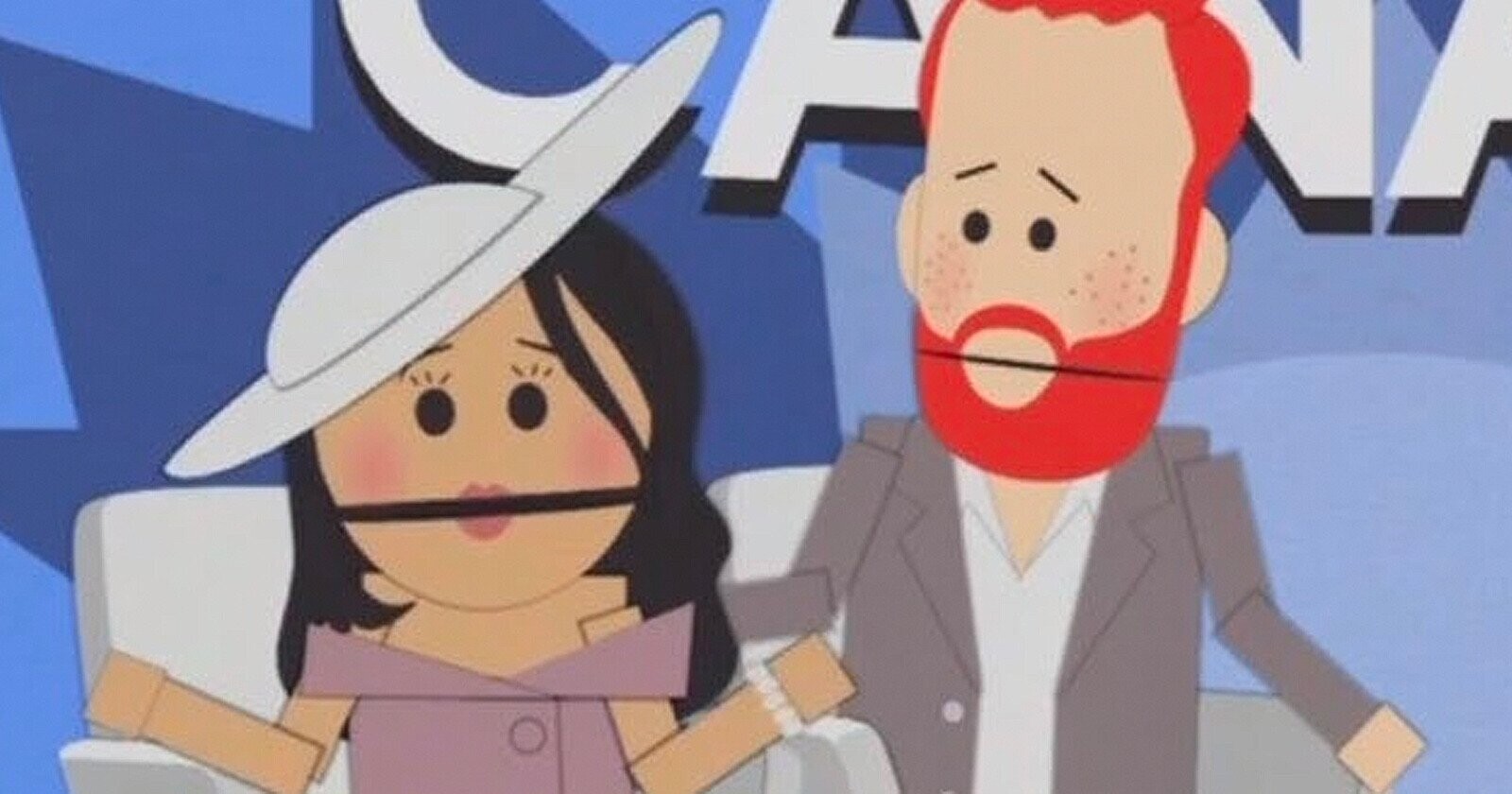
The South Park episode titled “The Worldwide Privacy Tour” aired on February 15, 2023, as the second episode of the show’s 26th season. Its official description said that the Prince of Canada and his wife were trying to find privacy and seclusion in a small mountain town.
The fictional couple was not formally named as Harry and Meghan. However, the visual references were about as discreet as a brass band in a library.
The red-haired prince promoted a memoir that clearly echoed Harry’s bestselling book Spare. His wife wore outfits resembling clothing associated with Meghan. Together, they traveled with signs demanding privacy while appearing on television, promoting products, consulting brand experts, and creating as much attention as possible.
The Joke Was About Privacy, Publicity, and Personal Branding
The episode’s central joke was not merely that two celebrities wanted privacy. It was that they appeared to want privacy while participating in a publicity economy built around documentaries, interviews, books, podcasts, speeches, and carefully managed public identities.
That contradiction had already become a popular criticism of the Duke and Duchess of Sussex. After stepping back from senior royal duties in 2020, they moved to California and pursued media and commercial projects while continuing to discuss their experiences with the royal family and the British press.
Supporters argued that seeking control over personal information is not the same as disappearing from public life. A person can appear in a documentary and still object to photographers following children or newspapers publishing private correspondence. Critics, meanwhile, saw the couple’s media deals as incompatible with their complaints about intrusion.
South Park compressed that complicated debate into 22 minutes of cardboard Canadians, shouting, magazine covers, branding consultants, and the sort of restraint normally displayed by a raccoon inside a bakery.
The Ending Added a More Serious Message
Beneath the insults, the episode offered a broader criticism of celebrity branding. Kyle argues that reducing people to carefully constructed brands turns them into products rather than human beings. The fictional prince eventually appears to understand the point and considers abandoning the publicity machine in favor of an ordinary life.
His wife does not respond, leading to one of the episode’s harshest visual jokes. The fictional prince then leaves the branding office without her.
That final sequence provided perfect fuel for tabloid speculation. Commentators could easily transform an animated couple separating within a fictional scene into a story suggesting that the real Harry and Meghan were also moving in different directions.
How the Marriage-Rift Rumor Took Off
Within days of the broadcast, articles appeared claiming Meghan was “upset” or “overwhelmed” by the parody. Other reports suggested that attorneys for the couple were reviewing the episode and considering legal action. A few commentaries went further, alleging that Harry and Meghan were frustrated enough to be taking their anger out on each other.
The marriage-rift angle was especially attractive to tabloids because it combined three reliable traffic magnets: royalty, relationship trouble, and celebrity humiliation. Add South Park, a show famous for controversy, and editors had a headline buffet.
However, the reports generally relied on unnamed friends, unspecified insiders, royal commentators, or one publication repeating another publication’s account. Readers were given emotion-heavy descriptions but little information about how anyone supposedly knew what was happening inside the couple’s home.
Anonymous Sources Are Not Automatically Unreliable
Responsible journalism sometimes depends on confidential sources. Whistleblowers, government employees, corporate staff members, and people close to sensitive negotiations may face serious consequences for speaking publicly.
The problem arises when anonymity is combined with weak sourcing and sensational conclusions. A source described only as a “friend,” “expert,” or “palace insider” may have direct knowledgeor may simply be repeating gossip.
Strong reporting normally offers additional support: documents, multiple independent sources, specific timelines, direct observations, or an explanation of why the source is positioned to know the information. The South Park marriage-rift stories offered little of that.
The Couple Denied the Legal-Action Reports
On February 21, 2023, a representative for Harry and Meghan rejected reports that they planned to sue over the episode. The spokesperson characterized those stories as nonsense, baseless, and boring.
That denial specifically addressed rumors of a lawsuit. It did not provide a detailed account of how either Harry or Meghan privately felt about every joke in the episode. They may have disliked it, ignored it, laughed at parts of it, or reacted differently from one another. None of those possibilities can responsibly be reported as fact without evidence.
What can be said is that no lawsuit against the show followed, and no credible proof emerged that the episode had caused a marital crisis.
Did ‘South Park’ Actually Cause a Rift Between Harry and Meghan?
There is no verified evidence that it did.
Public figures can experience disagreement after an embarrassing parody. One spouse may want to respond while the other prefers silence. One may find a joke amusing while the other finds it cruel. That would be normal behavior in many marriages, not proof of an approaching separation.
More importantly, outsiders do not have access to the couple’s private conversations. A satirical episode showing fictional royals moving apart cannot be used as evidence that the real couple did the same.
Later Public Events Did Not Support the Dramatic Narrative
In the months and years following the episode, Harry and Meghan continued to appear together at major events. They attended the Invictus Games in Germany in September 2023, traveled together to Nigeria in May 2024, visited Colombia in August 2024, and appeared together at the 2025 Invictus Games in Canada.
These appearances do not prove that every moment of their marriage has been perfect. Public photographs are not marriage certificates of emotional harmony. However, they do demonstrate why predictions of an immediate collapse after the South Park episode were premature.
In December 2024, Harry publicly joked about the relentless divorce speculation, saying that media coverage had apparently divorced the couple many times. His response captured the recurring pattern: separate professional appearances or routine travel schedules are repeatedly converted into evidence of a supposed split.
The prediction often disappears when nothing happens, only to return later wearing a new hat.
Why Harry and Meghan Generate So Many Tabloid Stories
Harry and Meghan occupy a uniquely profitable position in the celebrity ecosystem. They are connected to the British monarchy but no longer operate as traditional working royals. They are public figures who criticize media intrusion while also producing media. They have passionate defenders, passionate critics, and a large audience eager to argue before breakfast.
That combination makes almost any story commercially useful.
They Represent Several Cultural Debates at Once
Coverage of the couple rarely stays limited to clothing, travel, or charity work. Their story touches debates about race, class, monarchy, colonial history, press freedom, family loyalty, mental health, celebrity branding, and the difference between public interest and public curiosity.
As a result, readers often interpret the same event in completely different ways. A documentary may look like honest testimony to one viewer and strategic self-promotion to another. A request for security may appear sensible to supporters and entitled to critics. Even a comedy episode becomes a cultural referendum.
Conflict Produces More Clicks Than Stability
“Married Couple Continues Being Married” is not a headline likely to send editors dancing through the newsroom. Conflict is more marketable.
Relationship stories are especially effective because they invite readers to participate as amateur detectives. A missing wedding ring, separate entrance, postponed appearance, changed facial expression, or solo business project can become a “clue.” When direct evidence is unavailable, body-language experts and anonymous insiders can keep the narrative alive.
The resulting story may sound detailed while remaining almost impossible to verify.
What ‘South Park’ Got Right About the Celebrity Economy
The episode’s sharpest observation was not necessarily about Harry or Meghan as individuals. It was about an industry in which identity becomes a product.
Modern public figures are expected to maintain a recognizable brand across interviews, social media, streaming programs, books, charitable work, product launches, and public appearances. Every project must reinforce a story about who they are.
Authenticity itself becomes part of the marketing plan.
Privacy Is More Complicated Than Silence
Public participation does not eliminate the right to private family life. An actor who promotes a movie is not inviting strangers into a child’s school. An author who publishes a memoir is not automatically consenting to hacked messages or illegally obtained medical information.
At the same time, extensive media exposure can make privacy arguments harder to communicate. Audiences may struggle to distinguish between information voluntarily shared and information obtained without permission.
The Sussexes’ critics frequently collapse those categories. Their defenders sometimes dismiss legitimate questions about how personal stories are commercialized. The truth is less convenient for both camps: privacy and publicity can coexist, but the boundary requires constant explanation.
Satire Works by Simplifying Contradictions
Satire does not need to provide a balanced legal brief. It selects a contradiction, enlarges it, adds absurdity, and invites the audience to recognize the target.
That is why “The Worldwide Privacy Tour” was effective television. The image of celebrities loudly demanding to be left alone while marching past cameras was simple, visual, and instantly understandable.
It was also incomplete. Comedy can capture a public contradiction without explaining the security concerns, lawsuits, racism allegations, family history, or press practices surrounding it. A joke may contain insight without containing the entire truth.
The Real Rift May Be Between Facts and the Tabloid Business Model
The most revealing part of the controversy was not whether Meghan disliked a cartoon. Most people would be less than thrilled to see themselves portrayed as an empty-headed publicity machine on international television.
The revealing part was how quickly a plausible emotional reaction became a reported marital crisis.
The progression looked something like this: the show mocked the couple; commentators assumed the couple was angry; unnamed sources supposedly confirmed emotional distress; articles suggested legal action; additional articles predicted relationship trouble; and social media presented the entire chain as established fact.
At each step, the wording became slightly more confident.
“May have caused tension” became “caused tension.” “Reportedly upset” became “furious.” A fictional separation became a real marriage rift. By the time the story reached social platforms, uncertainty had been polished away like an inconvenient fingerprint.
This is not unique to royal coverage. The same process affects politicians, athletes, actors, musicians, and online creators. Speculation becomes content, content becomes repetition, and repetition begins to feel like confirmation.
Experiencing Viral Satire: What Public Scrutiny Can Do to Real People
Being mocked by a globally recognized television series is not an ordinary experience. Even people who willingly enter public life may find mass ridicule disorienting, particularly when the jokes are followed by millions of strangers analyzing their reactions.
A public figure cannot simply experience embarrassment in private. The embarrassment becomes a second story. Commentators ask whether the person cried, shouted, contacted lawyers, blamed a spouse, fired an adviser, or secretly watched the episode six times while angrily reorganizing a decorative pillow collection.
The subject is expected to respond, yet every response carries a cost.
Responding Can Make the Story Bigger
A detailed rebuttal may extend the controversy and inspire another news cycle. Silence may be interpreted as humiliation. Humor may be accused of feeling forced. Anger may be presented as proof that the satire was accurate.
This creates a no-win communication problem. Public-relations professionals often recommend refusing to feed a short-lived story, but silence leaves an information vacuum. Tabloids are rarely shy about furnishing that vacuum with anonymous insiders and dramatic adjectives.
Harry and Meghan’s representative chose a brief response to the legal rumors rather than a long defense. By calling the reports baseless and boring, the statement attempted to reduce the story’s importance rather than debate every allegation.
Couples Under Scrutiny Lose Control of Ordinary Moments
For heavily photographed couples, routine independence can be framed as emotional distance. Separate work projects become evidence of separate lives. One spouse traveling alone becomes a sign of abandonment. A serious expression becomes anger. A glance in another direction becomes a body-language emergency.
This level of interpretation can place unusual pressure on any relationship. Partners may need to discuss not only what they feel but how each public action could be edited into a narrative. Decisions that ordinary couples make casuallywho attends an event, who speaks first, who stays home with the childrencan become international entertainment.
That does not mean every celebrity-rift report is false. Famous couples separate like everyone else. It means the public should distinguish between observable facts and stories built from interpretation.
Audiences Also Participate in the Experience
Readers and viewers are not passive. Every click rewards a headline. Every angry repost extends its reach. Even comments criticizing a tabloid story may help the story trend.
A useful habit is to pause before sharing and ask several questions. Is there a named source? Did either person confirm the claim? Is the article reporting an event or interpreting an image? Are multiple outlets independently verifying the information, or are they all citing the same original rumor?
These questions do not remove the fun from celebrity coverage. They simply prevent entertainment from dressing up as evidence.
Humor Can Reveal Truth Without Becoming Proof
The South Park episode successfully highlighted the awkward relationship between celebrity privacy and celebrity branding. Viewers were free to find it brilliant, cruel, accurate, unfair, or some chaotic combination of all four.
What the episode could not do was provide evidence about the private condition of Harry and Meghan’s marriage. Animated satire is commentary, not surveillance footage from a marital counseling session.
The experience offers a broader lesson. A joke can shape public perception more effectively than a detailed investigation because it gives audiences an unforgettable image. Once the fictional prince walked away from his fictional wife, tabloids possessed an easy metaphor. The temptation to treat that metaphor as reality was apparently irresistible.
Conclusion: A Great Headline Is Not the Same as a Verified Story
“The Worldwide Privacy Tour” was a sharp and deliberately brutal parody of Prince Harry and Meghan Markle’s public image. It mocked their media strategy, privacy messaging, commercial projects, and transformation from working royals into globally marketed personalities.
What it did not do was establish that their real marriage was in trouble.
British tabloids and commentators used the episode to build a larger story involving anger, legal threats, private arguments, and marital tension. The legal-action reports were publicly denied, while the rift claims remained unverified. Later appearances showed Harry and Meghan continuing to work and travel together, although no public event can fully describe a private relationship.
The fairest conclusion is also the least sensational: the couple may not have enjoyed being mocked, but there is no reliable evidence that a cartoon caused a meaningful rupture in their marriage.
Unfortunately, “Famous Couple Possibly Annoyed by Mean Television Episode” lacks the sparkle of a royal crisis. Somewhere, a tabloid headline writer is already reaching for stronger adjectives.