
Editorial note: This article is an original, web-ready analysis based on publicly available defense reporting, open-source intelligence, and policy materials. It discusses the S-70 Okhotnik-B as a military technology and does not provide operational instructions.
Introduction: Meet the “Hunter”
Russia’s first autonomous strike drone sounds like something that should arrive with thunder, dramatic music, and possibly a villain stroking a white cat. In reality, the Sukhoi S-70 Okhotnik-B, commonly called “Hunter,” entered the public imagination in a much less cinematic way: blurry runway images, official test videos, bold state-media promises, and eventually, wreckage scattered near the front lines in Ukraine.
The S-70 Okhotnik-B is not a small quadcopter, not a hobbyist gadget with a grenade taped to it, and definitely not the kind of drone your neighbor crashes into a maple tree during a Fourth of July barbecue. It is a heavy unmanned combat aerial vehicle, or UCAV, developed by Sukhoi with support from Russia’s broader military aviation industry. Its mission concept is ambitious: fly deep, carry weapons internally, operate with a degree of autonomy, and support manned aircraft such as the Su-57 fighter.
That makes the Hunter one of the most interesting and controversial Russian drone programs of the modern era. It sits at the intersection of stealth aircraft design, artificial intelligence, electronic warfare, manned-unmanned teaming, and the brutal lessons of the Russia-Ukraine war. On paper, it looks like Russia’s answer to the future of air combat. In practice, the story is messier, and far more revealing.
What Is the S-70 Okhotnik-B?
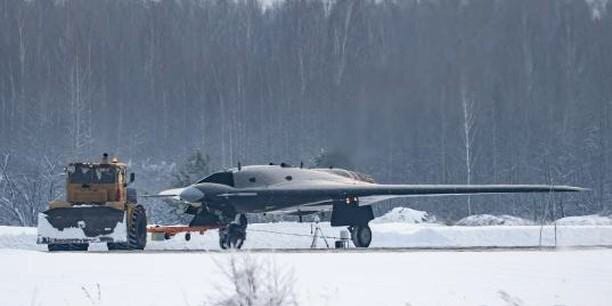
The S-70 Okhotnik-B is a large, jet-powered unmanned combat aircraft designed in a flying-wing configuration. “Okhotnik” means “Hunter” in Russian, which is a dramatic name, though admittedly better branding than “Large Gray Triangle That May Or May Not Be Ready.”
The drone has been described as weighing roughly 20 tons, with a wingspan of about 19 to 20 meters. That puts it in a very different category from the small first-person-view drones that dominate many battlefield videos from Ukraine. The S-70 is closer to a pilotless combat aircraft than a tactical battlefield drone. It was designed to carry weapons internally, reduce radar visibility, and perform reconnaissance or strike missions in high-threat airspace.
Its flying-wing shape is significant. Aircraft with this layout lack a traditional tail and fuselage, which can help reduce radar reflections when the design is executed properly. The visual comparison many observers make is to American stealth aircraft such as the B-2 bomber or certain experimental unmanned systems. Of course, looking stealthy and being stealthy are not the same thing. A black hoodie does not make someone a ninja, and a flying wing does not automatically make a drone invisible.
Why “Autonomous” Does Not Mean “Robot Overlord”
The phrase “autonomous strike drone” can sound alarming, and for good reason. In defense technology, autonomy refers to a system’s ability to perform certain tasks with limited human input. That can include navigation, flight control, target recognition support, mission following, or coordination with other aircraft. It does not always mean a machine independently decides everything from takeoff to weapons release.
The S-70 has been described as capable of automated flight and as a platform that may support missions directed by ground operators or Su-57 pilots. In other words, autonomy is better understood as a spectrum. On one end, a drone follows direct human commands moment by moment. On the other, it can select and engage targets without further human intervention. Most real-world military systems sit somewhere in between, and governments are often intentionally vague about exactly where.
That ambiguity is part of the debate. Autonomous weapons raise legal, ethical, and strategic questions: Who is responsible if a system makes a mistake? How much human judgment is enough? Can an autonomous aircraft perform reliably in an environment saturated with jamming, spoofing, decoys, and broken communications? The S-70 is not just an aircraft program; it is a flying test case for these questions.
The Su-57 Connection: A Loyal Wingman With Russian Characteristics
One of the most important ideas behind the Okhotnik-B is manned-unmanned teaming. Russia has promoted the concept of pairing the S-70 with the Su-57, its fifth-generation fighter. In this role, the drone could act as a “loyal wingman,” flying ahead of or alongside a crewed jet to scout, extend sensor coverage, carry weapons, or attack dangerous targets while keeping the pilot farther from harm.
The logic is simple: pilots are expensive to train, politically costly to lose, and inconveniently human. A large combat drone can take risks that commanders might hesitate to assign to a crewed aircraft. It can probe defended airspace, carry weapons, and share data with manned platforms. If it survives, wonderful. If it does not, nobody has to send a rescue helicopter for the pilot.
In theory, one Su-57 could coordinate multiple S-70 drones. That would allow a manned fighter to operate less like a lone aircraft and more like the quarterback of an airborne team. The concept mirrors trends in the United States and other countries, where collaborative combat aircraft are being developed to support next-generation air operations.
But theory is where defense brochures live their best lives. Turning the concept into reliable combat performance is much harder. The aircraft must communicate securely, resist electronic attack, interpret mission data, and behave predictably under stress. A loyal wingman that wanders off at the worst possible moment is less “future of war” and more “very expensive Labrador without recall training.”
Design Features: Stealth Shape, Heavy Payload, Big Questions
The S-70’s design points to several intended roles. Its size suggests long range and meaningful payload. Its internal weapons bay suggests the designers wanted to preserve a reduced radar profile while carrying bombs or missiles. Its jet engine gives it far more speed and altitude potential than propeller-driven drones.
Reported figures vary, but public estimates often describe the Hunter as capable of high subsonic speeds and long-distance missions. It has been associated with air-to-ground strike roles, reconnaissance, and possibly air-to-air concepts. Reports after the Ukraine crash suggested the drone may have been carrying or testing glide bombs, which would fit the idea of using it as a stand-off strike platform.
Still, several questions remain. Early images showed a conventional round exhaust nozzle, which is not ideal for stealth because it can increase radar and infrared signatures. Later versions appeared to feature a flatter nozzle, indicating an effort to improve low-observable characteristics. That change matters because stealth is not one magic trick. It is a whole cookbook of shaping, materials, heat management, sensors, emissions discipline, and maintenance. Forget one ingredient, and the soufflé collapses.
From Test Flights to Combat Reality
The Okhotnik-B first attracted major public attention in 2019, when images and videos showed the aircraft during ground trials and flight testing. Russian officials presented it as a major leap forward for the country’s unmanned aviation sector. Later footage showed the S-70 flying alongside a Su-57, reinforcing the loyal-wingman narrative.
For Russia, the program served several purposes. It showed domestic audiences that the aerospace industry could still produce advanced systems. It signaled to foreign rivals that Moscow was pursuing artificial intelligence and unmanned strike aviation. It also offered a potential answer to a real military problem: how to conduct high-risk air operations without losing pilots or expensive manned aircraft.
Then came Ukraine, where drone warfare stopped being a futuristic PowerPoint slide and became daily reality. The war showed that unmanned systems can reshape reconnaissance, artillery targeting, air defense, logistics, and long-range strikes. Cheap drones became deadly. Electronic warfare became essential. Innovation cycles shrank from years to weeks. In that environment, the S-70 looked both impressive and vulnerable.
The 2024 Ukraine Incident: A Costly Reality Check
In October 2024, an aircraft identified as an S-70 Okhotnik-B crashed near Kostyantynivka in eastern Ukraine. Open-source imagery and reporting suggested that the drone may have been shot down by a Russian fighter after Russia lost control of it. The reported reason was brutally practical: better to destroy the drone than let Ukraine and its allies study it intact.
That is where the story turned from “look at our futuristic combat drone” into “please do not look too closely at our futuristic combat drone.” Ukrainian personnel reportedly recovered parts of the wreckage, and later claims pointed to Western-made components inside the system. That finding echoed a broader pattern in the war: despite sanctions and export controls, Russia has continued to obtain foreign electronics through gray markets, intermediaries, recycled components, and complex supply chains.
The crash mattered for several reasons. First, it suggested the S-70 was being tested or used in a real combat environment. Second, it showed that even advanced drones remain vulnerable to loss of control, electronic interference, and battlefield chaos. Third, it may have handed Ukrainian and Western analysts a valuable opportunity to examine Russian design choices, components, and weaknesses.
For a prototype-heavy program, losing even one aircraft can hurt. These are not disposable quadcopters printed by the thousands. They are expensive, rare, and packed with lessons engineers would prefer not to share with the other team.
Why the Hunter Matters Beyond Russia
The S-70 is important not because it proves Russia has mastered autonomous air combat, but because it shows where major militaries are trying to go. The future of airpower is likely to include teams of crewed and uncrewed aircraft, with drones handling dangerous, dull, or high-risk missions. The pilot may increasingly become a mission commander, supported by semi-autonomous systems that sense, jam, scout, strike, or decoy.
This shift could change the economics of air combat. Traditional fighter jets are staggeringly expensive. Training pilots takes years. Stealth aircraft require enormous maintenance support. If a military can add unmanned aircraft that are cheaper than crewed fighters but more capable than small drones, it may gain flexibility. That is the promise behind platforms like the S-70.
But there is a catch. Large autonomous strike drones are not automatically cheap, simple, or expendable. The Hunter appears closer to a high-end aircraft than a mass-produced battlefield drone. That means it may carry many of the same burdens as manned aviation: complex manufacturing, sensitive electronics, limited production capacity, difficult testing, and expensive losses.
The Ukraine war has delivered an uncomfortable lesson to every military planner: quantity has a quality all its own. A gorgeous stealth drone that exists in tiny numbers may be less strategically useful than a swarm of cheap systems that can be produced, lost, adapted, and replaced quickly. The future may belong not to one perfect robot falcon, but to thousands of ugly little sky gremlins with software updates.
Autonomy, Electronic Warfare, and the Messy Middle
The strongest argument for autonomy is that communication links can fail. In a jammed environment, a drone that depends entirely on remote control may become useless. Autonomy can allow an aircraft to continue flying, return home, follow a mission plan, or avoid hazards when operators cannot communicate with it.
The strongest argument against autonomy is that war is full of surprises. Sensors misread objects. Maps become outdated. Targets move. Civilians appear. Decoys fool algorithms. Weather changes. A system that works in testing may behave unpredictably under electronic attack. Autonomous military systems need rigorous validation, human oversight, and clear rules for use.
The reported loss of the S-70 illustrates this messy middle. A drone may be advanced enough to fly with limited human control, but not mature enough to recover from every battlefield disruption. It may be capable enough to carry precision weapons, but not reliable enough to prevent a humiliating loss. It may be stealthy enough for a brochure, but not stealthy enough to avoid becoming a souvenir pile.
How the S-70 Compares With Other Drone Trends
The Hunter should not be confused with Russia’s mass use of Shahed-type one-way attack drones. Those systems are cheaper, simpler, and designed for saturation strikes against infrastructure and military targets. They are not stealthy loyal wingmen. They are flying explosives with endurance, persistence, and a very unpleasant work ethic.
The S-70 sits in a different category. It is a reusable combat aircraft intended for sophisticated missions. Its value would come from range, survivability, payload, and integration with other aircraft. That makes it more comparable to high-end UCAV concepts than to loitering munitions.
Still, the war has blurred categories. Cheap drones are gaining better navigation and autonomy. Long-range attack drones are becoming harder to intercept. Interceptor drones are hunting other drones. Missiles, glide bombs, and unmanned aircraft are being combined in new ways. The S-70 is one piece of a much larger transformation in which the sky is becoming more crowded, more automated, and much less forgiving.
Russia’s Strengths and Weaknesses in Drone Development
Russia has strengths that should not be dismissed. It has a deep aerospace tradition, experienced design bureaus, combat experience, and a willingness to test systems under harsh conditions. The S-70 program benefits from Sukhoi’s aircraft knowledge and from Russia’s interest in substituting machines for personnel in dangerous missions.
But Russia also faces serious constraints. Sanctions have limited access to advanced components. Brain drain and industrial bottlenecks can slow innovation. Quality control has been a recurring concern across several Russian weapons programs. The war has forced urgent production priorities, often favoring systems that can be made quickly and used immediately.
That creates a strategic tension. Russia may want the S-70 as a symbol of next-generation power, but the battlefield demands practical tools now. A heavy stealth UCAV is impressive, but a drone that can be built by the thousands may have more immediate impact. The Hunter may therefore become less a mass battlefield weapon and more a specialized platform for high-value missions, experimentation, and prestige.
Experience Section: What Watching the Hunter Teaches About the Drone Age
Following the S-70 Okhotnik-B story offers a useful experience in separating military reality from military theater. Every country with a defense industry knows how to unveil a futuristic machine under flattering lighting. The aircraft rolls out, officials smile, cameras click, and the public hears phrases like “next generation,” “game changing,” and “unmatched capability.” Somewhere nearby, an engineer quietly stares at a clipboard and wonders whether the landing gear sensor will behave today.
The Hunter reminds us that advanced drone development is not a straight road. It is a bumpy runway full of delays, redesigns, budget fights, technical compromises, and battlefield feedback. A system can be impressive and immature at the same time. It can represent real progress while also exposing serious weaknesses. That is exactly what makes the S-70 so interesting.
One practical lesson is that autonomy is only as valuable as reliability. A drone that can fly itself in calm conditions is useful. A drone that can keep functioning when navigation is jammed, communications are degraded, and enemy sensors are hunting it is far more valuable. The gap between those two things is where many programs struggle. Combat is the world’s rudest product tester. It does not care about prototypes, slogans, or animated promotional videos.
Another lesson is that expensive drones face a harsh identity crisis. If they cost too much, commanders hesitate to risk them. If they are too rare, losing one becomes a strategic embarrassment. If they are too complex, production slows. But if they are too simple, they may not survive advanced air defenses. The perfect balance is difficult, and the S-70 has not yet proven that it found it.
The Ukraine war also shows that small drones and large drones solve different problems. A small FPV drone can change a firefight. A Shahed-type drone can pressure air defenses and infrastructure. A heavy UCAV like the S-70 aims at a different mission: penetrating or supporting operations in contested airspace. The temptation is to rank them like sports cars, but that misses the point. The battlefield is not asking, “Which drone is coolest?” It is asking, “Which drone solves today’s problem at a price we can afford?”
For readers, analysts, and policymakers, the Hunter is a case study in humility. It is easy to laugh at a failed test or a friendly-fire shootdown, and yes, sometimes the jokes write themselves. But behind the embarrassment is a serious trend: militaries are moving toward more autonomous, more networked, and more numerous unmanned systems. Some will fail spectacularly. Some will quietly improve. A few may reshape air combat.
The best way to understand the S-70 is not as a finished superweapon, but as a signpost. It points toward a future where aircraft are not always piloted, where human decision-making is distributed across teams of machines, and where the line between drone, missile, decoy, sensor, and aircraft continues to blur. The Hunter may or may not become the weapon Russia hoped for. But the era it represents has already arrived.
Conclusion: A Flying Warning About the Future of War
The S-70 Okhotnik-B is Russia’s most visible attempt to build a large autonomous strike drone for high-end warfare. It combines stealth-inspired shaping, heavy payload potential, jet performance, and a concept of operation tied to the Su-57 fighter. It is ambitious, expensive, and strategically meaningful.
Yet the Hunter’s story is not a simple tale of Russian technological triumph. It is also a story of uncertainty, delays, component dependence, battlefield testing, and the unforgiving reality of electronic warfare. The 2024 crash in Ukraine showed that a futuristic drone can still become a very old-fashioned intelligence prize when something goes wrong.
For SEO readers searching “Russia autonomous strike drone,” “S-70 Okhotnik-B,” or “Russia Hunter drone,” the key takeaway is this: the Hunter matters because it reveals the direction of modern air combat, not because it has already mastered it. The future will likely include autonomous and semi-autonomous combat aircraft, but that future will be shaped by reliability, production scale, human oversight, and battlefield adaptation.
Russia’s first autonomous strike drone is not just a weapon. It is a warning label with wings.