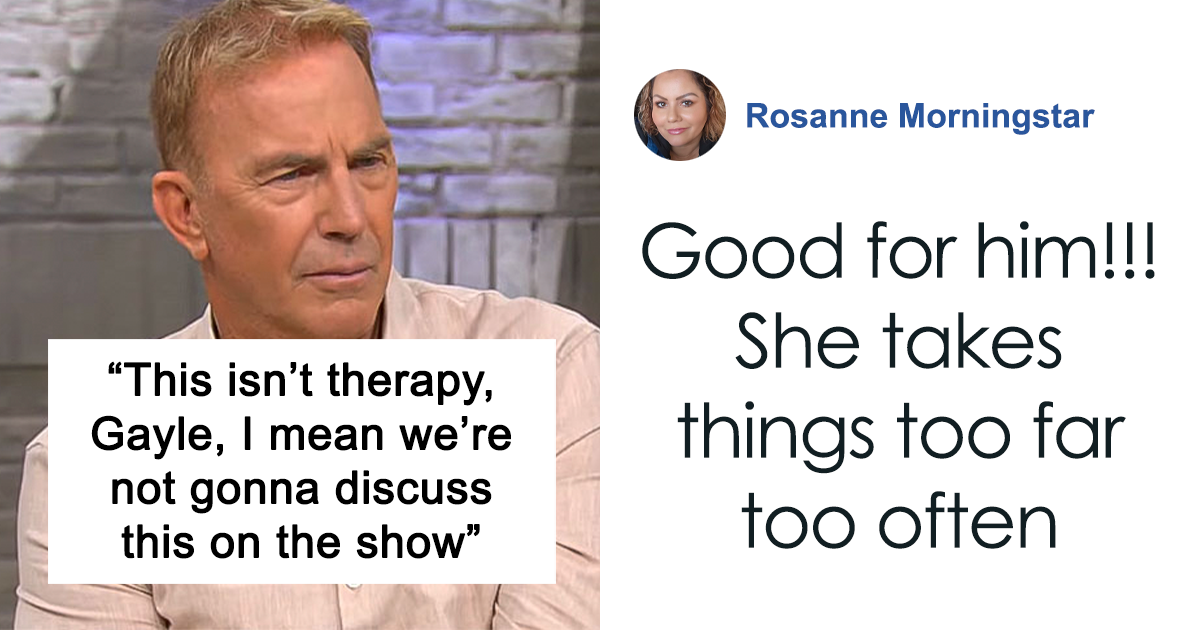
“This Isn’t Therapy”: Kevin Costner Claps Back At Journalist’s Question About Yellowstone

Kevin Costner went on morning television to promote an enormous Western movie. Gayle King, speaking for millions of curious Yellowstone fans, wanted to talk about the ranch-sized elephant in the room. What followed was not a shouting match, a celebrity meltdown, or an old-fashioned duel at sunrise. It was something much more interesting: a veteran actor calmly deciding exactly where an interview would stop.
Kevin Costner’s “This Isn’t Therapy” Moment Explained
During a June 2024 appearance on CBS Mornings, Kevin Costner sat down with Gayle King while promoting Horizon: An American SagaChapter 1. The interview naturally turned toward his highly publicized departure from Yellowstone, the Paramount Network drama in which he had played powerful Montana rancher John Dutton since 2018.
King did not approach the subject with a tiny spoon. She brought the full excavation equipment.
She raised the widespread theory that Costner’s ambitious Horizon project had created difficulties for Yellowstone. She also asked whether Costner and series creator Taylor Sheridantwo successful, influential figures with firm creative opinionshad become trapped in a contest of competing egos.
Costner rejected that interpretation. He emphasized that he loved the series and had supported it from its earliest days. He also suggested that he would have considered returning if the circumstances, material, and schedule had made sense.
King continued pressing. If the disagreement was not simply a battle of egos, she asked, why could the two men not work it out?
That was when Costner delivered the line that immediately traveled across entertainment websites and social media: “This isn’t therapy, Gayle.” He added that they were not going to unpack the private dispute on the program and defended his professional history, saying he had never failed to meet his career obligations.
Was Kevin Costner Really “Clapping Back”?
Headlines described the exchange as tense, testy, or confrontational. Those descriptions were not entirely unreasonable, but they can create an image of Costner angrily kicking over a studio coffee table while dramatic Western music plays in the background.
The actual moment was more controlled.
Costner did not insult King, refuse to answer every question, or storm off the set. His tone was firm, with a dash of dry humor. King responded that she was a good therapist, briefly lightening the exchange before the conversation moved forward.
The phrase “claps back” works as internet shorthand because Costner challenged the premise of the question and established a boundary. Yet the more accurate description may be that he declined to turn a complicated professional separation into a televised relationship-counseling session.
Gayle King Was Doing Her Job
It is equally important not to portray King as a villain armed with nothing but invasive questions and a suspiciously cheerful morning-show mug.
Yellowstone was one of television’s biggest dramas, and John Dutton was central to its identity. Costner’s uncertain status had generated months of rumors involving scripts, shooting schedules, money, creative disagreements, and his commitment to Horizon. Viewers understandably wanted a clear explanation.
King’s job was to ask the questions audiences were already discussing. Costner’s job was not necessarily to answer them in the form she requested. That tensionbetween a journalist seeking specificity and a public figure protecting private negotiationsis what made the exchange compelling.
Why Kevin Costner Left Yellowstone
The public dispute was never as simple as “Kevin Costner chose one Western over another.” It involved a shifting production timetable, a divided final season, missing or unfinished scripts, contractual negotiations, and the extraordinary logistical demands of Costner’s self-financed film saga.
Season 5 Was Divided Into Two Parts
Yellowstone Season 5 was expanded and separated into two installments. Costner later said the arrangement created serious scheduling complications because filming would require more than one production period. That mattered because he was simultaneously organizing Horizon, a decades-long passion project in which he served as director, producer, co-writer, and star.
Reports initially suggested that Costner wanted to reduce his time on the Yellowstone set. His camp disputed the idea that he had casually abandoned the series. Costner maintained that he had adjusted his schedule for the show and that production delays, rather than a sudden lack of commitment, caused the collision between the two projects.
The Scripts Became Part of the Disagreement
Costner repeatedly referred to uncertainty surrounding the scripts for the second half of Season 5. He argued that he could not indefinitely reserve large sections of his calendar without knowing exactly when or what he would be filming.
From a production perspective, this was not a disagreement that could be solved by telling two powerful men to shake hands, hug near a horse trailer, and promise to communicate better. Major television shows coordinate hundreds of performers, crew members, locations, contracts, and release plans. Meanwhile, Horizon was not a weekend hobby Costner had scheduled between golf games. It was a vast multipart movie project carrying substantial personal and financial risk.
The situation became public in 2023, when reports described scheduling disagreements among Costner, Sheridan, Paramount, and the show’s producers. Paramount eventually confirmed that Yellowstone would conclude with its fifth season. Costner later announced directly to fans that he would not return for the final episodes.
Costner’s Defense of His Yellowstone Record
Costner’s most important response to King was not the therapy line. It was his insistence that he had behaved professionally.
By saying he had fulfilled his obligations throughout his career, Costner was addressing a narrative larger than one television interview. He appeared frustrated by reports suggesting that he had become difficult, demanded excessive concessions, or placed his movie ahead of the series without regard for colleagues.
His version of events was that he had supported Yellowstone, adapted his plans, waited through delays, and remained open to returning if a workable proposal emerged. He also expressed disappointment that people connected to the production had not publicly defended him when negative stories circulated.
That does not prove every scheduling decision favored Costner’s account. Production disputes rarely come with a perfectly innocent cowboy in a white hat and an obviously guilty outlaw twirling a mustache. It does explain why King’s question touched a nerve. To Costner, the issue was not merely whether he and Sheridan liked each other. It concerned his reputation for reliability after decades in the film industry.
What Costner Did Not Reveal
Costner never provided a complete private record of negotiations, nor was he required to do so. He did not disclose every conversation with Sheridan, every contractual proposal, or every attempted compromise.
His restraint left room for competing interpretations. Supporters viewed him as an established filmmaker refusing to accept an unfair public narrative. Critics saw an actor whose personal project contributed to the disruption of a successful series. The available reporting suggests that scheduling conflicts, production delays, creative uncertainty, and competing priorities all played roles.
In other words, the real explanation is annoyingly complicated. The internet generally prefers a feud that can be summarized using one angry emoji.
How Horizon Changed the Conversation
Horizon: An American Saga was central to the controversy because it demonstrated the scale of Costner’s commitment outside Yellowstone. He invested heavily in the project and intended it as a multipart exploration of Western expansion, migration, conflict, survival, and the myths surrounding America’s frontier.
Costner was not merely collecting an acting paycheck. He had tied his creative reputation and a remarkable amount of personal money to the films. The first chapter premiered at the Cannes Film Festival before opening in American theaters on June 28, 2024the day after widespread coverage of his exchange with King.
The project’s unconventional structure and financial risk made it one of the boldest undertakings of Costner’s career. It also made his calendar considerably less flexible than that of an actor waiting for a call sheet.
When Costner said it was time to move on from Yellowstone, he described the decision as painful but necessary. He continued expressing affection for the show, its world, and its audience even while closing the door on his return.
The Costner-Sheridan Relationship Was Bigger Than a Simple Feud
Kevin Costner and Taylor Sheridan were essential to Yellowstone in different ways. Sheridan supplied the show’s distinctive voice, family warfare, political conflicts, and modern-Western mythology. Costner gave the series a recognizable center of gravity.
John Dutton could be ruthless, stubborn, tender, hypocritical, and strangely persuasivesometimes within the same scene. Costner’s presence helped transform the character from a standard television patriarch into a cultural symbol. His weathered authority made even John’s least defensible decisions sound as though they had been carved into a stone tablet somewhere in Montana.
Sheridan acknowledged that Costner’s departure affected the planned conclusion of John Dutton’s story. Costner, meanwhile, continued crediting Sheridan and expressing affection for the series. That combination does not look like a simple friendship, but neither does it resemble total personal hatred.
Creative partnerships can contain respect, frustration, loyalty, resentment, and incompatible schedules simultaneously. Hollywood may market stories in neat three-act structures, but Hollywood disagreements generally arrive as a drawer full of tangled charging cables.
Why the Interview Moment Resonated With Viewers
The “this isn’t therapy” remark became memorable because it applied far beyond celebrity interviews.
Many people have experienced a conversation in which someone asks a fair question using an unhelpful frame. A manager asks why two coworkers cannot “just work it out,” ignoring structural problems. A relative demands the complete emotional history behind a career decision during dinner. A stranger decides that one awkward moment entitles them to the director’s commentary for your entire life.
Costner’s response appealed to viewers who recognized the value of a boundary. He did not claim the subject was unimportant. He indicated that the setting was not appropriate for a deeper personal discussion.
At the same time, King’s persistence resonated with fans tired of vague celebrity answers. Audiences had followed Yellowstone for years. They wanted to know why its central star would be absent from the conclusion. King briefly became the representative of everyone shouting, “Yes, but what actually happened?” at their televisions.
Both instincts were understandable. That is why the exchange produced more discussion than a standard promotional interview filled with compliments, trailers, and cheerful reminders to buy tickets.
What Happened to Yellowstone Without Kevin Costner?
Yellowstone returned for its final episodes in November 2024 without Costner physically appearing as John Dutton. The story addressed the patriarch’s absence immediately and shifted its emotional focus toward Beth, Kayce, Jamie, Rip, and the future of the ranch.
The series concluded on December 15, 2024, ending its five-season run after 53 episodes. Critical reactions to the final stretch were mixed, with some reviewers arguing that Costner’s absence weakened the show’s dramatic foundation. Others found that the finale delivered an appropriate resolution to the central conflict over the Dutton land.
Whatever viewers thought of the ending, the final episodes confirmed how closely Yellowstone had been associated with Costner. John Dutton’s shadow remained over the story even when the actor was no longer standing beneath the ranch’s enormous sky.
Experience-Based Lessons From the Kevin Costner Interview
The most useful way to examine this celebrity exchange is not to pretend we know every private detail. It is to compare it with familiar experiences involving workplace exits, public questions, professional reputations, and personal boundaries.
Lesson 1: A Simple Question Can Contain a Faulty Assumption
“Why can’t you work it out?” sounds reasonable. In many professional situations, however, it assumes the disagreement is primarily emotional. Sometimes the actual obstacle is contractual, logistical, financial, or structural.
Imagine two department leaders being asked why they cannot settle a scheduling dispute. One controls a project requiring six uninterrupted months. The other needs the same employees during that exact period. The problem may not disappear because everyone admits their feelings and shares a respectful handshake.
Costner’s response reflected that frustration. King’s question emphasized the relationship between two men. Costner wanted the discussion centered on obligations, schedules, scripts, and his record of completing work.
Lesson 2: Setting a Boundary Does Not Require Creating a Scene
People often believe boundaries must be delivered as dramatic ultimatums. In practice, the most effective version can be brief: this topic is private, this setting is inappropriate, or this question goes beyond what I am willing to discuss.
Costner’s line worked because it was clear and memorable. He did not spend ten minutes arguing about whether King was allowed to ask. He simply declined the invitation to analyze the relationship on television.
That approach can be useful during performance reviews, family conversations, media interviews, and workplace conflicts. A calm refusal is still a refusal. Volume is not the same thing as strength.
Lesson 3: Reputation Becomes Personal
Professionals frequently react more strongly to claims about reliability than to criticism of a single decision. A person may accept that a project ended badly while objecting fiercely to the suggestion that they were lazy, dishonest, or irresponsible.
Costner had spent decades directing, producing, financing, and starring in demanding productions. Reports questioning his commitment to Yellowstone therefore challenged the identity he had built around professional responsibility.
This is a familiar experience for business owners, freelancers, managers, and creative workers. A disagreement over one deadline can suddenly become a judgment about character. Once that happens, conversations become more emotionally chargedeven when someone insists the conversation is not therapy.
Lesson 4: Public Silence Creates a Vacuum
When negotiations remain confidential, outside observers fill the missing space with theories. One side is labeled difficult. The other is called controlling. Every delayed production photo becomes evidence in a case nobody has actually been authorized to investigate.
Costner and the Yellowstone team offered limited information for long periods, which was understandable from a legal and professional perspective. Unfortunately, silence rarely stops speculation. It merely gives speculation better parking.
Organizations can learn from this. When a major employee, founder, or creative leader leaves, a carefully prepared factual statement may prevent rumors from becoming accepted history. It does not need to expose confidential negotiations, but it should explain timelines, responsibilities, and next steps clearly.
Lesson 5: Two People Can Both Have Legitimate Priorities
Costner wanted to complete an enormous personal film project. Sheridan and Paramount needed to finish a hit television series involving a large ensemble and complicated production machinery. Neither objective was ridiculous.
Conflicts often become destructive when observers insist that only one priority can be legitimate. In reality, two reasonable plans may be impossible to execute simultaneously. The result can still be disappointing without requiring one participant to be declared the official villain.
That may be the most mature reading of the Yellowstone split. A hugely successful partnership reached a point where its timelines, creative plans, and business needs no longer aligned. Fans lost the conclusion they originally expected, Costner moved toward Horizon, and the series found another route to its ending.
Conclusion: A Firm Answer in a Complicated Hollywood Story
Kevin Costner’s “this isn’t therapy” response became a headline because it was sharp, funny, and delivered during an already sensitive discussion. Yet reducing the interview to a celebrity clapback misses the more revealing story.
Gayle King asked a legitimate question on behalf of an enormous fan base. Costner gave a legitimate answer about the limits of that conversation. Between them sat years of production delays, scheduling conflicts, unfinished negotiations, financial risks, creative ambitions, and competing accounts of what went wrong.
The exchange did not solve the mystery of Costner’s Yellowstone exit. It clarified something else: he would discuss his work, defend his reputation, and express love for the show, but he would not publicly dissect his relationship with Taylor Sheridan simply because a television interview offered the opportunity.
For a man famous for playing a rancher who protected his boundaries with horses, lawyers, political power, and the occasional trip to the train station, a firm verbal boundary was probably the gentlest possible option.