This Sweden-Based Artist Creates Punny Doodles That Might Change The Way You Look At Some Words (35 New Pics)

Some artists paint sunsets. Some sculpt marble. Nadia Tolstoy takes ordinary English words, gives them a tiny mischievous twist, and suddenly your brain is laughing at a “cat-a-log” like it just discovered comedy for the first time.
Meet Nadia Tolstoy, the Artist Behind the Punny Doodles
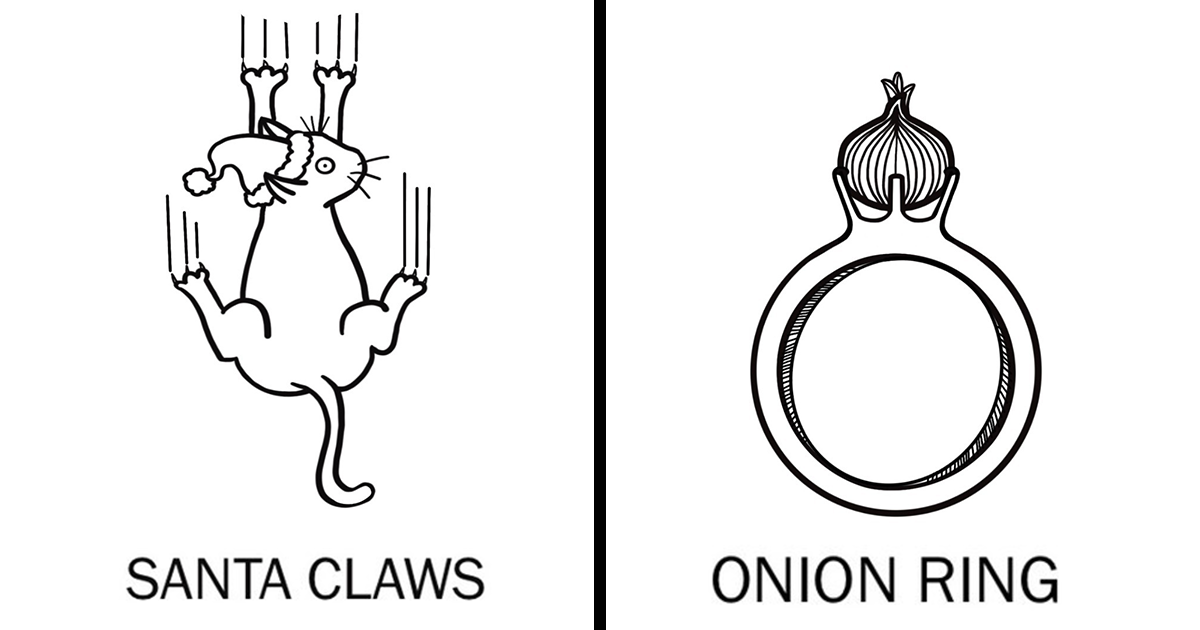
Nadia Tolstoy is a Stockholm-based artist, cartoonist, interior architect, writer, and illustrator whose playful series, Surrealians, turns simple words and phrases into funny, surreal, and strangely memorable drawings. Her work is built around visual puns: a word becomes a picture, a picture becomes a joke, and the joke gently ambushes your brain while you are trying to act like a serious adult.
Her doodles have gained attention online because they do something rare in internet humor: they are quick without feeling lazy, clever without feeling smug, and cute without requiring a warning label for excessive sweetness. The idea is simple. Take a familiar word or phrase, interpret it literally, mix in unexpected objects or animals, and create an image that makes viewers say, “Ohhh, I see it now.” That tiny delay between confusion and recognition is where the magic lives.
Tolstoy’s art is often described as mildly amusing, surreal, and frequently punny. That description fits beautifully. Her drawings are not loud punchline machines. They are quiet little brain tickles. One moment you are looking at a basic black-and-white doodle; the next, you are rethinking how words are built, how meanings overlap, and why English is basically a comedy club wearing a trench coat.
Why These Punny Doodles Feel So Addictive
The charm of Nadia Tolstoy’s work comes from the way it blends language and image. A normal pun usually depends on sound, spelling, or double meaning. A visual pun adds another layer: it makes the joke visible. Instead of simply hearing a word like “sea lion” and moving on, the viewer might see a lion merged with the sea, or another playful interpretation that turns language into a tiny illustrated puzzle.
That puzzle quality is important. The viewer does not just receive the joke; they help complete it. First, the eye scans the drawing. Then the brain compares the image to the caption. Then the hidden connection clicks. In that moment, the audience becomes part of the creative process. It is not passive scrolling. It is a mini treasure hunt with a punchline at the end.
The “Aha!” Moment
Good wordplay often works because it creates a small mental detour. You think a word means one thing, then the artist nudges you toward another meaning. That shift produces surprise, and surprise is comedy’s favorite snack. Tolstoy’s doodles rely on that exact mechanism. They invite the viewer to pause long enough to decode the joke, but not so long that the experience becomes homework. Nobody wants to do a crossword puzzle with a deadline while eating cereal.
In her world, a simple phrase can become a character. A compound word can split into two visual ideas. A familiar expression can be taken so literally that it becomes absurd. The result is a style of funny illustration that makes viewers look twice, smile once, and occasionally groan in the proud tradition of all respectable pun lovers.
What Makes “Surrealians” Different From Ordinary Wordplay Art?
There are plenty of pun accounts online, but Tolstoy’s Surrealians stand out because of their restraint. The drawings are usually minimal, clean, and direct. They do not need neon colors, chaotic backgrounds, or a caption that explains the joke three times while waving a tiny flag. The simplicity allows the idea to shine.
This is where her background in interior architecture becomes interesting. Interior design teaches balance, proportion, negative space, and the relationship between objects. Those same instincts show up in her doodles. The images often feel carefully composed even when they look spontaneous. A line is placed where it needs to be. A character has just enough detail to be expressive. The joke gets breathing room.
Minimal Lines, Maximum Meaning
One reason these punny doodles work so well is that they avoid clutter. When a joke depends on word-image recognition, visual noise can ruin the timing. Tolstoy keeps the scene simple enough for the viewer to understand the concept quickly. That matters online, where people scroll with the speed and focus of a squirrel who just drank cold brew.
Her doodles also carry a gentle surrealist flavor. Surrealism has long played with unexpected combinations, dreamlike logic, and ordinary objects placed in unusual contexts. Tolstoy’s work uses a softer, more approachable version of that idea. Instead of melting clocks or haunting dreamscapes, we get cheerful absurdity: words becoming creatures, objects becoming jokes, and language behaving like it left the house without supervision.
The Art of Making Words Look Funny
Visual puns are harder than they look. A successful punny doodle needs at least three things: a word with playful potential, a drawing that communicates the twist, and timing that lets the joke land. If the image is too obvious, the viewer may not feel the delight of discovery. If it is too obscure, the joke disappears into the fog and everyone politely pretends they understood it.
Tolstoy often uses literal interpretation as her main engine. A phrase that most people use automatically becomes strange when taken at face value. This is why her work can change the way people look at words. It reminds us that language is full of hidden trapdoors. Words are not only definitions in a dictionary; they are sounds, shapes, associations, cultural habits, and tiny accidents waiting to become cartoons.
Examples of the Style
Some of Tolstoy’s popular ideas play with compound words and familiar phrases. A title like “Cat-A-Log,” for instance, invites the viewer to break apart a word and imagine it visually. Other examples use animals, food, objects, or everyday expressions to create humorous hybrids. The exact joke may be simple, but the effect is surprisingly sticky. Once you see a word illustrated literally, it can be difficult to return to its boring old office job as a normal word.
That is the secret power of these doodles: they make language feel fresh again. English is packed with expressions we rarely question. We say them, read them, and scroll past them. Tolstoy slows the process down and asks, “But what would that actually look like?” Suddenly, the familiar becomes funny.
Why Punny Doodles Are Perfect for the Internet
In the attention economy, short-form visual humor has a natural advantage. People online often scan rather than read deeply, so a compact image with a clever twist can travel quickly. Punny doodles are especially shareable because they reward both instant recognition and repeat viewing. You can understand one in seconds, then send it to a friend with the caption, “This is painfully you.” Friendship is beautiful.
These illustrations also work across different moods. They are light enough for a coffee break, clever enough for design lovers, and harmless enough to send in a family group chat without starting a constitutional crisis. Unlike some internet humor that depends on sarcasm or outrage, Tolstoy’s doodles lean into curiosity, innocence, and word-loving silliness.
They Are Tiny Brain Games
Part of the pleasure comes from the mental exercise. A pun asks the brain to hold two meanings at once. A visual pun asks the brain to connect language, image, and context. That makes the experience more active than simply reading a joke. The viewer becomes a detective, although thankfully without the trench coat, rain-soaked alley, and unpaid emotional baggage.
This is also why the doodles appeal to people who love language learning, writing, design, children’s books, comics, and creative thinking. They show that humor does not always need a long setup. Sometimes all it needs is one word, one drawing, and a mind willing to make a ridiculous connection.
The Human Side of Nadia Tolstoy’s Creative Process
One of the most relatable things about Tolstoy’s story is that her work did not begin as a giant strategic brand plan with a 47-slide presentation and a person named Chad saying “synergy.” Her doodling habit grew from ordinary life: spare moments, curiosity, family, work, and the need to make room for creativity.
She has spoken about balancing her day job, family life, and creative projects. That balance gives the work a grounded quality. These are not drawings made from a distant ivory tower of artistic mystery. They feel like ideas caught in real life: early in the morning, late at night, between responsibilities, or during those strange moments when the brain suddenly says, “What if an onion ring was actually a ring?”
Her process also reflects an important lesson for creative people: ideas rarely arrive in a neat line. They come while you are busy doing something else. They appear in lists, scraps, suggestions, and half-formed thoughts. Tolstoy’s habit of collecting ideas gives her a creative pantry to return to when inspiration is acting dramatic and unavailable.
Why Adults Still Love Childlike Wordplay
There is something wonderfully childlike about taking words literally. Children do this naturally because they are still learning how language works. Adults, on the other hand, become efficient. We stop noticing how odd common phrases are. We accept them as normal because everyone else does. Then an artist like Tolstoy comes along and reminds us that language is deeply weird.
This childlike perspective is not childish. It is creative. It asks viewers to look again at things they thought they already understood. That is what many great cartoons, comics, and illustrations do. They restore surprise. They make the ordinary wobble just enough to become interesting.
Curiosity Is the Real Punchline
Tolstoy’s doodles are funny, but they are also about curiosity. They encourage viewers to ask questions: What happens if this word is split apart? What if this phrase were literal? What if two unrelated meanings shook hands and started a tiny illustrated business together?
That curiosity is valuable far beyond art. Writers use it to find fresh metaphors. Designers use it to solve visual problems. Teachers use it to make lessons memorable. Parents use it to make children laugh. And the rest of us use it to survive a world where emails still begin with “Just circling back.” Frankly, we need all the whimsy we can get.
How Punny Doodles Can Inspire Writers, Artists, and Content Creators
If you create content, Nadia Tolstoy’s work offers a useful reminder: clever does not have to mean complicated. Many creators assume that originality requires a massive concept, a complicated style, or a production setup involving lights, tripods, ring lights, backup ring lights, and a mild identity crisis. Tolstoy’s doodles show the opposite. A small idea, executed clearly, can be more memorable than a noisy one.
For writers, visual puns are a lesson in compression. A good pun packs multiple meanings into a small space. For illustrators, they are a lesson in clarity. A good doodle communicates fast without becoming dull. For social media creators, they are a lesson in repeatable format. A consistent concept gives audiences a reason to return.
Creative Takeaways
- Start with words people already know. Familiar language makes the twist easier to understand.
- Look for hidden meanings. Compound words, idioms, animal names, food phrases, and everyday expressions are excellent playgrounds.
- Keep the image clean. If the joke needs decoding, do not bury it under unnecessary detail.
- Let the audience participate. A small gap between image and meaning makes the punchline more satisfying.
- Make room for play. Not every idea needs to be profound. Sometimes a doodle can simply make someone smile, which is already a noble public service.
The Deeper Appeal: Seeing Language as a Playground
The best thing about Tolstoy’s punny doodles is that they make language feel playful again. In school, language can become rules. At work, language becomes emails, reports, and calendar invitations that could have been one sentence shorter. Online, language often becomes arguments. Punny illustrations rescue words from all that seriousness and toss them into a sandbox.
When viewers encounter a Surrealians doodle, they are invited to enjoy language as a living thing. Words bend. Meanings overlap. Sounds misbehave. A phrase that once seemed ordinary becomes visual, funny, and memorable. That transformation is small, but it changes how we pay attention.
This is why the title “might change the way you look at some words” feels accurate. After spending time with these drawings, you may start noticing visual jokes everywhere. A “butterfly” suddenly sounds suspicious. A “keyboard” becomes funnier than it should be. A “bookworm” might need a tiny library card. Congratulations: the pun brain has activated. There is no known cure, but the symptoms include smiling at grocery labels.
Conclusion: Little Doodles, Big Word Magic
Nadia Tolstoy’s punny doodles prove that humor does not need to shout. Sometimes it can arrive as a small black-and-white drawing, a familiar word, and a twist so simple you wonder why you never saw it before. Her Surrealians series blends visual puns, surreal illustration, language play, and gentle comedy into a format that feels perfectly built for curious minds and fast-scrolling feeds.
What makes the work special is not only the jokes themselves, but the way they reawaken attention. These doodles encourage us to look at words, not just through them. They remind us that creativity often begins with a tiny question: “What else could this mean?” In a world overloaded with content, that kind of playful clarity is refreshing. It is smart, charming, and delightfully ridiculousthe holy trinity of a good pun.
Experience Section: How Punny Doodles Change the Way We Read Words
Spending time with punny doodles like Nadia Tolstoy’s can genuinely change the way you experience everyday language. At first, you look at them as quick jokes. You see the word, decode the drawing, laugh a little, and move on. But after a while, something strange happens: the doodles train your brain to slow down. You start noticing the hidden pictures inside ordinary words. You begin treating language less like a fixed system and more like a box of building blocks someone left unattended near a very imaginative raccoon.
For example, after seeing visual puns built from compound words, you may start mentally illustrating everything. “Deadline” becomes a line with dramatic consequences. “Brainstorm” becomes a tiny weather event inside a skull. “Cupcake” starts to look suspiciously like a cake trying to fit into formal drinkware. These little mental images are silly, but they make reading more active. You are no longer just accepting words; you are inspecting them.
This experience is especially useful for writers and artists. Punny doodles remind creators that the first idea is not always the only idea. A word can be twisted, split, flipped, or taken literally. That habit leads to better headlines, sharper jokes, more memorable illustrations, and more surprising storytelling. Even if you never draw a single cartoon, you can borrow the method: look at a phrase, ask what it literally suggests, then follow the weirdest answer that still makes sense.
There is also a nostalgic pleasure in this kind of humor. Many people first discover wordplay as children, through riddles, cartoons, picture books, and jokes that made adults groan loudly enough to count as applause. Tolstoy’s doodles bring back that feeling without becoming childish. They are simple, but not empty. They are cute, but not shallow. They are clever enough for adults and friendly enough for younger viewers, which is a difficult balance to achieve.
On a personal level, the best experience these doodles offer is permission to be playful. Modern life tends to reward speed, productivity, and seriousness. A punny doodle interrupts that rhythm for a few seconds. It says, “Look closer. This word has a secret.” That tiny pause can brighten a work break, spark a classroom discussion, inspire a sketchbook idea, or make a group chat briefly less chaotic. And honestly, any artwork that can make a person smile at a word they have seen a thousand times has done something wonderful.
SEO Tags
Note: This article is written as original SEO-friendly content based on publicly available information about Nadia Tolstoy, her Surrealians series, pun-based illustration, visual humor, and language-play art.