
Professional athletes are supposed to arrive in one standard package, right? They should have sculpted shoulders, visible abs, superhero posture, and the permanent expression of someone who has just finished sprinting up a mountain before breakfast.
Real sports, fortunately, are much more interesting than fitness advertisements.
Some legendary competitors are unusually short. Others are stocky, slow-moving, casually dressed, or shaped nothing like the popular image of an elite athlete. Yet once the game begins, appearances become about as useful as a chocolate stopwatch. Technique, timing, balance, intelligence, coordination, courage, and competitive instinct take over.
This list celebrates ten awesome sportspeople who challenged conventional ideas about athletic appearance. The point is not to judge their bodies. It is to laugh at the stubborn stereotype that greatness must come with a six-pack and a protein-shake sponsorship.
Why Athletic Greatness Has No Standard Body Type
Different sports reward different physical qualities. A basketball center needs a different build from a point guard. A heavyweight wrestler relies on different strengths than a marathon runner. Golfers, darts players, pitchers, and hockey forwards each perform highly specialized movements that cannot be measured by simply asking who looks best in gym clothes.
Even within one sport, successful athletes may look completely different. Explosive power, reaction time, spatial awareness, hand-eye coordination, decision-making, endurance, and technical efficiency are not always visible while someone is standing in a grocery-store line.
The following unconventional athletes turned supposedly unsuitable bodies, relaxed mannerisms, or unexpected personal styles into parts of unforgettable sporting careers.
Top 10 Sportspeople Who Shattered the Athletic Stereotype
1. Bartolo Colón: Baseball’s Surprisingly Durable Workhorse
Bartolo Colón never looked like he had been assembled in a laboratory for elite pitchers. With his round build, cheerful expression, and wonderfully uncomplicated approach, he sometimes resembled the fun uncle who had wandered onto the mound while carrying snacks for everyone.
Then he started throwing strikes.
Known affectionately as “Big Sexy,” Colón spent 21 seasons in Major League Baseball. He won 247 games, earned four All-Star selections, and captured the 2005 American League Cy Young Award. His longevity was particularly remarkable because pitching places enormous stress on the shoulder and elbow. Colón remained effective into his forties by locating pitches, changing speeds, and trusting a fastball that hitters knew was coming but still struggled to square up.
His career demonstrated that pitching is not a bodybuilding contest. Repeatable mechanics, control, deception, and nerve can keep a supposedly ordinary-looking athlete employed for two decades.
2. Nikola Jokić: The Basketball Genius Who Appears to Be in No Hurry
Nikola Jokić often moves as though he has accidentally joined an NBA game while searching for his horses. He rarely performs dramatic poses, does not depend on explosive jumping, and sometimes appears to be operating at the speed of a thoughtful airport escalator.
That relaxed appearance is deeply misleading.
Jokić won three NBA Most Valuable Player awards between 2021 and 2024 and led the Denver Nuggets to their first championship in 2023. His real superpowers are anticipation, balance, touch, passing vision, and the ability to process several moving players before a defender has completed his first thought.
He proves that elite basketball athleticism is not limited to vertical leaps and sprinting speed. Controlling angles, absorbing contact, creating space, and making instant decisions are also athletic skills. Jokić simply performs them with the facial expression of a man waiting for his number to be called at the post office.
3. Muggsy Bogues: The 5-Foot-3 Giant of the NBA
At 5 feet 3 inches, Muggsy Bogues did not merely look unlike a professional basketball player. He was shorter than many of the people seated in the expensive courtside chairs.
The NBA is a league in which even point guards can tower over the average adult, yet Bogues built a 14-season career. He became the shortest player in league history while competing against athletes who were often more than a foot taller.
Bogues survived through remarkable quickness, strength, ball control, defensive pressure, and an unusually low center of gravity. Taller opponents could not casually dribble around him because he attacked the ball relentlessly. On offense, he slipped through spaces that larger players could barely see.
His career remains one of the clearest examples of an athlete turning an apparent disadvantage into a tactical identity. Height mattered, but skill, confidence, and intelligence mattered enough to keep him in the world’s strongest basketball league for well over a decade.
4. Daniel Cormier: The Compact Fighter Who Conquered Two Divisions
Daniel Cormier did not have the long, lean build commonly associated with magazine-cover fighters. He was compact, thick through the middle, and occasionally subjected to unfair jokes about his physique.
Opponents generally stopped laughing once he grabbed them.
Cormier was an elite wrestler before becoming a mixed martial arts champion. He won UFC titles at light heavyweight and heavyweight, becoming one of the promotion’s simultaneous two-division champions. He was later inducted into the UFC Hall of Fame.
His shorter frame helped him wrestle with a powerful base, close distance, control opponents against the cage, and generate force from tight positions. Rather than fighting as though he wished he had someone else’s body, Cormier built an entire system around the body he possessed.
That is one of the defining traits of elite competitors: they do not wait to become perfect. They turn their existing attributes into weapons.
5. John Daly: Golf’s Loudest Everyman
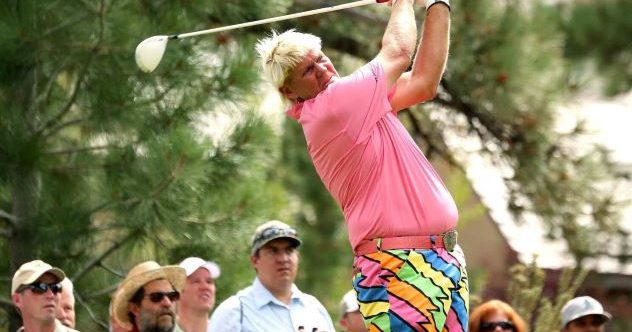
John Daly has rarely looked like the traditional country-club athlete. With his colorful pants, relaxed posture, long backswing, and rock-star personality, he often appeared more prepared to headline a roadside music festival than compete in a major golf championship.
His golf ball had other plans.
Daly shocked the sport by winning the 1991 PGA Championship after entering the field as an alternate. He later won the 1995 Open Championship at St. Andrews, defeating Costantino Rocca in a playoff.
His enormous driving distance made him famous, but his success required more than swinging hard. Major championships demand touch, course management, emotional control, and the ability to execute under suffocating pressure.
Daly’s appearance and lifestyle made him seem like an outsider. His talent made it impossible to leave him outside.
6. Phil Kessel: Hockey’s Hot-Dog-Loving Ironman
Phil Kessel became a fan favorite partly because he seemed refreshingly uninterested in performing the role of a grim, muscle-bound hockey warrior. His casual manner and famous connection to hot dogs inspired countless jokes.
Meanwhile, he kept showing up for work more reliably than nearly anyone in NHL history.
Kessel set the league record by playing 1,064 consecutive regular-season games. He finished his NHL career with 992 points in 1,286 games and won the Stanley Cup three times, including back-to-back championships with the Pittsburgh Penguins.
That ironman streak required durability, recovery discipline, pain tolerance, and consistency far beyond what his everyman image suggested. Kessel also possessed elite speed and one of hockey’s quickest, most dangerous releases.
Apparently, a player can enjoy a hot dog and still skate away from defenders. Sports science may need an additional chapter.
7. Prince Fielder: A Power Hitter Who Moved Like a Much Smaller Man
Prince Fielder had a large, powerful frame that caused some observers to underestimate his agility. This was usually corrected when he launched a baseball into another postal district or sprinted around the bases with surprising speed.
Fielder became a six-time All-Star, won two Home Run Derby titles, and finished his career with 319 home runs and 1,028 RBIs. In 2007, he hit 50 home runs and became the youngest player at that time to reach 50 in a season.
His success was not simply a product of body mass. Generating elite bat speed requires coordination, timing, hip rotation, pitch recognition, and the ability to adjust to a ball moving at nearly 100 miles per hour.
Fielder’s career challenged the idea that baseball players must be lean to be explosive. He was flexible, coordinated, durable during his peak years, and capable of producing frightening power without sacrificing control of the strike zone.
8. Eric “Butterbean” Esch: The Round-Shaped Knockout Machine
Eric Esch was nicknamed “Butterbean,” wore American-flag trunks, and entered the ring with a body type rarely featured in boxing advertisements. He looked less like a carefully sculpted heavyweight and more like someone who had been asked to guard the buffet.
He could also hit with the force of a falling refrigerator.
Butterbean emerged from Toughman competitions and developed into a famous knockout attraction. He held a super-heavyweight title, fought professionally for many years, and later competed in kickboxing and mixed martial arts. ESPN credited him with 97 wins during his fighting career.
His approach was not complicated: close the distance, plant his feet, and throw compact punches carrying tremendous weight. Yet simplicity does not mean ease. Delivering accurate combinations while another heavyweight is trying to rearrange your furniture requires timing, courage, conditioning, and composure.
Butterbean became a spectacle, but he was never merely a costume. The power was very real.
9. Rulon Gardner: The Farm-Built Wrestler Who Beat the Unbeatable
Rulon Gardner looked more like a rugged farm worker than a polished Olympic celebrity, which was appropriate because he grew up working on a Wyoming dairy farm. His broad, heavy build did not create the sleek silhouette people often associate with world-class athletes.
It did create an extremely difficult human being to lift.
At the 2000 Sydney Olympics, Gardner defeated Russian legend Aleksandr Karelin in the Greco-Roman super-heavyweight final. Karelin had been unbeaten internationally for 13 years and had won three consecutive Olympic gold medals. Gardner’s 1-0 victory became one of the most famous upsets in Olympic history.
Gardner’s performance depended on disciplined defense, balance, leverage, grip fighting, and the ability to remain calm against an opponent whose reputation had defeated many wrestlers before the match even began.
He did not win because he happened to be large. He won because he knew exactly how to use every pound.
10. Andy Fordham: The Darts Champion Who Looked Like a Pub Regular
Andy Fordham, known as “The Viking,” had a huge beard, a substantial frame, and the unmistakable appearance of a man who might offer excellent advice about the nearest comfortable chair.
He was also capable of throwing tiny objects at tiny targets while thousands of noisy spectators watched his every movement.
Fordham won the 2004 BDO World Darts Championship after defeating defending champion Raymond van Barneveld in the semifinal and Mervyn King in the final.
Darts may not demand marathon endurance, but elite competition requires exceptional repetition, fine motor control, mathematical awareness, emotional stability, and concentration. A small technical error can turn a perfect scoring opportunity into a visit to the wrong side of the board.
Fordham’s success reminds us that athletic skill can be intensely specialized. Not every champion has to run fast. Some need to make the same precise movement under pressure hundreds of times without allowing a trembling hand or wandering mind to interfere.
A Fan’s-Eye Experience: What Watching These Athletes Teaches Us
First Impressions Become Useless Almost Immediately
Watching an unconventional athlete for the first time creates an interesting experience. Before the contest starts, the mind tries to predict what will happen based on appearance. The shorter player will be overwhelmed. The heavier athlete will tire. The relaxed competitor will lack intensity. The ordinary-looking veteran will be outclassed by the younger physical specimen.
Then Muggsy Bogues steals the ball. Bartolo Colón paints the outside corner. Phil Kessel accelerates through open ice. Nikola Jokić delivers a no-look pass through a gap that appeared to exist only in his imagination.
The prediction collapses within seconds.
Invisible Skills Suddenly Become Visible
These athletes encourage viewers to pay attention to details beyond obvious speed and muscle. Watch Jokić’s feet when he creates room near the basket. Study how Cormier positions his hips before completing a takedown. Notice how Daly transfers his weight through a violent but coordinated golf swing.
Once those details become visible, the athlete no longer looks unathletic. The viewer simply develops a better definition of athleticism.
Efficiency is especially fascinating. Great competitors eliminate unnecessary movement. They may appear slow because they arrive early, having anticipated the play before everyone else. They may appear relaxed because their technique has been repeated thousands of times. What looks casual from the sofa can be the finished product of years of highly specific practice.
The Best Body Is the One That Performs the Required Job
A useful way to experience sports is to stop comparing athletes from unrelated disciplines. The ideal body for Olympic wrestling is not the ideal body for professional basketball. A pitcher’s value cannot be determined by how fast he completes a mile, just as a distance runner should not be judged by home-run power.
Rulon Gardner’s size gave him stability against Karelin. Bogues’ low center of gravity helped him change direction and protect the ball. Fielder’s powerful frame supported the rotational force behind his swing. Physical traits that appear inconvenient in one activity may become competitive advantages in another.
This realization makes sports more enjoyable because it replaces one narrow hierarchy with dozens of specialized forms of excellence.
Underdog Stories Feel Better When the Achievement Is Understood
It is easy to enjoy these athletes as lovable characters, but their careers become more impressive when the technical difficulty is appreciated. Colón did not remain in Major League Baseball because audiences found him amusing. Kessel did not play 1,064 consecutive games because opponents were being polite. Fordham did not win a world title because the dartboard moved closer.
Humor can introduce the story, but performance must remain at its center.
The most rewarding fan experience comes from recognizing both sides: the entertaining contrast between appearance and expectation, followed by serious respect for the skill that destroyed the expectation.
The Lesson Applies Outside Professional Sports
These surprising sports legends also offer a practical lesson for recreational athletes. Many people avoid gyms, running clubs, basketball courts, or martial arts classes because they believe they do not have an “athletic body.” That belief confuses a starting condition with a final verdict.
A person does not need to resemble a professional model to improve strength, coordination, mobility, or endurance. Progress begins with choosing an activity, learning its techniques, and practicing consistently. The body then adapts to the work instead of waiting for permission from a mirror.
Elite athletes are extraordinary and should not be used as unrealistic comparisons. Their broader message, however, is wonderfully ordinary: competence is developed through action. Nobody becomes capable by standing still and trying to look capable first.
Conclusion: Never Scout an Athlete by Silhouette Alone
The world’s most memorable sportspeople are not produced by one mold. Some are tall, some are short, some are lean, and some are built like they could move a refrigerator without unplugging it.
Bartolo Colón, Nikola Jokić, Muggsy Bogues, Daniel Cormier, John Daly, Phil Kessel, Prince Fielder, Butterbean Esch, Rulon Gardner, and Andy Fordham succeeded because their abilities were far more important than public expectations about their appearance.
Their careers reveal a simple truth: athleticism is not a look. It is the ability to perform a demanding task repeatedly, accurately, intelligently, and under pressure. The next time someone does not look like an athlete, it may be wise to postpone judgment until after the whistle.
Note: The descriptions in this article use appearance as a playful way to challenge sports stereotypes. They are not intended to shame any athlete’s body, health, or personal identity.
SEO Metadata