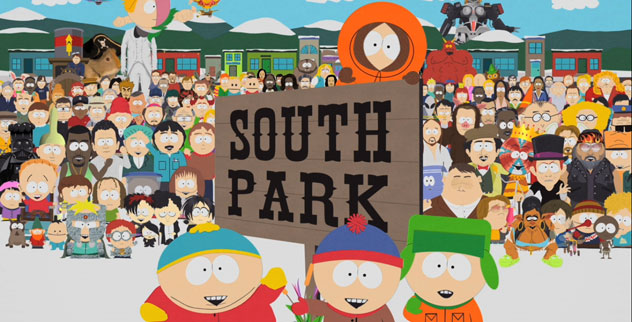

Ranking the greatest South Park episodes is a dangerous business. Choose the wrong favorite and an angry mob may arrive dressed as ninjas, World of Warcraft characters, or disappointed Denver baseball dads. Still, somebody has to do it.
Since debuting in 1997, Trey Parker and Matt Stone’s animated comedy has evolved from a crudely drawn curiosity into one of television’s sharpest satirical institutions. Its best installments combine outrageous jokes with disciplined storytelling, memorable character work, cultural insight, and just enough bad taste to make the neighbors nervous.
This ranking considers critical recognition, fan consensus, originality, influence, rewatch value, and how effectively each episode represents the show at its peak. Some are brilliant social satires. Others simply place Cartman inside a cardboard robot and let consequences do the writing. Both approaches are perfectly valid.
How the Greatest South Park Episodes Were Ranked
A high audience score alone does not automatically make an episode an all-time classic. The strongest entries usually succeed on several levels: they tell a complete story, give familiar characters meaningful roles, deliver jokes that survive beyond the week’s headlines, and reveal something uncomfortable about human behavior.
Standalone episodes received a slight advantage because they are easier for new viewers to enjoy. Multi-part adventures such as “Imaginationland” and the “Black Friday” trilogy remain exceptional, but this list emphasizes individual emphasizes episodes that can provide a satisfying beginning, middle, and deeply inappropriate ending in roughly 22 minutes.
10. “The Losing Edge”
Season 9, Episode 5
Most sports stories celebrate determined underdogs trying to win. “The Losing Edge” flips that formula by following children who desperately want to lose baseball games so their summer can finally begin. Unfortunately, every opposing team has developed exactly the same strategy.
The episode’s reverse-sports narrative would be funny enough on its own, but Randy Marsh transforms it into a classic. Convinced that drunken fights between fathers are the true purpose of youth baseball, Randy trains like a movie boxer and eventually encounters his terrifying rival, Bat Dad.
What makes the episode great is the way its two plots collide. The children want elimination, Randy wants glory, and both sides accidentally help the other. It is a beautifully constructed parody of inspirational sports movies, competitive parenting, and adults who somehow make children’s activities entirely about themselves.
9. “Woodland Critter Christmas”
Season 8, Episode 14
This holiday episode begins like a painfully cheerful television special. Stan discovers adorable woodland animals preparing for the birth of their savior. They sing, smile, and speak with the sugary enthusiasm of decorations that have somehow escaped from a greeting card.
Then Stan learns that the animals worship Satan, and the story descends into one of the darkest Christmas parodies ever broadcast. The contrast between the narrator’s cozy rhymes and the increasingly horrifying events creates a comic rhythm that is uniquely South Park.
“Woodland Critter Christmas” works because it does not rely on a single shocking reveal. Every new development escalates the nightmare while preserving the innocent presentation. By the finale, the episode has mocked sentimental holiday storytelling, religious pageantry, fantasy narration, and the audience’s assumption that cute animals must be morally trustworthy. Never trust a smiling squirrel with an agenda.
8. “Trapped in the Closet”
Season 9, Episode 12
“Trapped in the Closet” represents South Park at its most fearless. Stan takes a personality test and is identified as the>“Trapped in the Closet” represents South Park at its most fearless. Stan takes a personality test and reincarnation of Scientology founder L. Ron Hubbard. Church leaders, celebrities, and an increasingly absurd spiritual narrative quickly surround him.
The episode’s most effective device is its straightforward explanation of Scientology’s space-opera mythology, accompanied by an on-screen reminder that the program is describing actual church teachings rather than inventing another random alien joke. That deadpan presentation does more satirical work than a dozen angry speeches.
Tom Cruise’s refusal to leave Stan’s closet provides the central running gag, while the episode also attacks celebrity worship, financial exploitation, institutional secrecy, and litigation as a method of discouraging criticism. Its cultural impact extended far beyond one broadcast, reinforcing the show’s reputation for challenging powerful organizations instead of selecting only convenient targets.
7. “The Return of the Fellowship of the Ring to the Two Towers”
Season 6, Episode 13
Behind its spectacularly overstuffed title is one of the show’s best childhood adventures. Stan, Kyle, and Cartman are asked to return a copy of The Lord of the Rings to a video store. Because the adults accidentally gave them the wrong tape, the simple errand becomes a frantic mission involving parents, older children, and a deeply confused Butters.
The episode lovingly recreates fantasy-adventure conventions without requiring viewers to know every corner of Middle-earth. The children interpret ordinary neighborhoods as a vast kingdom, bicycles become noble transportation, and a videotape becomes an object of dangerous power.
Much of the humor comes from the gap between childhood imagination and adult panic. The boys believe they are protecting a legendary artifact, while their parents race behind them attempting to prevent an extremely awkward education. The resulting story captures how children can turn a boring afternoon into an epic questand how adults can ruin everything by trying to explain it.
6. “Casa Bonita”
Season 7, Episode 11
Kyle invites Stan, Kenny, and Butters to his birthday celebration at Casa Bonita, the famous Colorado restaurant. Cartman is excluded, so he responds with the calm maturity audiences expect from him: he convinces Butters that civilization has ended and hides him in a bomb shelter.
The scheme grows more elaborate as Cartman invents nuclear destruction, poisoned survivors, and a complete social collapse. His objective is not wealth, revenge, or political power. He simply wants cliff divers, arcade games, sopapillas, and the restaurant’s artificial cave system.
That childish motivation makes his criminal dedication even funnier. The episode is also an excellent character study because Cartman never questions whether the plan is morally acceptable. He only worries about whether it will work. His final sprint through Casa Bonita, frantically experiencing every attraction before the police catch him, is a nearly perfect piece of visual comedy.
5. “Good Times with Weapons”
Season 8, Episode 1
After tricking a flea-market vendor into selling them real martial-arts weapons, the boys imagine themselves as powerful anime warriors. The visual style repeatedly switches from familiar construction-paper animation to dramatic Japanese-inspired action sequences, complete with heroic poses and a gloriously excessive theme song.
The fantasy ends abruptly when Kenny throws a ninja star into Butters’ eye. Instead of seeking help, the boys disguise the injured Butters as a dog because admitting what happened would get them grounded. Their priorities are monstrous, childish, and completely believable.
The episode uses the contrast between fantasy and reality to expose how children misunderstand danger. It also lands one of the show’s sharpest observations about public outrage: the adults become more offended by accidental nudity than by the bloody injury directly in front of them. Few episodes balance inventive animation, physical comedy, social criticism, and sympathy for poor Butters this effectively.
4. “AWESOM-O”
Season 8, Episode 5
Cartman disguises himself as a robot called AWESOM-O to uncover embarrassing secrets about Butters. The plan immediately backfires when Butters treats his new robotic friend with exhausting kindness and reveals that he possesses humiliating footage of Cartman.
Unable to abandon the disguise without risking exposure, Cartman is dragged through meals, bathroom emergencies, Hollywood meetings, and a government interrogation. Every attempt to regain control pushes him deeper into his cardboard prison.
The Hollywood sequence is particularly effective. Executives believe AWESOM-O can generate endless movie concepts, most of which involve Adam Sandler entering unlikely situations. Long before automated entertainment became an everyday concern, the episode mocked an industry that treats creativity like a machine-operated assembly line.
At its heart, however, “AWESOM-O” is a classic story about arrogance meeting consequences. Butters does not defeat Cartman through strategy. He merely remains sincere while Cartman’s own deception slowly cooks him inside a silver box.
3. “The Death of Eric Cartman”
Season 9, Episode 6
After Cartman selfishly eats all the crispy skin from the family-sized fried chicken, the other boys decide to ignore him. Cartman concludes that he must have died, while Butterswho was not told about the planbelieves he can communicate with Cartman’s ghost.
This misunderstanding creates one of the show’s finest character pairings. Cartman attempts to perform good deeds so his soul can enter heaven, but even his acts of redemption remain self-centered. Butters, meanwhile, accepts every supernatural development with heartbreaking sincerity.
The premise allows the episode to examine Cartman’s total inability to imagine that people might simply dislike him. Death seems more plausible to him than social rejection. It also turns Butters’ innocence into both a comic engine and a source of genuine affection.
Many episodes make Cartman cruel, but “The Death of Eric Cartman” makes his narcissism almost philosophical. He cannot see the world as it is because every fact must first pass through the Eric Cartman Department of Eric Cartman Affairs.
2. “Make Love, Not Warcraft”
Season 10, Episode 8
When a high-level griefer repeatedly kills the boys’ characters in World of Warcraft, they abandon normal life and train obsessively to defeat him. Their heroic campaign consists largely of sitting in a basement, gaining weight, and eliminating an unreasonable number of low-level creatures.
Produced with assistance from Blizzard Entertainment, the episode blends South Park animation with in-game imagery. That technical collaboration gives the parody an unusual authenticity: the writers clearly understand the appeal of online games even while exaggerating their most antisocial possibilities.
The episode does not merely mock gamers. Its real target is obsessive commitmentthe idea that wasting months preparing for a digital battle can feel noble when accompanied by sufficiently dramatic music. Randy’s clumsy entrance into the virtual conflict gives the finale an additional dose of chaos.
“Make Love, Not Warcraft” won a Primetime Emmy Award for Outstanding Animated Program. More importantly, its jokes still make sense to viewers who have never created an online character. It is a gaming satire, a sports-training parody, and a story about friendship surviving dangerously poor hygiene.
1. “Scott Tenorman Must Die”
Season 5, Episode 4
No episode changed the audience’s understanding of Eric Cartman more dramatically than “Scott Tenorman Must Die.” After teenager Scott Tenorman repeatedly humiliates him, Cartman attempts a series of increasingly foolish revenge plans. Scott appears to remain comfortably aheaduntil the chili competition.
The final revelation is so dark that it permanently redefines Cartman. He is no longer merely an obnoxious child who says terrible things. He is patient, manipulative, theatrical, and capable of designing revenge on a scale that would make a Shakespearean villain ask everyone to calm down.
Radiohead’s guest appearance adds another layer to the trap, turning Scott’s favorite band into an instrument of humiliation. Meanwhile, Cartman’s delight in tasting his enemy’s tears completes one of television comedy’s most unforgettable endings.
The episode earns the top position because it combines surprise, escalation, character development, and pitch-black humor with extraordinary precision. Later Cartman stories became more ambitious, but nearly all of them draw power from the moment viewers realized exactly what he could do. “Scott Tenorman Must Die” is not simply one of the funniest South Park episodes. It is the episode that changed the rules.
Great South Park Episodes That Narrowly Missed the List
Reducing decades of television to ten selections inevitably leaves excellent material behind. “Butters’ Very Own Episode” is a master class in tonal contrast, mixing a cheerful sitcom presentation with an exceptionally dark family crisis. “Fishsticks” turns a simple joke into a brutal study of celebrity ego, while “Tsst” imagines Cartman finally meeting an adult immune to his manipulation.
“With Apologies to Jesse Jackson” offers one of the show’s most challenging examinations of prejudice and empathy. “Best Friends Forever” combines a real-world right-to-die debate with an absurd battle between heaven and hell. The “Imaginationland” trilogy and the “Black Friday” trilogy also deserve recognition for building large-scale fantasy adventures without abandoning the show’s satirical personality.
The Experience of Rewatching South Park’s Greatest Episodes
Rewatching classic South Park is a surprisingly different experience from encountering the episodes when they first aired. The initial viewing is often powered by shock. You wonder whether the show will actually follow through on a ridiculous premise, and then it follows through, reverses direction, and drives through a wall that television standards presumably installed for safety.
On a second or third viewing, the construction becomes more noticeable. “The Losing Edge,” for example, seems like a collection of baseball jokes until you observe how carefully the children’s desire to lose aligns with Randy’s desire to fight. Every mistake moves both plots toward the same ending. The episode feels chaotic, but the writing underneath it is remarkably controlled.
Character-based episodes often improve the most with repetition. Once you know where “Scott Tenorman Must Die” is going, Cartman’s failed early schemes no longer look like random detours. They become misdirection. The audience is encouraged to underestimate him for the same reason Scott does. The ending remains horrifying, but the route toward it becomes even funnier because the writers were hiding a trap in plain sight.
“AWESOM-O” and “The Death of Eric Cartman” provide a different pleasure. Their plots depend on personalities that viewers understand immediately. Butters wants to believe in friendship, while Cartman assumes everyone else exists to serve him. Put them together and almost no setup is required. Their reactions generate the story naturally, like a tiny comedy laboratory with one innocent child and one highly unstable contaminant.
The visual experimentation also holds up well. The anime transformations in “Good Times with Weapons” are funny because they represent how the boys see themselves. When the show returns to its ordinary style, the contrast restores the consequences they were trying to ignore. Similarly, the in-game scenes of “Make Love, Not Warcraft” transform hours of repetitive virtual labor into an epic training montage. The boys believe they are becoming heroes; their physical condition tells another story.
Some topical references inevitably age. A younger viewer may need context for particular celebrities, political controversies, video formats, or television personalities. Yet the strongest episodes survive because their central targets are larger than the headline that inspired them. “Trapped in the Closet” concerns institutional power and unquestioning loyalty. “Casa Bonita” concerns selfish desire. “Woodland Critter Christmas” concerns the dangerous assumption that cheerful packaging guarantees wholesome content.
A marathon also reveals how frequently the children behave like children. Beneath the profanity and social satire, many memorable plots begin with familiar childhood experiences: being excluded from a birthday, wanting summer vacation, turning an errand into a quest, hiding an accident from parents, or taking a game far too seriously. The extreme circumstances make those emotions funnier without completely erasing their truth.
The ideal rewatch is not necessarily a chronological binge. A carefully mixed selection works better: begin with the accessible adventure of “The Return of the Fellowship of the Ring to the Two Towers,” move into the character comedy of “AWESOM-O,” add the technical spectacle of “Make Love, Not Warcraft,” and save “Scott Tenorman Must Die” for the end. That progression demonstrates the show’s range while preventing a dozen consecutive Cartman schemes from making you lose faith in Colorado.
Ultimately, revisiting the best South Park episodes explains the series’ unusual longevity. The animation may appear intentionally primitive, and the jokes may arrive wearing muddy boots, but the finest stories are built with real precision. They reward attention, punish complacency, and frequently make viewers laugh at something they would strongly prefer not to explain at work the next morning.
Conclusion
The greatest South Park episodes do more than provoke. They combine tight plots, recognizable human flaws, fearless satire, and characters whose terrible decisions make perfect sense within their distorted little world.
“Scott Tenorman Must Die” takes the top spot because it permanently transformed Cartman and delivered one of the boldest endings in animated comedy. “Make Love, Not Warcraft” follows closely as a technically inventive parody with enormous crossover appeal. Together with “Good Times with Weapons,” “Casa Bonita,” and the remaining selections, these episodes demonstrate why the series has remained culturally relevant for decades.
Fans will always disagree about the exact rankingand they should. A show this extensive offers different classics for different tastes. Some viewers prefer social commentary, others want elaborate fantasy, and a worrying number are simply waiting for Randy Marsh to remove his shirt and challenge another father.