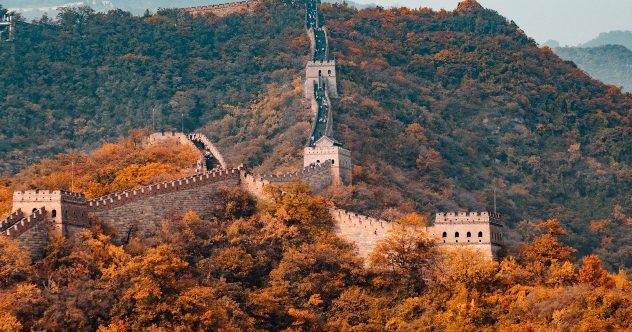

The Great Wall of China looks like a stone dragon winding across mountains, deserts, and grasslands. Yet the familiar postcard view reveals only a fraction of its story. This enormous landmark was not built in one burst of imperial enthusiasm, nor is it a single uninterrupted wall. It is a sprawling network of fortifications created, abandoned, repaired, and expanded over many centuries.
From ingenious signaling systems to construction materials that changed with the landscape, the wall offers far more than impressive scenery. It tells a complicated story about military strategy, frontier trade, cultural exchange, political power, and the lives of ordinary laborers. These ten interesting facts about the Great Wall of China separate history from legendand may change the way you picture this celebrated landmark.
1. The Great Wall Is a Network, Not One Continuous Wall
Despite its name, the Great Wall is not a single unbroken structure stretching neatly across northern China. It is a vast defensive network containing walls, trenches, natural barriers, beacon towers, fortresses, military roads, and fortified mountain passes.
Different states and dynasties built sections in different places according to the threats and borders of their time. Some lines run parallel, while others branch away, overlap, or end abruptly. In certain regions, builders relied on steep mountains, rivers, and desert terrain instead of constructing an artificial barrier.
Think of the Great Wall less as one gigantic backyard fence and more as a nationwide security system assembled over generations. The result is wonderfully complicated, historically layered, and far more interesting than a single line on a map.
2. Its Total Measured Length Exceeds 13,000 Miles
A comprehensive archaeological survey reported that the surviving and documented Great Wall system measures approximately 13,171 miles, or 21,196 kilometers. That figure includes walls associated with multiple historical periods, along with branches, trenches, and other defensive features.
For perspective, that distance is longer than a journey from New York to Los Angeles and backtwicewith plenty of mileage left for sightseeing. However, the number should not be interpreted as the length of one perfectly preserved walkway. Many sections have disappeared, eroded into the landscape, or survive only as low ridges of packed earth.
Why Do Different Sources Give Different Lengths?
Older estimates often counted only prominent masonry walls or well-known Ming dynasty sections. Modern surveys use archaeological research, historical records, remote sensing, and field measurements to identify a much broader defensive network. Different definitions of what belongs to the Great Wall can therefore produce different totals.
3. Construction Spanned More Than 2,000 Years
The Great Wall was not one ruler’s weekend project. Its construction history extends across more than two millennia, from early regional fortifications built before China was politically unified to major projects completed during the Ming dynasty.
Walls appeared during the Spring and Autumn and Warring States periods, when rival states constructed barriers to defend their territories. After Qin Shi Huang unified China in 221 BCE, he ordered existing northern fortifications connected and expanded as protection against the Xiongnu and other steppe groups.
Later dynasties repaired old barriers or built new ones as borders and military priorities changed. The Han extended defensive systems westward, partly to secure strategic corridors associated with Silk Road travel. Centuries later, the Ming dynasty undertook the most extensive masonry construction, creating many of the dramatic brick-and-stone sections recognized today.
4. Most Famous Sections Were Built by the Ming Dynasty
Qin Shi Huang is closely associated with the Great Wall, but visitors generally are not walking on his original fortifications. Most iconic sections near Beijingincluding Badaling, Mutianyu, and parts of Jiankoudate primarily from the Ming dynasty, which ruled from 1368 to 1644.
The Ming faced persistent military pressure from Mongol groups in the north. In response, the government strengthened the frontier with walls, watchtowers, garrison settlements, passes, and troop routes. Where resources allowed, builders used durable stone foundations and fired bricks instead of relying entirely on compacted soil.
Ming defenses were wider, taller, and more elaborate than many earlier structures. The battlements, arched doorways, drainage systems, and imposing towers seen in travel photographs are largely products of this later period. In other words, the wall’s most famous “ancient” look is often several centuries younger than its earliest history.
5. Builders Used Whatever Materials Were Available Nearby
There was no universal Great Wall construction kit delivered by imperial wagon. Builders adapted to local geography and used materials that could be gathered or produced nearby. Transporting heavy supplies across remote mountains and deserts would have been painfully slow and expensive.
Early walls were commonly made from rammed earth. Workers placed soil inside wooden frames and compressed it into dense layers. In dry northwestern regions, they sometimes alternated packed earth with reeds, brushwood, gravel, or other plant material. Some ancient earthen sections remain visible because the desert climate preserved them.
Mountain sections incorporated locally quarried stone. During the Ming period, bricks became common around important passes and areas near major production centers. Bricks were easier to shape and handle than irregular rocks, allowing workers to construct arches, parapets, steps, and towers with greater precision.
Was Sticky Rice Used in the Mortar?
Researchers have found that some historic Chinese masonry incorporated sticky-rice compounds into lime mortar. This organic-inorganic mixture could improve strength and water resistance. However, sticky rice was not a magical ingredient poured into every mile of the Great Wall. Its use varied by location, period, and construction project.
6. The Wall Functioned as a Military Communication Network
The Great Wall was designed to do more than physically slow attackers. Its watchtowers and beacon towers created a rapid communication system across enormous distances. Guards could transmit warnings using smoke during the day and fire at night. Flags, drums, bells, and later explosive signals also played roles in military communication.
Different signal combinations could indicate the approximate size or nature of an approaching force. A warning could pass from tower to tower much faster than a messenger traveling alone through difficult terrain. It was an ancient version of a group notificationonly with more smoke and considerably higher stakes.
Towers also provided observation points, shelters, storage space, and positions for soldiers. The wall’s elevated pathways helped troops and supplies move along the frontier, although steep stairs and rugged ridgelines ensured that nobody confused military service with a relaxing stroll.
7. It Helped Control Trade and Movement
Defense was the Great Wall’s best-known purpose, but the system also helped governments manage frontier traffic. Fortified passes created controlled entry points where officials could inspect travelers, regulate migration, collect duties, and supervise the movement of livestock and goods.
During the Han dynasty, western fortifications helped secure routes connected with the Silk Road. Garrisons could protect strategic corridors, water sources, and communication lines used by merchants, diplomats, soldiers, and messengers.
The wall therefore acted as both a barrier and a gateway. It separated political zones while also channeling contact between them. Trade, diplomacy, migration, and cultural exchange continued across the frontier, demonstrating that even history’s most famous wall was never completely sealed.
8. The Great Wall Did Not Always Stop Invaders
No defensive structure is unbeatable, particularly when politics enters the conversation. Armies sometimes crossed weakened areas, bypassed fortifications, bribed guards, or entered through gates. A wall could delay attackers and provide early warning, but it could not replace reliable leadership, trained troops, and adequate supplies.
One of the most famous episodes occurred in 1644. As the Ming dynasty collapsed amid rebellion, General Wu Sangui allied with Manchu forces and allowed them through Shanhai Pass. The Manchus helped defeat the rebels but then established the Qing dynasty and took control of China.
The episode illustrates a central lesson of the Great Wall’s history: stone and brick can resist weapons, but they are less effective against shifting alliances. After the Qing expanded imperial territory north of the wall, many sections lost their strategic importance and were neglected.
9. It Cannot Be Seen from the Moon with the Naked Eye
The claim that the Great Wall of China is the only human-made object visible from the Moon is one of the world’s most persistent geography myths. It is also false.
Although the wall is extraordinarily long, it is relatively narrow and often resembles the color and texture of the surrounding terrain. From the Moon, individual buildings, highways, and walls are far too small to distinguish with unaided human vision.
Even from low Earth orbit, astronauts generally find the wall difficult or impossible to identify without magnification and favorable lighting. Certain sections can appear in photographs taken with powerful lenses, while radar and high-resolution satellite instruments can detect them more effectively.
The myth probably survived because length sounds more impressive than width. A very long thread does not become visible from hundreds of thousands of miles away simply because someone keeps unrolling it.
10. The Wall Is Both a World Heritage Site and a Vulnerable Landmark
UNESCO added the Great Wall to the World Heritage List in 1987, recognizing its architectural, historical, military, and cultural significance. It remains one of China’s best-known symbols and one of the most recognizable landmarks on Earth.
Yet much of the Great Wall is fragile. Wind, rain, temperature changes, vegetation, and desert erosion steadily damage ancient structures. Human activitiesincluding construction, poorly managed tourism, removal of bricks, and inappropriate repairshave created additional threats.
Popular destinations such as Badaling and Mutianyu have been restored and receive large numbers of visitors. Remote “wild wall” sections may be unrestored, unstable, and difficult to access. Preservation experts must balance tourism, public safety, archaeological integrity, and the needs of nearby communities.
Conserving the wall does not mean making every section look brand-new. Thoughtful preservation protects original materials and historical evidence. A weathered rammed-earth ridge may not dominate social media, but it can reveal construction methods and frontier history that polished bricks cannot.
Experiencing the Great Wall of China
Learning Great Wall facts is fascinating, but encountering the landscape adds an entirely different dimension. The first surprise for many visitors is the terrain. Photographs emphasize graceful curves, yet those curves often run over seriously steep ridges. Some stairways feel nearly vertical, and individual steps may vary dramatically in height. After several towers, admiration for the original builders is usually accompanied by a sincere conversation with one’s leg muscles.
Choosing the Right Section
Badaling is among the most accessible and heavily restored sections. Its transportation links and visitor facilities make it practical for first-time travelers, families, and people who prefer predictable walking conditions. Its popularity also means crowds can be substantial, especially during holidays and peak travel seasons.
Mutianyu offers restored architecture, mountain scenery, and a somewhat calmer atmosphere on many days. Cable-car access can reduce the initial climb, while optional descents may add a playful finish. Watching fortified towers emerge along forested ridges makes it easy to understand why this section appears so frequently in travel photography.
More rugged locations, such as Jiankou, provide dramatic scenery but demand greater preparation. Unrestored masonry may be loose, paths can be exposed, and rescue access can be limited. Travelers should respect closures and local rules, hire qualified guides where appropriate, and avoid treating protected ruins like an outdoor obstacle course.
What to Notice While Walking
The best Great Wall experience comes from looking beyond the panoramic view. Notice how the structure follows the terrain instead of flattening it. Examine drainage openings, battlements, tower windows, brick patterns, and changes in width. From a watchtower, consider what guards could see, how quickly they could send a warning, and how exposed the post might have felt during a freezing winter night.
It is also worth pausing between towers. At quieter moments, wind replaces the noise of tour groups, and the wall seems less like a tourist attraction than a frontier landscape. Mountains extend in layers, towers shrink into the distance, and the structure’s scale becomes easier to feel than to calculate.
Practical Ways to Improve the Visit
Supportive walking shoes are essential; fashionable footwear receives no special mercy from Ming dynasty stairs. Carry water, sun protection, and weather-appropriate layers. Conditions can change quickly on exposed ridges, while shade may be limited. A light snack is useful, but visitors should carry all trash away and avoid leaving marks on historic surfaces.
Arriving early can provide cooler temperatures, softer light, and fewer crowds. Spring and fall often offer comfortable hiking conditions, although weather and visibility vary. Winter may produce remarkable snow-covered scenery, but ice and strong winds can make walking hazardous.
Most importantly, allow enough time to move slowly. The Great Wall is not improved by rushing from one tower to another merely to collect photographs. Read about the section’s history before arriving, observe its materials, and imagine the soldiers, builders, merchants, and families whose lives intersected with the frontier. That approach transforms the visit from a famous-item checklist into an encounter with more than 2,000 years of changing human ambition.
Conclusion
The Great Wall of China is remarkable not because of one exaggerated legend, but because its real history is so richly complicated. It was created by numerous states and dynasties, constructed from materials ranging from compressed earth to brick, and used for communication, transportation, border control, and defense.
It did not form an impenetrable line, and it cannot be seen from the Moon with the naked eye. What it does offer is something better: physical evidence of evolving technology, political conflict, cultural contact, and extraordinary human effort. Every surviving tower and weathered earthen ridge contributes another chapter to one of history’s greatest architectural stories.